
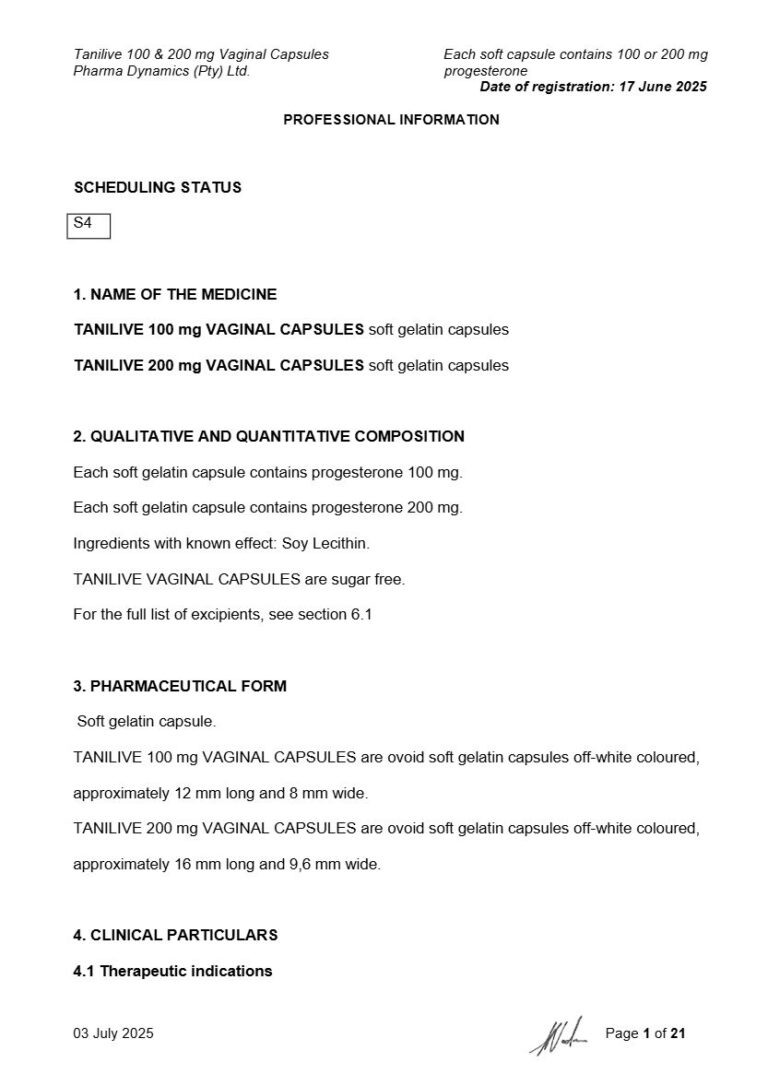
Tanilive 200 Mg Soft Gel Capsules
PDF Leaflet Revision Date: 03 July 2025
Clinical Summary
Quick overview from the medicine insert
Indication
Progesterone support in ovarian insufficiency, IVF cycles, and threatened miscarriage.
Dosage (summary)
100 mg daily on days 13-14, 200 mg on days 15-25; max 600 mg/day if pregnancy occurs.
Special Populations
- Elderly
- Renal impairment
- Hepatic impairment
Pregnancy & Breastfeeding
Use restricted to first trimester; contraindicated in breastfeeding.
Key Drug Interactions
- Enzyme inducers (e.g., carbamazepine)
- Enzyme inhibitors (e.g., ketoconazole)
- Anticoagulants
Contraindications
- Hypersensitivity to progesterone
- Severe liver disease
- Undiagnosed vaginal bleeding
- Thromboembolic disorders
Common side effects
- Drowsiness
- Dizziness
- Vaginal discharge
Counselling Points
- Insert capsule deep into the vagina
- Monitor for mood changes
- Avoid driving until effects are known
Serious warnings
- Risk of thromboembolism
- Breast cancer risk
- Endometrial hyperplasia risk
Important Disclaimer
The Tanilive 200 Mg Soft Gel Capsules professional information leaflet below is the property of Pharma Dynamics and is provided on Medinsert exactly as issued, with no.. alterations or editorial changes. We make every effort to keep content current by updating documents as soon as new versions become available. Medinsert serves as a trusted access point for healthcare professionals, but does not replace official sources or clinical judgement. For more details, please read our full disclaimer. read more>>
 Healthcare Professionals Only
This content is for registered healthcare professionals
Sign in or create a free account to read the full package insert.
Free for HPCSA-registered professionals. Powered by Medinsert.
Clinical Particulars
Section 4 of the official insert — extracted exactly as issued, no alterations
4.1 Therapeutic indications
Vaginal route:
- progesterone support during ovarian insufficiency or complete ovarian failure in women lacking ovarian function (oocyte donation)
- supplementation of the luteal phase during in-vitro fertilization (IVF) cycles
- supplementation of the luteal phase during spontaneous or induced cycles, in cases of sub-fertility or primary or secondary infertility, particularly due to dysovulation
- in cases of threatened miscarriage or prevention of recurrent miscarriage due to luteal phase deficiency, until week 12 of pregnancy.
For all other indications of progesterone, the vaginal route represents an alternative to the oral route in cases of:
- side effects caused by progesterone (drowsiness following absorption via the oral route).
4.2 Posology and method of administration
It is important to adhere strictly to the recommended dosages for all therapeutic indications. The dosage must not exceed 200 mg per dose, regardless of the indication and route of administration (oral or vaginal).
Vaginal route:
Progesterone replacement therapy in cases of ovarian insufficiency or complete ovarian failure in women lacking ovaries (oocyte donation). The therapeutic regimen (in addition to appropriate estrogen therapy) is as follows:
- 100 mg TANILIVE VAGINAL CAPSULES per day on days 13 and 14 of the transfer cycle,
- then 200 mg of TANILIVE VAGINAL CAPSULES per day on days 15 and 25 of the transfer cycle, split over one or two doses per day,
- then from day 26 of the cycle, and in cases of an incipient pregnancy, the dose may be increased up to a maximum of 600 mg per day, split over three doses. This dosage should be adhered to until day 60, or until week 12 of pregnancy at the latest.
u2022 Supplementation of the luteal phase during IVF cycles: The recommended dosage is 400 mg - 600 mg per day, over two to three doses per day, from the date of HCG injection until week 12 of pregnancy.
u2022 Supplementation of the luteal phase in cases of spontaneous or induced cycles, in subjects with sub-fertility or primary or secondary sterility, particularly due to dysovulation: The recommended dosage is 200 mg - 300 mg per day, over two doses, for ten days, from day 17 of the cycle. If menstruation does not resume and pregnancy is diagnosed, treatment should be quickly resumed until week 12 of pregnancy.
u2022 Threatened early miscarriage or repeated miscarriage due to luteal phase insufficiency: The recommended dosage is 200 mg - 400 mg per day, split over two doses, until week 12 of pregnancy.
Paediatric population: TANILIVE VAGINAL CAPSULES are not indicated in paediatric patients.
Method of administration: Vaginal route: Each capsule should be inserted deep into the vagina.
4.3 Contraindications
TANILIVE VAGINAL CAPSULES are contraindicated in:
- known hypersensitivity to progesterone or to any of the ingredients of TANILIVE VAGINAL CAPSULES (see section 6.1)
- severe liver disease such as cholestatic jaundice, or hepatitis, or a history of severe liver disease, hepatic cell tumours, Rotor syndrome, or Dubin-Johnson syndrome.
- undiagnosed vaginal bleeding
- conditions of rare occurrence known to be affected by sex steroids i.e. herpes gestationis, jaundice of pregnancy, otosclerosis, severe pruritus, or porphyria
- personal and family history of breast cancer
- previous or current thromboembolism disorders (e.g. deep venous thrombosis, pulmonary embolism) or thrombophlebitis
- known thrombophilic disorders.
- cerebral haemorrhage
- patients known with inherited genetic mutation: BRCA 1 and BRCA 2 genes
- early menstrual periods (before the age of 12 years)
- history of non-cancerous breast diseases (atypical hyperplasia or lobular carcinoma in situ)
- previous treatment using radiation therapy to the chest or breast
- previous exposure to diethylstilbestrol (DES)
- breastfeeding (see section 4.6).
4.4 Special warnings and precautions for use
In the event that results of liver function tests become abnormal or if cholestatic jaundice appears, therapy with TANILIVE VAGINAL CAPSULES should be discontinued. More than half early spontaneous abortions are due to genetic defects. Moreover, infections and mechanical disorders may cause early miscarriages. In these cases, the only effect of progesterone administration will be to delay the expulsion of the dead egg (or interruption of a terminated pregnancy). Upon diagnosis of a missed abortion, therapy should be discontinued.
A pre-treatment physical examination, including a complete personal and family medical history, prior to the initiation of hormone replacement treatment should include special attention to breast and pelvic organs as well as Papanicolaou smear and by the contraindications and warnings for use. During treatment, periodic check-ups are recommended of a frequency and nature adapted to the individual woman. Women should be advised what changes in their breasts should be reported to their doctor or nurse (see 'Breast cancer' below). Investigations, including appropriate imaging tools, e.g. mammography, should be carried out in accordance with currently accepted screening practices, modified to the clinical needs of the individual.
The use of TANILIVE VAGINAL CAPSULES must be reserved for cases with insufficient secretion of the corpus luteum. TANILIVE VAGINAL CAPSULES has no contraceptive effect when taken under the recommended conditions of use.
The use of progesterone during pregnancy is restricted to the first trimester and only via the vaginal route. TANILIVE VAGINAL CAPSULES are not a treatment for the threat of preterm birth. During the second and third trimesters of pregnancy, exceptional cases of cytolytic hepatitis and intrahepatic cholestasis of pregnancy have been reported in patients taking TANILIVE VAGINAL CAPSULES. For the treatment of postmenopausal symptoms, HRT should only be initiated for symptoms that adversely affect quality of life. In all cases, a careful appraisal of the risks and benefits should be undertaken at least annually, and HRT should only be continued as long as the benefit outweighs the risk.
Evidence regarding the risks associated with HRT in the treatment of premature menopause is limited. Due to the low level of absolute risk in younger women, however, the balance of benefits and risks for these women may be more favourable than in older women.
Conditions requiring supervision: If any of the following conditions are present, have occurred previously, and/or have been aggravated during pregnancy or previous hormone treatment, the patient should be closely supervised. It should be taken into account that these conditions may recur or be aggravated during treatment with TANILIVE VAGINAL CAPSULES, in particular:
- leiomyoma (uterine fibroids) or endometriosis
- risk factors for thromboembolic disorders (see below)
- risk factors for estrogen dependent tumours, e.g. 1st degree heredity for breast cancer
- hypertension
- liver disorders (e.g. liver adenoma)
- diabetes mellitus with or without vascular involvement
- cholelithiasis
- migraine or (severe) headache
- systemic lupus erythematosus
- a history of endometrial hyperplasia (see below)
- epilepsy
- asthma
- otosclerosis
- depression
- photosensitivity.
Reasons for immediate withdrawal of therapy: Therapy should be discontinued in case a contraindication is discovered and in the following situations:
- jaundice or deterioration in liver function
- significant increase in blood pressure
- new onset of migraine-type headache
- pregnancy
- sudden or gradual, partial or complete loss of vision
- proptosis or diplopia
- papilloedema
Endometrial hyperplasia and carcinoma: In women with an intact uterus the risk of endometrial hyperplasia and carcinoma is increased when estrogens are administered alone for prolonged periods. The reported increase in endometrial cancer risk among estrogen-only users varies from 2-to 12-fold greater compared with non-users, depending on the duration of treatment and estrogen dose (see section 4.8). After stopping treatment risk may remain elevated for at least 10 years. The addition of progesterone for at least 12 days per month/28-day cycle or continuous combined estrogen-progestogen therapy in non-hysterectomised women prevents the excess risk associated with estrogen-only HRT. Breakthrough bleeding and spotting may occur during the first months of treatment. If breakthrough bleeding persists, a lower dose of TANILIVE VAGINAL CAPSULES for 25 days per cycle could be considered (see section 4.2). Persistent breakthrough bleeding or after discontinuation of treatment may be an indication for endometrial assessment, which may include biopsy to exclude endometrial malignancy.
Breast cancer: Combined estrogen and progesterone or estrogen only which, on prolonged use, may increase the risk of developing breast cancer. A meta-analysis of prospective epidemiological studies from 1992 to 2018 reported a significant increase in the risk of developing breast cancer in 55 575 women 40 u2013 59 years of age who used menopausal hormone therapy (MHT). The risk increased steadily with duration of use and was slightly greater for estrogen-progestogen than estrogen only preparations, and the risk persisted for more than 10 years after stopping the treatment. The relative risk (RR) to develop breast cancer for estrogen-progestogen preparations was 1,60 at 1-4 years and RR=2,08 at 5-14 years, while that for estrogen only preparations was 1,17 at 1-4 years and 1,33 at 5-14 years. There was no risk of developing breast cancer in women who started MHT at 60 years of age.
All women on TANILIVE VAGINAL CAPSULES should receive yearly breast examinations by a healthcare provider and perform monthly breast self-examinations. Mammography evaluations should be done based on patient age, risk factors, and prior mammogram results.
Ovarian cancer: Ovarian cancer is much rarer than breast cancer. Epidemiological evidence from a large meta-analysis suggests a slightly increased risk in women taking estrogen-only or combined estrogen-progestogen HRT, which becomes apparent within 5 years of use and diminishes over time after stopping. Some other studies, including the Womenu2019s Health initiative (WHI) trial, suggest that use of combined Hormone replacement therapy (HRTs) may be associated with a similar or slightly smaller risk (see section 4.8).
Venous thromboembolism: HRT is associated with a 1,3-3-fold risk of developing venous thromboembolism (VTE), i.e. deep vein thrombosis or pulmonary embolism. The occurrence of such an event is more likely in the first year of HRT than later (see section 4.8). Patients with known thrombophilic states have an increased risk of VTE and HRT may add to this risk. HRT is therefore contraindicated in these patients (see section 4.3). Generally recognised risk factors for VTE include, use of estrogens, older age, major surgery, prolonged immobilisation, obesity (BMI > 30 kg/m2), pregnancy/postpartum period, systemic lupus erythematosus (SLE), and cancer. There is no consensus about the possible role of varicose veins in VTE. As in all postoperative patients, prophylactic measures need be considered to prevent VTE following surgery. If prolonged immobilisation is to follow elective surgery, temporarily stopping HRT 4 to 6 weeks earlier is recommended. Treatment should not be restarted until the woman is completely mobilised. In women with no personal history of VTE but with a first degree relative with a history of thrombosis at young age, screening may be offered after careful counselling regarding its limitations (only a proportion of thrombophilic defects are identified by screening). If a thrombophilic defect is identified which segregates with thrombosis in family members or if the defect is severe (e.g. anti-thrombin, protein S, or protein C deficiencies or a combination of defects) HRT is contraindicated.
Women already on chronic anticoagulant treatment require careful consideration of the benefit-risk of use of HRT. If VTE develops after initiating therapy, TANILIVE VAGINAL CAPSULES should be discontinued. Patients should be told to contact their doctors immediately when they are aware of a potential thromboembolic symptom (e.g. painful swelling of a leg, sudden pain in the chest, dyspnoea).
Coronary artery disease (CAD): There is no evidence from randomised controlled trials of protection against myocardial infarction in women with or without existing CAD who received combined estrogen-progestogen or estrogen-only HRT. Combined estrogen-progestogen therapy: The relative risk of CAD during use of combined estrogen + progestogen HRT is slightly increased. As the baseline absolute risk of CAD is strongly dependent on age, the number of extra cases of CAD due to estrogen + progestogen use is very low in healthy women close to menopause, but will rise with more advanced age.
Ischaemic stroke: Combined estrogen-progestogen and estrogen-only therapy are associated with an up to 1,5-fold increase in risk of ischaemic stroke. The relative risk does not change with age or time since menopause. However, as the baseline risk of stroke is strongly age-dependent, the overall risk of stroke in women who use HRT will increase with age (see section 4.8).
Depression: Depressed mood and depression are well-known undesirable effects of hormonal contraceptive use (see section 4.8). Depression can be serious and is a well-known risk factor for suicidal behaviour and suicide. Women should be advised to contact their medical practitioner in case of mood changes and depressive symptoms, including shortly after initiating the treatment.
Other conditions: HRT use does not improve cognitive function. There is some evidence of increased risk of probable dementia in women who start using continuous combined or estrogen-only HRT after the age of 65.
Excipients with known effect: TANILIVE VAGINAL CAPSULES contains soy lecithin and may cause hypersensitivity reactions (urticarial and anaphylactic shock in hypersensitive patients). As there is a possible relationship between allergy to soya and allergy to peanut, patients with peanut allergy should avoid taking TANILIVE VAGINAL CAPSULES.
4.5 Interaction with other medicines and other forms of interaction
Enzyme inducers: The efficacy of TANILIVE VAGINAL CAPSULES may be decreased due to an enhanced metabolism of progesterone by hepatic enzyme inducing-medicines, such as carbamazepine, phenobarbital, phenytoin, rifabutin or rifampicin, griseofulvin, some antibiotics (ampicillin, tetracyclines), phenylbutazone, bromocriptine, spironolactone and also herbal products containing St. Johnu2019s wort (Hypericum perforatum).
Enzyme inhibitors: The bioavailability of TANILIVE VAGINAL CAPSULES may be increased by hepatic metabolic enzyme inhibitors such as ketoconazole, ritonavir and nelfinavir. The metabolism of progesterone by human liver microsomes was inhibited by ketoconazole (IC50 <0, 1 u03bcM).
Immunosuppressants: TANILIVE VAGINAL CAPSULES may raise the plasma concentration of ciclosporin.
Xanthines: TANILIVE VAGINAL CAPSULES may raise the plasma concentration of theophyllines.
Macrolide antibiotics: TANILIVE VAGINAL CAPSULES may raise the plasma concentration of troleandomycin.
Anti-steroidal medicines: Aminoglutethimide markedly reduces the plasma concentrations of medroxyprogesterone acetate and megestrol, possibly through a hepatic enzyme-inducing effect.
Anticoagulants: TANILIVE VAGINAL CAPSULES may enhance or reduce the anticoagulant effect of coumarins. TANILIVE VAGINAL CAPSULES antagonises the anticoagulant effect of phenindione.
Diabetic medicines: An adjustment in anti-diabetic dosage may be required for women being treated concomitantly with TANILIVE VAGINAL CAPSULES.
Emergency contraceptives: The concomitant use of ulipristal acetate with progesterone may result in reduced efficacy of TANILIVE VAGINAL CAPSULES.
Diazepam: TANILIVE VAGINAL CAPSULES may increase the plasma concentration of diazepam.
Tizanidine: TANILIVE VAGINAL CAPSULES may increase the plasma concentration of tizanidine.
Terbinafine: There have been occasional reports of breakthrough bleeding when terbinafine is used concomitantly with TANILIVE VAGINAL CAPSULES.
Laboratory tests: TANILIVE VAGINAL CAPSULES may affect the results of laboratory tests of hepatic and/or endocrine functions.
4.6 Fertility, pregnancy and lactation
Pregnancy: Safety in pregnancy has not been established. The use of progesterone during pregnancy is restricted to the first trimester via the vaginal route. Cases of hepatic cytolysis and cases of cholestasis of pregnancy have been reported during administration of micronized progesterone during the 2nd and 3rd trimesters of pregnancy. If pregnancy occurs whilst on therapy, TANILIVE VAGINAL CAPSULES should be withdrawn immediately. Therapy with TANILIVE VAGINAL CAPSULES beyond the first trimester of pregnancy may reveal gravidic cholestasis.
Breastfeeding: TANILIVE VAGINAL CAPSULES are contraindicated when breastfeeding (see section 4.3).
Fertility: TANILIVE VAGINAL CAPSULES are indicated to support luteal deficiency in sub-fertile or infertile women.
4.7 Effects on ability to drive and use machines
Drowsiness, dizziness and vertigo are possible side effects of TANILIVE VAGINAL CAPSULES. Patients should be warned to avoid driving or using machines until they know how TANILIVE VAGINAL CAPSULES affects them.
4.8 Undesirable effects
a). Summary of adverse reactions
Vaginal route:
- no local intolerances (such as burning, pruritus or fatty discharge) have been observed during various clinical trials
- no general side effects, including drowsiness or transient feelings of dizziness, have been reported during clinical studies, at the recommended dosages.
The information given below is based on extensive post marketing experience from vaginal administration of progesterone.
System Organ Class Frequency Side effects
Skin and subcutaneous tissue disorders Frequency unknown Pruritus
Reproductive system and breast disorders Frequency unknown Vaginal haemorrhage, vaginal discharge
c). Description of selected adverse reactions
Somnolence or transient dizziness may occur 1 to 3 hours after intake of TANILIVE VAGINAL CAPSULES. Dosing upon retiring and dose reduction may reduce these effects. The following adverse reactions have also been reported in association with systemic estrogen/progestogen treatment:
System Organ Class Frequency Side effects
Metabolism and nutrition disorders Frequency unknown Weight changes
Psychiatric disorders Frequency unknown Insomnia, depression, probable dementia over the age of 65 (see section 4.4)
Gastrointestinal disorders Frequency unknown Gall bladder disease
Skin and subcutaneous tissue disorders Frequency unknown Rash, urticaria chloasma/melasma, alopecia, erythema multiforme, erythema nodosum, vascular purpura
Reproductive system and breast disorders Frequency unknown Irregular menstruation, amenorrhoea, breast pain/oedema, changes in libido
General disorders and administrative site conditions Frequency unknown Pyrexia, Fluid retention/oedema
Reporting of suspected adverse reactions: Reporting suspected adverse reactions after authorisation of the medicine is important. It allows continued monitoring of the benefit/risk balance of the medicine. Healthcare professionals are asked to report any suspected adverse reactions to SAHPRA via the Med Safety APP (Medsafety X SAHPRA) and eReporting platform (who-umc-org) found on the SAHPRA website. An email can be sent directly to the company, [email protected] to ensure safety of the product.
4.9 OVERDOSE
Signs and symptoms: Symptoms of overdosage may include nausea, vomiting, somnolence, dizziness, fatigue, euphoria or dysmenorrhoea.
Management of overdose: Treatment of overdosage consists of discontinuation of TANILIVE VAGINAL CAPSULES and institution of appropriate symptomatic and supportive care.
