
Lutiges 100 mg Vaginal tablets.
PDF Leaflet Revision Date: 29 June 2021
Clinical Summary
Quick overview from the medicine insert
Indication
Luteal support in ART for infertile women.
Dosage (summary)
100 mg vaginally three times daily for 30 days post-oocyte retrieval.
Special Populations
- Elderly
- Renal impairment
- Hepatic impairment
Pregnancy & Breastfeeding
Not recommended during lactation; limited data on congenital anomalies in pregnancy.
Key Drug Interactions
- Inducers of CYP450-3A4 may decrease bioavailability
- Inhibitors of CYP450-3A4 may increase bioavailability
Contraindications
- Hypersensitivity
- Undiagnosed vaginal bleeding
- Missed abortion
- Severe hepatic dysfunction
- Breast or genital tract cancer
- Active thromboembolism
- Porphyria
Common side effects
- Headache
- Vulvovaginal disorders
- Uterine spasm
Counselling Points
- Use applicator for administration
- Report any severe headaches or vision changes
- Monitor for mood changes
Serious warnings
- Discontinue if myocardial infarction or thromboembolism suspected
- Caution in hepatic dysfunction
- Monitor diabetic patients
Important Disclaimer
The Lutiges 100 mg Vaginal tablets. professional information leaflet below is the property of Ferring and is provided on Medinsert exactly as issued, with no.. alterations or editorial changes. We make every effort to keep content current by updating documents as soon as new versions become available. Medinsert serves as a trusted access point for healthcare professionals, but does not replace official sources or clinical judgement. For more details, please read our full disclaimer. read more>>
 Healthcare Professionals Only
This content is for registered healthcare professionals
Sign in or create a free account to read the full package insert.
Free for HPCSA-registered professionals. Powered by Medinsert.
Clinical Particulars
Section 4 of the official insert — extracted exactly as issued, no alterations
4.1 Therapeutic indications
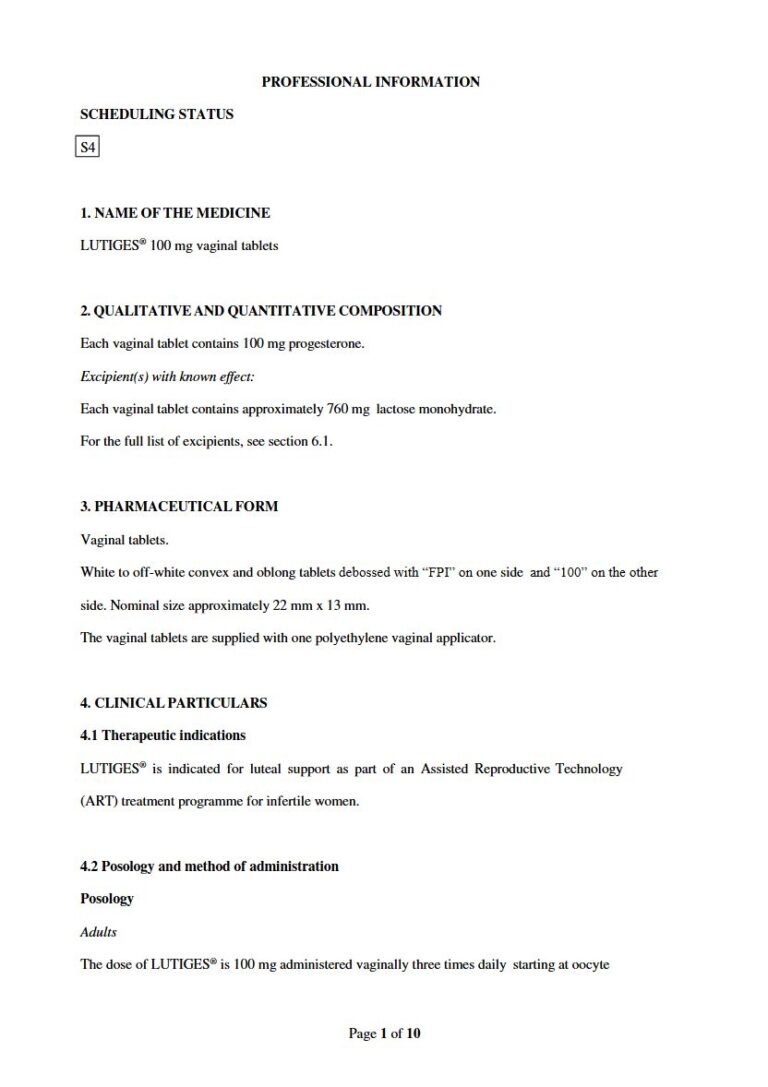
LUTIGES u00ae is indicated for luteal support as part of an Assisted Reproductive Technology (ART) treatment programme for infertile women.
4.2 Posology and method of administration
Posology
Adults
The dose of LUTIGES u00ae is 100 mg administered vaginally three times daily starting at oocyte retrieval. The administration of LUTIGES u00ae should be continued for 30 days, if pregnancy has been confirmed.
Paediatric population
There is no relevant use of LUTIGES u00ae in the paediatric population.
Elderly
No clinical data have been collected in patients aged over 65.
Use in special populations
There is no experience with use of LUTIGES u00ae in patients with impaired liver or renal function.
Method of administration
LUTIGES u00ae is to be placed directly into the vagina by the applicator provided.
4.3 Contraindications
LUTIGES u00ae should not be used in individuals with any of the following conditions:
- hypersensitivity to the active substance(s) or to any of the excipients listed in section 6.1
- undiagnosed vaginal bleeding
- known missed abortion or ectopic pregnancy
- severe hepatic dysfunction (child-pugh class C) or disease
- known or suspected breast or genital tract cancer
- active arterial or venous thromboembolism or severe thrombophlebitis, or a history of these events
- porphyria.
4.4 Special warnings and precautions for use
LUTIGES u00ae should be discontinued if any of the following conditions are suspected: myocardial infarction, cerebrovascular disorders, arterial or venous thromboembolism (venous thromboembolism or pulmonary embolism), thrombophlebitis, or retinal thrombosis.
Cautious use in patients with mild to moderate hepatic dysfunction.
Patients with a history of depression need to be closely observed. Consider discontinuation if symptoms worsen.
Because LUTIGES u00ae may cause some degree of fluid retention, conditions that might be influenced by this factor (e.g. epilepsy, migraine, asthma, cardiac or renal dysfunction) require careful observation.
A decrease in insulin sensitivity and thereby in glucose tolerance has been observed in a small number of patients on oestrogen-progestogen combination medicines. The mechanism of this decrease is not known. For this reason, diabetic patients should be carefully observed while receiving LUTIGES u00ae therapy.
LUTIGES u00ae use may also increase the risk of retinal vascular lesions. To prevent these latter complications, caution is to be taken in users >35 years, in smokers, and in those with risk factors for atherosclerosis. Use should be terminated in case of transient ischemic events, appearance of sudden severe headaches, or vision impairments related to papillary oedema or retinal haemorrhage.
Abrupt discontinuation of progesterone dosing may cause increased anxiety, moodiness, and increased sensibility to seizures.
Before starting treatment with LUTIGES u00ae, the patient and her partner should be assessed by a doctor for causes of infertility.
4.5 Interaction with other medicinal products and other forms of interaction
Medicines known to induce the hepatic cytochrome P450-3A4 system (e.g. rifampicin, carbamazepine or St. Johnu2019s wort (Hypericum perforatum)-containing herbal products) may increase the elimination rate and thereby decrease the bioavailability of progesterone.
In contrast ketoconazole and other inhibitors of cytochrome P450-3A4 may decrease elimination rate and thereby increase the bioavailability of progesterone.
The effect of concomitant vaginal products on the exposure of progesterone from LUTIGES u00ae has not been assessed. However, LUTIGES u00ae is not recommended for use with other vaginal products (such as antifungal products) as this may alter progesterone release and absorption from the vaginal tablet.
4.6 Fertility, pregnancy and lactation
Pregnancy: LUTIGES u00ae vaginal tablets are only indicated during the first trimester of pregnancy for use as part of an assisted reproduction (ART) regimen. There is yet limited and inconclusive data on the risk of congenital anomalies, including genital abnormalities in male or female infants, following intrauterine exposure during pregnancy. In the pivotal trial, the rate of foetal anomalies following 10-week exposure to LUTIGES u00ae 100 mg TID was 4,5 %, a total of 7 cases of foetal anomalies (i.e. oesophageal fistula, underdeveloped right ear with hypospadias, small aorta/valvular regurgitation/deviated septum, hand deformity, cleft palate/cleft lip, hydrocephalus and holoprosencephaly/proboscis/polydactylia) were seen in 404 patients. The rate of foetal anomalies observed during the clinical trial is comparable with the event rate described in the general population, although the total exposure is too low to allow conclusions to be drawn. During the conduct of the pivotal clinical trial, the number of spontaneous abortions and ectopic pregnancies associated with the use of LUTIGES u00ae 100 mg TID were 5,4 % and 1 %, respectively.
Breastfeeding: Detectable amounts of progesterone have been identified in the milk of mothers. Therefore, LUTIGES u00ae should not be used during lactation.
4.7 Effects on ability to drive and use machines
LUTIGES u00ae has minor or moderate influence on the ability to drive and use machines. Progesterone may cause drowsiness and/or dizziness; therefore, caution is advised in drivers and users of machines.
4.8 Undesirable effects
The most frequently reported adverse drug reactions during treatment with LUTIGES u00ae in IVF patients during clinical trials are headache, vulvovaginal disorders and uterine spasm, reported in 1,5 %, 1,5 % and 1,4 % subjects, respectively. The table below displays the main adverse reactions in women treated with LUTIGES u00ae in the clinical trial distributed by system organ classes (SOCs) and frequency.
System Organ Class (SOC)
Common (> 1/100 and <1/10)
Uncommon (> 1/1000 and < 1/100)
Not known*** (cannot be estimated from the available data)
Nervous system disorders
- Headache
- Dizziness
- Insomnia
- Fatigue
Gastrointestinal disorders
- Abdominal distension
- Abdominal pain
- Nausea
- Diarrhoea
- Constipation
- Vomiting
Skin and subcutaneous tissue disorders
- Urticaria
- Rash
- Hypersensitivity reactions
Reproductive system and breast disorders
- Uterine spasm
- Vulvovaginal disorders*
- Vaginal mycosis
- Breast disorders**
- Pruritus genital
General disorders and administration site
- Oedema peripheral
* Vulvovaginal disorders such as vulvovaginal discomfort, vaginal burning sensation, vaginal discharge, vulvovaginal dryness and vaginal haemorrhage, have been reported following use of LUTIGES u00ae, with cumulative reporting frequency of 1,5 %.
** Breast disorders, such as breast pain, breast swelling and breast tenderness have been reported in the clinical trial as single cases, with cumulative reporting frequency of 0,4 %.
***Cases seen during post marketing experience.
Reporting of suspected adverse reactions
Reporting suspected adverse reactions after authorisation of the medicine is important. It allows continued monitoring of the benefit/risk balance of the medicine. Health care providers are asked to report any suspected adverse reactions to SAHPRA via the u201c6.04 Adverse Drug Reactions Reporting Formu201d, found online under SAHPRAu2019s publications: https://www.sahpra.org.za/Publications/Index/8. To report any adverse reactions to Ferring, please contact us on +27 12 345 6358.
4.9 Overdose
High doses of progesterone may cause drowsiness. Treatment of overdosage consists of discontinuation of LUTIGES u00ae together with institution of appropriate symptomatic and supportive care.
