
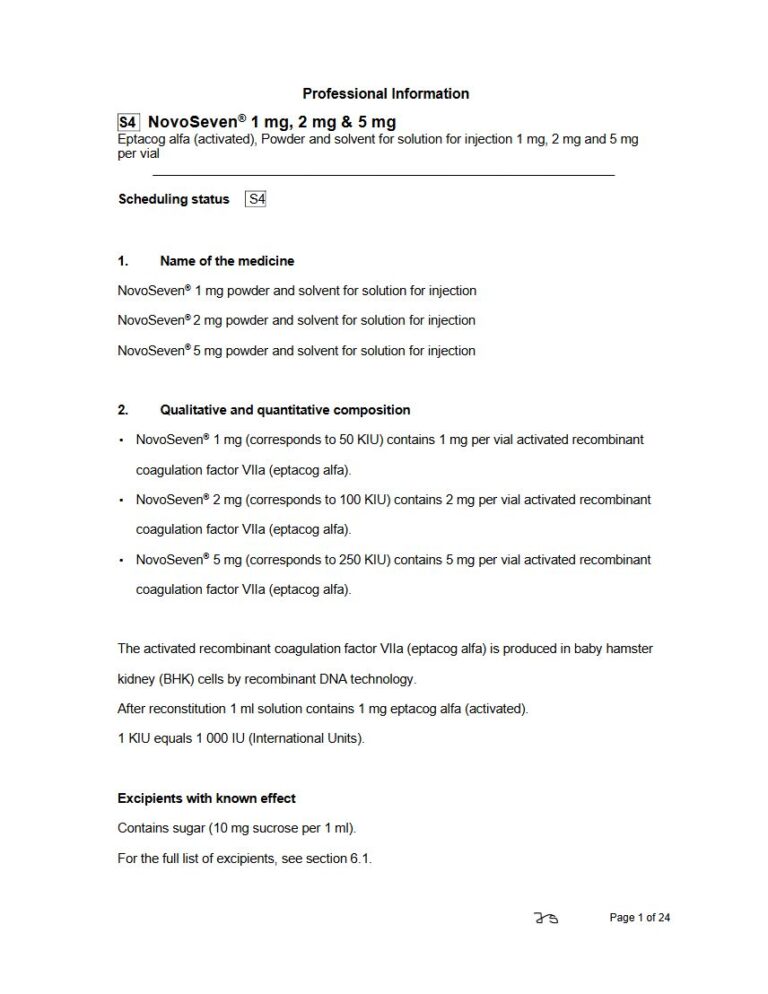
Novosevena 1 Mg/2 Mg/5 Mg Solution
PDF Leaflet Revision Date: 08 November 2021
Clinical Summary
Quick overview from the medicine insert
Indication
Treatment of bleeding in patients with haemophilia and other bleeding disorders.
Dosage (summary)
Initial dose: 90 u03bcg/kg IV; repeat as needed based on bleeding severity.
Onset of Action / Duration
Onset: Immediate, Duration: Varies based on clinical response.
Special Populations
- Paediatric patients
- Elderly patients
Pregnancy & Breastfeeding
Safety in pregnancy not established; caution advised. Unknown if excreted in breast milk.
Key Drug Interactions
- Avoid simultaneous use with prothrombin complex concentrates
- Limited data on anti-fibrinolytics
Contraindications
- Hypersensitivity to eptacog alfa or excipients
- History of thromboembolic events
Common side effects
- Pyrexia
- Rash
- Thromboembolic events
Counselling Points
- Administer under medical supervision
- Home treatment limited to 24 hours
- Report any signs of allergic reactions
Serious warnings
- Risk of thrombotic events in certain conditions
- Monitor for hypersensitivity reactions
Important Disclaimer
The Novosevena 1 Mg/2 Mg/5 Mg Solution professional information leaflet below is the property of Novo Nordisk and is provided on Medinsert exactly as issued, with no.. alterations or editorial changes. We make every effort to keep content current by updating documents as soon as new versions become available. Medinsert serves as a trusted access point for healthcare professionals, but does not replace official sources or clinical judgement. For more details, please read our full disclaimer. read more>>
 Healthcare Professionals Only
This content is for registered healthcare professionals
Sign in or create a free account to read the full package insert.
Free for HPCSA-registered professionals. Powered by Medinsert.
Clinical Particulars
Section 4 of the official insert — extracted exactly as issued, no alterations
4.1 Therapeutic indications
u2022 NovoSeven u00ae is intended for use in the treatment of patients with haemophilia with inhibitors to coagulation factor VIII and factor IX. The use of NovoSeven u00ae is indicated for patients suffering life- or limb-threatening bleeds or requiring surgery and in home-treatment setting for early intervention to treat mild to moderate bleeding episodes.
u2022 NovoSeven u00ae is indicated for the treatment of bleeding episodes and for the prevention of bleeding in patients with congenital FVII deficiency undergoing surgery or invasive procedures.
u2022 NovoSeven u00ae is indicated for the treatment of bleeding episodes and for the prevention of bleeding in those patients undergoing surgery or invasive procedures with Glanzmannu2019s thrombasthenia with or without antibodies to GP IIb-IIIa and/or HLA, and with past or present refractoriness to platelet transfusions, or where platelets are not readily available.
u2022 NovoSeven u00ae is indicated for the treatment of bleeding episodes and for the prevention of bleeding in those patients with acquired haemophilia undergoing surgery or invasive procedures.
4.2 Posology and method of administration
Treatment should be initiated under the supervision of a medical practitioner, experienced in the treatment of haemophilia and/or bleeding disorders.
Posology
Haemophilia A or B with inhibitors or expected to have a high anamnestic response
Dose
NovoSeven u00ae should be given as early as possible after the start of a bleeding episode. The recommended initial dose, administered by intravenous bolus injection, is 90 u03bcg per kg body weight. Following the initial dose of NovoSeven u00ae further injections may be repeated. The duration of treatment and the interval between injections will vary with the severity of the haemorrhage, the invasive procedures or surgery being performed.
Paediatric population
Current clinical experience does not warrant a general differentiation in dosing between children below 18 years and adults, although young children (below 12 years) have faster clearance than adults. Therefore, higher doses of rFVIIa may be needed in paediatric patients to achieve similar plasma concentrations as in adult patients (see section 5.2).
Dose interval
Initially 2 u2013 3 hours to obtain haemostasis. If continued therapy is needed, the dose interval can be increased successively once effective haemostasis is achieved to every 4, 6, 8 or 12 hours for as long as treatment is judged as being indicated.
Mild to moderate bleeding episodes (including home therapy): Early intervention has been shown to be efficacious in the treatment of mild to moderate joint, muscle and mucocutaneous bleeds. Two dosing regimens can be recommended:
1. Two to three injections of 90 u03bcg (4,5 KIU) per kg body weight administered at three-hour intervals. If further treatment is required, one additional dose of 90 u03bcg per kg body weight can be administered.
2. One single injection of 270 u03bcg per kg body weight.
The duration of home treatment should not exceed 24 hours. If continued therapy is indicated the haemophilia treatment centre should be contacted. There is no clinical experience with administration of a single dose of 270 u03bcg per kg body weight in elderly patients.
Serious bleeding episodes:
The dosage varies according to the type and severity of the haemorrhages. As a guideline an initial dosage of 4,5 KIU (90 u03bcg) per kg body weight is recommended. Dosing frequency should initially be every second hour until clinical improvement is observed. If continued therapy is indicated, the dose interval can then be increased to 3 hours for 1 u2013 2 days. Thereafter, the dose interval can be increased successively to every 4; 6; 8 or 12 hours for as long as treatment is judged as being indicated. A major bleeding episode may be treated for 2 u2013 3 weeks but can be extended beyond this if clinically warranted.
Surgery/invasive procedure:
An initial dose of 4,5 KIU (90 u03bcg) per kg body weight should be given immediately before the procedure. The dose should be repeated after 2 hours and then at 2 u2013 3 hour intervals for the first 24 u2013 48 hours depending on the surgery performed and the clinical status of the patient.
In major surgery, the dosage should be continued at 2 u2013 4 hour intervals for 6 u2013 7 days. The dose interval may then be increased to 6 u2013 8 hours for another two weeks of treatment. Patients undergoing major surgery may be treated for up to 2 u2013 3 weeks until healing has occurred. For patients with factor IX inhibitors or acquired antibodies to factor VIII, only experience of the use of NovoSeven u00ae in minor surgery exists.
Acquired haemophilia
Dose and dose interval
NovoSeven u00ae should be given as early as possible after the start of a bleeding episode. The recommended initial dose, administered by intravenous bolus injection, is 90 u03bcg per kg body weight. Following the initial dose of NovoSeven u00ae further injections may be given if required. The duration of treatment and the interval between injections will vary with the severity of the haemorrhage, the invasive procedures or the surgery being performed. The initial dose interval should be 2 u2013 3 hours. Once haemostasis has been achieved, the dose interval can be increased successively to every 4; 6; 8 or 12 hours for as long as treatment is judged to be indicated.
Factor VII deficiency
Dose, dose range and dose interval
The recommended dose range for treatment of bleeding episodes and for the prevention of bleeding in patients undergoing surgery or invasive procedures is 15 u2013 30 u03bcg per kg body weight every 4 u2013 6 hours until haemostasis is achieved. Dose and frequency of injections should be adapted to each individual.
Paediatric population
Limited clinical experience in long term prophylaxis has been gathered in the paediatric population below 12 years of age, with a severe clinical phenotype (see section 5.1).
Dose and frequency of injections for prophylaxis should be based on clinical response and adapted to each individual.
Glanzmannu2019s thrombasthenia
Dose, dose range and dose interval
The recommended dose range for treatment of bleeding episodes and for the prevention of bleeding in patients undergoing surgery or invasive procedures is 90 u03bcg (range 80 u2013 120 u03bcg) per kg body weight at intervals of two hours (1,5 u2013 2,5 hours). At least three doses should be administered to secure effective haemostasis. The recommended route of administration is bolus injection as lack of efficacy may appear in connection with continuous infusion. For those patients who are not refractory, platelets are the first line treatment for Glanzmannu2019s thrombasthenia.
Method of administration
For instructions on reconstitution of NovoSeven u00ae before administration, see section 6.6. Administer the solution as an intravenous bolus injection over 2 u2013 5 minutes.
Monitoring of treatment u2013 laboratory tests
There is no requirement for monitoring of NovoSeven u00ae therapy. Severity of bleeding condition and clinical response to NovoSeven u00ae administration must guide dosing requirements. After administration of rFVIIa, prothrombin time (PT) and activated partial thromboplastin time (aPTT) have been shown to shorten, however no correlation has been demonstrated between PT and aPTT and clinical efficacy of rFVIIa.
4.3 Contraindications
Known hypersensitivity to eptacog alfa (the active ingredient), the excipients listed in section 6.1, or to mouse, hamster or bovine protein.
4.4 Special warnings and precautions for use
In patients receiving NovoSeven u00ae after major surgery or in pathological conditions in which tissue factor may be expressed more extensively than considered normal e.g. conditions like advanced atherosclerotic disease, crush injury, liver failure, malignancy or septicaemia, there may be a potential risk of development of thrombotic events or induction of disseminated intravascular coagulation (DIC) in association with NovoSeven u00ae treatment. Patients in such conditions receiving NovoSeven u00ae should be kept under close observation for signs and symptoms of untoward activation of the coagulation system or thrombosis.
Because of the risk of thromboembolic complications, caution should be exercised when administering NovoSeven u00ae to patients with a history of coronary heart disease, to patients with liver disease, to neonates, or to patients at risk of thromboembolic phenomena or disseminated intravascular coagulation. In each of these situations, the potential benefit of treatment with NovoSeven u00ae should be weighed against the risk of these complications. As recombinant coagulation factor VIIa, NovoSeven u00ae may contain trace amounts of mouse IgG, bovine IgG and other residual culture proteins (hamster and bovine serum proteins), the remote possibility exists that patients treated with NovoSeven u00ae may develop hypersensitivity to these proteins. In such cases treatment with antihistamines IV should be considered. If allergic or anaphylactic-type reactions occur, the administration should be discontinued immediately. In case of shock, standard medical treatment for shock should be implemented. Patients should be informed of the early signs of hypersensitivity reactions. If such symptoms occur, the patient should be advised to discontinue use of NovoSeven u00ae immediately and contact their medical practitioner.
In case of severe bleeds NovoSeven u00ae should be administered in hospitals preferably specialised in treatment of haemophilia patients with coagulation factor VIII or IX inhibitors, or if not possible, in close collaboration with a medical practitioner specialised in haemophilia treatment. In case of mild to moderate bleeding episodes, NovoSeven u00ae may be administered at home; however this should only be done in close collaboration with a haemophilia centre where the patient is regularly followed up. The duration of home treatment should not exceed 24 hours. If bleeding is not kept under control, hospital care is mandatory. Patients or carers should inform the medical practitioners or supervising hospital at the earliest possible opportunity about all usages of NovoSeven u00ae . Factor VII deficient patients should be monitored for prothrombin time and factor VII coagulant activity before and after administration of NovoSeven u00ae . In case the factor VIIa activity fails to reach the expected level or bleeding is not controlled after treatment with the recommended doses, antibody formation may be suspected and analysis for antibodies should be performed. Thrombosis has been reported in FVII deficient patients receiving NovoSeven u00ae during surgery but the risk of thrombosis in factor VII deficient patients treated with NovoSeven u00ae is unknown (see section 5.1 One case of angioneurotic oedema has been reported spontaneously in a patient with Glanzmannu2019s thrombasthenia after administration of NovoSeven u00ae . Contains sucrose. Patients with rare hereditary conditions such as fructose intolerance, glucose-galactose malabsorption or sucrase-isomaltase insufficiency should not receive NovoSeven u00ae .
NovoSeven u00ae contains less than 1 mmol sodium (23 mg) per injection, indicating that it is essentially u201csodium freeu201d.
4.5 Interaction with other medicines and other forms of interaction
The risk of a potential interaction between NovoSeven u00ae and coagulation factor concentrates is unknown. Simultaneous use of prothrombin complex concentrates, activated or not, should be avoided. Anti-fibrinolytics have been reported to reduce blood loss in association with surgery in haemophilia patients, especially in orthopaedic surgery and surgery in regions rich in fibrinolytic activity, such as the oral cavity. Experience with concomitant administration of anti-fibrinolytics and NovoSeven u00ae treatment is however limited. Based on a non-clinical study, it is not recommended to combine NovoSeven u00ae and recombinant coagulation factor XIII (rFXIII). There are no clinical data available on interaction between rFVIIa and rFXIII.
4.6 Fertility, pregnancy and lactation
Women of childbearing potential
It is not known whether NovoSeven u00ae can affect reproduction capacity.
Pregnancy
Safety in pregnancy has not been established. As a precautionary measure, it is preferable to avoid the use of NovoSeven u00ae during pregnancy. Data on a limited number of exposed pregnancies within approved indications indicate no adverse effects of NovoSeven u00ae on pregnancy or on the health of the foetus/new-born child. To date, no other relevant epidemiological data are available. Animal studies do not indicate direct or indirect harmful effects with respect to pregnancy, embryonal/foetal development, parturition or postnatal development.
Breastfeeding
It is not known whether NovoSeven u00ae is excreted in human breast milk. The excretion of NovoSeven u00ae in milk has not been studied in animals. A decision on whether to continue/discontinue breastfeeding or to continue/discontinue therapy with NovoSeven u00ae should be made taking into account the benefit of breastfeeding to the child and benefit of NovoSeven u00ae therapy to the woman.
Fertility
Data from non-clinical studies as well as post-marketing data show no indication that NovoSeven u00ae has a harmful effect on male or female fertility.
4.7 Effects on ability to drive and use machines
No studies on the effect on the ability to drive a vehicle and use machines have been performed.
4.8 Undesirable effects
Clinical trials conducted in 484 patients (including 4 297 treatment episodes) with haemophilia A and B, acquired haemophilia, factor VII deficiency and Glanzmannu2019s thrombasthenia have shown that adverse reactions are common (u2265 1/100 to < 1/10). As the total number of treatment episodes is below 10 000, the lowest possible frequency of adverse reactions that can be assigned is rare (u2265 1/10 000, 1/1 000 to < 1/100), and the most serious adverse reactions are thromboembolic events. The frequencies of both serious and non-serious adverse reactions are listed by system organ classes in the table below:
System Organ Class Side effects Blood and lymphatic system disorders Rare (u2265 1/10 000, < 1/1 000) uf0b7 Disseminated intravascular coagulation and related laboratory findings, including elevated levels of D-dimer and decreased levels of AT uf0b7 Coagulopathy Immune system disorders Rare (u2265 1/10 000, < 1/1 000) uf0b7 Hypersensitivity *Frequency not known uf0b7 Anaphylactic reaction Gastrointestinal disorders Rare (u2265 1/10 000, < 1/1 000) uf0b7 Nausea Nervous system disorders Rare (u2265 1/10 000, < 1/1 000) uf0b7 Headache Vascular disorders Uncommon (u2265 1/1 000, < 1/100) uf0b7 Venous thromboembolic events: (deep vein thrombosis, thrombosis at IV site, pulmonary embolism, thromboembolic events of the liver including portal vein thrombosis, renal vein thrombosis, thrombophlebitis, superficial thrombophlebitis and intestinal ischaemia) Rare (u2265 1/10 000, < 1/1 000) uf0b7 Arterial thromboembolic events: ( myocardial infarction, cerebral infarction, cerebral ischaemia, cerebral artery occlusion, cerebrovascular accident, renal artery thrombosis, peripheral ischaemia, peripheral arterial thrombosis and intestinal ischaemia) uf0b7 Angina pectoris * Frequency not known uf0b7 Intracardiac thrombus Skin and subcutaneous tissue disorders Uncommon (u2265 1/1 000, < 1/100) uf0b7 Rash (including allergic dermatitis and rash erythematous) uf0b7 Pruritus and urticaria * Frequency not known uf0b7 Flushing uf0b7 Angioedema General disorders and administration site conditions Uncommon (u2265 1/1 000, < 1/100) uf0b7 Therapeutic response decreased. (It is important that the dosage regimen of NovoSeven u00ae is compliant with the recommended dosage, as stated in section 4.2.) uf0b7 Pyrexia Rare (u2265 1/10 000, < 1/1 000) uf0b7 Injection site reaction including injection site pain Investigations Rare (u2265 1/10 000, < 1/1 000) uf0b7 Increased fibrin degradation products uf0b7 Increase of alanine aminotransferase, alkaline phosphatase, lactate dehydrogenase and prothrombin levels *Adverse reactions reported post-marketing only (i.e. not in clinical trials) are presented with a frequency of not known.
Description of selected adverse reactions
Inhibitory antibody formation
In post-marketing experience, there have been no reports of inhibitory antibodies against NovoSeven u00ae or FVII in patients with haemophilia A or B. Development of inhibitory antibodies to NovoSeven u00ae has been reported in a post-marketing observational registry of patients with congenital factor VII deficiency. In clinical trials of patients with factor VII deficiency, formation of antibodies against NovoSeven u00ae and FVII is the only adverse drug reaction reported (frequency: common (u2265 1/100 to < 1/10)). In some cases, the antibodies showed inhibitory effect in vitro . Risk factors that may have contributed to antibody development including previous treatment with human plasma and/or plasma-derived factor VII, severe mutation of FVII gene, and overdose of NovoSeven u00ae , were present. Patients with factor VII deficiency treated with NovoSeven u00ae should be monitored for factor VII antibodies (see section 4.4).
Thromboembolic events u2013 arterial and venous
When NovoSeven u00ae is administered to patients outside approved indications, arterial thromboembolic events are common (u2265 1/100 to < 1/10). A higher risk of arterial thromboembolic adverse events (see side effects table above: Vascular disorders) (5,6 % in patients treated with NovoSeven u00ae versus 3,0 % in placebo-treated patients) has been shown in a meta-analysis of pooled data from placebo-controlled trials conducted outside current approved indications in various clinical settings, each of these having distinct patient characteristics and hence different underlying risk profiles.
Safety and efficacy of NovoSeven u00ae have not been established outside the approved indications and therefore NovoSeven u00ae should not be used. Thromboembolic events may lead to cardiac arrest.
Other special populations
Patients with acquired haemophilia
Clinical trials conducted in 61 patients with acquired haemophilia with a total of 100 treatment episodes, showed that certain adverse drug reactions were reported more frequently (1 % based on treatment episodes): Arterial thromboembolic events (cerebral artery occlusion, cerebrovascular accident), venous thromboembolic events (pulmonary embolism and deep vein thrombosis), angina pectoris, nausea, pyrexia, erythematous rash and investigation of increased levels of fibrin degradation products.
Reporting of suspected adverse reactions
Reporting suspected adverse reactions after authorisation of NovoSeven u00ae is important. It allows continued monitoring of the benefit/risk balance of NovoSeven u00ae . Health care providers are asked to report any suspected adverse reactions via the u201c6.04 Adverse Drug Reaction Reporting Formu201d , found online under SAHPRAu2019s publications: https://www.sahpra.org.za/Publications/Index/8.
4.9 Overdose
Dose limiting toxicities of NovoSeven u00ae have not been investigated in clinical trials. Cases of overdose have been reported in patients with haemophilia. The only complication reported in connection with an overdose was a slight transient increase in blood pressure in a 16- year-old patient receiving 24 mg rFVIIa instead of 5,5 mg.
No cases of overdose have been reported in patients with acquired haemophilia or Glanzmannu2019s thrombasthenia.
In patients with factor VII deficiency, where the recommended dose is 15 u2013 30 u03bcg/kg rFVIIa, one episode of overdose has been associated with a thrombotic event (occipital stroke) in an elderly (> 80 years) male patient treated with 10 u2013 20 times the recommended dose. In addition, the development of antibodies against NovoSeven u00ae and FVII has been associated with overdose in one patient with factor VII deficiency.
The dose schedule should not be intentionally increased above the recommended doses due to the absence of information on the additional risk that may be incurred. Treatment is symptomatic and supportive.
