
Refena 175 μg Solution for inhalation
PDF Leaflet Revision Date: 14 February 2023
Clinical Summary
Quick overview from the medicine insert
Indication
Maintenance treatment of COPD.
Dosage (summary)
175 u03bcg once daily via nebuliser.
Special Populations
- Elderly
- Renal impairment
- Hepatic impairment
Pregnancy & Breastfeeding
Limited data; not recommended during breastfeeding.
Key Drug Interactions
- Anticholinergics
- OATP1B1 and OATP1B3 inhibitors
Contraindications
- Hypersensitivity to revefenacin or excipients
Common side effects
- Cough
- Nasopharyngitis
- Headache
Counselling Points
- Use only with a nebuliser
- Discard vial after use
- Monitor for signs of glaucoma or urinary retention
Serious warnings
- Paradoxical bronchospasm
- Worsening of narrow-angle glaucoma
- Worsening of urinary retention
Important Disclaimer
The Refena 175 μg Solution for inhalation professional information leaflet below is the property of Mylan and is provided on Medinsert exactly as issued, with no.. alterations or editorial changes. We make every effort to keep content current by updating documents as soon as new versions become available. Medinsert serves as a trusted access point for healthcare professionals, but does not replace official sources or clinical judgement. For more details, please read our full disclaimer. read more>>
 Healthcare Professionals Only
This content is for registered healthcare professionals
Sign in or create a free account to read the full package insert.
Free for HPCSA-registered professionals. Powered by Medinsert.
Clinical Particulars
Section 4 of the official insert — extracted exactly as issued, no alterations
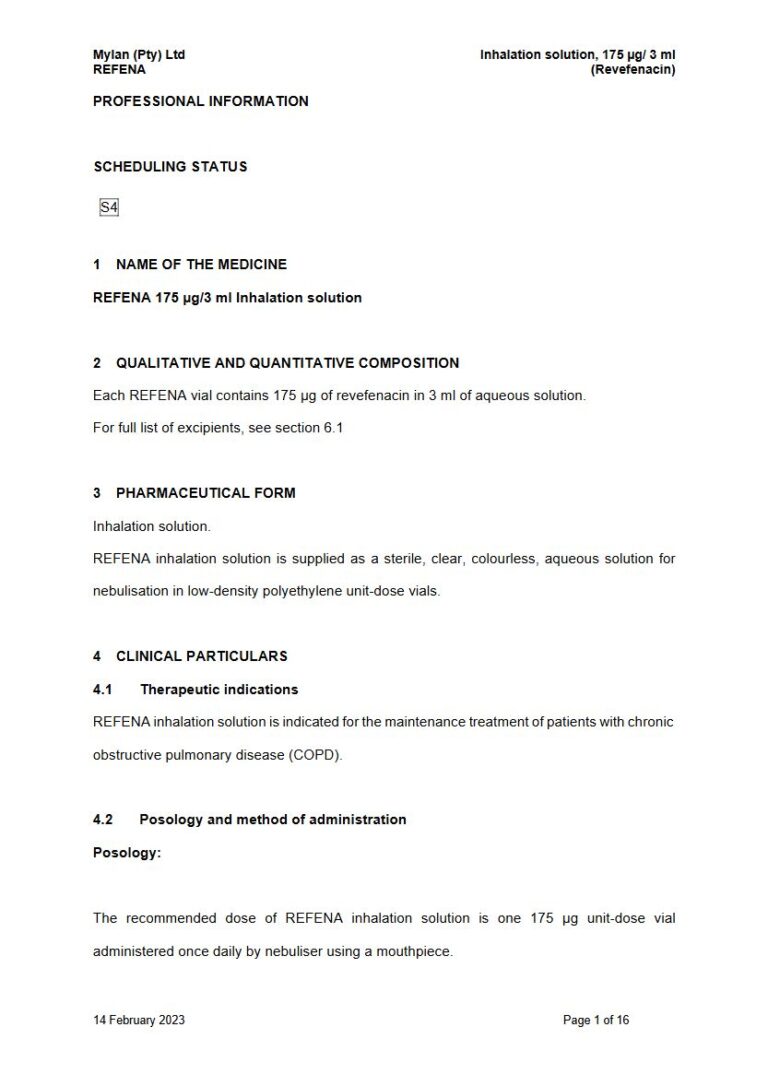
4.1 Therapeutic indications
REFENA inhalation solution is indicated for the maintenance treatment of patients with chronic obstructive pulmonary disease (COPD).
4.2 Posology and method of administration
Posology: The recommended dose of REFENA inhalation solution is one 175 u03bcg unit-dose vial administered once daily by nebuliser using a mouthpiece.
REFENA should be administered by the orally inhaled route via a standard jet nebuliser connected to an air compressor (See Patient Information). The safety and efficacy of REFENA have been established in clinical trials when administered using the PARI LC Sprint nebulizer with a mouthpiece and the PARI Trek S compressor. The safety and efficacy of REFENA delivered from non-compressor based nebuliser systems have not been established. The REFENA unit-dose vial should only be removed from the foil pouch and opened IMMEDIATELY BEFORE USE. The vial and any residual content should be discarded after use. No dosage adjustment is required for elderly patients, or patients with renal impairment (see section 4.4). The compatibility (physical and chemical), efficacy, and safety of REFENA when mixed with other medicines in a nebuliser have not been established.
4.3 Contraindications
- REFENA is contraindicated in patients with known hypersensitivity revefenacin or any of the excipients (see section 6.1).
4.4 Special warnings and precautions for use
Deterioration of Disease and Acute Episodes
REFENA should not be initiated in patients during acutely deteriorating or potentially life-threatening episodes of COPD. REFENA has not been studied in subjects with acutely deteriorating COPD. The initiation of REFENA in this setting is not appropriate. REFENA is intended as a once-daily maintenance treatment for COPD and should not be used for relief of acute symptoms, i.e. as rescue therapy for the treatment of acute episodes of bronchospasm, and extra doses should not be used for that purpose. Acute symptoms should be treated with an inhaled, short-acting beta-agonist.
COPD may deteriorate acutely over a period of hours or chronically over several days or longer. If REFENA no longer controls symptoms of bronchoconstriction, the patient's inhaled, short-acting beta-agonist becomes less effective, or the patient needs more inhalations of a short-acting beta-agonist than usual, these may be markers of deterioration of disease. In this setting, a re-evaluation of the patient and the COPD treatment regimen should be undertaken at once. Increasing the daily dose of REFENA beyond the recommended dose is not appropriate in this situation.
Paradoxical Bronchospasm
REFENA can produce paradoxical bronchospasm that may be life-threatening. If paradoxical bronchospasm occurs following dosing with REFENA, it should be treated immediately with an inhaled, short-acting bronchodilator; REFENA should be discontinued immediately and alternative therapy should be instituted.
Worsening of Narrow-Angle Glaucoma
REFENA should be used with caution in patients with narrow-angle glaucoma. Prescribers and patients should be alert for signs and symptoms of acute narrow-angle glaucoma (e.g. eye pain or discomfort, blurred vision, visual halos or coloured images in association with red eyes from conjunctival congestion and corneal oedema). Instruct patients to consult a medical practitioner immediately if any of these signs or symptoms develops.
Worsening of Urinary Retention
REFENA should be used with caution in patients with urinary retention. Prescribers and patients should be alert for signs and symptoms of urinary retention (e.g. difficulty passing urine, painful urination), especially in patients with prostatic hyperplasia or bladder-neck obstruction. Instruct patients to consult a healthcare provider immediately if any of these signs or symptoms develops.
Immediate Hypersensitivity Reactions
Immediate hypersensitivity reactions may occur after administration of REFENA. If such a reaction occurs, therapy with REFENA should be stopped at once and alternative treatments should be considered.
Special Populations
Paediatric Use
REFENA is not indicated for use in children. The safety and efficacy in paediatric patients have not been established.
Elderly Use
Based on available data, no adjustment of the dosage of REFENA in elderly patients is necessary. Clinical trials of REFENA included 441 subjects aged 65 years and older, and of those, 101 subjects were aged 75 years and older. No overall differences in safety or effectiveness were observed between these subjects and younger subjects, and other reported clinical experience has not identified differences in responses between the elderly and younger patients, but greater sensitivity of some older individuals cannot be ruled out.
Hepatic Impairment
The systemic exposure of revefenacin is unchanged while that of its active metabolite is increased in subjects with moderate hepatic impairment. The safety of REFENA has not been evaluated in COPD patients with mild-to-severe hepatic impairment. REFENA is not recommended in patients with any degree of hepatic impairment (see section 5.2).
Renal Impairment
No dosage adjustment is required in patients with renal impairment. Monitor for systemic antimuscarinic side effects in COPD patients with severe renal impairment (see section 5.2).
4.5 Interaction with other medicines and other forms of interaction
Anticholinergics
There is potential for an additive interaction with concomitantly used anticholinergic medicines. Therefore, avoid coadministration of REFENA with other anticholinergic-containing medicines as this may lead to an increase in anticholinergic adverse effects (see section 4.4).
Transporter-Related Interactions
OATP1B1 and OATP1B3 inhibitors (e.g. rifampicin, ciclosporin, etc.) could lead to an increase in systemic exposure of the active metabolite. Therefore, coadministration with REFENA is not recommended (see section 5.2).
4.6 Fertility, pregnancy and lactation
Pregnancy
Risk Summary
There are no adequate and well-controlled studies with REFENA in pregnant women. Women should be advised to contact their medical practitioner if they become pregnant while using REFENA. In animal reproduction studies, subcutaneous administration of revefenacin to pregnant rats and rabbits during the period of organogenesis produced no evidence of foetal harm at respective exposures approximately 209 times the exposure at the maximum recommended human dose (MRHD) (on an area under the curve [AUC] basis) (see Data). The estimated background risk of major birth defects and miscarriage for the indicated population is unknown.
Data
Animal Data
In an embryo-foetal development study in pregnant rats dosed during the period of organogenesis from gestation days 6 to 17, revefenacin was not teratogenic and did not affect foetal survival at exposures up to 209 times the MRHD (based upon summed AUCs for revefenacin and its active metabolite at maternal subcutaneous doses up to 500 mcg/kg/day). In an embryo-foetal development study in pregnant rabbits dosed during the period of organogenesis from gestation days 7 to 19, revefenacin was not teratogenic and did not affect foetal survival at exposures up to 694 times the MRHD (based upon summed AUCs for revefenacin and its active metabolite at maternal subcutaneous doses up to 500 mcg/kg/day). Placental transfer of revefenacin and its active metabolite was observed in pregnant rabbits. In a pre- and postnatal development (PPND) study in pregnant rats dosed during the periods of organogenesis and lactation from gestation day 6 to lactation day 20, revefenacin had no adverse developmental effects on pups at exposures up to 196 times the MRHD (based upon summed AUCs for revefenacin and its active metabolite at maternal subcutaneous doses up to 500 mcg/kg/day).
Lactation
Risk Summary
There is no information regarding the presence of revefenacin in human milk, the effects on the breastfed infant, or the effects on milk production. However, revefenacin was present in the milk of lactating rats following dosing during pregnancy and lactation (see Data). Mothers taking REFENA are advised not to breastfeed their infants. The motheru2019s clinical need for REFENA should be considered and any potential adverse effects on the breastfed infant from REFENA or from the underlying maternal condition.
Data
Animal Data
In a PPND study revefenacin and its active metabolite were present in milk of lactating rats on lactation day 22. Milk-to-plasma concentration ratios were up to 10 for revefenacin and its active metabolite.
4.7 Effects on ability to drive and use machines
REFENA has no or negligible influence on the ability to drive or use machines.
4.8 Undesirable effects
a. Summary of the safety profile
The following serious adverse reactions are discussed in section 4.4 Special warnings and precautions for use :
u2022 Paradoxical bronchospasm
u2022 Worsening of narrow-angle glaucoma
u2022 Worsening of urinary retention
u2022 Immediate hypersensitivity reactions
Clinical Trial Experience
Because clinical trials are conducted under widely varying conditions, adverse reaction rates observed in the clinical trials of a medicine may not reflect the rates observed in practice. The revefenacin safety database included 2,285 subjects with COPD in two 12-week efficacy studies and one 52-week long-term safety study. A total of 730 subjects received treatment with revefenacin 175 mcg once daily. The safety data described below are based on the two 12-week trials and the one 52-week trial.
12-Week Trials
Revefenacin was studied in two 12-week replicate placebo-controlled trials in patients with moderate to very severe COPD (Trials 1 and 2). In these trials, 395 patients were treated with revefenacin at the recommended dose of 175 u03bcg once daily. The population had a mean age of 64 years (range from 41 to 88 years), with 50 % males, 90 % Caucasian, and had COPD with a mean postbronchodilator forced expiratory volume in one second (FEV) percent predicted of 55 %. Of subjects enrolled in the two 12-week trials, 37 % were taking concurrent long-acting beta-agonist (LABA) or inhaled corticosteroid (ICS)/LABA therapy. Patients with unstable cardiac disease, narrow-angle glaucoma, or symptomatic prostatic hypertrophy or bladder outlet obstruction were excluded from these trials.
Table 1 shows the most common adverse reactions that occurred with a frequency of greater than or equal to 2 % in the revefenacin group and higher than placebo in the two 12-week placebo-controlled trials. The proportion of subjects who discontinued treatment due to adverse reactions was 13 % for the revefenacin-treated subjects and 19 % for placebo-treated subjects.
b. Tabulated summary of adverse reactions
Table 1: Adverse Events with Revefenacin u2265 2 % Incidence and Higher than Placebo
Placebo (N = 418) Revefenacin 175 u03bcg (N = 395)
Respiratory, Thoracic and Mediastinal Disorders
Cough 17 (4 %) 17 (4 %)
Infections and Infestations
Nasopharyngitis 9 (2 %) 15 (4 %)
Upper respiratory tract infection 9 (2 %) 11 (3 %)
Nervous System Disorders
Headache 11 (3 %) 16 (4 %)
Musculoskeletal and Connective Tissue Disorders
Back pain 3 (1 %) 9 (2 %)
Other adverse reactions defined as events with an incidence of u2265 1,0 %, less than 2,0 %, and more common than with placebo included the following: hypertension, dizziness, oropharyngeal pain, and bronchitis.
52-Week Trial
Revefenacin was studied in one 52-week, open-label, active-control (tiotropium 18 u03bcg once daily) trial in 1,055 patients with COPD. In this trial, 335 patients were treated with revefenacin 175 u03bcg once daily and 356 patients were treated with tiotropium. The demographic and baseline characteristics of the long-term safety trial were similar to those of the placebo-controlled 12-week studies described, with the exception that concurrent LABA or LABA/ICS therapy was used in 50 % of patients. The adverse reactions reported in the long-term safety trial for revefenacin were consistent with those observed in the placebo-controlled studies of 12-weeks.
Reporting of suspected adverse reactions
Reporting suspected adverse reactions after authorisation of the medicine is important. It allows continued monitoring of the benefit/risk balance of the medicine. Health care providers are asked to report any suspected adverse reactions to SAHPRA via the u201c6.04 Adverse Drug Reactions Reporting Formu201d, found online under SAHPRAu2019s publications: https://www.sahpra.org.za/Publications/Index/8
4.9 Overdose
An overdose of REFENA may lead to anticholinergic signs and symptoms such as nausea, vomiting, dizziness, light-headedness, blurred vision, increased intraocular pressure (causing pain, vision disturbances, or reddening of the eye), constipation or difficulties in voiding. In COPD patients, orally inhaled administration of REFENA at a once-daily dose of up to 700 u03bcg (4 times the maximum recommended daily dose) for 7 days was well tolerated. Treatment of overdosage consists of discontinuation of REFENA along with institution of appropriate symptomatic and/or supportive therapy.
