
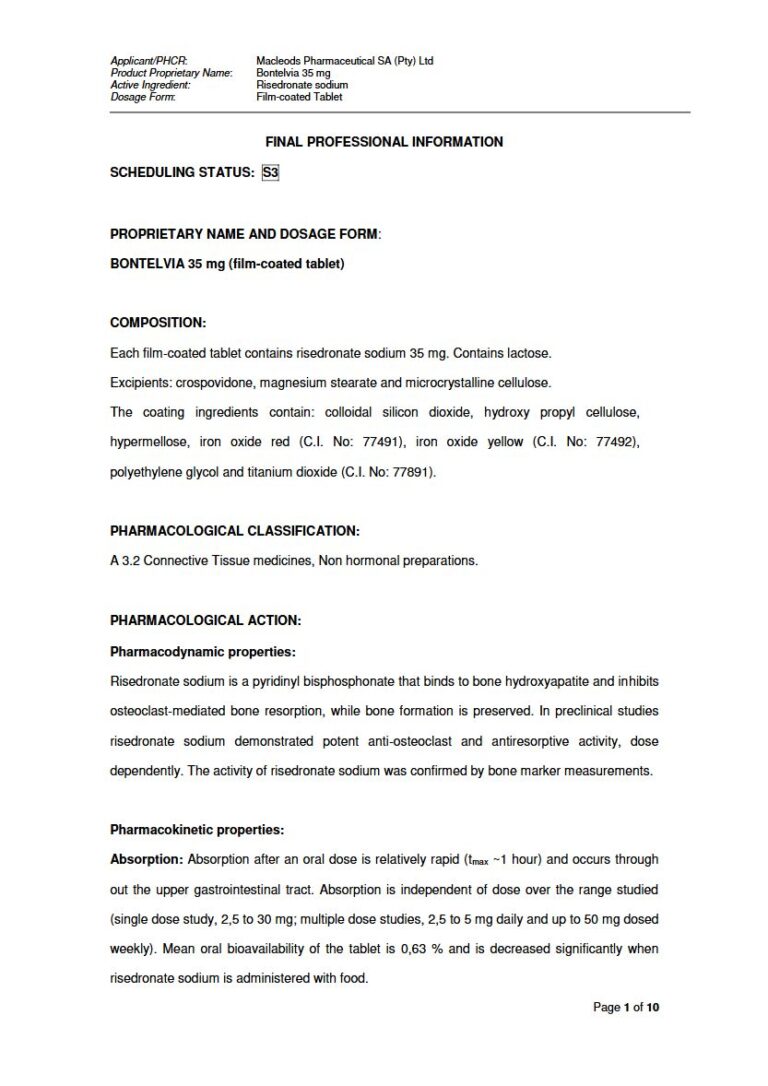
Bontelvia 35mg Injection
PDF Leaflet Revision Date: 13 December 2019
Clinical Summary
Quick overview from the medicine insert
Indication
Treatment of osteoporosis in postmenopausal women and males.
Dosage (summary)
One 35 mg tablet orally once a week.
Onset of Action / Duration
Onset: ~1 hour, Duration: Not specified
Special Populations
- Elderly
- Renal impairment
Pregnancy & Breastfeeding
Contraindicated in pregnancy and breastfeeding.
Key Drug Interactions
- Aspirin
- NSAIDs
- Hormone replacement therapy
- Polyvalent cations
Contraindications
- Hypersensitivity to risedronate
- Hypocalcaemia
- Advanced renal impairment
- Pregnancy
- Lactation
Common side effects
- Dyspepsia
- Nausea
- Constipation
- Diarrhoea
- Musculoskeletal pain
Counselling Points
- Take with a full glass of water
- Remain upright for 30 mins after taking
- Avoid food/drinks containing polyvalent cations around dosing time
Serious warnings
- Risk of oesophageal reactions
- Osteonecrosis of the jaw
- Atypical femur fractures
Important Disclaimer
The Bontelvia 35mg Injection professional information leaflet below is the property of Macleods Pharmaceutical Sa and is provided on Medinsert exactly as issued, with no.. alterations or editorial changes. We make every effort to keep content current by updating documents as soon as new versions become available. Medinsert serves as a trusted access point for healthcare professionals, but does not replace official sources or clinical judgement. For more details, please read our full disclaimer. read more>>
 Healthcare Professionals Only
This content is for registered healthcare professionals
Sign in or create a free account to read the full package insert.
Free for HPCSA-registered professionals. Powered by Medinsert.
Clinical Particulars
Section 4 of the official insert — extracted exactly as issued, no alterations
4.1 Therapeutic indications
Treatment of osteoporosis in postmenopausal women in combination with calcium 500 to 1000 mg per day. Additional administration of vitamin D should be considered when deficiency might be expected. Treatment of primary osteoporosis in males.
4.2 Posology and method of administration
The recommended dose is one 35 mg tablet orally once a week. The tablet should be taken on the same day each week. Foods, drinks (other than plain water) and medicinal products containing polyvalent cations (such as calcium, magnesium, iron and aluminum) may interfere with absorption of BONTELVIA 35 mg and should not be taken as same time. Therefore BONTELVIA 35 mg should be taken either at least 30 minutes before the first food, or other medicine or drink (other than plain water) of the day or at least 2 hours away from food or drink at any other time of the day and at least 30 minutes before going to bed. Patients should be instructed that if a dose is missed, one BONTELVIA 35 mg should be taken on the day that the tablet is remembered. Patients should then return to taking one tablet once a week on the day the tablet is normally taken. Two tablets should not be taken on the same day. The tablet must be swallowed whole and not sucked or chewed. Patients should take BONTELVIA 35 mg while in an upright (standing or sitting) position with a glass of plain water (> 120 ml) to aid delivery to the stomach. Patients should not lie down for 30 minutes after taking the tablet (see Warnings and Special Precautions).
Elderly: No dosage adjustment is necessary since bioavailability, and disposition were similar in elderly (>60 years of age) compared to younger patients.
Renal impairment: No dosage adjustment is necessary in patients with creatinine clearance u2265 30 ml/min. There is no clinical data in patients with severe renal impairment. (Creatinine clearance less than 30 ml/min) (see CONTRA-INDICATIONS).
Children: Safety and efficacy of BONTELVIA 35 mg have not been established in children and growing adolescents.
4.3 Contraindications
Known hypersensitivity to risedronate and any other ingredients of BONTELVIA 35 mg. Hypocalcaemia (see WARNINGS AND SPECIAL PRECAUTIONS). Advanced renal impairment: creatinine clearance < 30 ml/min. Pregnancy and lactation.
4.4 Special warnings and precautions for use
Efficacy of bisphosphonates including BONTELVIA 35 mg in the treatment of osteoporosis is related to the presence of low bone mineral density and/or prevalent fracture. High age or clinical risk factors for fracture alone are not sufficient reasons to initiate treatment of osteoporosis with a bisphosphonate such as BONTELVIA 35 mg. The evidence to support efficacy of bisphosphonates including BONTELVIA 35 mg in the very elderly (>80 years) is limited.
Bisphosphonates, including BONTELVIA 35 mg, have been associated with oesophagitis, gastritis, oesophageal ulcerations and gastroduodenal ulcerations. Thus, caution should be used:
- in patients who have a history of oesophageal disorders which delay oesophageal transit or emptying e.g. stricture or achalasia.
- in patients who are unable to stay in the upright position for at least 30 minutes after taking the tablet.
- if BONTELVIA 35 mg is given to patients with active or recent oesophageal or upper gastrointestinal problems (including known Barrett's oesophagus).
Medical practitioners should emphasise to patients the importance of paying attention to the dosing instructions and be alert to any signs and symptoms of possible oesophageal reaction. The patients should be instructed to seek timely medical attention if they develop symptoms of oesophageal irritation such as dysphagia, pain on swallowing, retrosternal pain or new/worsened heartburn.
In order to facilitate delivery to the stomach and minimise the possibility of gastrointestinal adverse effects, patients should take BONTELVIA 35 mg while in an upright position (sitting or standing) with a full glass of plain water and should avoid lying down for 30 minutes after taking BONTELVIA 35 mg. Foods, drinks (other than plain water) and medicinal products containing polyvalent cations (such as calcium, magnesium, iron and aluminium) interfere with the absorption of BONTELVIA 35 mg and should not be taken at the same time. Therefore to achieve the benefits of BONTELVIA 35 mg, patients should take the tablet either at least 30 minutes before the first food, medicine or drink (other than plain water) of the day or at least 2 hours away from food or drink at any time of the day.
Hypocalcaemia and other disturbances of bone and mineral metabolism should be effectively treated before starting BONTELVIA 35 mg. Asymptomatic small decreases in serum calcium and phosphorus levels have been observed in some patients. Adequate intake of calcium and vitamin D is important. Patients should receive supplemental calcium and vitamin D if dietary intake is inadequate.
BONTELVIA 35 mg is contraindicated in patients with severe renal impairment (creatinine clearance less than 30 ml/min) (see CONTRA-INDICATIONS).
Osteonecrosis of the jaw, frequently associated with tooth extraction and/or local infection (including osteomyelitis) has been reported. Osteonecrosis of the jaw has also been reported in patients with osteoporosis receiving oral bisphosphonates such as BONTELVIA 35 mg.
A dental examination with appropriate preventive dentistry should be considered prior to treatment with BONTELVIA 35 mg in patients with concomitant risk factors (e.g. cancer, chemotherapy, radiotherapy, corticosteroids, poor oral hygiene). While on treatment, these patients should avoid invasive dental procedures if possible. For patients who develop osteonecrosis of the jaw while on BONTELVIA 35 mg therapy, dental surgery may exacerbate the condition. For patients requiring dental procedures, there are no data available to suggest whether discontinuation of bisphosphonate (such as in BONTELVIA 35 mg) treatment reduces the risk of osteonecrosis of the jaw. Clinical judgment of the treating medical practitioner should guide the management plan of each patient based on individual benefit/risk assessment.
Osteonecrosis of the external auditory canal has been reported with bisphosphonates including BONTELVIA 35 mg, mainly in association with long-term therapy. Possible risk factors for osteonecrosis of the external auditory canal include steroid use and chemotherapy and/or local risk factors such as infection or trauma. The possibility of osteonecrosis of the external auditory canal should be considered in patients receiving BONTELVIA 35 mg who present with ear symptoms including chronic ear infections.
Atypical fractures of the femur: Atypical subtrochanteric and diaphyseal femoral fractures have been reported with BONTELVIA 35 mg, primarily in patients receiving long-term treatment for osteoporosis. These transverse or short oblique fractures can occur anywhere along the femur from just below the lesser trochanter to just above the supracondylar flare. These fractures occur after minimal or no trauma and some patients experience thigh or groin pain, often associated with imaging features of stress fractures, weeks to months before presenting with a completed femoral fracture. Fractures are often bilateral; therefore the contralateral femur should be examined in BONTELVIA 35 mg-treated patients who have sustained a femoral shaft fracture. Poor healing of these fractures has also been reported. Discontinuation of BONTELVIA 35 mg therapy in patients suspected to have an atypical femur fracture should be considered pending evaluation of the patient, based on an individual benefit risk assessment. During BONTELVIA 35 mg treatment patients should be advised to report any thigh, hip or groin pain and any patient presenting with such symptoms should be evaluated for an incomplete femur fracture.
4.5 Interactions with other medicines
BONTELVIA 35 mg has been used with aspirin and NSAIDs. BONTELVIA 35 mg may be used concomitantly with hormone replacement therapy. Concomitant ingestion of medicines containing polyvalent cations (e.g. calcium, magnesium, iron and aluminium) will interfere with the absorption of BONTELVIA 35 mg. BONTELVIA 35 mg is not systemically metabolised, does not induce cytochrome P450 enzymes and has low protein binding.
4.6 Fertility, pregnancy and lactation
BONTELVIA 35 mg is contraindicated in pregnant and breastfeeding women (see CONTRA-INDICATIONS).
4.7 Effects on ability to drive and use machines
BONTELVIA 35 mg has no or negligible influence on the ability to drive and use machines.
4.8 Undesirable effects
Immune system disorders: Frequency not known: anaphylactic reaction, hypersensitivity and skin reactions including angioedema.
Eye disorders: Less frequent: iritis. Frequency not known: uveitis.
Gastrointestinal disorders: Frequent: dyspepsia, nausea, constipation, diarrhoea, gastrointestinal disorders. Less frequent: oesophagitis, oesophageal ulcer, gastritis, dysphagia, duodenitis, oesophageal stricture, abdominal pain, glossitis. Frequency not known: flatulence, gastric haemorrhage, eructation, odynophagia.
Psychiatric disorders: Frequency not known: insomnia, somnolence.
Nervous system disorders: Frequent: headache.
Hepato-biliary disorders: Less frequent: abnormal liver function tests. Frequency not known: serious hepatic disorders.
Musculoskeletal and connective tissues disorders: Frequent: musculoskeletal pain, arthralgia, bone pain. Less frequent: osteonecrosis of the external auditory canal. Frequency not known: osteonecrosis of the jaw, atypical subtrochanteric and diaphyseal femoral fractures.
Skin and subcutaneous disorders: Frequency not known: generalised rash and bullous skin reactions, some severe including Stevens-Johnson syndrome toxic epidermal necrolysis, hyperhidrosis, hair loss, leukocytoclastic vasculitis.
Blood and lymphatic system disorders: Frequency not known: eosinophilia, neutropenia.
Reproductive system and breast disorders: Frequency not known: decreased libido.
General disorders: Frequent: pain. Frequency not known: fatigue, acute mountain sickness, pyrexia.
Investigations: Frequency not known: Decreases in serum calcium and phosphate levels.
4.9 Overdose
Decreases in serum calcium following overdose may be expected in some patients. Signs and symptoms of hypocalcaemia may also occur in some of these patients. Milk or antacids containing magnesium, calcium or aluminium should be given to bind risedronate and reduce absorption of BONTELVIA 35 mg.
