
Rupastral 10 mg tablet
PDF Leaflet Revision Date: 27 May 2025
Clinical Summary
Quick overview from the medicine insert
Indication
Symptomatic treatment of allergic rhinitis and urticaria in adults and adolescents over 12 years.
Dosage (summary)
10 mg once daily, with or without food.
Onset of Action / Duration
Onset: 30 mins, Duration: 24 hours
Special Populations
- Elderly
- Renal impairment
- Hepatic impairment
Pregnancy & Breastfeeding
Contraindicated in pregnancy; avoid during breastfeeding due to potential harm to neonates.
Key Drug Interactions
- CYP3A4 inhibitors
- Grapefruit juice
- CNS depressants
- Alcohol
Contraindications
- Hypersensitivity to rupatadine
- Children under 12 years
- Pregnancy
Common side effects
- Somnolence
- Headache
- Fatigue
- Dry mouth
- Dizziness
Counselling Points
- Take once daily
- Avoid grapefruit juice
- May cause drowsiness
Serious warnings
- Use with caution in patients with QT prolongation
- Caution in elderly patients
Important Disclaimer
The Rupastral 10 mg tablet professional information leaflet below is the property of Astral Pharma and is provided on Medinsert exactly as issued, with no.. alterations or editorial changes. We make every effort to keep content current by updating documents as soon as new versions become available. Medinsert serves as a trusted access point for healthcare professionals, but does not replace official sources or clinical judgement. For more details, please read our full disclaimer. read more>>
 Healthcare Professionals Only
This content is for registered healthcare professionals
Sign in or create a free account to read the full package insert.
Free for HPCSA-registered professionals. Powered by Medinsert.
Clinical Particulars
Section 4 of the official insert — extracted exactly as issued, no alterations
4.1 Therapeutic indications
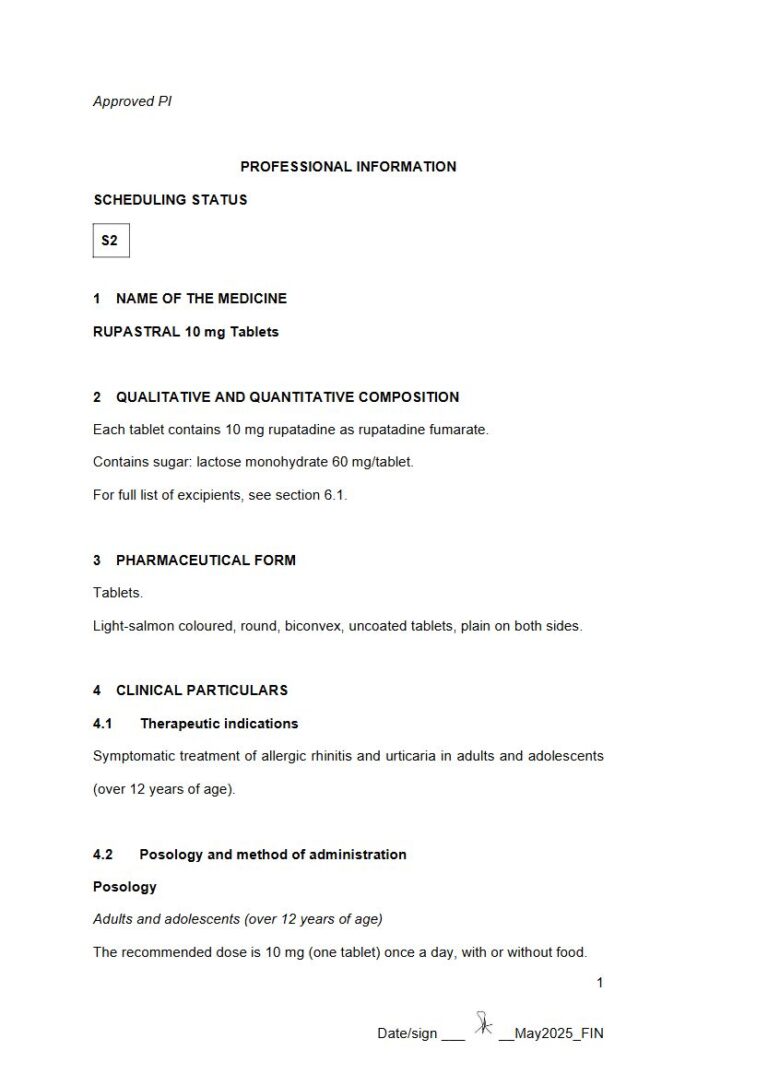
Symptomatic treatment of allergic rhinitis and urticaria in adults and adolescents (over 12 years of age).
4.2 Posology and method of administration
Posology
Adults and adolescents (over 12 years of age)
The recommended dose is 10 mg (one tablet) once a day, with or without food.
Method of administration
For oral use.
4.3 Contraindications
- Hypersensitivity to rupatadine or to any of the excipients (see section 6.1).
- RUPASTRAL is not recommended for use in children below 12 years of age.
- Pregnancy and lactation (see section 4.6).
4.4 Special warnings and precautions for use
Renal and hepatic impairment
As there is no data of patients with impaired renal or liver functions, the use of RUPASTRAL is not recommended in these patients.
Grapefruit juice
The administration with grapefruit juice is not recommended (see section 4.5).
Cardiac safety
RUPASTRAL should be used with caution in patients with known prolongation of the QT interval, patients with uncorrected hypokalaemia, patients with ongoing prodysrhythmic conditions, such as clinically significant bradycardia and acute myocardial ischemia.
Use in the elderly
RUPASTRAL should be used with caution in elderly patients (65 years and older).
4.5 Interaction with other medicines and other forms of interaction
CYP3A4 inhibitors
Co-administration with potent CYP3A4 inhibitors (e.g. itraconazole, ketoconazole, voriconazole, posaconazole, HIV protease inhibitors, clarithromycin, nefazodone) should be avoided and co-medication with moderate CYP3A4 inhibitors (erythromycin, fluconazole, diltiazem) should be used with caution.
(2) The concomitant administration of RUPASTRAL and ketoconazole or erythromycin increases the systemic exposure to rupatadine 10 times and 2 to 3 times respectively.
Alcohol
RUPASTRAL should be used with caution when administered with alcohol.
(1) Grapefruit
The concomitant administration of grapefruit juice with RUPASTRAL increased the systemic exposure of rupatadine by 3,5 times. It is recommended to avoid intake of grapefruit juice along with RUPASTRAL.
CNS depressants
Interactions with CNS depressants cannot be excluded.
SSRI antidepressant
No interactions have been observed with fluoxetine.
Statins
Asymptomatic CPK increases have been reported. The risk of interactions with statins, some of which are also metabolized by the cytochrome P450 CYPA4 isoenzyme, is unknown. RUPASTRAL should be used with caution when co-administered with statins.
Midazolam
After the administration of 10 mg rupatadine in combination with 7,5 mg midazolam, an increase of exposure (C max and AUC) of midazolam was mildly higher observed. For this reason, rupatadine acts as a mild inhibitor of CYP3A4.
Medicines with narrow therapeutic windows
Caution should be taken when is co-administered with other metabolised medicines with narrow therapeutic windows since knowledge of the effect of rupatadine on other medicines is limited.
4.6 Fertility, pregnancy and lactation
Pregnancy
RUPASTRAL is contraindicated during pregnancy (see section 4.3).
Breastfeeding
Rupatadine is excreted in animal milk. Due to potential harmful effects in neonates, the use of RUPASTRAL should be avoided during breastfeeding (see section 4.3).
Fertility
There are no clinical data on fertility. Studies in animals have shown a significant reduction of fertility at exposure levels higher than those observed in humans at the maximum therapeutic dose.
4.7 Effects on ability to drive and use machines
At the recommended dosage, RUPASTRAL is not expected to influence the ability to drive or use machinery. Nevertheless, RUPASTRAL may cause somnolence, headache, dizziness and a disturbance in attention; thus, care should be taken before driving or using machinery until the patient's individual reaction to RUPASTRAL has been established (see section 4.8).
4.8 Undesirable effects
a. Summary of the safety profile
The most frequent adverse reactions reported were somnolence, headache, fatigue, asthenia, dry mouth and dizziness.
b. Tabulated summary of adverse reactions
MedDRA System Organ Class
Frequency Side Effects
Infections and Infestations Less frequent Pharyngitis, rhinitis
Immune system disorders Frequency unknown Hypersensitivity reactions (including anaphylactic reactions, angioedema and urticarial)
Metabolism and nutrition disorders Less frequent Increased appetite
Psychiatric disorders Less frequent Irritability
Nervous system disorders Frequent Somnolence, headache, dizziness
Less frequent Disturbance in attention
Frequency unknown Disorientation, abnormal gait, increased sweating
Eye disorders Frequency unknown Conjunctiva! hyperaemia, blepharitis and blister
Cardiac disorders Frequency unknown Tachycardia and palpitations
Respiratory, thoracic and mediastinal disorders Less frequent Epistaxis, nasal dryness, upper respiratory disorders (e.g. cough, dry throat, oropharyngeal pain).
Gastrointestinal disorders Frequent Dry mouth
Less frequent Nausea, upper abdominal pain, diarrhoea, dyspepsia, vomiting, abdominal pain, constipation
Skin and subcutaneous tissue disorders Less frequent Rash
Frequency unknown Genital erythema, Erythema
Musculoskeletal, connective tissue and bone disorders Less frequent Back pain, arthralgia, myalgia
General disorders and administrative site conditions Frequent Fatigue, asthenia
Less frequent Thirst, malaise, pyrexia
Investigations Less frequent Increase weight, increased blood creatine phosphokinase, increased alanine aminotransferase, increased aspartate aminotransferase, abnormal liver function test
Reporting of suspected adverse reactions
Reporting suspected adverse reactions after authorisation of the medicine is important. It allows continued monitoring of the benefit/risk balance of the medicine. Health care providers are asked to report any suspected adverse reactions to SAHPRA via the u201c6.04 Adverse Drug Reactions Reporting Formu201d, found online under SAHPRAu2019s publications: https://www.sahpra.org.za/Publications/Index/8
4.9 Overdose
The most common adverse reaction when 100 mg rupatadine was taken for 6 days was somnolence. If accidental ingestion of very high doses occurs symptomatic treatment together with the required supportive measures should be given. Concomitant medicines taken should also be taken into account.
