
Agiobulk Granules
Clinical Summary
Quick overview from the medicine insert
Indication
Management of constipation and to promote regular bowel movements.
Dosage (summary)
Adults: 1-2 teaspoons (5-10 g) mixed with water, taken 1-3 times daily. Children: Consult a healthcare professional for appropriate dosing.
Onset of Action / Duration
Typically within 12-72 hours after ingestion.
Special Populations
- Elderly
- Patients with gastrointestinal disorders
- Patients with swallowing difficulties
Pregnancy & Breastfeeding
Generally considered safe for use during pregnancy and lactation; however, consult a healthcare professional before use.
Key Drug Interactions
- May reduce the absorption of certain medications if taken simultaneously; separate dosing by at least 2 hours.
Contraindications
- Bowel obstruction
- Severe abdominal pain of unknown origin
- Hypersensitivity to ispaghula or any of the excipients
Common side effects
- Bloating
- Flatulence
- Abdominal cramps
- Diarrhea (if not taken with adequate fluid)
Counselling Points
- Instruct patients to take with plenty of water to prevent choking.
- Advise gradual increase in dosage to minimize gastrointestinal discomfort.
- Encourage dietary fiber intake and hydration for optimal results.
Serious warnings
- Not to be used in cases of intestinal obstruction.
- Monitor for allergic reactions in sensitive individuals.
Important Disclaimer
The Agiobulk Granules professional information leaflet below is the property of Viatris South Africa and is provided on Medinsert exactly as issued, with no.. alterations or editorial changes. We make every effort to keep content current by updating documents as soon as new versions become available. Medinsert serves as a trusted access point for healthcare professionals, but does not replace official sources or clinical judgement. For more details, please read our full disclaimer. read more>>
 Healthcare Professionals Only
This content is for registered healthcare professionals
Sign in or create a free account to read the full package insert.
Free for HPCSA-registered professionals. Powered by Medinsert.
Clinical Particulars
Section 4 of the official insert — extracted exactly as issued, no alterations
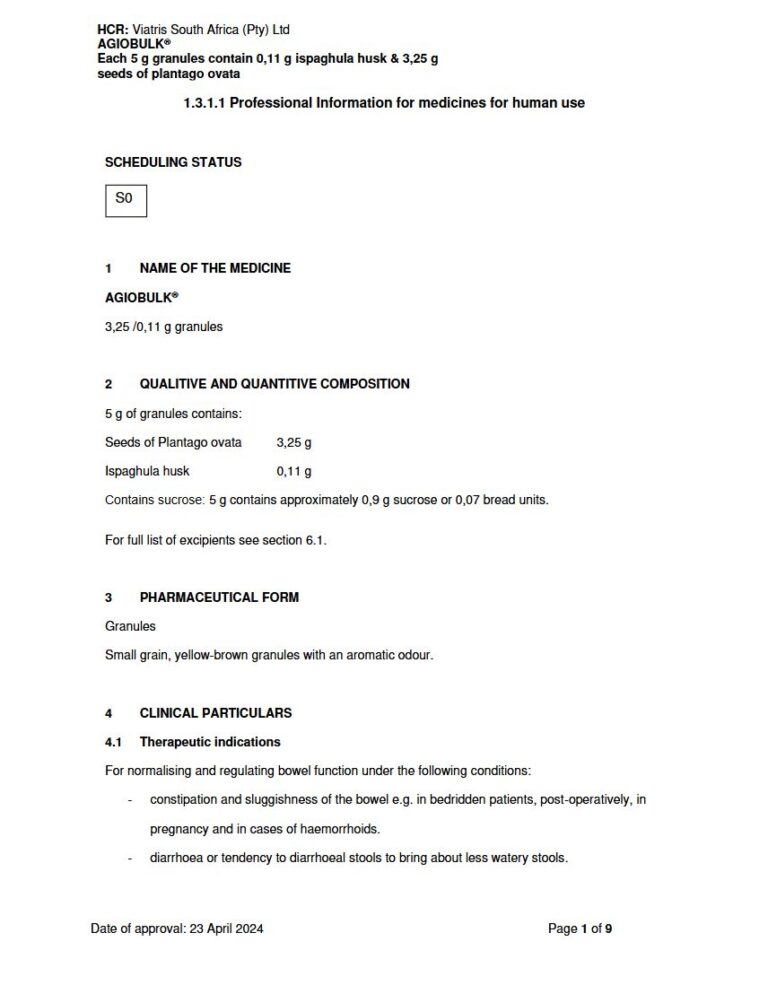
4.1 Therapeutic indications
For normalising and regulating bowel function under the following conditions:
- constipation and sluggishness of the bowel e.g. in bedridden patients, post-operatively, in pregnancy and in cases of haemorrhoids.
- diarrhoea or tendency to diarrhoeal stools to bring about less watery stools.
- alternating diarrhoea and constipation e.g. in patients with irritable bowel syndrome (IBS) and diverticulosis.
Note: Persistent irregularities of the bowels (more than 3 days) requires diagnosis by a medical practitioner.
4.2 Posology and method of administration
Posology
5 g granules = 7 ml = approximately 1 heaped 5 ml medicine measure. Unless otherwise directed by the medical practitioner, the following dosages are recommended:
Adults:
- Constipation: 10 g Agiobulk u00ae should be taken after the evening meal (at least 1 hour before bedtime). If required, 5 g Agiobulk u00ae may also be taken in the morning before breakfast.
- Diarrhoea: initially take 10 g Agiobulk u00ae 3 times daily (for 1 to 3 days) then, if required, 5 g Agiobulk u00ae 3 times daily.
- Irritable Bowel Syndrome (IBS) and diverticulosis: the dosage should be individualised u2013 according to the medical practitioneru2019s recommendations.
Special populations
Paediatric patients under the age of 12: Half the adult dosage should be taken.
Method of administration
For oral use. The granules should be swallowed with a full glass of liquid (preferably water). The granules should not be chewed or dissolved but swallowed whole. One glass of water (200 ml) should be taken separately for every measuring spoon and wait at least 5 minutes before taking another measuring spoon. An interval of u00bd to 1 hour should be adhered to after the intake of other medicines. The daily consumption of fluid should be 1 - 2 litres.
4.3 Contraindications
- Hypersensitivity to the active substances (seeds of plantago ovata and ispaghula husk), peppermint oil or to any of the other excipients listed in section 6.1.
- Agiobulk u00ae should not be given to patients with unexplained abdominal pain or with symptoms or signs of ileus or megacolon syndrome; stenosis and obstruction within the gastrointestinal tract including the oesophagus and in patients who have difficulty in swallowing or have throat problems.
- Agiobulk u00ae should not be used by patients: with faecal impaction (faecal stones); after intake of a laxative not followed by defecation and with rectal bleeding not further investigated.
- Agiobulk u00ae should not be used by patients with poorly controlled diabetes.
4.4 Special warnings and precautions for use
In cases of diarrhoea, where there is no response to Agiobulk u00ae, a medical practitioner should be consulted and electrolyte levels (especially that of potassium) should be checked. Agiobulk u00ae should not be used if there is abdominal pain, nausea and/or vomiting. If a change in bowel habit occurs and persists for more than 2 weeks, a medical practitioner should be consulted to determine the cause.
Inadequate fluid intake may cause obstruction of the bowel. Agiobulk u00ae must be taken with adequate liquid (200 ml of water for every measuring spoon) to prevent faecal impaction and oesophageal obstruction. Not to be used by patients with faecal impaction and symptoms such as abdominal pain, nausea and vomiting unless advised by a medical practitioner because these symptoms can be signs of potential or existing obstruction. If the constipation does not resolve within 3 days, if abdominal pain should occur or in case of irregular bowel movement, use of Agiobulk u00ae should be discontinued and a medical practitioner should be consulted. Treatment of debilitated patients and the elderly must occur under the supervision of a medical practitioner.
Excipient information
Sucrose Agiobulk u00ae contains sucrose (0,9 g per measuring spoon or 0,07 bread units) which may have an effect on the glycaemic control of patients with diabetes mellitus. Patients with rare hereditary problems of fructose intolerance, glucose-galactose malabsorption or sucrase-isomaltase insufficiency should not take Agiobulk u00ae.
4.5 Interaction with other medicines and other forms of interaction
Bulk-forming laxatives, including Agiobulk u00ae, lower the transit time through the gut and could interfere with the absorption of other medicines such as minerals (e.g. calcium, iron, lithium, zinc), vitamins (vitamin B12), cardiac glycosides and coumarins. Therefore, an interval of u00bd to 1 hour should be adhered to before and after intake of other medicines.
Bulking-forming medicines and anti-diarrhoeal medicines, which inhibit motility (e.g. diphenoxylate, difenoxin, opium tincture, loperamide HCI), must not be administered simultaneously, because ileus can occur. If thyroid hormones are taken concomitantly, dose adjustment could be necessary. Note: In insulin dependent diabetics, a reduction in the insulin dose may be required.
4.6 Fertility, pregnancy and lactation
Women of childbearing potential/Contraception in males and females
No information available.
Pregnancy and Breastfeeding
There is no data available for the use of ispaghula husk during pregnancy and lactation. Bulk-forming laxatives appear to be safe in pregnancy.
Fertility
No effect on fertility expected.
4.7 Effects on ability to drive and use machines
Agiobulk u00ae has no known effect on mental and/or physical abilities to perform or execute tasks or activities requiring mental alertness, judgment and/or sound coordination and vision.
4.8 Undesirable effects
Tabulated list of adverse reactions
Immune system disorders
Frequency unknown: Plantago ovata and ispaghula husks/seeds contain allergic substances. Therefore, upon oral administration or upon skin contact, Agiobulk u00ae may cause hypersensitivity reactions such as rhinitis, conjunctivitis and bronchospasm including anaphylactic reactions. Cutaneous symptoms including exanthema and/or pruritis have also been reported. Note: In sensitised patients, peppermint oil can cause hypersensitivity reactions (including respiratory distress).
Gastrointestinal disorders
Frequency unknown: Pre-existing complaints such as bloating or sensation of fullness may become more pronounced during the first days of treatment but will diminish as treatment is continued. In particular, in case of insufficient fluid intake, swelling of the abdomen (tympanites) may occur, and there will be a risk of ileus, oesophageal obstruction as well as constipation. Nausea and vomiting can occur. Water and electrolyte output may be increased due to the diarrhoea. In patients with ileostomy there is a danger of exacerbating water and electrolyte depletion.
Reporting of suspected adverse reactions
Reporting suspected adverse reactions after authorisation of the medicine is important. It allows continued monitoring of the benefit/risk balance of the medicine. Healthcare providers are asked to report any suspected adverse reactions to SAHPRA via the u201c6.04 Adverse Drug Reactions Reporting Formu201d, found online under SAHPRAu2019s publications: https://www.sahpra.org.za/Publications/Index/8
4.9 Overdose
In overdose, side effects can be precipitated and/or be of increased severity (see section 4.8). Plenty of liquid should be drunk. Treatment is symptomatic and supportive.
