
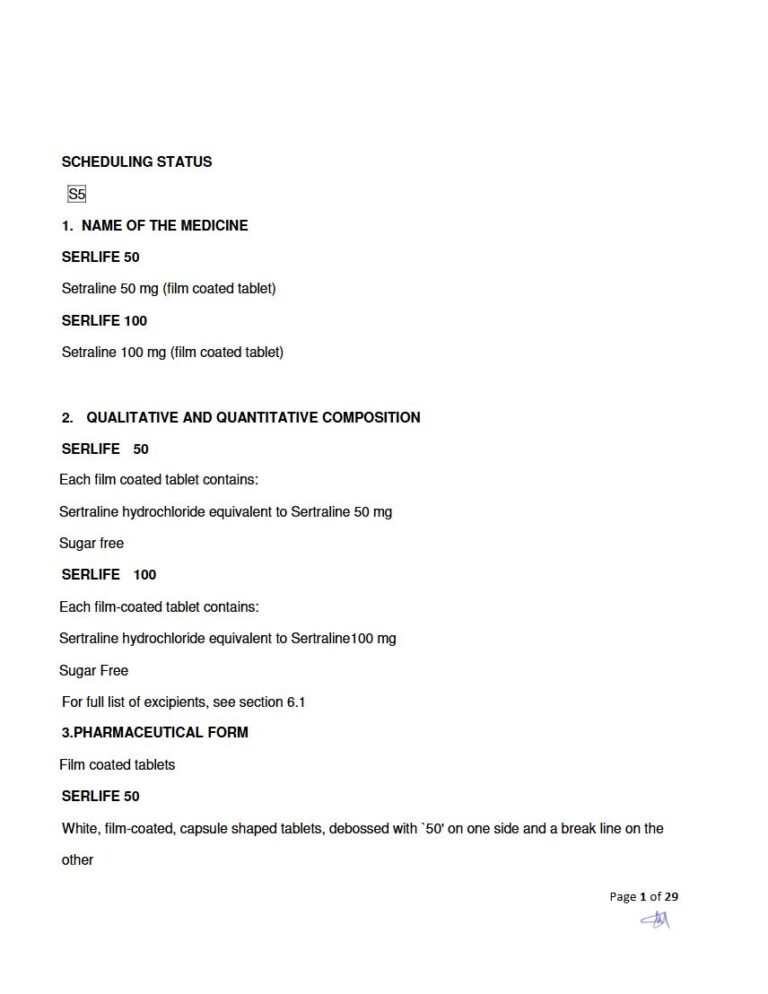
Serlife 50 mg, 100 mg Each FC tablet
PDF Leaflet Revision Date: 04 November 2022
Clinical Summary
Quick overview from the medicine insert
Indication
Treatment of major depressive illness, OCD, and panic disorders.
Dosage (summary)
Starting dose 50 mg daily; max 200 mg for adults.
Onset of Action / Duration
Onset: 7 days, Duration: 24 hours
Special Populations
- Elderly
- Renal impairment
- Hepatic impairment
Pregnancy & Breastfeeding
Safety not established; avoid breastfeeding.
Key Drug Interactions
- MAOIs
- Pimozide
- Lithium
- Warfarin
Contraindications
- Hypersensitivity
- MAOI use
- Hepatic insufficiency
- Renal insufficiency
Common side effects
- Nausea
- Insomnia
- Dizziness
- Dry mouth
Counselling Points
- Monitor for worsening symptoms
- Avoid alcohol
- Taper off to discontinue
Serious warnings
- Serotonin syndrome
- QTc prolongation
- Suicidal thoughts
Important Disclaimer
The Serlife 50 mg, 100 mg Each FC tablet professional information leaflet below is the property of Ranbaxy Pharmaceuticals {Pty) Ltd and is provided on Medinsert exactly as issued, with no.. alterations or editorial changes. We make every effort to keep content current by updating documents as soon as new versions become available. Medinsert serves as a trusted access point for healthcare professionals, but does not replace official sources or clinical judgement. For more details, please read our full disclaimer. read more>>
 Healthcare Professionals Only
This content is for registered healthcare professionals
Sign in or create a free account to read the full package insert.
Free for HPCSA-registered professionals. Powered by Medinsert.
Clinical Particulars
Section 4 of the official insert — extracted exactly as issued, no alterations
4.1 Therapeutic indication
SERLIFE is indicated in adults for the treatment of :
- Major depressive illness such as single episodes and recurrent depression
- Obsessive compulsive disorder (OCD).
- Panic disorders, with or without agoraphobia
SERLIFE is also indicated in:
- the treatment of children aged 13 u2013 17 with OCD
- Panic disorder
Panic disorder is characterised by the occurrence of unexpected panic attacks and associated concern about having additional attacks, worry about the implications or consequences of the attacks, and/or a significant change in behaviour related to the attacks. Panic disorder is characterised by recurrent unexpected panic attacks i.e. a discrete period of intense fear or discomfort in which four (or more) of the following symptoms develop abruptly and reach a peak within 10 minutes: palpitations, pounding heart, or accelerated heart rate; sweating; trembling or shaking; sensations of shortness of breath or smothering; feeling of choking; chest pain or discomfort; nausea or abdominal distress; feeling dizzy, unsteady, light-headed, or faint; derealisation (feelings of unreality) or depersonalisation (being detached from oneself); fear of losing control; fear of dying; paraesthesias (numbness or tingling sensations); chills or hot flushes.
The effectiveness of SERLIFE in long-term use i.e. for more than 12 weeks, has not been systematically evaluated. Therefore, patients should be periodically re-evaluated regarding the long-term usefulness of the medicine (see section 4.2).
4.2 Posology and Method of Administration
Posology
Depression: The starting dose is 50 mg daily and the usual antidepressant dose is 50 mg daily. In patients with incomplete response but good toleration at lower doses, dosage adjustments should be made in 50 mg increments over a period of 2 weeks to a maximum of 150 - 200 mg daily.
Obsessive Compulsive Disorder: Adults The minimum effective dose is 50 mg daily and doses above 100 mg did not have any additional benefit. The onset of therapeutic effect may be seen within 7 days, although 2-4 weeks (and even longer in OCD) are usually necessary for full activity.
Paediatric obsessive-compulsive disorder (OCD) The administration of SERLIFE to paediatric OCD patients (aged 13 u2013 17) should commence at 50 mg/day. Subsequent doses may be increased in case of lack of response in 50 mg/day increments up to 200 mg as needed. However, the generally lower body weights of children compared to adults should be taken into consideration in advancing the dose from 50 mg, in order to avoid excessive dosing. Given the 24 hour elimination half-life of SERLIFE, dose changes should not occur at intervals of less than 1 week.
Panic disorder: For panic disorder, the minimum recommended effective dose of SERLIFE is 50 mg/day. However, therapy for panic disorder should commence at 25 mg/day, increasing to 50 mg/day after one week. This dosage regimen has been demonstrated to reduce the frequency of early treatment emergent side effects characteristic of panic disorder.
Special populations
Use in the elderly No special precautions are required. The usual adult dose is recommended.
Use in patients with renal or hepatic impairment SERLIFE should be used with caution in patients with renal and hepatic impairment.(see section 4.3 and 4.4)
Discontinuation: If SERLIFE therapy has to be discontinued, SERLIFE should be tapered.
Method of administration For oral use. SERLIFE tablets should be given as a single daily dose with or without food.
4.3 Contraindications
- SERLIFE is contra-indicated in patients who have shown hypersensitivity to any of the components of the product.
- Concomitant use of SERLIFE in patients taking monoamine oxidase inhibitors (MAOIs) including linezolid is contra-indicated (see section 4.4).
- Concomitant use in patients taking pimozide is contraindicated (see section 4.5).
- Use in hepatic or renal insufficiency (see section 4.4).
- Pregnancy and lactation as safety has not been established (see section 4.6)
- Children < 18 years of age with both OCD and a major depressive disorder (see section 4.4).
4.4 Special warnings and precautions for use
Serotonin Syndrome (SS) The development of potentially life-threatening syndromes like serotonin syndrome (SS) or Neuroleptic Malignant Syndrome (NMS) has been reported with Selective Serotonin Reuptake Inhibitors (SSRIs), including treatment with Sertraline. The risk of SS or NMS with SSRIs is increased with concomitant use of serotonergic medicines (including triptans and fentanyl and its analogues, tramadol, dextromethorphan, tapentadol, meperidine, methadone and pentazocine), with medicines which impair metabolism of serotonin (including MAOIs), antipsychotics and other dopamine antagonists. SS symptoms include mental status changes (e.g. agitation, hallucinations, coma), autonomic instability (e.g. tachycardia, labile blood pressure, hyperthermia), neuromuscular aberrations (e.g. hyperreflexia, incoordination) and/or gastrointestinal symptoms (e.g. nausea, vomiting, diarrhoea). Some signs of SS, including hyperthermia, muscle rigidity, autonomic instability with possible rapid fluctuation of vital signs, and mental status changes resemble NMS. Patients should be monitored for the emergence of signs and symptoms of SS or NMS syndrome (see section 4.3).
Monoamine oxidase inhibitors: Cases of serious reactions, sometimes fatal, have been reported in patients receiving medicines containing Sertraline such as SERLIFE in combination with a MAOI, including selegiline, moclobemide, linezolid and methylene blue. Some cases presented with features resembling serotonin syndrome. Therefore, SERLIFE should not be used in combination with a MAOI or within 14 days of discontinuing treatment with a MAOI. Similarly, at least 14 days should elapse after discontinuing SERLIFE treatment and starting a MAOI (see section 4.3).
Other serotonergic medicines: Co-administration of medicines containing Sertraline such as SERLIFE with other medicines which enhance the effect of serotonergic neurotransmission, such as tryptophan, fenfluramine and fentanyl, or 5-HT antagonists, or the herbal medicine St. Johnu2019s Wort (hypericum perforatum) should be undertaken with caution and avoided whenever possible due to the potential for pharmacodynamic interaction (see section 4.5).
QTc prolongation/Torsade de Pointes (TdP) Cases of QTc prolongation and Torsade de Pointes (TdP) have been reported during post-marketing use of medicines containing Sertraline such as SERLIFE. The majority of reports occurred in patients with other risk factors for QTc prolongation//TdP. Therefore, SERLIFE should be used with caution in patients with risk factors for QTc prolongation.
Switching from selective serotonin reuptake inhibitors (SSRIs), antidepressants or anti-obsessional medicines: There is limited controlled experience regarding the optimal timing of switching from other antidepressants or anti-obsessional medicines to medicines containing Sertraline such as SERLIFE. Care and prudent medical judgement should be exercised when switching, particularly from long-acting medicines such as fluoxetine. The duration of a washout period when switching from one SSRI to another has not been established.
Activation of mania/hypomania: Hypomania or mania may occur in patients treated with medicines containing Sertraline such as SERLIFE.
Seizures: Seizures have been observed in patients using medicines containing Sertaline. These medicines should be avoided in patients with unstable epilepsy and patients with controlled epilepsy should be carefully monitored. Sertraline containing medicines should be discontinued in any patient who develops seizures.
Suicide/suicidal thoughts or clinical worsening: All patients treated with medicines containing Sertraline such as SERLIFE, in particular those at high risk, should be monitored appropriately and observed closely for clinical worsening and suicidality. Patients, their families, and their caregivers should be encouraged to be alert to the need to monitor for any clinical worsening, suicidal behaviour or thoughts and unusual changes in behaviour especially when initiating therapy or during any change in dose or dosage regimen. The risk of suicide attempt must be considered, especially in depressed patients, and the smallest quantity of medicine, consistent with good patient management, should be provided to reduce the risk of overdose. Patients with major depressive disorder, both adults and children, may experience worsening of their depression and/or the emergence of suicidal ideation and behaviour, whether or not they are taking antidepressant medicines. This risk may persist until significant remission occurs. A causal role, however, for antidepressant medicine in inducing such behaviour has not been established. Patients being treated with medicines containing Sertraline should, nevertheless, be observed closely for clinical worsening and suicidality, especially at the beginning of a course of therapy or at any time of dose changes, either increases or decreases.
Because of the possibility of co-morbidity between major depressive disorder and other psychiatric and non-psychiatric symptoms for whom such symptoms are severe, abrupt in onset, or were not part of the disorders, the same precautions observed when treating patients with major depressive disorders should be observed when treating patients with other psychiatric and non-psychiatric disorders.
The following symptoms have been reported in patients being treated with antidepressants for major depressive disorder as well as for other indications, both psychiatric and non-psychiatric: anxiety, agitation, panic attacks, insomnia, irritability, hostility, aggressiveness, impulsivity, akathisia, hypomania, and mania. Although a causal link between the emergences of suicidal impulses has not been established, consideration should be given to changing the therapeutic regimen, including possibly discontinuing SERLIFE, in patientu2019s presenting symptoms. If a decision is made to discontinue treatment, SERLIFE should be tapered (see section 4.2).
Abnormal bleeding/haemorrhage: There have been reports of bleeding abnormalities with SSRIs from ecchymosis and purpura to life-threatening haemorrhage. Caution is advised in patients taking SSRIs, particularly in concomitant use with medicines known to affect platelet function (e.g. atypical antipsychotics and phenothiazines, most tricyclic antidepressants, aspirin and non-steroidal anti-inflammatory drugs [NSAIDS]) as well as in patients with a history of bleeding disorders (see section 4.5). SSRIs/SNRIs may increase the risk of postpartum haemorrhage (see section 4.6 and 4.8).
Hyponatraemia: Hyponatraemia may occur as a result of treatment with SSRIs such as SERLIFE. In many cases, hyponatraemia appears to be the result of a syndrome of inappropriate antidiuretic hormone secretion (SIADH). Cases of serum sodium levels lower than 110 mmol/l have been reported. Elderly patients may be at greater risk of developing hyponatraemia with SSRIs such as SERLIFE. Also, patients taking diuretics or who are otherwise volume-depleted may be at greater risk. Discontinuation of SERLIFE should be considered in patients with symptomatic hyponatraemia and appropriate medical intervention should be instituted. Signs and symptoms of hyponatraemia include headache, difficulty concentrating, memory impairment, confusion, weakness and unsteadiness which may lead to falls. Signs and symptoms associated with more severe and/or acute cases have included hallucination, syncope, seizure, coma, respiratory arrest and death.
Bone fractures: Epidemiological studies show an increased risk of bone fractures in patients receiving serotonin reuptake inhibitors (SRIs) including medicines containing Sertraline such as SERLIFE. The mechanism leading to this risk is not fully understood.
Use in patients with concomitant illness: Caution is advisable in using SERLIFE in patients with diseases or conditions that could affect metabolism or haemodynamic responses. SERLIFE has not been evaluated or used to any appreciable extent in patients with a recent history of myocardial infarction or unstable heart disease.
Use in hepatic insufficiency: As might be predicted from its primary site of metabolism, liver impairment can affect the elimination of Sertraline containing medicines such as SERLIFE. The elimination half-life of Sertraline containing medicines such as SERLIFE is prolonged. The use of SERLIFE in patients with liver disease must be avoided.
Use in renal impairment: In patients with mild to moderate renal impairment (creatinine clearance 30 u2013 60 ml/min) or severe renal impairment (creatinine clearance < 30 ml/min), multiple dose pharmacokinetics parameters (AUC or Cmax) are modest. Sertraline containing medicines such as SERLIFE should not be used in patients with renal impairment (see section 4.3).
Uricosuric effect: Medicines containing Sertraline such as SERLIFE is associated with a mean decrease in serum uric acid of approximately 7%. The clinical significance of this weak uricosuric effect is unknown.
Diabetes/loss of glycaemic control: Cases of new onset diabetes mellitus have been reported in patients receiving SSRIs including SERLIFE. Loss of glycaemic control including both hyperglycaemia and hypoglycaemia has also been reported in patients with and without pre-existing diabetes. Patients should therefore be monitored for signs and symptoms of glucose fluctuations. Diabetic patients, especially, should have their glycaemic control carefully monitored since their dosage of insulin and/or concomitant oral hypoglycaemic medicine may need to be adjusted.
Laboratory tests: False-positive urine immunoassay screening tests for benzodiazepines have been reported in patients taking Sertraline containing medicines such as SERLIFE. This is due to lack of specificity of the screening tests. False-positive test results may be expected for several days following discontinuation of SERLIFE therapy. Confirmatory tests, such as gas chromatography/mass spectrometry, will distinguish Sertraline containing medicines such as SERLIFE from benzodiazepines.
Angle-closure glaucoma: SSRIs including SERLIFE may have an effect on pupil size resulting in mydriasis. This mydriatic effect has the potential to narrow the eye angle resulting in increased intraocular pressure and angle-closure glaucoma, especially in patients pre-disposed. Sertraline containing medicines such as SERLIFE should therefore be used with caution in patients with angle-closure glaucoma or history of glaucoma.
Weight loss: Significant weight loss may be an undesirable result of treatment with Sertraline containing medicines such as SERLIFE for some patients, approximately 0.5 u2013 1.0 kg weight loss.
Paediatric population: The safety and efficacy of Sertraline containing medicines such as SERLIFE have been established in paediatric obsessive-compulsive disorder (OCD) patients aged 13 u2013 17. Safety and efficacy in the paediatric population other than paediatric patients with OCD have not been established. In clinical trials in major depressive disorder, there were increased reports of hostility and suicide-related adverse events such as suicidal ideation and self-harm (see section 4.3).
Use in geriatrics: No geriatric specific problems have been documented to date with the use of SERLIFE.
Withdrawal symptoms: Abrupt discontinuation of Sertraline containing medicines such as SERLIFE may lead to withdrawal symptoms which include dizziness, sweating, nausea, insomnia, tremor, confusion, sensory disturbances, agitation and anxiety.
4.5 Interaction with other medicines and other forms of Interaction
Monoamine oxidase inhibitors: The concomitant use of Sertraline containing medicines such as SERLIFE with a monoamine oxidase inhibitor (MAOI) is contraindicated. (See sections 4.3 and 4.4).
Pimozide: Increased pimozide levels have been demonstrated with Sertraline containing medicines such as SERLIFE co-administration but were not associated with any changes in ECG. While the mechanism of this interaction is unknown, due to the narrow therapeutic index of pimozide, concomitant administration of SERLIFE and pimozide is contraindicated (see section 4.3).
Medicines that prolong the QTc interval: The risk of QTc prolongation and/or ventricular dysrhythmias (e.g. TdP) is increased with concomitant use of other medicines which prolong the QTc interval (e.g. some antipsychotics and antibiotics) (see section 4.4).
CNS depressants and alcohol: Co-administration of Sertraline containing medicines such as SERLIFE (sertraline 200 mg daily) did not potentiate the effects of alcohol, carbamazepine, haloperidol or phenytoin on cognitive and psychomotor performance in healthy subjects. However, the concomitant use of SERLIFE and alcohol in depressed patients is not recommended.
Lithium: It is recommended that plasma lithium levels be monitored following initiation of Sertraline therapy such as SERLIFE, so that appropriate adjustments to the lithium dose may be made if necessary. Co-administration with lithium may lead to a higher incidence of 5HT-associated side effects, resulting in an increase in tremor relative to placebo, indicating a possible pharmacodynamic interaction. Therefore, caution is recommended when co-administering SERLIFE with medicines such as lithium, which may act via serotonergic mechanisms and patients should be appropriately monitored.
Phenytoin: Increased phenytoin concentrations may occur when Sertraline containing medicines such as SERLIFE and phenytoin are used concomitantly, especially in patients with other medical conditions and/or those receiving multiple concomitant medications. Plasma phenytoin concentrations should be monitored when SERLIFE and phenytoin are used concomitantly with appropriate adjustments to the phenytoin dose. In addition, co-administration of phenytoin may cause a reduction of plasma levels of sertraline in SERLIFE.
Sumatriptan: There have been post-marketing reports describing patients with weakness, hyperreflexia incoordination, confusion, anxiety, and agitation following the use of Sertraline containing medicines such as SERLIFE and sumatriptan. If concomitant treatment with SERLIFE and sumatriptan is clinically warranted, appropriate observation of the patient is advised (see section 4.4 and Other serotonergic medicines below).
Other serotonergic medicines: Co-administration of Sertraline containing medicines such as SERLIFE with other medicines which enhance the effect of serotonergic neurotransmission, such as tryptophan, fenfluramine and fentanyl, 5-HT antagonists, or the herbal medicine St. Johnu2019s Wort (hypericum perforatum) should be undertaken with caution and avoided whenever possible due to the potential for pharmacodynamic interaction (see section 4.4).
Protein-bound medicines: Sertraline found in SERLIFE is highly bound to serum proteins (98%) in the range of 20 to 500 ng/ml. However, at up to 300 and 200 ng/ml concentrations, respectively, sertraline and N-desmethylsertraline contained in SERLIFE do not alter the plasma protein binding of two other highly protein-bound medicines, viz. warfarin and propranolol. However, in interaction studies with diazepam, tolbutamide and warfarin respectively, Sertraline as found in SERLIFE had no significant effects on the protein binding of the substrate (see Warfarin and Other medicine interactions).
Warfarin: Co-administration of Sertraline containing medicines such as SERLIFE 200 mg daily with warfarin resulted in a small but statistically significant increase in prothrombin time. Accordingly, prothrombin time should be carefully monitored when SERLIFE therapy is initiated or stopped.
Other medicine interactions: Co-administration of Sertraline containing medicines such as SERLIFE 200 mg daily with diazepam or tolbutamide resulted in small, statistically significant changes in some pharmacokinetic parameters. Co-administration with cimetidine caused a substantial decrease in SERLIFE clearance. The clinical significance of these changes is unknown. Sertraline containing medicines such as SERLIFE has no effect on the beta-adrenergic blocking ability of atenolol. No interaction of Sertraline containing medicines such as SERLIFE 200 mg daily was observed with glibenclamide or digoxin.
Electroconvulsive therapy (ECT): There are no clinical studies establishing the risks or benefits of the combined use of ECT and Sertraline containing medicines such as SERLIFE.
Medicines metabolised by cytochrome P450 (CYP) 2D6: There is variability among antidepressants in the extent of clinically important inhibition of the medicine metabolising isoenzyme CYP 2D6. The clinical significance of this depends on the extent of the inhibition and the therapeutic index of the co-administered medicine. CYP 2D6 substrates with a narrow therapeutic index include tricyclic antidepressants (TCAs) and class 1C anti-dysrythmics such as propenone and flecainide. In formal interaction studies, chronic dosing with Sertraline containing medicines such as SERLIFE 50 mg daily showed minimal elevation of steady state desipramine plasma levels (a marker of CYP 2D6 isoenzyme activity).
Medicines metabolised by other CYP enzymes (CYP 3A3/4, CYP 2C9, CYP 2C19, CYP 1A2): CYP 3A3/4: Chronic administration of Sertraline containing medicines such as SERLIFE 200 mg daily does not inhibit the CYP 3A3/4 mediated 6-u03b2 hydroxylation of endogenous cortisol or the metabolism of carbamazepine. In addition, the chronic administration of Sertraline containing medicines such as SERLIFE 50 mg daily does not inhibit the CYP 3A3/4 mediated metabolism of alprazolam. The results of these studies suggest that Sertraline containing medicines such as SERLIFE is not a clinically relevant inhibitor of CYP 3A3/4. CYP 2C9: The apparent lack of clinically significant effects of the chronic administration of Sertraline containing medicines such as SERLIFE 200 mg daily on plasma concentrations of tolbutamide, phenytoin and warfarin suggests that SERLIFE is not a clinically relevant inhibitor of CYP 2C9 (see Other medicine interactions, Phenytoin and Warfarin). CYP 2C19: The apparent lack of clinically significant effects of the chronic administration of Sertraline containing medicines such as SERLIFE 200 mg daily on plasma concentrations of diazepam suggests that SERLIFE is not a clinically relevant inhibitor of CYP 2C19 (see Other medicine interactions). CYP 1A2: In vitro studies indicate that Sertraline containing medicines such as SERLIFE has little or no potential to inhibit CYP 1A2.
4.6 Fertility, pregnancy and lactation
Women of childbearing potential should employ an adequate method of contraception if taking SERLIFE (see section 4.3).
Pregnancy: The safety of SERLIFE during pregnancy and lactation has not been established. Observational data indicate an increased risk (less than 2-fold) of postpartum haemorrhage following SSRI/SNRI exposure within the month prior to birth (see section 4.4 and 4.8).
Lactation: Women using SERLIFE should not breastfeed their infants.
Fertility: There is no clinical trial data on fertility. In animal studies, no effect on fertility parameters was observed.
4.7 Effects on ability to drive and use machines
Since antidepressant or anti-obsessional medicines may impair the abilities required to perform potentially hazardous tasks such as driving a car or operating machinery, the patient should be cautioned accordingly.
4.8 Undesirable effects
System Organ Class Frequent Less Frequent Frequency Unknown
Infections and infestations - Pharyngitis - Upper respiratory tract infection - Rhinitis - Diverticulitis - Gastroenteritis - Otitis media
Neoplasms benign, malignant (including cysts and polyps) - Neoplasm
Blood and lymphatic system disorders - Lymphadenopathy - Leucopenia - Thrombocytopenia - Abnormal platelet function test
Immune system disorders - Hypersensitivity - Allergic reaction - Allergy - Anaphylactoid reaction
Endocrine disorders - Hypothyroidism - Hyperprolactinemia - Inappropriate antidiuretic hormone secretion
Metabolism and nutrition disorders - Anorexia - Decreased appetite - Increased appetite - Hyponatremia - Diabetes mellitus - Hypercholesterolaemia - Hypoglycaemia - Hyperglycaemia
Psychiatric disorders - Insomnia - Depression - Depersonalisation - Nightmare - Agitation - Anxiety - Nervousness - Decreased libido - Bruxism - Suicidal Ideation/Behaviour - Suicide Attempts - Depressive symptoms - Euphoric mood - Hallucination - Aggression - Apathy - Abnormal thinking - Paroniria - Psychosis - Conversion disorder - Medicine dependence - Psychotic disorder - Paranoia - Sleep walking - Premature ejaculation
Nervous system disorders - Dizziness - Somnolence - Insomnia - Headache - Hypoaesthesia* - Movement disorders including extrapyramidal symptoms such as hyperkinesia, hypertonia, dystonia, teeth grinding or gait abnormalities), paraesthesia*, tremor, - Convulsion - Involuntary muscle contractions - Abnormal coordination - Hyperkinesia - Amnesia - Speech disorder - Postural dizziness - Migraine - Syncope - Coma - Choreoathetosis - Dyskinesia - Akathisia and psychomotor restlessness (see section 4.4) - cerebrovascular spasm (including reversible cerebral vasoconstriction syndrome and Call-Fleming syndrome)
Eye disorders - Vision Abnormal - Visual disturbance - Mydriasis - Glaucoma - Lacrimal disorder - Scotoma - Diplopia - Photophobia - Hyphaema - Visual impairment - Periorbital Oedema - Unequal pupils
Ear and labyrinth disorders - Tinnitus - Ear pain
Cardiac disorders - Palpitations - Tachycardia - Myocardial infarction - Bradycardia - Cardiac disorder - Increased blood cholesterol - QTc prolongation - Torsade de Pointes
Vascular disorders - Hot flush - Hypertension - Flushing - Peripheral ischaemia - Haematuria - Abnormal bleeding (such as gastrointestinal bleeding) - Haemorrhage - Cerebral vasoconstriction(including reversible cerebral vasoconstriction syndrome and Call-Fleming syndrome
Respiratory, thoracic and mediastinal disorders - Yawning - Rhinitis - Pharyngitis - Bronchospasm - Dyspnoea - Epistaxis - Laryngospasm - Hyperventilation - Hypoventilation - Stridor - Dysphonia, - Hiccups - Interstitial lung disease
Gastrointestinal disorders - Diarrhoea/loose stools - Dry mouth - Nausea - Abdominal pain - Constipation - Dyspepsia - Vomiting - Flatulence - Oesophagitis - Dysphagia - Haemorrhoids - Salivary - Hypersecretion - Tongue disorder - Eructation - Melaena - Haematochezia - Stomatitis - Tongue ulceration - Tooth disorder - Glossitis - Mouth ulceration - Pancreatitis - Gastrointestinal Haemorrahage
Hepatobiliary disorders - Abnormal hepatic function - Serious liver events (including hepatitis, jaundice, and hepatic failure) - Increased alanine aminotransferase - Increased aspartate aminotransferases - Liver injury
Skin and subcutaneous tissue disorders - Hyperhidrosis - Rash* - Alopecia - Periorbital oedema - Pruritus - Purpura - Face oedema - Cold sweat - Dry skin - Urticaria - Angioedema - Photosensitivity skin reaction - Severe cutaneous adverse reactions (SCAR) e.g. Stevens - Johnson syndrome and epidermal necrolysis, dermatitis, bullous dermatitis, follicular rash, abnormal hair texture, abnormal skin odour
Musculoskeletal and connective tissue disorders - Arthralgia - Myalgia - Muscle cramps/spasm - Osteoarthritis - Muscular weakness - Back pain - Muscle twitching - Bone disorder - Rhabdomyolysis - Trismus
Renal and urinary disorders - Urinary incontinence - Nocturia - Urinary retention - Polyuria - Pollakiuria - Micturition disorder - Oliguria - Urinary hesitation - Enuresis - Haematuria
Reproductive system and breast disorders - Ejaculation failure - Erectile dysfunction - Irregular Menstruation - Sexual dysfunction - Ejaculation disorder - Vaginal haemorrhage - Female sexual dysfunction - Menorrhagia - Atrophic vulvovaginitis - Balanoposthitis - Genital discharge - Galactorrhoea - Gynaecomastia - Priapism - Postpartum Haemorrhage
General disorders and administration site conditions - Fatigue - Asthenia - Chest pain - Malaise* - Peripheral oedema - Chills - Pyrexia - Thirst - Hernia - Decreased medicine tolerance - Gait disturbance - Face Oedema - Medicine withdrawal syndrome
Investigations - Increased alanine aminostransferase (ALT) - Increased aspartate aminotransferase (AST) - Decreased weight - Increased weight - Abnormal semen - Abnormal clinical laboratory results - Altered platelet function - Increased blood cholesterol
Injury, poisoning and procedural complications - Injury - Fracture
Surgical and medical procedures - Vasodilation procedure
Other - Symptoms Following the discontinuation of sertraline containing medicines such as SERLIFE have been reported and included agitation, anxiety, dizziness, headache, nausea, paraesthesia.
4.9 Overdose
Sertraline containing medicines such as SERLIFE has a wide margin of safety. No serious sequelae have been reported following sertraline overdose as high as 6 g. Symptoms of overdose include serotonin-mediated side effects such as electrocardiogram QT prolonged, Torsade de Pointes, somnolence, gastrointestinal disturbances (such as nausea and vomiting), tachycardia, tremor, agitation and dizziness. Less frequently reported was coma. Although there have been no reports of death due to sertraline-only overdose, fatalities have occurred in combination with other medicines and/or alcohol. No specific therapy is recommended and there is no specific antidote to SERLIFE. Treatment is essentially symptomatic and supportive, possibly including:
- Establishing and monitoring airway.
- Ensuring adequate oxygenation and ventilation.
- Monitoring cardiac function and vital signs.
- Administering activated charcoal, which may be used with sorbitol, may be as or more effective than emesis or gastric lavage.
Dialysis, forced diuresis, haemoperfusion and exchange transfusions are unlikely to be of benefit due to SERLIFE large volume of distribution and high degree of protein binding.
