
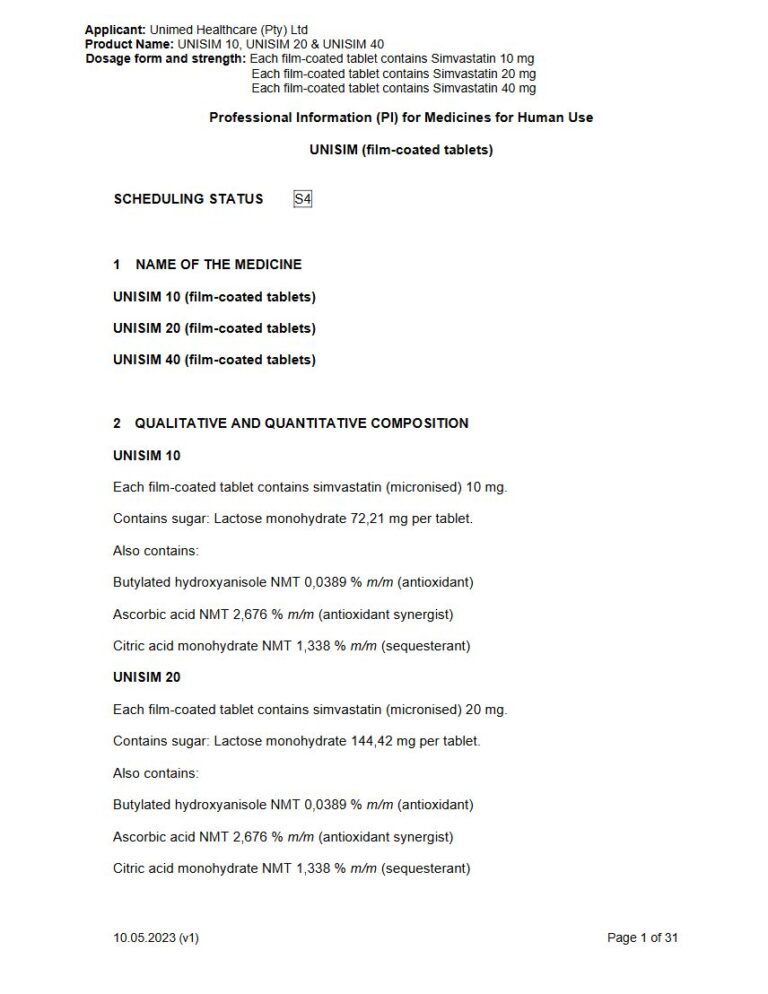
Unisim 10 mg, 20 mg, 40 mg FC tablets.
PDF Leaflet Revision Date: 10 May 2023
Clinical Summary
Quick overview from the medicine insert
Indication
Hypercholesterolaemia and coronary heart disease.
Dosage (summary)
Initial dose: 10 mg daily in the evening for hypercholesterolaemia; 20 mg daily for coronary heart disease.
Special Populations
- Renal impairment
- Elderly
Pregnancy & Breastfeeding
Contraindicated in pregnancy and lactation.
Key Drug Interactions
- CYP3A4 inhibitors
- Gemfibrozil
- Ciclosporin
Contraindications
- Hypersensitivity to simvastatin
- Liver disease
- Pregnancy
- Lactation
Common side effects
- Myalgia
- Muscle cramps
- Nausea
- Headache
Counselling Points
- Report unexplained muscle pain
- Avoid grapefruit juice
- Monitor liver function tests
Serious warnings
- Risk of myopathy and rhabdomyolysis
- Liver function abnormalities
Important Disclaimer
The Unisim 10 mg, 20 mg, 40 mg FC tablets. professional information leaflet below is the property of Unimed Healthcare and is provided on Medinsert exactly as issued, with no.. alterations or editorial changes. We make every effort to keep content current by updating documents as soon as new versions become available. Medinsert serves as a trusted access point for healthcare professionals, but does not replace official sources or clinical judgement. For more details, please read our full disclaimer. read more>>
 Healthcare Professionals Only
This content is for registered healthcare professionals
Sign in or create a free account to read the full package insert.
Free for HPCSA-registered professionals. Powered by Medinsert.
Clinical Particulars
Section 4 of the official insert — extracted exactly as issued, no alterations
4.1 Therapeutic indications
Hypercholesterolaemia
UNISIM is indicated, in combination with diet, to decrease elevated serum total cholesterol and LDL-cholesterol in patients with:
- Primary hypercholesterolaemia
- Heterozygous familial hypercholesterolaemia or
- Mixed hyperlipidaemia when response to diet or other non-pharmacological measures alone are not adequate.
Coronary heart disease
UNISIM is indicated in patients with coronary heart disease and hypercholesterolaemia unresponsive to diet, to:
- Reduce the risk of total mortality by reducing coronary death
- Reduce the risk of non-fatal myocardial infarction
- Reduce the risk for undergoing myocardial revascularisation procedures (coronary artery bypass grafting and percutaneous transluminal coronary angioplasty) and
- Slow the progression of coronary atherosclerosis.
4.2 Posology and method of administration
Posology
The patient must follow a cholesterol-lowering diet before initiation of, and while on UNISIM therapy.
Hypercholesterolaemia
Adults
Initial dose: 10 mg daily as a single dose in the evening. The dose of UNISIM should be reduced if LDL-cholesterol levels fall below 1,94 mmol/l, or total plasma cholesterol levels fall below 3,6 mmol/l.
Coronary Heart Disease
Adults
Initial dose: 20 mg/day as a single dose in the evening.
Dosage Adjustments
If required, the dose should be adjusted at intervals of not less than 4 weeks, up to a maximum of 80 mg daily as a single dose in the evening.
Dosage in Renal Insufficiency
UNISIM does not undergo significant renal excretion, therefore, modification of dose should not be necessary in patients with mild to moderate renal insufficiency. In patients with severe renal insufficiency (creatinine clearance < 30 mu2113/min), dosages above 10 mg/day should be carefully considered and, if deemed necessary, implemented cautiously.
Concomitant therapy
UNISIM is effective alone or in combination with bile acid sequestrants. When both medicines are prescribed, UNISIM should be given 1 hour before or 4 hours after cholestyramine administration (see section 4.5). A maximum daily dose of 10 mg UNISIM is recommended in patients taking ciclosporin, fibrates (other than gemfibrozil) or niacin concomitantly (see section 4.3 and section 4.5). The dose should not exceed 20 mg daily in patients receiving concomitant medicines such as amiodarone, verapamil, diltiazem or amlodipine (see section 4.5). Elderly population: No dosage adjustment is required for this population.
Paediatric population
Use in paediatric patients is not recommended, as safety and efficacy have not been established.
Method of administration
For oral use
UNISIM can be taken with meals or on an empty stomach.
4.3 Contraindications
- Hypersensitivity to simvastatin, other HMG-CoA reductase inhibitors or any of the excipients of UNISIM listed in section 6.1.
- Acute or chronic liver diseases.
- Unexplained persistent elevations of serum transaminases.
- Pregnancy and lactation (see section 4.6).
- Concomitant administration of potent CYP3A4 inhibitors (medicines that increase AUC approximately 5-fold or greater) (e.g. itraconazole, ketoconazole, posaconazole, voriconazole, HIV protease inhibitors (e.g. ritonavir, saquinavir and nelfinavir), boceprevir, telaprevir, erythromycin, clarithromycin, telithromycin, nefazodone and medicines containing cobicistat) (see section 4.4 and section 4.5).
- Concomitant administration of gemfibrozil, ciclosporin or danazol (see section 4.4 and section 4.5).
- Porphyria: Safety has not been established.
- In patients with HoFH, concomitant administration of lomitapide with doses > 40 mg UNISIM (See section 4.4 and section 4.5).
4.4 Special warnings and precautions for use
Use in paediatric patients is not recommended, as safety and efficacy have not been established.
Muscle Effects
Risk of myasthenia gravis and ocular myasthenia. UNISIM occasionally causes myopathy manifested as muscle pain, tenderness or weakness with creatine kinase (CK) above ten times the Upper Limit of Normal (ULN). Myopathy sometimes takes the form of rhabdomyolysis with or without acute renal failure secondary to myoglobinuria, and very rare fatalities have occurred. The risk of myopathy is increased by high levels of HMG-CoA reductase inhibitory activity in plasma (i.e., elevated UNISIM and simvastatin acid plasma levels), which may be due, in part, to interacting medicines that interfere with UNISIM metabolism and/or transporter pathways (see section 4.5).
Reducing the risk of myopathy
Reduced function of transport proteins. Reduced function of hepatic OATP transport proteins can increase the systemic exposure of simvastatin acid and increase the risk of myopathy and rhabdomyolysis. Reduced function can occur as the result of inhibition by interacting medicines (e.g. ciclosporin) or in patients who are carriers of the SLCO1B1 c.521T>C genotype.
Creatine Kinase measurement
Creatine Kinase (CK) should not be measured following strenuous exercise or in the presence of any plausible alternative cause of CK increase as this makes value interpretation difficult. If CK levels are significantly elevated at baseline (> 5 x ULN), levels should be re-measured within 5 to 7 days later to confirm the results.
General measures: Patients starting therapy with UNISIM should be advised of the risk of myopathy and should report, promptly, unexplained muscle pain, tenderness or weakness. A creatine kinase (CK) level above 10 times the Upper Limit of Normal (ULN) in a patient, with unexplained symptoms, indicates myopathy. UNISIM should be discontinued if myopathy is diagnosed or suspected.
Caution should be exercised in patients with pre-disposing factors for rhabdomyolysis. In order to establish a reference baseline value, a CK level should be measured before starting a treatment in the following situations:
- Elderly (age u2265 65 years).
- Female gender.
- Renal impairment.
- Uncontrolled hypothyroidism.
- Personal or familial history of hereditary muscular disorders.
- Previous history of muscular toxicity with a statin of fibrate.
- Alcohol abuse.
In such situations, the risk of treatment should be considered in relation to possible benefit, and clinical monitoring is recommended. If a patient has previously experienced a muscle disorder on a fibrate or a statin, treatment with a different member of the class should only be initiated with caution. If CK levels are significantly elevated at baseline (> 5 x ULN), treatment should not be started.
Whilst on treatment
If muscle pain, weakness or cramps occur whilst a patient is receiving treatment with a statin, their CK levels should be measured. If these levels are found, in the absence of strenuous exercise, to be significantly elevated (> 5 x ULN), treatment should be stopped. If muscular symptoms are severe and cause daily discomfort, even if CK levels are < 5 x ULN, treatment discontinuation may be considered. If myopathy is suspected for any other reason, treatment should be discontinued.
There have been very rare reports of an immune-mediated necrotizing myopathy (IMNM) during or after treatment with some statins. INMN is clinically characterized by persistent proximal muscle weakness and elevated serum creatine kinase, which persist despite discontinuation of statin treatment (see section 4.8). If symptoms resolve and CK levels return to normal, then re-introduction of the statin or introduction of an alternative statin may be considered at the lowest dose and with close monitoring. A higher rate of myopathy has been observed in patients titrated to the 80 mg dose (see section 5.1). Periodic CK measurements are recommended as they may be useful to identify subclinical cases of myopathy. However, there is no assurance that such monitoring will prevent myopathy.
Measures to reduce the risk of myopathy caused by medicine interactions: The benefit and risks of using UNISIM concomitantly with immune-suppressants, fibrates (except fenofibrate) or lipid lowering doses of niacin should be carefully considered, and the dose of UNISIM should generally not exceed 10 mg/day. Cautions should be used when prescribing fenofibrate with UNISIM, as either medicine can cause myopathy when given alone. The risk of myopathy and rhabdomyolysis is increased by high levels of UNISIM activity in plasma. Simvastatin is metabolised by the cytochrome P450 isoform 3A4. Certain medicines which inhibit this metabolic pathway can raise the plasma levels of simvastatin and may increase the risk of myopathy. These include itraconazole, ketoconazole posaconazole, voriconazole, the macrolide antibiotics erythromycin and clarithromycin, and the ketolide antibiotic telithromycin, HIV protease inhibitors (e.g. ritonavir, saquinavir and nelfinavir), boceprevir, telaprevir, the antidepressant nefazodone and medicines containing cobicistat. Combination of these medicines with UNISIM is contraindicated. If short-term treatment with potent CYP3A4 inhibitors (medicines that increase AUC approximately 5-fold or greater) is unavoidable, therapy with UNISIM must be suspended (and use of an alternative statin considered) during the course of treatment.
Moreover, caution should be exercised when combining UNISIM with certain other less potent CYP3A4 inhibitors: fluconazole, verapamil, diltiazem (see section 4.2 and section 4.5). The combined use of UNISIM with gemfibrozil, ciclosporin or danazol is contraindicated (see section 4.3 and section 4.5). Concomitant intake of grapefruit juice and UNISIM should be avoided. The risk of myopathy and rhabdomyolysis is also increased by concomitant use of amiodarone, amlodipine, verapamil, or diltiazem with certain doses of UNISIM (see section 4.2 and section 4.5). The risk of myopathy, including rhabdomyolysis, may be increased by concomitant administration of fusidic acid with statins (see section 4.5). For patients with HoFH, this risk may be increased by concomitant use of lomitapide with UNISIM. UNISIM must not be co-administered with systemic formulations of fusidic acid or within 7 days of stopping fusidic acid treatment. In patients where the use of systemic fusidic acid is considered essential, statin treatment should be discontinued throughout the duration of fusidic acid treatment. There have been reports of rhabdomyolysis (including some fatalities) in patients receiving fusidic acid and statins in combination (see section 4.5). The patient should be advised to seek medical advice immediately if they experience any symptoms of muscle weakness, pain or tenderness. Statin therapy may be re-introduced seven days after the last dose of fusidic acid. In exceptional circumstances, where prolonged systemic fusidic acid is needed, e.g. for the treatment of severe infections, the need for co-administration of UNISIM and fusidic acid should only be considered on a case by case basis and under close medical supervision. The combined use of UNISIM at doses higher than 20 mg daily with amiodarone, amlodipine, verapamil, or diltiazem should be avoided. In patients with HoFH, the combined use of UNISIM at doses higher than 40 mg daily with lomitapide must be avoided (see section 4.3 and section 4.5). Patients taking other medicines labelled as having a moderate inhibitory effect on CYP3A4 concomitantly with UNISIM particularly higher UNISIM doses, may have an increased risk of myopathy. When co-administering UNISIM with a moderate inhibitor of CYP3A4 (medicines that increase AUC approximately 2- to 5-fold), a dose adjustment of UNISIM may be necessary. For certain moderate CYP3A4 inhibitors e.g. diltiazem, a maximum dose of 20 mg UNISIM is recommended (see section 4.2).
Simvastatin as in UNISIM is a substrate of the Breast Cancer Resistant Protein (BCRP) efflux transporter. Concomitant administration of medicines that are inhibitors of BCRP (e.g. elbasvir and grazoprevir) may lead to increased plasma concentrations of UNISIM and an increased risk of myopathy; therefore, a dose adjustment of UNISIM should be considered depending on the prescribed dose. Co-administration of elbasvir and grazoprevir with UNISIM has not been studied; however, the dose of UNISIM should not exceed 20 mg daily in patients receiving concomitant treatment with medicines containing elbasviror grazoprevir (see section 4.5).
Rare cases of myopathy/rhabdomyolysis have been associated with concomitant administration of HMG-CoA reductase inhibitors and lipid-modifying doses (u2265 1 g/day) of niacin (nicotinic acid), either of which can cause myopathy when given alone.
Daptomycin
Cases of myopathy and/or rhabdomyolysis have been reported with HMG-CoA reductase inhibitors (e.g. simvastatin as in UNISIM) co-administered with daptomycin. Caution should be used when prescribing HMG-CoA reductase inhibitors with daptomycin, as either medicine can cause myopathy and/or rhabdomyolysis when given alone. Consideration should be given to temporarily suspend UNISIM in patients taking daptomycin unless the benefits of concomitant administration outweigh the risk. Consult the professional information of daptomycin to obtain further information about this potential interaction with HMG-CoA reductase inhibitors (e.g. simvastatin as in UNISIM) and for further guidance related to monitoring (see section 4.5).
Diabetes mellitus
Increase in HbA1C and fasting blood glucose levels have been reported with statin use, including UNISIM. In some patients, at high risk of future diabetes, UNISIM may produce a level of hyperglycaemia where formal diabetes care is appropriate. This risk, however, is outweighed by the reduction in vascular risk with statins and therefore should not be a reason for stopping statin treatment. Patients at risk (fasting glucose 5,6 to 6,9 mmol/L, BMI > 30 kg/m2, raised triglycerides, hypertension) should be monitored both clinically and biochemically.
UNISIM should be used with caution in patients who:
- Consume substantial amounts of alcohol and/or who have a history of liver disease.
- May be predisposed to developing renal failure secondary to rhabdomyolysis such as in those with severe acute infection, hypotension, severe metabolic, endocrine or electrolyte disorders, uncontrolled seizures, major surgery or trauma. There is an increased risk of developing renal failure if rhabdomyolysis occurs.
- Have severe renal impairment.
Hepatic effects
Liver function tests, including serum transaminase determinations are recommended prior to initiation of UNISIM therapy and periodically until one year after the last elevation in dose. Patients titrated to the 80 mg dose should receive an additional test prior to titration, 3 months after titration to the 80 mg dose, and periodically thereafter (e.g. semi-annually) for the first year of treatment. Special attention should be paid to patients who develop elevated serum transaminase levels, and in those patients, measurements should be repeated promptly and then performed more frequently. UNISIM should be discontinued if the rise in transaminase levels is persistent and/or increases to three times or more the Upper Limit of Normal (ULN). Note that ALT may emanate from muscle, therefore ALT rising with CK may indicate myopathy (see above Myopathy/Rhabdomyolysis).
Fatal and non-fatal hepatic failure in patients taking statins, including UNISIM may occur. If serious liver injury with clinical symptoms and/or hyperbilirubinemia or jaundice occurs during treatment with UNISIM, promptly interrupt therapy. If an alternate aetiology is not found, do not restart UNISIM. UNISIM should be used with caution in patients who consume substantial quantities of alcohol and/or have a past history of liver disease. Active liver diseases or unexplained transaminase elevations are contraindications to the use of UNISIM. As with other lipid-lowering medicines, moderate (< 3 x ULN) elevations of serum transaminases have been reported following therapy with simvastatin as in UNISIM. These changes appeared soon after initiation of therapy, were often transient, were not accompanied by any symptoms and interruption of treatment was not required.
Surgery
Therapy with UNISIM should be temporarily stopped a few days prior to elective surgery and when any major medical or surgical condition supervenes.
Chinese patients
Because the incidence of myopathy is higher in Chinese than in non-Chinese patients, co-administration of simvastatin with lipid-modifying doses (u22651 g/day) of niacin (nicotinic acid) is not recommended in Asian patients.
Interstitial lung disease
Cases of interstitial lung disease have been reported with some statins, including simvastatin, especially with long term therapy (see section 4.8). Presenting features can include dyspnoea, non-productive cough and deterioration in general health (fatigue, weight loss and fever). If it is suspected a patient has developed interstitial lung disease, statin therapy should be discontinued.
Lactose
UNISIM contains lactose. Patients with rare hereditary problems of galactose intolerance, Lapp lactase deficiency or glucose-galactose malabsorption should not take UNISIM.
4.5 Interaction with other medicines and other forms of interaction
Multiple mechanisms may contribute to potential interactions with HMG-CoA reductase inhibitors. Medicines including herbal medicines that inhibit certain enzymes (e.g. CYP3A4) and/or transporter (e.g. OATP1B) pathways may increase UNISIM and simvastatin acid plasma concentrations and may lead to an increased risk of myopathy/rhabdomyolysis. Consult the professional information of all concomitantly used medicines to obtain further information about their potential interactions with UNISIM and/or the potential for enzyme or transporter alterations and possible adjustments to dose and regimens.
Pharmacodynamic interaction
Interactions with lipid-lowering medicines that can cause myopathy when given alone. The risk of myopathy, including rhabdomyolysis, is increased during concomitant administration with fibrates. Additionally, there is a pharmacokinetic interaction with gemfibrozil resulting in increased UNISIM plasma levels (see below Pharmacokinetic interactions and section 4.3 and section 4.4). When UNISIM and fenofibrate are given concomitantly, there is no evidence that the risk of myopathy exceeds the sum of the individual risks of each medicine. Adequate pharmacovigilance and pharmacokinetic data are not available for other fibrates. Rare cases of myopathy/rhabdomyolysis have been associated with UNISIM co-administered with lipid-modifying doses (u2265 1 g/day) of niacin (see section 4.4).
Pharmacokinetic interactions
Prescribing recommendations for interacting medicines are summarised in the table below (further details are provided in the text; see also section 4.3 and section 4.4).
Medicine Interactions Associated with Increased Risk of Myopathy/Rhabdomyolysis
Interacting medicines
Prescribing recommendations
Potent CYP3A4 inhibitors, e.g. Itraconazole, Ketoconazole, Posaconazole, Voriconazole, Erythromycin, Clarithromycin, Telithromycin, HIV-protease inhibitors (e.g. nelfinavir), Boceprevir, Telaprevir, Nefazodone, Cobicistat, Ciclosporin, Danazol, Gemfibrozil
Contraindicated with UNISIM
Other fibrates (except fenofibrate)
Do not exceed 10 mg UNISIM daily
Fusidic acid
It is not recommended with UNISIM
Niacin (nicotinic acid) (u2265 1 g/day)
For Asian patients, not recommended with UNISIM
Amiodarone, Amlodipine, Verapamil
Do not exceed 20 mg UNISIM daily
Diltiazem, Elbasvir, Grazoprevir, Lomitapide
For patients with HoFH, do not exceed 40 mg UNISIM daily
Daptomycin
It should be considered to temporarily suspend UNISIM in patients taking daptomycin unless the benefits of concomitant administration outweigh the risk (see section 4.4)
Ticagrelor
Doses greater than 40 mg UNISIM daily are not recommended
Grapefruit
Avoid grapefruit juice when taking UNISIM
Effects of other medicines on UNISIM
Interactions involving inhibitors of CYP3A4 UNISIM is a substrate of cytochrome P450 3A4. Potent inhibitors of cytochrome P450 3A4 increase the risk of myopathy and rhabdomyolysis by increasing the concentration of HMG-CoA reductase inhibitory activity in plasma during UNISIM therapy. Such inhibitors include itraconazole, ketoconazole, posaconazole, voriconazole, the macrolide antibiotics erythromycin and clarithromycin, and the ketolide antibiotic telithromycin, HIV protease inhibitors (e.g. ritonavir, saquinavir and nelfinavir), boceprevir, telaprevir, the antidepressant nefazodone, or grapefruit juice and medicines containing cobicistat. Combination of these medicines with UNISIM is contraindicated.
If short-term treatment with potent CYP3A4 inhibitors (medicines that increase AUC approximately 5-fold or greater) is unavoidable, therapy with UNISIM must be suspended (and use of an alternative statin considered) during the course of treatment.
Caution should be exercised when combining UNISIM with certain other less potent CYP3A4 inhibitors: fluconazole, verapamil, diltiazem (see section 4.2 and section 4.5). The combined use of UNISIM with gemfibrozil, ciclosporin or danazol is contraindicated (see section 4.3 and section 4.5). Fluconazole
Cases of rhabdomyolysis associated with concomitant administration of simvastatin (such as UNISIM) and fluconazole have been reported (see section 4.4).
Ciclosporin
The risk of myopathy/rhabdomyolysis is increased by concomitant administration of ciclosporin with UNISIM; therefore, use with ciclosporin is contraindicated (see section 4.3 and section 4.4). Although the mechanism is not fully understood, ciclosporin has been shown to increase the AUC of HMG-CoA reductase inhibitors such as UNISIM. The increase in AUC for simvastatin acid is presumably due, in part, to inhibition of CYP3A4 and/or OATP1B1.
Danazol
The risk of myopathy and rhabdomyolysis is increased by concomitant administration of danazol with UNISIM; therefore, use with danazol is contraindicated (see section 4.3 and section 4.4).
Gemfibrozil
Gemfibrozil increases the AUC of simvastatin acid by 1,9-fold, possibly due to inhibition of the glucuronidation pathway and/or OATP1B1 (see section 4.3 and section 4.4). Concomitant administration of UNISIM with gemfibrozil is contraindicated (see CONTRAINDICATIONS section 4.3).
A maximum dose of 10 mg UNISIM daily is recommended in patients taking fibrates (other than gemfibrozil) or lipid-lowering doses of niacin (nicotinic acid).
Fusidic acid
The risk of myopathy including rhabdomyolysis may be increased by the concomitant administration of systemic fusidic acid with statins (such as UNISIM). Co-administration of this combination may cause increased plasma concentrations of both medicines. The mechanism of this interaction (whether it is pharmacodynamic or pharmacokinetic, or both) is unknown. There have been reports of rhabdomyolysis (including some fatalities) in patients receiving this combination. If treatment with fusidic acid is necessary, UNISIM treatment should be discontinued throughout the duration of the fusidic acid treatment (see section 4.4).
Amiodarone
The risk of myopathy and rhabdomyolysis is increased by concomitant administration of amiodarone with UNISIM (see section 4.4). The dose of UNISIM should not exceed 20 mg daily in patients receiving concomitant medication with amiodarone.
Calcium Channel Blockers
The risk of myopathy and rhabdomyolysis is increased by concomitant administration of UNISIM with calcium channel blockers verapamil, diltiazem and amlodipine (see section 4.4). Concomitant administration with calcium channel blockers results in an increase in exposure of simvastatin acid (diltiazem 2,7 fold, amlodipine 1,6 fold, verapamil 2,3 fold), presumably due to inhibition of CYP3A4. Therefore, the dose of UNISIM should not exceed 20 mg daily in patients receiving concomitant medication with calcium channel blockers.
Lomitapide
The risk of myopathy and rhabdomyolysis may be increased by concomitant administration of lomitapide with UNISIM (see section 4.3 and section 4.4). Therefore, in patients with HoFH, the dose of UNISIM must not exceed 40 mg daily in patients receiving concomitant treatment with lomitapide.
Moderate Inhibitors of CYP3A4
Patients taking other medicines having a moderate inhibitory effect on CYP3A4 concomitantly with UNISIM, particularly at higher doses, may have an increased risk of myopathy (see section 4.4).
Inhibitors of the Transport Protein OATP1B1
Simvastatin acid is a substrate of the transport protein OATP1B1. Concomitant administration of medicines that are inhibitors of the transport protein OATP1B1 may lead to increased plasma concentrations of simvastatin acid and an increased risk of myopathy (see section 4.3 and section 4.4).
Inhibitors of Breast Cancer Resistant Protein (BCRP)
Concomitant administration of medicines that are inhibitors of BCRP, including products containing elbasvir or grazoprevir, may lead to increased plasma concentrations of UNISIM and an increased risk of myopathy (see section 4.4).
4.6 Fertility, pregnancy and lactation
UNISIM is contraindicated in pregnancy and lactation (see section 4.3). Women of childbearing potential
The active metabolite of simvastatin is fetotoxic and teratogenic in rats, and it should therefore not be used in female patients of child-bearing potential.
Pregnancy: Safety in pregnancy has not been established. No controlled clinical trials with UNISIM have been conducted in pregnant women. Rare reports of congenital anomalies following intrauterine exposure to HMG-CoA reductase inhibitors have been received. Maternal treatment with UNISIM may reduce the foetal levels of mevalonate which is a precursor of cholesterol biosynthesis. Atherosclerosis is a chronic process, and ordinarily discontinuation of lipid-lowering medicines during pregnancy should have little impact on the long-term risk associated with primary hypercholesterolaemia. For these reasons, UNISIM must not be used in women who are pregnant, trying to become pregnant or suspect they are pregnant. Treatment with UNISIM must be suspended for the duration of pregnancy or until it has been determined that the woman is not pregnant (see sections 4.3).
Breastfeeding
It is not known whether UNISIM or its metabolites are excreted in breast milk. Because many medicines are excreted in human milk and because of the potential for serious adverse reactions, women taking UNISIM must not breastfeed their babies (see section 4.3).
Fertility
No clinical trial data are available on the effects of UNISIM on human fertility.
4.7 Effects on ability to drive and use machines
When driving vehicles or operating machines, it should be taken into account that dizziness has been reported.
4.8 Undesirable effects
Table 1: Tabulated list of adverse reactions
System Organ Class Adverse reactions Frequency
Blood and lymphatic system disorders Anaemia, neutropenia. Less frequent
Immune system disorders An apparent hypersensitivity syndrome has been reported. Reactions may include angioedema, lupus-like syndrome, polymyalgia rheumatica, dermatomyositis, vasculitis, thrombocytopenia, increased erythrocyte sedimentation rate (ESR), eosinophilia, arthritis, arthralgia, urticaria, photosensitivity, fever, flushing, malaise, dyspnoea, toxic epidermal necrosis, erythema multiforme, including Stevens-Johnson syndrome. Anaphylaxis.
Endocrine disorders Increases in HbA1C and fasting glucose levels. Diabetes mellitus. Less Frequent
Metabolism and nutritional disorders Mass gain has been reported. Frequency unknown
Psychiatric disorders Insomnia. Less frequent Depression, sleep disturbances (including nightmares). Frequency unknown
Nervous system disorders Dizziness, headache, paraesthesia, peripheral neuropathy, fatigue. Cognitive impairment (e.g. memory loss, forgetfulness, amnesia, memory impairment, confusion). Less frequent Myasthenia gravis. Frequency unknown
Cardiac disorders Atrial fibrillation. Less frequent
Eye disorders Photosensitivity, vision blurred, visual impairment. Less frequent
Respiratory, thoracic and mediastinal disorders Dyspnoea, hypersensitivity pneumonitis. Less frequent Interstitial lung disease (see section 4.4), respiratory infections, bronchitis, sinusitis. Frequency unknown
Gastrointestinal disorders Nausea, flatulence, dyspepsia, abdominal pain, cramps, vomiting. Frequent Constipation, diarrhoea, pancreatitis, gastritis. Less Frequent
Hepatobiliary disorders Hepatitis/jaundice, fatal and non-fatal hepatic failure. Less frequent
Skin and subcutaneous tissue disorders Skin rash, pruritus, alopecia, eczema. Lichenoid drug eruptions. Less frequent
Musculoskeletal and connective tissue disorders Myalgia, muscle cramps. Frequent Mopathy, myositis, arthralgia, rhabdomyolysis (presenting as muscle pain with elevated creatine phosphokinase and myoglobinuria leading to renal failure), muscle rupture. Less Frequent Tendinopathy; sometimes complicated by rupture, Frequency unknown
immune-mediated necrotising myopathy (IMNM)**. Reproductive system and breast disorders Gynecomastia. Less Frequent Erectile dysfunction. Frequency unknown
General disorders and administration site conditions Asthenia, oedema, swelling. Less Frequent
Investigations Marked and persistent increases of serum transaminases and elevated alkaline phosphatase and gamma-glutamyl transpeptidase. Liver function test abnormalities. Increases in serum creatine kinase (CK) levels derived from skeletal muscle (see section 4.4) Less frequent
The following additional adverse event have been reported with some statins: u2022 Sexual dysfunction
Paediatric population The long-term effects on physical, intellectual and sexual maturation are unknown.
IMNM** There have been very rare reports of immune-mediated necrotising myopathy (IMNM), an autoimmune myopathy, during or after treatment with some statins. IMNM is clinically characterized by: persistent proximal muscle weakness and elevated serum creatine kinase, which persist despite discontinuation of statin treatment; muscle biopsy showing necrotising myopathy without significant inflammation; improvement with immunosuppressive medicines (see section 4.4).
Reporting of suspected adverse reactions
Reporting suspected adverse reactions after authorisation of the medicine is important. It allows continued monitoring of the benefit/risk balance of the medicine. Health care providers are asked to report any suspected adverse reactions to SAHPRA via the u201c6.04 Adverse Drug Reactions Reporting Formu201d, found online under SAHPRAu2019s publications: https://www.sahpra.org.za/Publications/Index/8
4.9 Overdose
(See section 4.8 and 4.4). General measures should be adopted and liver function should be monitored. Treatment is symptomatic and supportive.
