
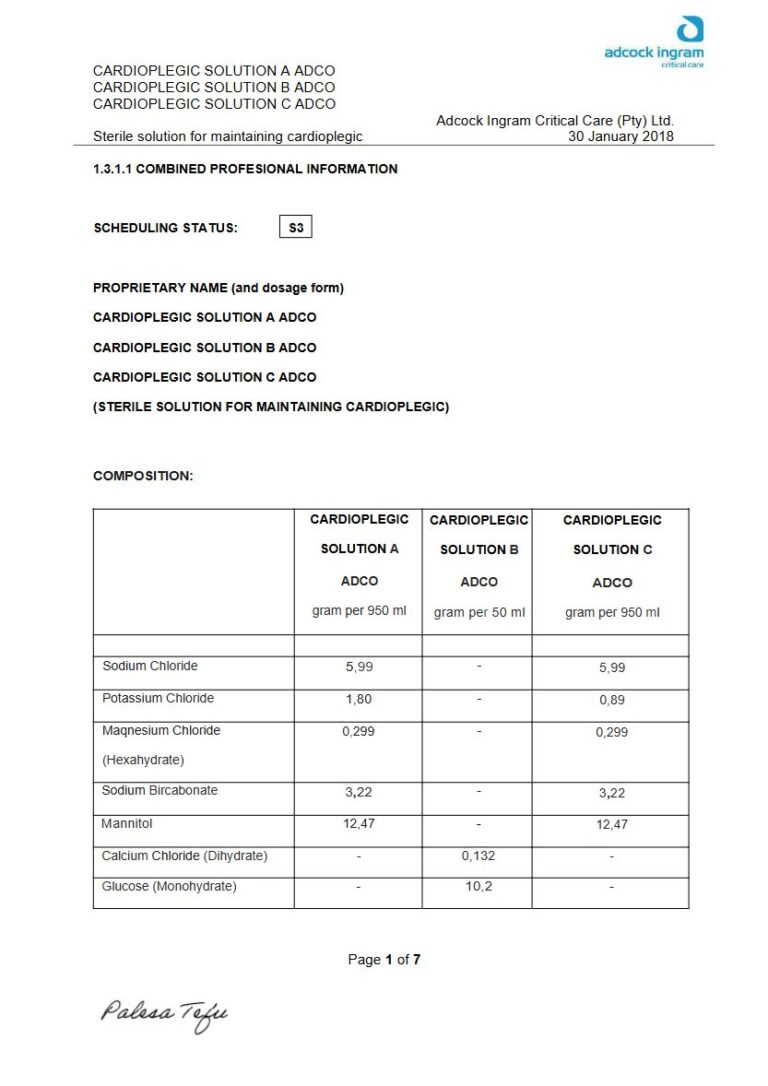
Cardioplegic 950 ml/50 ml Solution
PDF Leaflet Revision Date: 30 January 2018
Clinical Summary
Quick overview from the medicine insert
Indication
Myocardial protection during cardiac bypass surgery.
Dosage (summary)
Initial infusion of 1L of Solution A and B in 300ml increments; maintain with Solutions B and C.
Special Populations
- Congestive heart failure
- Severe renal insufficiency
Pregnancy & Breastfeeding
Safety in pregnancy and lactation not established.
Common side effects
- Febrile response
- Extravasion
- Hypervolemia
Counselling Points
- Store below 25u00b0C, refrigerate after mixing, use within 24 hours.
Serious warnings
- Use with caution in patients with sodium or potassium retention.
- Risk of fluid overload.
Important Disclaimer
The Cardioplegic 950 ml/50 ml Solution professional information leaflet below is the property of Adcock Ingram Critical Care and is provided on Medinsert exactly as issued, with no.. alterations or editorial changes. We make every effort to keep content current by updating documents as soon as new versions become available. Medinsert serves as a trusted access point for healthcare professionals, but does not replace official sources or clinical judgement. For more details, please read our full disclaimer. read more>>
 Healthcare Professionals Only
This content is for registered healthcare professionals
Sign in or create a free account to read the full package insert.
Free for HPCSA-registered professionals. Powered by Medinsert.
Clinical Particulars
Section 4 of the official insert — extracted exactly as issued, no alterations
4.1 INDICATIONS
Myocardial protection during extracorporeal circulation in cardiac bypass surgery.
4.2 CONTRA-INDICATIONS
No known contra-indications.
4.4 WARNINGS and SPECIAL PRECAUTIONS
Solutions containing sodium should be used with great care in patients with congestive heart failure, severe renal insufficiency, and in clinical states in which there exists oedema with or without sodium retention.
Solutions containing potassium ions should be used with great care in patients with hyperkalemia, severe renal failure and in conditions in which potassium retention is present.
Solutions containing calcium ions should not be administered through the same administration set as blood anticoagulated with calcium chelators, e.g. Anticoagulant Citrate Glucose or Citrate Phosphate Glucose because of the likelihood of coagulation.
The intravascular administration of these solution can cause fluid and/or solute overloading, resulting in dilution of serum concentrations, overhydration, congested states or pulmonary oedema.
Additives may be incompatible. Consult with pharmacist if necessary, to ensure compatibility of prescribed additives. When introducing additives, use aseptic technique. Mix thoroughly when additives have been introduced. Do not store solutions containing additives. Do not administer unless the solution is clear and the seal is intact. The solution should be kept refrigerated after admixing and used within 24 hours.
4.5 INTERACTIONS
Interaction studies have not been performed or no interactions have been experienced.
4.6 PREGNANCY AND LACTATION
Safety in pregnancy and lactation has not been established.
4.2 DOSAGE AND DIRECTIONS FOR USE
Initial infusion of one litre of CARDIOPLEGIC SOLUTION A ADCO and CARDIOPLEGIC SOLUTION B ADCO in 300 ml increments is used in order to effect cardioplegia immediately following aortic clamping. The solution is infused under positive pressure using a positive displacement pump. Maintenance of cardioplegic is effected by the administration of CARDIOPLEGIC SOLUTION B ADCO and CARDIOPLEGIC SOLUTION C ADCO or CARDIOPLEGIC SOLUTION A ADCO and CARDIOPLEGIC SOLUTION B ADCO and maintained for the duration of the procedure.
4.8 SIDE-EFFECTS
Reactions which may occur because of the solution or the technique of administration include febrile response, extravasation and hypervolemia.
4.9 KNOWN SYMPTOMS OF OVERDOSAGE AND PARTICULARS OF ITS TREATMENT
Symptoms of overdosage and particulars of its treatment has not been established.
