
Macaine Hcl 0,5 % Injection With Adrenaline 1 mL Injection
PDF Leaflet Revision Date: 11 August 2025
Clinical Summary
Quick overview from the medicine insert
Indication
Peripheral nerve block, caudal or epidural block.
Dosage (summary)
Varies by procedure; max 150 mg per injection.
Onset of Action / Duration
Onset: Rapid, Duration: Several hours
Special Populations
- Elderly
- Renal impairment
- Hepatic impairment
Pregnancy & Breastfeeding
Not established for use in pregnancy; caution in breastfeeding.
Key Drug Interactions
- Antidysrhythmics
- Beta blockers
- Halogenated anesthetics
Contraindications
- Sensitivity to bupivacaine/adrenaline
- IV regional anesthesia
- Severe heart disease
Common side effects
- Dizziness
- Hypotension
- Urinary retention
- Nausea
Counselling Points
- Avoid driving for 2-4 hours post-procedure
- Report any unusual symptoms
- Stay hydrated before procedure
Serious warnings
- Risk of systemic toxicity
- Monitor for overdose
- Caution in patients with cardiovascular disease
Important Disclaimer
The Macaine Hcl 0,5 % Injection With Adrenaline 1 mL Injection professional information leaflet below is the property of Adcock Ingram Critical Care and is provided on Medinsert exactly as issued, with no.. alterations or editorial changes. We make every effort to keep content current by updating documents as soon as new versions become available. Medinsert serves as a trusted access point for healthcare professionals, but does not replace official sources or clinical judgement. For more details, please read our full disclaimer. read more>>
 Healthcare Professionals Only
This content is for registered healthcare professionals
Sign in or create a free account to read the full package insert.
Free for HPCSA-registered professionals. Powered by Medinsert.
Clinical Particulars
Section 4 of the official insert — extracted exactly as issued, no alterations
4.1 Therapeutic indications
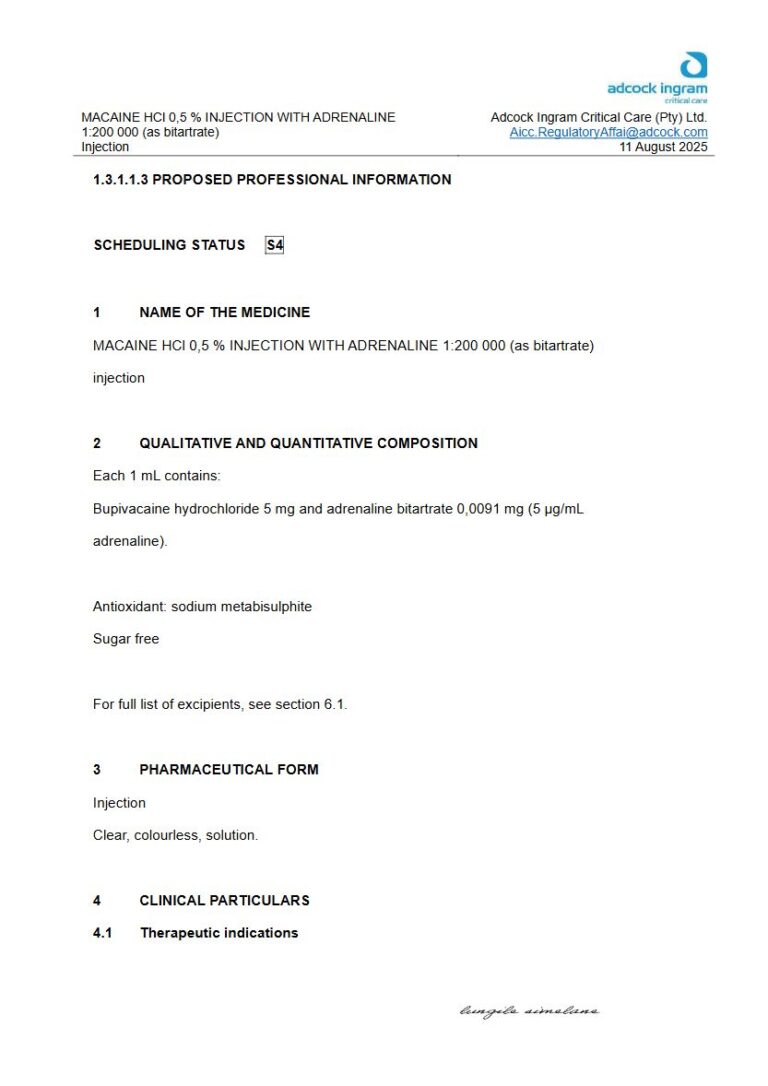
MACAINE HCI 0,5 % INJECTION WITH ADRENALINE 1:200 000 (as bitartrate) is indicated for peripheral nerve block, caudal or epidural block.
4.2 Posology and method of administration
Posology
Dosage varies and depends upon the area to be anaesthetised, the vascularity of the tissues, the number of neuronal segments to be blocked, individual tolerance and technique of anaesthesia. In recommended doses, MACAINE HCI 0,5 % INJECTION WITH ADRENALINE 1:200 000 (as bitartrate) produces complete sensory block, but the effect on motor function differs depending on volume utilised. The duration of anaesthesia is such that for most indications, a single dose is sufficient. The dosages of MACAINE HCI 0,5 % INJECTION WITH ADRENALINE 1:200 000 (as bitartrate) in the table below have generally proved satisfactory and are recommended as a guide for use in the average adult.
Procedure
Dose
Remarks
mL
mg
Trigeminal block
0,5 u2013 4
2,5 u2013 20
Axillary block
15 u2013 30
75 u2013 150
Intercostal block
3 u2013 5
15 u2013 25
The dose indicated is for every segment.
Epidural anaesthesia
10 u2013 20
50 u2013 100
Continuous epidural anaesthesia
Initially 10 mL followed by 3 u2013 5 u2013 8 mL every 4 u2013 6 hours. The dose depends on the number of segments to be rendered analgesic and the patientu2019s age.
Caudal anaesthesia
15 u2013 30
75 u2013 150
The maximum recommended dose of MACAINE HCI 0,5 % INJECTION WITH ADRENALINE 1:200 000 (as bitartrate) in a single injection is 150 mg and should not be exceeded unless there are special considerations present. Where dosage is calculated on the patient's mass, this should not exceed 2 mg/kg body mass up to a maximum of 150 mg.
Paediatric population
Until further experience is gained, MACAINE HCI 0,5 % INJECTION WITH ADRENALINE 1:200 000 (as bitartrate) is not recommended for children younger than 12 years.
Method of administration
Injection
4.3 Contraindications
u2022 MACAINE HCI 0,5 % INJECTION WITH ADRENALINE 1:200 000 (as bitartrate) is contraindicated in patients with known sensitivity to bupivacaine and adrenaline or to any of the excipients listed in section 6.1
u2022 Bupivacaine is contraindicated for use in intravenous regional anaesthesia (Bier's block) and for paracervical block in obstetrics
u2022 Solutions containing adrenaline are contraindicated in patients with hyperthyroidism or severe heart disease particularly when tachycardia is present
u2022 Solutions of bupivacaine containing adrenaline should not be used in connection with anaesthesia in areas of the body supplied by end arteries or otherwise having a compromised blood supply such as digits, nose, external ear or genitalia owing to the risk of tissue necrosis. Injection of bupivacaine containing adrenaline in areas of end arteries (e.g. penile block, Oberst block) may cause ischaemic tissue necrosis
u2022 Epidural anaesthesia, regardless of the local anaesthetic used, has its own contraindications which include:
o Active disease of the central nervous system such as meningitis, poliomyelitis, intracranial haemorrhage, subacute combined degeneration of the cord due to pernicious anaemia, and cerebral and spinal tumours
o Tuberculosis of the spine
o Pyogenic infection of the skin at or adjacent to the site of lumbar puncture
o Cardiogenic or hypovolaemic shock
o Coagulation disorders or ongoing anticoagulation treatment
o Patients with an expanding cerebral lesion, a tumour, cyst or abscess, which may, if the intracranial pressure is suddenly altered, cause obstruction to the cerebrospinal fluid or blood circulation (the pressure cone).
4.4 Special warnings and precautions for use
Regional or local anaesthetic procedures should always be performed in a properly equipped and staffed area. Equipment and medicines necessary for monitoring and emergency resuscitation should be immediately available whenever local or general anaesthesia is administered. Patients receiving major blocks should be in an optimal condition and have an IV line inserted before the blocking procedure. The healthcare professional responsible should take the necessary precautions to avoid overdose or intravascular injection, always including careful aspiration, and be appropriately trained and familiar with the diagnosis and treatment of side effects, systemic toxicity and other complications such as marked restlessness, twitching or convulsions followed by coma with apnoea and cardiovascular collapse. Major peripheral nerve blocks may require the administration of a large volume of local anaesthetic in areas of high vascularity, often close to large vessels where there is an increased risk of intravascular injection and/or systemic absorption. This may lead to high plasma concentrations. Small doses of local anaesthetics injected into the head and neck, including retrobulbar, dental and stellate ganglion blocks, may produce systemic toxicity due to inadvertent intra-arterial injection. Healthcare professionals who perform retrobulbar blocks should be aware that there have been reports of respiratory arrest following local anaesthetic injection. Prior to retrobulbar block, necessary equipment, medicines and personnel should be immediately available as with all other regional procedures. Bupivacaine may cause acute toxicity effects on the central nervous and cardiovascular systems if utilised for local anaesthetic procedures resulting in high blood concentrations of the medicine. Accidental intravascular injection of bupivacaine may lead to systemic toxicity which could result in:
u2022 Cerebral haemorrhage due to the sudden rise in blood pressure
u2022 Convulsions leading to cardiac arrest
u2022 Ventricular dysrhythmia, ventricular fibrillation, sudden cardiovascular collapse and death. Patients treated with antidysrhythmic medicines such as amiodarone should be under close surveillance and ECG monitoring, since cardiac effects may be additive. Although regional anaesthesia is frequently the optimal anaesthetic technique, some patients require special attention in order to reduce the risk of dangerous side effects:
u2022 The very young, elderly, acutely ill, or debilitated patients, who may be more susceptible to systemic toxicity induced by local anaesthetics
u2022 Patients with partial or complete heart block u2013 due to the fact that local anaesthetics may depress myocardial conduction
u2022 Patients with advanced liver disease or severe renal dysfunction
u2022 Patients in late stages of pregnancy. Injection of repeated doses of bupivacaine hydrochloride may cause significant increases in blood levels with each repeated dose due to slow accumulation of the medicine. Since bupivacaine is metabolised in the liver, it should be used cautiously in patients with liver disease or with reduced liver blood flow. Local anaesthetics should be used with caution for epidural anaesthesia in the following situations: Severe shock, dehydration, gross hypertension, marked obesity, senility, cerebral atheroma, myocardial degeneration, toxaemia, congestive heart failure, hepatic disease or impairment, cardiovascular function impairment, hypotension, hypovolaemia, history of sensitivity to bupivacaine or chemically related anaesthetics, inflammation or infection in region of injection and renal disease. MACAINE HCI 0,5 % INJECTION WITH ADRENALINE 1:200 000 (as bitartrate) should be used cautiously in areas with limited blood supply, in the presence of disease that may adversely affect the patient's cardiovascular system or in patients with peripheral vascular disease. Epidural anaesthesia with any local anaesthetic can cause hypotension and bradycardia which should be anticipated and appropriate precautions taken. These may include preloading the circulation with crystalloid or colloid solution. Epidural anaesthesia, properly performed, is generally well tolerated by obese patients and by those with obstructive lung disease. However, patients with a splinted diaphragm which interferes with breathing, such as those with hydramnios, large ovarian or uterine tumours, pregnancy, ascites or omental obesity are at risk from hypoxia due to respiratory inadequacy and aortocaval compression due to tumour mass. Lateral tilt, oxygen and mechanical ventilation should be used when indicated. Dosage should be reduced in such patients. Patients who are breathless from any cause e.g. pleural effusion may become hypoxic, especially if the level of anaesthesia is so high as to cause paralysis of the intercostal muscles. Septicaemia can increase the risk of intraspinal abscess formation in the post-operative period. For vasoconstrictor-containing preparations such as MACAINE HCl 0,5 % INJECTION WITH ADRENALINE 1:200 000 (as bitartrate), special care should be taken with the following conditions: Asthma, cardiac disease or dysrhythmias, diabetes mellitus, hyperthyroidism, hypertension, peripheral vascular disease, phaeochromocytoma, narrow angle glaucoma, hypokalaemia, hypercalcaemia, severe renal impairment, prostatic adenoma leading to residual urine, cerebrovascular disease, organic brain damage or arteriosclerosis, in elderly patients, in patients with shock (other than anaphylactic shock) and in organic heart disease or cardiac dilatation. Adrenaline should be used cautiously, if at all, during general anaesthesia with halogenated hydrocarbon anaesthetics (see section 4.5). MACAINE HCl 0,5 % INJECTION WITH ADRENALINE 1:200 000 (as bitartrate) contains sodium metabisulphite. This may cause allergic-type reactions including anaphylaxis and life threatening or less severe asthmatic episodes in certain susceptible individuals. Paediatric population: The safety and efficacy of MACAINE HCl 0,5 % INJECTION WITH ADRENALINE 1:200 000 (as bitartrate) in children aged under the age of 12 years have not been established. For epidural anaesthesia, children should be given incremental doses commensurate with their age and weight as especially epidural anaesthesia at a thoracic level may result in severe hypotension and respiratory impairment.
4.5 Interactions with other medicines
Bupivacaine should be used with caution in patients receiving other local anaesthetics or medicines structurally related to amide-type local anaesthetics, e.g. certain antidysrhythmics, such as lidocaine (lignocaine) and mexiletine, since systemic toxic effects are additive. Specific interaction studies with bupivacaine and antidysrhythmic medicines class III (e.g. amiodarone) have not been performed, but caution should be advised (see also section 4.4). Adrenaline should not be administered concomitantly with other sympathomimetic medicines because of the possibility of additive effects and increased toxicity. Alpha-blockers, such as phentolamine, antagonise the vasoconstrictor and hypertensive effects of adrenaline. This effect may be beneficial in adrenaline overdose (see section 4.9). There is an increased risk of myocardial depression when bupivacaine and antidysrhythmics are given together. Beta blockers such as propranolol reduce the clearance of bupivacaine and may increase bupivacaine toxicity. Severe hypertension and reflex bradycardia may occur with non-cardioselective beta blocking medicines such as propranolol, due to alpha-mediated vasoconstriction. Beta blockers, especially non-cardioselective medicines, also antagonise the cardiac and bronchodilator effects of adrenaline. Concomitant use of halothane may cause increased cardiotoxicity of bupivacaine. Administration of adrenaline in patients receiving halogenated hydrocarbon general anaesthetics that increase cardiac irritability and seem to sensitise the myocardium to adrenaline may result in dysrhythmias including ventricular premature contractions, tachycardia or fibrillation (see section 4.4). Adrenaline specifically reverses the antihypertensive effects of adrenergic neurone blockers such as guanethidine, with the risk of severe hypertension. Adrenaline increases blood pressure and may antagonise the effects of antihypertensive medicines. Tricyclic antidepressants such as imipramine inhibit reuptake of directly acting sympathomimetic medicines, and may potentiate the effect of adrenaline, increasing the risk of development of hypertension and cardiac dysrhythmias. Although monoamine oxidase (MAO) is one of the enzymes responsible for adrenaline metabolism, MAO inhibitors do not markedly potentiate the effects of adrenaline. Phenothiazines block alpha-adrenergic receptors. Adrenaline should not be used in patients receiving high dosage of other medicines (e.g. cardiac glycosides) that can sensitise the heart to dysrhythmias. Some antihistamines (e.g. diphenhydramine) and thyroid hormones may potentiate the effects of adrenaline, especially on heart rhythm and rate. Histamine H2-antagonists such as cimetidine may decrease clearance of bupivacaine. Solutions containing adrenaline should also be used with caution in patients receiving dopaminergics such as entacapone, the respiratory stimulant doxapram and the interotropic hormone oxytocin. The hypokalaemic effect of adrenaline may be potentiated by other medicines that cause potassium loss, including corticosteroids, potassium-depleting diuretics, aminophylline and theophylline. Hypokalaemia may result in increased susceptibility to cardiac dysrhythmias caused by digoxin and other cardiac glycosides. Adrenaline-induced hyperglycaemia may lead to loss of blood-sugar control in diabetic patients treated with insulin or oral hypoglycaemic medicines.
4.6 Fertility, pregnancy and lactation
Pregnancy
Safe use of MACAINE HCl 0,5 % INJECTION WITH ADRENALINE 1:200 000 (as bitartrate) in pregnant women, other than those in labour, has not been established. Bupivacaine should not therefore be given in early pregnancy unless the benefits are considered to outweigh the risks. The addition of adrenaline may potentially decrease uterine blood flow and contractility, especially after inadvertent injection into maternal blood vessels.
Foetal bradycardia frequently follows paracervical block with some amide-type local anaesthetics and may be associated with foetal acidosis. Added risk appears to be present in prematurity, toxaemia of pregnancy and foetal distress. Until further clinical experience is gained, paracervical block with MACAINE HCl 0,5 % INJECTION WITH ADRENALINE 1:200 000 (as bitartrate) is not recommended. Labour may be prolonged leading to the need for caesarean section.
Breastfeeding
Bupivacaine is distributed into breast milk in small amounts.
Fertility
No data on male and female fertility is available.
4.7 Effects on ability to drive and use machines
In general, it is sufficient to allow 2 u2013 4 hours post-nerve block or until full functions have returned following regional nerve block. In many situations, patients receive sedative or other CNS depressant medicines e.g. diazepam, midazolam to allow the block to be performed.
4.8 Undesirable effects
a. Summary of the safety profile
Reactions to MACAINE HCI 0,5 % INJECTION WITH ADRENALINE 1:200 000 (as bitartrate) are characteristic of those associated with other amide-type local anaesthetics. High plasma levels caused by excessive dosage, inadvertent intravascular injection or slow metabolic degradation, cause systemic reactions involving the central nervous system and the cardiovascular system.
b. Tabulated list of adverse reactions
System organ class
Frequency
Adverse reaction
Blood and lymphatic system disorders
Less frequent
Anaemia, methaemoglobinaemia
Immune system disorders
Frequency unknown
Allergic effects are characterised by cutaneous lesions (e.g. urticaria), oedema and other manifestations of allergy. Detection of sensitivity by skin testing is of doubtful value
Nervous system disorders
Frequent
Paraesthesia, dizziness
Less frequent
Drowsiness, headache, faecal/urinary incontinence, paralysis of legs, paraesthesias. persistent anaesthesia, respiratory paralysis, restlessness, seizures, trismus of facial muscles, unconsciousness. Signs and symptoms of CNS toxicity (convulsions, circumoral paraesthesia, numbness of the tongue, hyperacusis, visual disturbances, loss of consciousness, tremor, light headedness, tinnitus, dysarthria, muscle twitching)
Frequency unknown
Excitation or depression: The first manifestation may be nervousness, dizziness, blurred vision or tremors, followed by drowsiness, sometimes merging into unconsciousness and respiratory arrest. Other effects may be chills, constriction of the pupils or tinnitus
Eye disorders
Less frequent
Diplopia
Cardiac disorders
Less frequent
Cardiac dysrhythmias, chest pain, tachycardia, bradycardia
Frequency unknown
Depression of the myocardium and cardiac arrest
Vascular disorders
Frequent
Hypotension
Less frequent
Dizziness, hypertension, peripheral vasodilation
Respiratory, thoracic and mediastinal disorders
Less frequent
Respiratory depression
Gastrointestinal disorders
Less frequent
Constipation, nausea and/or vomiting, prolonged numbness of lips and mouth
Skin and subcutaneous tissue disorders
Less frequent
Hives, pruritus, skin rash
Musculoskeletal and connective tissue disorders
Less frequent
Back pain
Renal and urinary disorders
Frequent
Urinary retention
Reproductive system and breast disorders
Less frequent
Impotence
General disorders and administration site conditions
Less frequent
Fever, hypothermia
c. Description of selected adverse reactions
Following epidural injection of some local anaesthetic medicines including bupivacaine, high sympathetic blockade may occasionally result in ocular and other symptoms similar to those seen in Horner's syndrome. These effects are encountered more commonly in pregnant women.
c. Paediatric population
Adverse medicine reactions in children are similar to those in adults, however, in children, early signs of local anaesthetic toxicity may be difficult to detect in cases where the block is given during sedation or general anaesthesia.
Reporting of suspected adverse reactions
Reporting suspected adverse reactions after authorisation of the medicine is important. It allows continued monitoring of the benefit/risk balance of the medicine. Healthcare providers are asked to report any suspected adverse reactions to SAHPRA via the Med Safety APP (Medsafety X SAHPRA) and eReporting platform (who-umc-org) found on SAHPRA website. For reporting of side effects directly to the Holder of the Certificate of Registration, contact +27 11 635 0134 or email [email protected]
4.9 Overdose
Toxic effects of local anaesthetics require symptomatic treatment; there is no specific cure. The medical practitioner should be prepared to maintain an airway and to support ventilation with oxygen. Supportive treatment of the cardiovascular system includes intravenous fluids and when appropriate, vasopressors. Convulsions may be controlled with oxygen and intravenous administration of diazepam or short-acting barbiturates.
