
Norditropin 5 mg/10 mg/15 mg per 1.5 mL Solution for injection
PDF Leaflet Revision Date: 23 December 2025
Clinical Summary
Quick overview from the medicine insert
Indication
Growth failure due to somatropin deficiency in children.
Dosage (summary)
0.025 - 0.035 mg/kg/day for growth hormone deficiency; 0.045 - 0.067 mg/kg/day for Turner syndrome.
Special Populations
- Children
- Patients with diabetes
Pregnancy & Breastfeeding
Contraindicated in pregnancy; breastfeeding not recommended during treatment.
Key Drug Interactions
- Glucocorticoids may inhibit growth
- Increased clearance of CYP450 metabolized drugs
Contraindications
- Hypersensitivity to somatropin
- Active tumors
- Closed epiphyses
- Acute critical illness
- Proliferative diabetic retinopathy
Common side effects
- Headache
- Rash
- Arthralgia
- Injection site pain
- Peripheral edema
Counselling Points
- Inject in the evening
- Rotate injection sites
- Monitor blood glucose regularly
- Report any severe headaches or visual changes
Serious warnings
- Monitor for glucose intolerance
- Risk of benign intracranial hypertension
- Scoliosis monitoring recommended
Important Disclaimer
The Norditropin 5 mg/10 mg/15 mg per 1.5 mL Solution for injection professional information leaflet below is the property of Novo Nordisk and is provided on Medinsert exactly as issued, with no.. alterations or editorial changes. We make every effort to keep content current by updating documents as soon as new versions become available. Medinsert serves as a trusted access point for healthcare professionals, but does not replace official sources or clinical judgement. For more details, please read our full disclaimer. read more>>
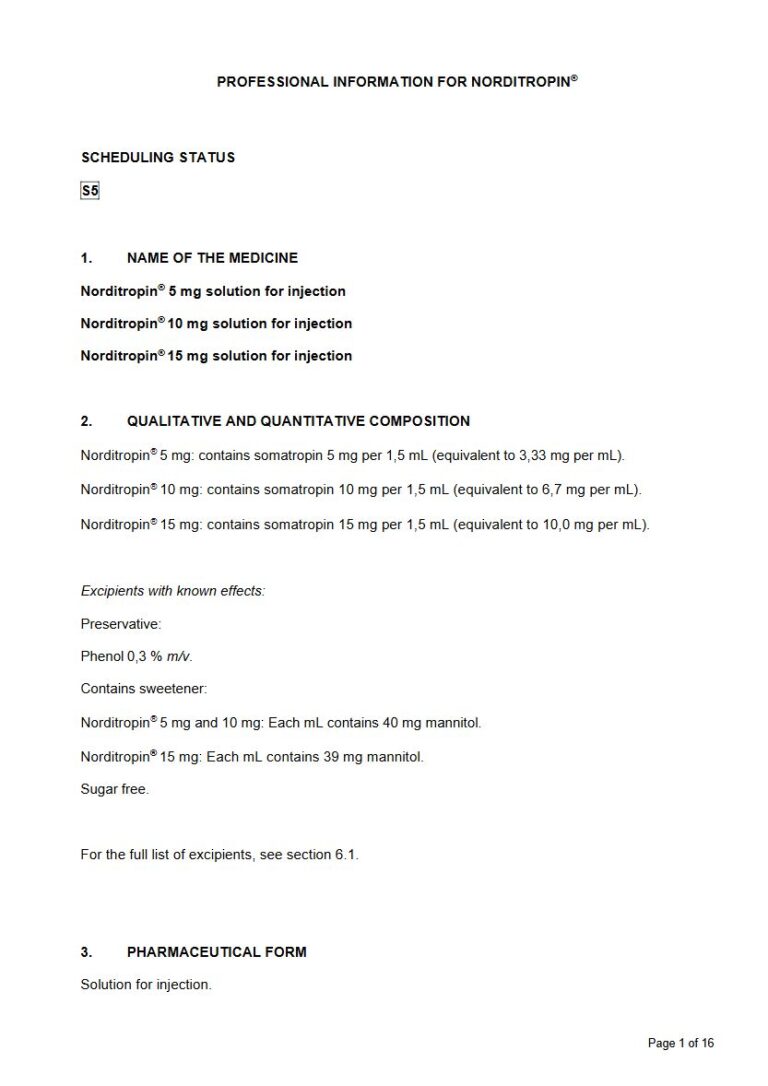 Healthcare Professionals Only
This content is for registered healthcare professionals
Sign in or create a free account to read the full package insert.
Free for HPCSA-registered professionals. Powered by Medinsert.
Clinical Particulars
Section 4 of the official insert — extracted exactly as issued, no alterations
4.1 Therapeutic indications
u2022 Treatment of children who have growth failure due to somatropin deficiency. The diagnosis should be verified by an investigation of pituitary function before the preparation is administered. Norditropin u00ae is only effective as long as the epiphysial fusion has not taken place. Levels of growth hormone or IGF-1 are not required to commence treatment but may be required to set the diagnosis of growth hormone deficiency.
u2022 Turner syndrome. In Turner syndrome children it is recommended to measure the IGF-1 level before start of treatment and twice a year thereafter. If on repeated measurements IGF-1 levels exceed +2 SD compared to references for age and pubertal status, the dose should be reduced to achieve an IGF-1 level within the normal range.
4.2 Posology and method of administration
Posology
1 mg of somatropin corresponds to 3 IU (international unit) of somatropin. The dosage is individual, based on body weight or body surface and must always be adjusted in accordance with the individualu2019s response to therapy. Generally, daily subcutaneous administration in the evening is recommended. The injection site should be varied to prevent lipo-atrophy. Pre-treatment glucose tolerance should be assessed by means of fasting blood glucose and HbA1c. These parameters should be monitored during treatment.
Growth hormone deficiency
0,025 - 0,035 mg/kg/day
The Norditropin u00ae dosage and administration schedule should be individualised based on the growth response of each patient. Serum insulin-like growth factor I (IGF-1) levels may be useful during dose titration.
Turner syndrome
0,045 u2013 0,067 mg/kg/day
The Norditropin u00ae dosage and administration schedule should be individualised based on the growth response of each patient.
Method of administration
Patients should wash their hands thoroughly with soap and water and/or disinfectant prior to contact with Norditropin uf8e8 . The solution should be protected from light and not be shaken vigorously at any time. Norditropin uf8e8 is a pre-filled pen designed to be used with NovoFine uf8e8 or NovoTwist u00ae disposable needles up to a length of 8 mm. Norditropin uf8e8 5 mg/1,5 mL delivers a maximum of 1,5 mg somatropin per dose in increments of 0,025 mg somatropin. Norditropin u00ae 10 mg/1,5 mL delivers a maximum of 3,0 mg somatropin per dose in increments of 0,050 mg somatropin. Norditropin u00ae 15 mg/1,5 mL delivers a maximum of 4,5 mg somatropin per dose in increments of 0,075 mg somatropin. To ensure proper dosing and avoid injection of air, the flow must be checked before the first injection. A dose is selected by turning the dosage selector, until the desired dose appears at the window of the housing. If the wrong dose is selected, the dose can be corrected by turning the dosage selector the opposite way. The push button is pressed to inject the dose. Always use a new needle for each injection.
Always replace the pen cap on the Norditropin uf8e8 pre-filled pen after each injection. The needle must not be screwed onto the pre-filled pen when it is not in use.
4.3 Contraindications
Hypersensitivity to somatropin or to any of the other ingredients in Norditropin uf8e8 (see section 6.1). Norditropin uf8e8 should not be used when there is any evidence of activity of any tumour . Intracranial neoplasm must be inactive and anti -tumour therapy should be complete prior to the institution of therapy. Norditropin uf8e8 should be discontinued if there is any evidence of recurrent tumour growth and the patient should be thoroughly re-examined. Norditropin uf8e8 should not be used for longitudinal growth promotion in children with closed epiphyses. Patients with acute critical illness suffering from complications following open heart surgery, abdominal surgery, multiple accidental trauma, acute respiratory failure or similar conditions should not be treated with Norditropin uf8e8 . Growth hormone is contraindicated in patients with proliferative or pre-proliferative diabetic retinopathy. Uncontrolled or poorly controlled diabetes mellitus (Type I and II). Pregnancy and lactation (see section 4.6).
4.4 Special warnings and precautions for use
Children treated with Norditropin uf8e8 should be regularly assessed by a specialist in child growth. Norditropin uf8e8 treatment should always be investigated by a medical practitioner with special knowledge of growth hormone insufficiency and its treatment. This is also true for the management of Turner syndrome.
The maximum recommended daily dose should not be exceeded (see section 4.2). The stimulation of skeletal growth in children can only be expected until the epiphysial discs are closed.
Turner syndrome
Monitoring the growth of hands and feet in Turner syndrome patients treated with growth hormone is recommended and a dose reduction to the lower part of the dose range should be considered if increased growth is observed. Girls with Turner syndrome have an increased risk of otitis media, therefore regular otological evaluation is recommended.
Patients with growth hormone deficiency secondary to an intracranial lesion should be examined frequently for progression or recurrence of the underlying disease process.
Scoliosis
Scoliosis is known to be more frequent in some of the patient groups treated with somatropin for example Turner syndrome. In addition, rapid growth in any child can cause progression of scoliosis. Somatropin has not been shown to increase the incidence or severity of scoliosis. Signs of scoliosis should be monitored during treatment.
Blood glucose and insulin
In Turner syndrome children it is recommended to measure fasting blood glucose before the start of treatment and annually thereafter. In patients with increased risk for diabetes mellitus (e.g. familial history of diabetes, obesity, severe insulin resistance, acanthosis nigricans) oral glucose tolerance testing (OGTT) should be considered. If overt diabetes occurs, growth hormone should not be administered.
Norditropin uf8e8 has been found to influence carbohydrate metabolism, therefore, patients should be observed for evidence of glucose intolerance.
IGF-1
In Turner syndrome children it is recommended to measure the IGF-1 level before the start of treatment and regularly thereafter. If on repeated measurements IGF-1 levels exceed +2 SD compared to references for age and pubertal status, dose reduction to achieve an IGF-1 level within the normal range should be considered.
Neoplasms
There is no evidence for increased risk of new primary cancers in children treated with Norditropin uf8e8 . In patients in complete remission from tumours or malignant disease, growth hormone therapy has not been associated with an increased relapse rate. An overall slight increase in second neoplasms has been observed in childhood cancer survivors treated with growth hormone, with the most frequent being intracranial tumours. The dominant risk factor for second neoplasms seems to be prior exposure to radiation. Patients who have achieved complete remission of malignant disease should be followed closely for relapse after commencement of Norditropin uf8e8 therapy.
Leukaemia
Leukaemia has been reported in a small number of growth hormone deficient patients some of whom have been treated with somatropin. Based on 10 years of global assessment there is no indication of increased risk of development of leukaemia during somatropin treatment.
Benign intracranial hypertension
Some cases of benign intracranial hypertension have been reported. In the event of severe or recurrent headache, visual problems, nausea, and/or vomiting, a funduscopy for papilloedema is recommended. If papilloedema is confirmed, a diagnosis of benign intracranial hypertension should be considered and if appropriate the growth hormone treatment should be discontinued. At present there is insufficient evidence to guide clinical decision making in patients with resolved intracranial hypertension. If growth hormone therapy is restarted, careful monitoring for symptoms of intracranial hypertension is necessary.
Thyroid function
A state of hypothyroidism may develop during Norditropin u00ae treatment due to the increased peripheral deiodination of T4 to T3. Monitoring of thyroid function should therefore be conducted in all patients. In patients with hypopituitarism, standard replacement therapy must be closely monitored when Norditropin u00ae treatment is administered. In patients with a pituitary disease in progression, hypothyroidism may also develop. Patients with Turner syndrome have an increased risk of developing primary hypothyroidism associated with anti- thyroid antibodies. As hypothyroidism interferes with the response to Norditropin u00ae therapy patients should have a periodic thyroid function test and should be treated with thyroid hormone when indicated.
Insulin sensitivity
Because somatropin may reduce insulin sensitivity, patients should be monitored for evidence of glucose intolerance (see section 4.5).
Due to the diabetogenic action of growth hormone, Norditropin uf8e8 should be used with caution in patients with diabetes mellitus or with a family history of diabetes mellitus. In insulin treated patients adjustment of insulin dose may be needed after initiation of Norditropin uf8e8 treatment. Patients with diabetes or glucose intolerance should be monitored closely during Norditropin uf8e8 treatment.
Antibodies
Formation of antibodies directed against somatropin has been observed during therapy. The binding capacity of these antibodies is low, and there is no effect on growth rate. Patients failing to respond to treatment should be tested for antibodies.
Acute adrenal insufficiency
Introduction of Norditropin uf8e8 treatment may result in inhibition of 11u03b2HSD -1 and reduced serum cortisol concentrations. In patients treated with Norditropin uf8e8 , previously undiagnosed central (secondary) hypoadrenalism may be unmasked and glucocorticoid replacement may be required. In addition, patients treated with glucocorticoid replacement therapy for previously diagnosed hypoadrenalism may require an increase in their maintenance or stress doses, following initiation of Norditropin uf8e8 treatment (see section 4.5).
Slipped capital femoral epiphysis
Slipped capital femoral epiphysis may occur more frequently in patients with endocrine disorders and Legg-Calvu00e9-Perthes disease may occur more frequently in patients with short stature. These diseases may present as the development of a limp or complaints of hip or knee pain and medical practitioners and parents should be alerted to this possibility.
Pancreatitis
Although rare, pancreatitis should be considered in somatropin-treated patients who develop severe abdominal pain, especially in children.
Clinical trial experience
Two placebo-controlled clinical trials of patients in intensive care units have demonstrated an increased mortality among patients suffering from acute critical illness due to complications following open heart or abdominal surgery, multiple accidental trauma or acute respiratory failure, who were treated with somatropin in high doses (5,3 u2013 8 mg/day). The safety of continuing somatropin treatment in patients receiving replacement doses for approved indications who concurrently develop these illnesses has not been established. Therefore, the potential benefit of treatment continuation with somatropin in patients having acute critical illnesses should be weighed against the potential risk. One open-label, randomised clinical trial (dose range 0,045 u2013 0,090 mg/kg/day) with patients with Turner syndrome indicated a tendency for a dose-dependent risk of otitis externa and otitis media. The increase in ear infections did not result in more ear operations/tube insertions compared to the lower dose group in the trial.
4.5 Interaction with other medicines and other forms of interaction
Concomitant glucocorticoid therapy may inhibit growth and thereby oppose the growth-promoting effect of Norditropin uf8e8 . Patients with adrenocorticotropic hormone (ACTH) deficiency should have their glucocorticoid replacement therapy carefully adjusted to avoid any inhibitory effect on growth. Growth hormone decreases the conversion of cortisone to cortisol and may unmask previously undiscovered central hypoadrenalism or render low glucocorticoid replacement doses ineffective (see section 4.4).
Data from an interaction study performed in growth hormone deficient adults suggest that somatropin administration may increase the clearance of compounds known to be metabolised by cytochrome P450 isoenzymes. The clearance of compounds metabolised by cytochrome P450 3A4 (e.g. sex steroids, corticosteroids, anticonvulsants and cyclosporine) may be especially increased resulting in lower plasma levels of these compounds. The clinical significance of this is unknown.
The effect of growth hormone on final height can also be influenced by additional therapy with other hormones e.g. gonadotropin, anabolic steroids, oestrogen and thyroid hormone. In insulin treated patients, adjustment of insulin dose may be needed after initiation of Norditropin uf8e8 treatment (see section 4.4). Interaction studies have only been performed in adults.
4.6 Fertility, pregnancy and lactation
Pregnancy
Norditropin uf8e8 is contraindicated during pregnancy (see section 4.3). In the event of pregnancy occurring during treatment, Norditropin uf8e8 therapy should be discontinued.
Lactation
The possibility that somatropin is secreted in breast milk cannot be discounted. Mothers should not breastfeed their infants while on Norditropin uf8e8 therapy.
Fertility
Fertility studies with Norditropin uf8e8 have not been performed.
4.7 Effects on ability to drive and use machines
No influence on ability to drive and use machines.
4.8 Undesirable effects
Growth hormone deficient patients are characterised by extracellular volume deficit. When treatment with Norditropin uf8e8 is initiated, this deficit is corrected. Mild arthralgia, muscle pain and paraesthesia may occur. Adverse reactions in children are uncommon or rare. Clinical trial experience:
System organ class Very common u22651/10 Common u22651/100 to <1/10 Uncommon u22651/1 000 to <1/100 Rare u22651/10 000 to <1/1 000
Nervous system disorders Headache Skin and subcutaneous tissue disorders Rash Musculoskeletal and connective tissue disorders Arthralgia, myalgia Reproductive system and breast disorders Gynaecomastia General disorders and administration site conditions Injection site pain, injection site reaction P eripheral oedema In children with Turner syndrome increased growth of hands and feet has been reported during Norditropin uf8e8 therapy.
A tendency for increased incidence of otitis media in Turner syndrome patients treated with high doses of Norditropin u00ae has been observed in one open-label randomised clinical trial. However, the increase in ear infections did not result in more ear operations/tube insertions compared to the lower dose group in the trial.
Post-marketing experience:
In addition to the above-mentioned adverse reactions, those presented below have been spontaneously reported and are by an overall judgement considered possibly related to Norditropin u00ae treatment. Frequencies of these adverse events cannot be estimated from the available data:
u2022 Neoplasms benign and malignant (including cysts and polyps): Leukaemia has been reported in a small number of growth hormone deficiency patients (see section 4.4); u2022 Immune system disorders: Generalised hypersensitivity reactions (e.g. anaphylactic reactions) have been reported. Formation of antibodies directed against somatropin. The titres and binding capacities of these antibodies have been very low and have not interfered with the growth response to Norditropin u00ae administration; u2022 Endocrine disorders: Hypothyroidism. Decrease in serum thyroxin levels (see section 4.4); u2022 Metabolism and nutrition disorders: Hyperglycaemia (see section 4.4); u2022 Nervous system disorders: Benign intracranial hypertension (see section 4.4); u2022 Musculoskeletal and connective tissue disorders: Legg-Calvu00e9-Perthes disease. Legg-Calvu00e9- Perthes disease may occur more frequently in patients with short stature; u2022 Investigations: Increase in blood alkaline phosphatase level.
Reporting of suspected adverse reactions
Reporting suspected adverse reactions after authorisation of the medicine is important. It allows continued monitoring of the benefit/risk balance of the medicine. Health care providers are asked to report any suspected adverse reactions to SAHPRA via the Med Safety APP (Medsafety X SAHPRA) and eReporting platform (who-umc.org) found on SAHPRA website and to Novo Nordisk (Pty) Ltd at [email protected] or telephone 010 500 8699 (toll free).
4.9 Overdose
Acute overdosage could lead initially to hypoglycaemia and subsequently to hyperglycaemia. These decreased glucose levels have been detected biochemically, but without clinical signs of hypoglycaemia. Long-term overdosage could result in signs and symptoms consistent with the effects of excess human growth hormone (acromegaly).
