
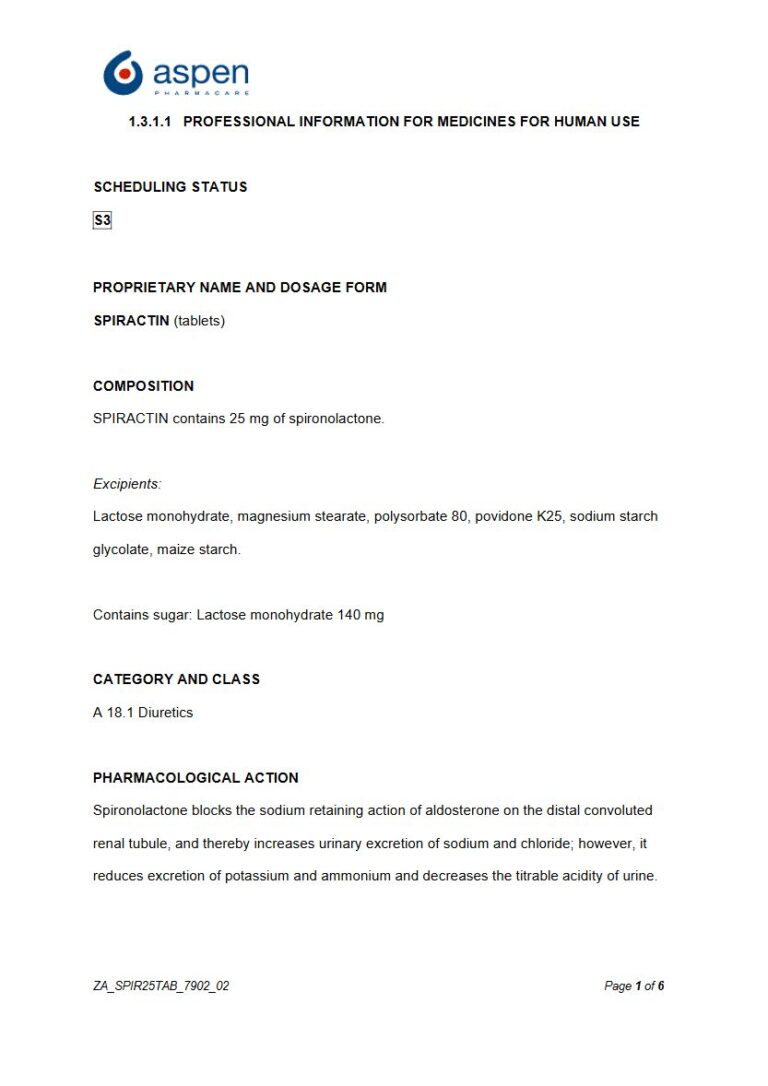
Spiractin 25 mg Tablets
PDF Leaflet Revision Date: 15 February 1979
Clinical Summary
Quick overview from the medicine insert
Indication
Treatment of oedema and ascites associated with hepatic cirrhosis.
Dosage (summary)
Initial 100 mg daily in 4 divided doses; may increase to 400 mg if necessary.
Special Populations
- Renal impairment
- Hepatic impairment
Pregnancy & Breastfeeding
Safety in pregnancy not established.
Key Drug Interactions
- Enhances effects of antihypertensives
- Caution with other potassium-sparing agents
Contraindications
- Acute renal insufficiency
- Anuria
- Hyperkalaemia
Common side effects
- Hyperkalaemia
- Hyponatraemia
- Drowsiness
- Headache
- Ataxia
Counselling Points
- Avoid potassium supplements
- Monitor serum electrolytes
- Gradually decrease dose on discontinuation
Serious warnings
- Risk of hyperkalaemia
- Caution in severe hepatic disease
Important Disclaimer
The Spiractin 25 mg Tablets professional information leaflet below is the property of Pharmacare and is provided on Medinsert exactly as issued, with no.. alterations or editorial changes. We make every effort to keep content current by updating documents as soon as new versions become available. Medinsert serves as a trusted access point for healthcare professionals, but does not replace official sources or clinical judgement. For more details, please read our full disclaimer. read more>>
 Healthcare Professionals Only
This content is for registered healthcare professionals
Sign in or create a free account to read the full package insert.
Free for HPCSA-registered professionals. Powered by Medinsert.
Clinical Particulars
Section 4 of the official insert — extracted exactly as issued, no alterations
4.1 Therapeutic indications
Spironolactone may be used initially in the treatment of patients with oedema and ascites associated with hepatic cirrhosis to avoid depletion of potassium or precipitation of hepatic coma that may follow use of a thiazide diuretic. If more profound diuresis is necessary, or in patients with congestive heart failure and the nephrotic syndrome, a thiazide or other diuretics may be given concomitantly with spironolactone. Spironolactone may be effective in treating patients who do not respond satisfactorily to other diuretic agents but it is most useful when given with another diuretic. Spironolactone is reported to have a hypotensive effect in patients with essential hypertension. The rise in serum potassium levels produced by spironolactone in patients with primary hyperaldosteronism has been used as an aid in the diagnosis of this affliction.
4.2 Posology and method of administration
The initial dosage is 100 mg daily in 4 divided doses. After 5 days the effect is evaluated; if the response is satisfactory the medicine is continued, if possible at a lower dose. If the response is not satisfactory, a conventional diuretic may be given concomitantly at usual doses. In certain circumstances the dose of spironolactone may have to be increased to 400 mg daily. On discontinuing the medicine the dose should be gradually decreased.
4.3 Contraindications
Spironolactone is contraindicated in patients with acute renal insufficiency, anuria and hyperkalaemia.
4.4 Special warnings and precautions for use
Because of the risk of producing hyperkalaemia, spironolactone should be given with caution to patients with impaired renal function. It should only be given under careful supervision in patients with severe hepatic disease as stupor and transient hepatic coma may develop in these patients. Plasma electrolyte determinations must be carried out during treatment to prevent electrolyte imbalance, especially hyponatraemia and hyperkalaemia.
Potassium supplementation in the form of either medication or a potassium-rich diet should not be given. Such supplementation can cause hyperkalaemia. Excipients contains lactose which may have an effect on the glycaemic control of patients with diabetes mellitus. Patients with the rare hereditary conditions of galactose intolerance e.g. galactosaemia, Lapp lactase deficiency, glucose-galactose malabsorption or fructose intolerance should not take SPIRACTIN.
4.5 Interactions with other medicines
Spironolactone may enhance the effects of other antihypertensive agents, the dose of which may need to be reduced. It should be given with caution with other potassium sparing medicines. Serum electrolytes should be estimated periodically.
4.6 Fertility, pregnancy and lactation
Safety in pregnancy has not been established.
4.8 Undesirable effects
Hyperkalaemia and hyponatraemia have been observed in patients treated with spironolactone. Drowsiness, headache, ataxia, coma, maculopapular or erythematous cutaneous eruptions, impotence, gynecomastia, mild androgenic effect including hirsutism, irregular menses and deepening voice may occur occasionally.
4.9 Overdose
The symptoms of overdosage are hyperkalaemia clinically characterised by paralysis or muscle spasm. Treatment is symptomatic with emphasis on potassium excretion.
