
Aldactone Tablets
Clinical Summary
Quick overview from the medicine insert
Indication
Management of edema associated with congestive heart failure, liver cirrhosis, and nephrotic syndrome; treatment of hypertension; treatment of primary hyperaldosteronism.
Dosage (summary)
Initial dose for adults is typically 25 mg to 100 mg once daily, adjusted based on clinical response.
Onset of Action / Duration
Diuretic effect usually begins within 24 to 48 hours; maximum effect may take several days.
Special Populations
- Elderly patients
- Patients with renal impairment
- Patients with hepatic impairment
Pregnancy & Breastfeeding
Use during pregnancy only if the potential benefit justifies the potential risk to the fetus. Spironolactone is excreted in breast milk; caution is advised when administered to nursing mothers.
Key Drug Interactions
- Potassium-sparing diuretics may increase the risk of hyperkalemia when used with other potassium-sparing agents.
- NSAIDs may reduce the diuretic effect of spironolactone.
- ACE inhibitors and ARBs may increase the risk of hyperkalemia.
Contraindications
- Anuria
- Acute renal insufficiency
- Hyperkalemia
- Addison's disease
Common side effects
- Hyperkalemia
- Hypotension
- Dizziness
- Gastrointestinal disturbances
- Gynecomastia
Counselling Points
- Monitor potassium levels regularly during treatment.
- Report any signs of hyperkalemia such as muscle weakness or irregular heartbeat.
- Take the medication as prescribed and do not discontinue without consulting a healthcare provider.
- Avoid potassium supplements and high-potassium foods unless directed by a healthcare provider.
Serious warnings
- Use with caution in patients with renal impairment.
- Monitor blood pressure regularly, especially when initiating therapy.
- Risk of dehydration and electrolyte imbalance; monitor electrolytes periodically.
Important Disclaimer
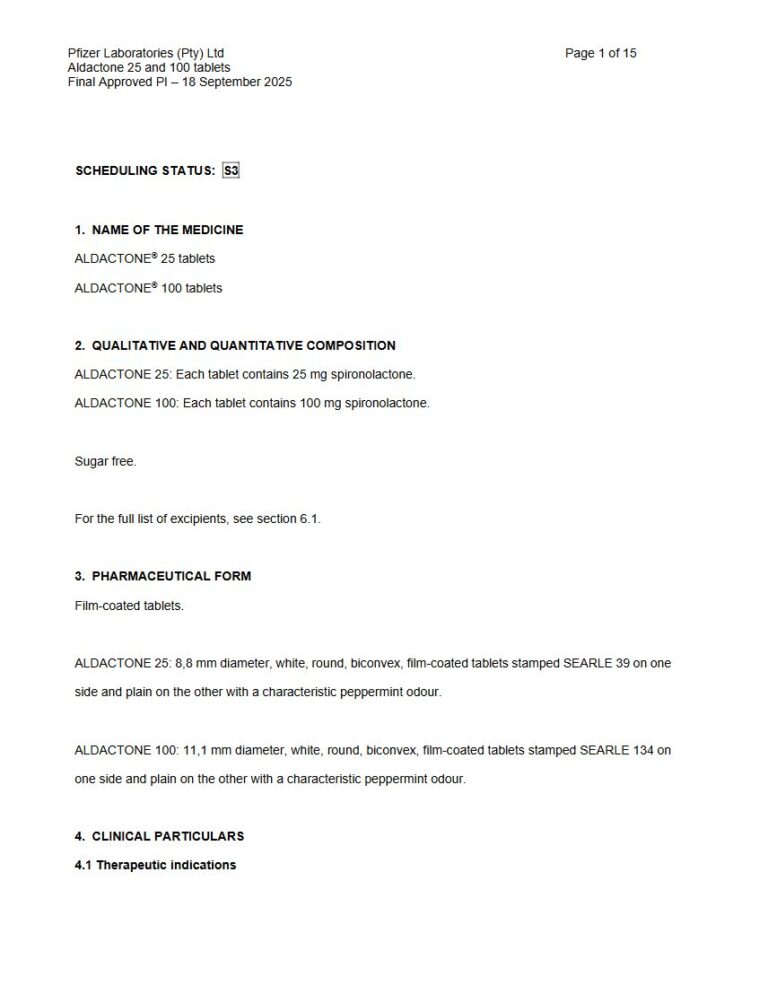
The Aldactone Tablets professional information leaflet below is the property of Pfizer Laboratories and is provided on Medinsert exactly as issued, with no.. alterations or editorial changes. We make every effort to keep content current by updating documents as soon as new versions become available. Medinsert serves as a trusted access point for healthcare professionals, but does not replace official sources or clinical judgement. For more details, please read our full disclaimer. read more>>
 Healthcare Professionals Only
This content is for registered healthcare professionals
Sign in or create a free account to read the full package insert.
Free for HPCSA-registered professionals. Powered by Medinsert.
Clinical Particulars
Section 4 of the official insert — extracted exactly as issued, no alterations
4.1 Therapeutic indications
u2022 Essential hypertension
u2022 Short-term preoperative treatment of patients with primary hyperaldosteronism
u2022 Congestive heart failure (alone or in combination with standard therapy), including severe heart failure (NYHA class III-IV)
u2022 Conditions in which secondary hyperaldosteronism may be present, including liver cirrhosis accompanied by oedema and/or ascites, nephrotic syndrome, and other oedematous conditions (alone or in combination with standard therapy)
u2022 Diuretic-induced hypokalaemia/hypomagnesaemia as adjunctive therapy
u2022 Establishing a diagnosis of primary hyperaldosteronism
4.2 Posology and method of administration
Posology
For adults, the daily dose may be given in divided doses or as a single daily dose.
Essential hypertension
The usual adult dose is 50 mg to 100 mg per day, which for difficult or severe cases may be gradually increased at intervals of 2 weeks up to 200 mg per day. Treatment should be continued for at least 2 weeks to ensure an adequate response to therapy. Dose should be adjusted as necessary.
Congestive heart failure
An initial daily dose of 100 mg of ALDACTONE administered in either single or divided doses is recommended but may range from 25 mg to 200 mg daily. Maintenance dose should be individually determined.
Severe heart failure in conjunction with standard therapy (NYHA Class III - IV)
Treatment in conjunction with standard therapy should be initiated at a dose of ALDACTONE 25 mg once daily in patients with a serum potassium u2264 5,0 mmol/L and serum creatinine u2264 220 u03bcmol/L. Patients who tolerate 25 mg once daily may have their dose increased to 50 mg once daily as clinically indicated. Patients who do not tolerate 25 mg once daily may have their dose reduced to 25 mg every other day. See section 4.4, Hyperkalaemia in patients with severe heart failure, for advice on monitoring serum potassium and serum creatinine.
Cirrhosis
If urinary Na+/K+ ratio is greater than 1,0, the usual adult dose is 100 mg per day. If the ratio is less than 1,0, the usual adult dose is 200 mg to 400 mg per day. Maintenance dose should be individually determined.
Nephrotic syndrome
The usual adult dose is 100 mg to 200 mg per day. ALDACTONE has not been shown to affect the basic pathological process, and its use is advised only if other therapy is ineffective.
Hypokalaemia/hypomagnesaemia
25 mg to 100 mg daily may be useful in treating diuretic-induced hypokalaemia and/or hypomagnesaemia when oral potassium and/or magnesium supplements are considered inappropriate.
Diagnosis and treatment of primary hyperaldosteronism
ALDACTONE may be employed as an initial diagnostic measure to provide presumptive evidence of primary hyperaldosteronism while patients are on normal diets.
Long test: Daily adult dose of 400 mg for 3 to 4 weeks. Correction of hypokalaemia and of hypertension provides presumptive evidence for the diagnosis of primary hyperaldosteronism.
Short test: Daily adult dose of 400 mg for 4 days. If serum potassium increases during ALDACTONE administration, but drops when ALDACTONE is discontinued, a presumptive diagnosis of primary hyperaldosteronism should be considered.
Short-term preoperative treatment of primary hyperaldosteronism
After the diagnosis of hyperaldosteronism has been established by more definitive testing procedures, ALDACTONE may be administered in daily doses of 100 mg to 400 mg in preparation for surgery. For patients who are considered unsuitable candidates for surgery, ALDACTONE may be employed for long-term maintenance therapy at the lowest effective dosage determined for the individual patient.
Paediatric population
Initial daily dosage is 3 mg/kg body weight given in divided doses. Dosage should be adjusted on the basis of response and tolerance. ALDACTONE is insoluble in water but the tablets may be crushed and given in suspension if necessary.
Method of administration
For oral use.
4.3 Contraindications
ALDACTONE is contraindicated in adult and paediatric patients with:
- hypersensitivity to spironolactone or to any of the excipients of ALDACTONE (listed in section 6.1)
- acute renal insufficiency
- rapidly progressing impairment of renal function
- anuria
- hyperkalaemia
- concomitant use of eplerenone
- Addisonu2019s disease
4.4 Special warnings and precautions for use
Concomitant use of spironolactone, such as contained in ALDACTONE, with other potassium-sparing diuretics, angiotensin-converting enzyme (ACE) inhibitors, nonsteroidal anti-inflammatory drugs (NSAIDs), angiotensin II antagonists, aldosterone blockers, heparin, low molecular weight heparin or other medicines or conditions known to cause hyperkalaemia, potassium supplements, a diet rich in potassium, or salt substitutes containing potassium, may lead to severe hyperkalaemia.
Reversible hyperchloraemic metabolic acidosis, usually in association with hyperkalaemia has been reported to occur in some patients with decompensated hepatic cirrhosis, even in the presence of normal renal function.
Caution should be observed in the presence of liver disease as hepatic coma may be precipitated in susceptible subjects. Periodic estimation of serum electrolytes may be desirable.
Hyperkalaemia in patients with severe heart failure
Hyperkalaemia may be fatal. It is critical to monitor and manage serum potassium in patients with severe heart failure receiving ALDACTONE. Avoid using other potassium-sparing diuretics. Avoid using oral potassium supplements in patients with serum potassium > 3,5 mmol/L. The recommended monitoring for potassium and creatinine is one week after initiation or increase in dose of ALDACTONE, monthly for the first 3 months, then quarterly for a year, and then every 6 months. Discontinue or interrupt treatment for serum potassium > 5 mmol/L or for serum creatinine > 350 u03bcmol/L (see section 4.2, Severe heart failure in conjunction with standard therapy (NYHA Class III-IV).
4.5 Interaction with other medicines and other forms of interaction
Concomitant use of medicines known to cause hyperkalaemia with ALDACTONE may result in severe hyperkalaemia.
ALDACTONE may have an additive effect when given concomitantly with other diuretics and antihypertensive medicines. The dose of such medicines may need to be reduced when ALDACTONE is added to the treatment regimen.
ALDACTONE reduces vascular responsiveness to norepinephrine (noradrenaline). Caution should be exercised in the management of patients subjected to anaesthesia while they are being treated with ALDACTONE.
ALDACTONE has been shown to increase the half-life of digoxin. Aspirin, and other NSAIDS such as indomethacin and mefenamic acid may attenuate the natriuretic efficacy of diuretics due to inhibition of intrarenal synthesis of prostaglandins and have been shown to attenuate the diuretic effect of ALDACTONE.
ALDACTONE enhances the metabolism of antipyrine. ALDACTONE can interfere with assays for plasma digoxin concentrations. Hyperkalaemic metabolic acidosis has been reported in patients given ALDACTONE concurrently with ammonium chloride or cholestyramine. Coadministration of ALDACTONE with carbenoxolone may result in decreased efficacy of either medicine. ALDACTONE binds to the androgen receptor and may increase prostate specific antigen (PSA) levels in abiraterone-treated prostate cancer patients. Use with abiraterone is not recommended.
ALDACTONE may reduce mitotane plasma levels in adrenocortical carcinoma patients treated with mitotane and should not be used concomitantly with mitotane.
4.6 Fertility, pregnancy and lactation
Pregnancy
There are limited data from the use of ALDACTONE in pregnant women. Studies in animals have shown reproductive toxicity associated with the anti-androgenic effect of ALDACTONE (see section 5.3). Diuretics can lead to reduced perfusion of the placenta and thus to impairment of intrauterine growth and are therefore not recommended for the standard therapy for hypertension and oedema during pregnancy. ALDACTONE should not be used during pregnancy.
Breastfeeding
Canrenone (a major and active) metabolites of spironolactone is excreted in human milk. There is insufficient information on the effects of ALDACTONE in newborns/infants. ALDACTONE should not be used during breast-feeding. If use of ALDACTONE is considered essential, an alternative method of infant feeding should be instituted.
Fertility
Spironolactone administered to female mice reduced fertility (see section 5.3).
4.7 Effects on ability to drive and use machines
Somnolence and dizziness have been reported to occur. Caution is advised when driving or operating machinery until the response to treatment with ALDACTONE has been determined.
4.8 Undesirable effects
The following side effects have been reported in association with ALDACTONE therapy.
Tabulated summary of adverse reactions
The table below lists the adverse reactions by system organ class and frequency using the following convention: Very common (u2265 1/10); common (u2265 1/100 to < 1/10); uncommon (u2265 1/1 000 to < 1/100); rare (u2265 1/10 000 to < 1/1 000); very rare (< 1/10 000) and not known (cannot be estimated from the available data).
System organ class Frequency Side effects
Neoplasms benign, malignant and unspecified (including cysts and polyps) Uncommon Benign breast neoplasm (male)
Blood and lymphatic system disorders Frequency not known (cannot be estimated from available data) Agranulocytosis, leukopenia, thrombocytopenia
Metabolism and nutrition disorders Very common Hyperkalaemia Uncommon Electrolyte imbalance
Psychiatric disorders Common Confusional state Frequency not known (cannot be estimated from available data) Libido disorder
Nervous system disorders Common Dizziness
Gastrointestinal disorders Common Nausea Frequency not known (cannot be estimated from available data) Gastrointestinal disorder
Hepato - biliary disorders Uncommon Abnormal hepatic function
Skin and subcutaneous tissue disorders Common Pruritus, rash Uncommon Urticaria Frequency not known (cannot be estimated from available data) Toxic epidermal necrolysis (TEN), Stevens-Johnson syndrome (SJS), Drug reaction with eosinophilia and systemic symptoms (DRESS), alopecia, hypertrichosis
Musculoskeletal, connective tissue and bone disorders Common Muscle spasms
Renal and urinary disorders Common Acute kidney injury
Reproductive system and breast disorders Common Gynaecomastia*, breast pain (male) Uncommon Menstrual disorder, breast pain (female)
General disorders and administration site conditions Common Malaise
* Gynaecomastia may be reversible when ALDACTONE is discontinued.
4.9 Overdose
Acute overdosage may be manifested by drowsiness, mental confusion, nausea, vomiting, dizziness or diarrhoea.
Hyperkalaemia
Electrocardiographic changes give the earliest indications of pathologically disturbed serum potassium levels. In the event of hyperkalaemia, discontinue ALDACTONE, reduce potassium intake and administer potassium-excreting diuretics and intravenous glucose with insulin or an oral ion-exchange resin as appropriate.
