
Sufenta Fortea 50 aµg Solution for injection or infusion
PDF Leaflet Revision Date: 6 November 2020
Clinical Summary
Quick overview from the medicine insert
Indication
Indicated for induction and maintenance of anaesthesia and post-operative pain management.
Dosage (summary)
IV: Initial 8-30 u03bcg/kg; Maintenance 0.5-0.75 u03bcg/kg. Epidural: Initial 30-50 u03bcg.
Onset of Action / Duration
Onset: 5-10 mins, Duration: 4-6 hours
Special Populations
- Elderly
- Renal impairment
- Hepatic impairment
Pregnancy & Breastfeeding
Safety in pregnancy not established; contraindicated in labor IV use; excreted in breast milk.
Key Drug Interactions
- CNS depressants
- MAOIs
- CYP3A4 inhibitors
Contraindications
- Known intolerance to components
- Severe hemorrhage or shock
- Infection at injection site
Common side effects
- Sedation
- Nausea
- Hypotension
- Respiratory depression
Counselling Points
- Avoid driving for 24 hours post-administration
- Monitor for signs of respiratory depression
- Do not breastfeed for 10 hours post-administration
Serious warnings
- Risk of respiratory depression
- Monitor vital signs
- Caution in patients with compromised respiratory function
Important Disclaimer
The Sufenta Fortea 50 aµg Solution for injection or infusion professional information leaflet below is the property of Piramal Critical Care and is provided on Medinsert exactly as issued, with no.. alterations or editorial changes. We make every effort to keep content current by updating documents as soon as new versions become available. Medinsert serves as a trusted access point for healthcare professionals, but does not replace official sources or clinical judgement. For more details, please read our full disclaimer. read more>>
 Healthcare Professionals Only
This content is for registered healthcare professionals
Sign in or create a free account to read the full package insert.
Free for HPCSA-registered professionals. Powered by Medinsert.
Clinical Particulars
Section 4 of the official insert — extracted exactly as issued, no alterations
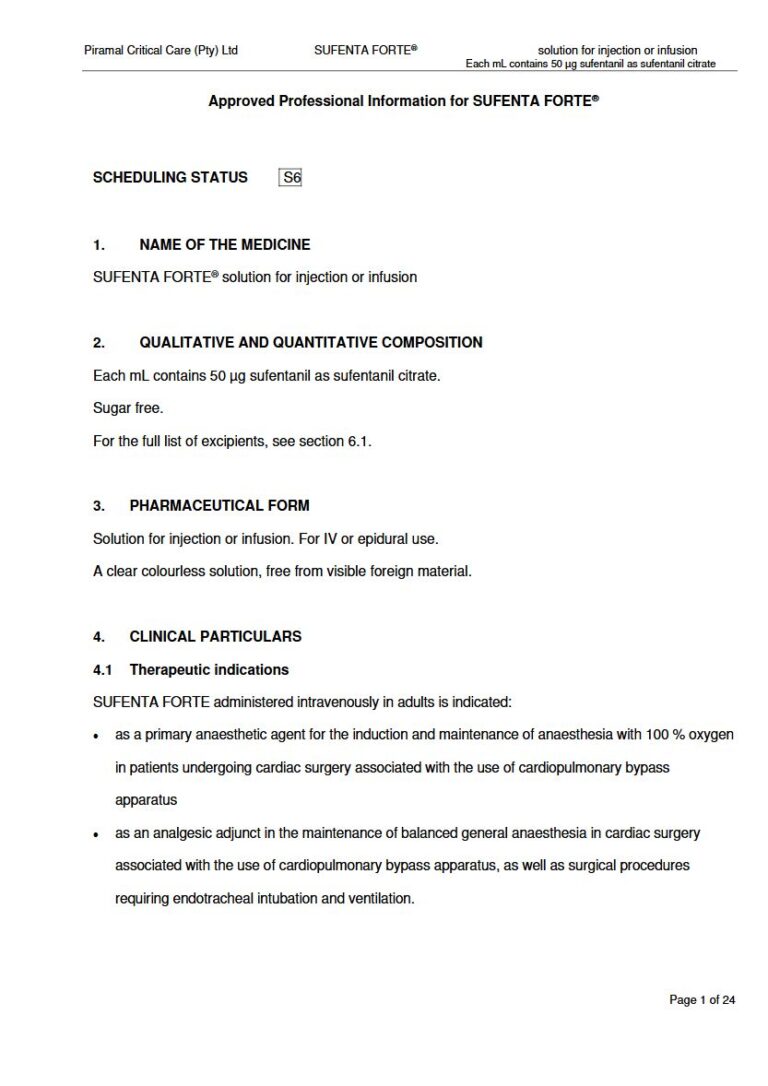
4.1 Therapeutic indications
SUFENTA FORTE administered intravenously in adults is indicated:
- as a primary anaesthetic agent for the induction and maintenance of anaesthesia with 100 % oxygen in patients undergoing cardiac surgery associated with the use of cardiopulmonary bypass apparatus
- as an analgesic adjunct in the maintenance of balanced general anaesthesia in cardiac surgery associated with the use of cardiopulmonary bypass apparatus, as well as surgical procedures requiring endotracheal intubation and ventilation.
SUFENTA FORTE administered by epidural route in adults is indicated:
- for the post-operative management of pain following general surgery, thoracic or orthopaedic procedures and caesarean sections
- as an analgesic adjunct to epidural bupivacaine with or without adrenaline (epinephrine) during labour and vaginal deliveries.
Use in children
Intravenous SUFENTA FORTE is indicated as an analgesic agent for use during induction and/or maintenance of balanced general anaesthesia in children over the age of 1 month. Epidural SUFENTA FORTE is indicated for use in children aged 1 year and over for the post-operative management of pain following general surgery, thoracic or orthopaedic procedures.
4.2 Posology and method of administration
Posology
The dosage of SUFENTA FORTE should be individualised. Factors to be considered in determining the dose are age, body mass, physical status, underlying pathological condition, use of other medicines, type of anaesthesia to be used and duration of the surgical procedure. The effect of the initial dose should be taken into account in determining the supplemental doses.
In obese patients, the dosage of SUFENTA FORTE should be determined on the basis of standard body mass.
Intravenous administration u2013 Adults
Initial dose: 8 u2013 30 u03bcg/kg (anaesthetic dose) administered with 100 % oxygen and muscle relaxant. SUFENTA FORTE produces sleep at dosages of 8 u03bcg/kg and maintains a deep level of anaesthesia without the use of additional anaesthetic agents.
Post-operative mechanical ventilation and observation are essential at this dosage level on account of extended post-operative respiratory depression.
Maintenance dose: 0,5 u2013 0,75 u03bcg/kg as determined by changes in vital signs that indicate surgical stress or lightening of analgesia.
Initial dose: 1 u2013 8 u03bcg/kg
The duration of action is 1 u2013 8 hours depending on the dose.
Maintenance dose: 0,1 u2013 0,5 u03bcg/kg as needed when movement and/or changes in vital signs indicate surgical stress or lightening of analgesia. Supplemental dosages should be individualised and adjusted to the remaining operative time anticipated.
Epidural administration: Proper placement of a needle or catheter in the epidural space should be verified before SUFENTA FORTE is injected to assure that unintentional intravascular or intrathecal administration does not occur. Unintentional intravascular injection of SUFENTA FORTE could result in potentially serious overdose including acute truncal muscular rigidity and apnoea. Unintentional intrathecal injection of the full sufentanil, local anaesthetic epidural doses and volume could produce effects of high spinal anaesthesia including prolonged paralysis and delayed recovery. If analgesia is inadequate, the placement and integrity of the catheter should be verified prior to administration of any additional epidural medications. SUFENTA FORTE should be administered by slow injection.
With epidural administration, caution should be exercised in the presence of respiratory depression and in the presence of fetal distress.
Epidural administration requires that the patient should be in a high care environment with continuous supervision. The patient should be closely monitored for at least 2 hours after each dose, as respiratory depression may occur.
Post-operative management of pain u2013 Adults: An initial dose of 30 u2013 50 u03bcg may be expected to provide adequate pain relief for up to 4 u2013 6 hours. Additional boli of 25 u03bcg may be administered if there is evidence of lightening of analgesia. There should be a minimum interval of 1 hour between doses.
Analgesic adjunct during labour and vaginal deliveries: The recommended dosage is 10 u2013 15 u03bcg administered with 10 mL bupivacaine 0,125 % with or without epinephrine (adrenaline). SUFENTA FORTE and a local anaesthetic, such as bupivacaine should be mixed together before administration. Doses can be repeated twice (for a total of three doses) at not less than one-hour intervals until delivery.
Special populations for intravenous administration
Elderly (65 years of age and older) The dose should be reduced in elderly and in debilitated patients.
Patients with severe renal impairment and end stage renal failure The dosage of SUFENTA FORTE should be reduced in patients with severe renal impairment and end stage renal failure. SUFENTA FORTE should be titrated with caution in these patients. Such patients also require prolonged post-operative monitoring.
Paediatric population
Children u2264 1 month (neonates) Due to the large variability of pharmacokinetic parameters in neonates, no dosing recommendations can be made (see sections 4.4 and 5.2).
Children > 1 month Premedication with an anticholinergic such as atropine is recommended for all doses (unless an anticholinergic is contraindicated).
Induction of anaesthesia SUFENTA FORTE can be administered as a slow bolus injection of 0,2 u2013 0,5 u03bcg/kg over 30 seconds or longer in combination with an anaesthetic induction agent. For major surgery (e.g. cardiac surgery) doses up to 1 u03bcg/kg can be administered.
Maintenance of anaesthesia in ventilated patients SUFENTA FORTE can be administered as part of balanced anaesthesia. Dosage depends on the dose of concomitant anaesthetic agents, type and duration of surgery. An initial dose of 0,3 u2013 2 u03bcg/kg administered by slow bolus injection over at least 30 seconds may be followed by additional boluses of 0,1 u2013 1 u03bcg/kg as required, up to a total maximum of 5 u03bcg/kg in cardiac surgery.
Special populations for epidural administration
Elderly (65 years and older) The dose should be reduced in elderly and in debilitated patients.
Paediatric population SUFENTA FORTE must be administered to children epidurally only by anaesthesiologists specifically trained in paediatric epidural anaesthesia and in management of respiratory depressant effects of opioids. Appropriate resuscitation equipment, including airway securing devices and an opioid antagonist must be readily available. Paediatric patients must be monitored for signs of respiratory depression for at least 2 hours after epidural administration of SUFENTA FORTE. Limited data are available for the use of epidural SUFENTA FORTE in paediatric patients.
Children < 1 year No data are available for epidural administration of SUFENTA FORTE to newborns and infants younger than 3 months, and limited data are available for children between 3 months and 1 year (see section 5.1). Safety and efficacy of SUFENTA FORTE in children younger than 1 year have not been established, (see sections 4.4 and 5.1). Therefore, no dosing recommendations can be made for children in this age group.
Children u2265 1 year A single bolus dose of 0,25 u2013 0,75 u03bcg/kg SUFENTA FORTE given intra-operatively provided pain relief for a period, which ranged from 1 to 12 hours in clinical trials. The duration of effective analgesia is influenced by the surgical procedure and concomitant use of epidural amide local anaesthetic.
Method of administration Epidural administration Proper placement of a needle or catheter in the epidural space should be verified before SUFENTA FORTE is injected.
4.3 Contraindications
SUFENTA FORTE is contraindicated in patients with a known intolerance to any of its components or to other opioids. Intravenous use in labour or before clamping of the cord during caesarean section is contraindicated due to the possibility of respiratory depression in the newborn infant. This is in contrast to the epidural use in labour, during which sufentanil in doses up to 30 u03bcg does not influence the condition of the mother or the newborn (see section 4.6).
Epidural SUFENTA FORTE should not be given in the presence of:
- severe haemorrhage or shock
- septicaemia
- infection at the injection site
- disturbances in haemostasis such as thrombocytopenia and coagulopathy and/or anticoagulant therapy
- other concomitant therapy or medical conditions which could contraindicate the technique of epidural administration
- patients on monoamine oxidase inhibitors (MAOIs) within the previous 2 weeks (see section 4.4).
4.4 Special warnings and precautions for use
Respiratory depression is dose related and can be reversed by a specific opioid antagonist, e.g. naloxone, but a repeated dose of the antagonist may be necessary because the respiratory depression may last longer than the duration of action of the opioid antagonist. Marked respiratory depression accompanies profound analgesia. The respiratory depression can persist in the post-operative period, and if SUFENTA FORTE has been given intravenously this can recur. Therefore, patients should remain under appropriate surveillance. Resuscitation equipment and opioid antagonists should be readily available.
Hyperventilation during anaesthesia may alter the patient's response to CO2 thus affecting respiration post-operatively. Concomitant use of SUFENTA FORTE and CNS depressants, especially benzodiazepines or related medicines, in spontaneous breathing patients, may increase the risk of profound sedation, respiratory depression, coma and death. If a decision is made to administer SUFENTA FORTE concomitantly with a CNS depressant, especially a benzodiazepine or a related medicine, the lowest effective dose of both medicines should be administered, for the shortest period of concomitant use. Patients should be carefully monitored for signs and symptoms of respiratory depression and profound sedation. In this respect, it is strongly recommended to inform patients and their caregivers to be aware of these symptoms (see section 4.5).
Respiratory depression may follow intravenous or epidural use of SUFENTA FORTE. Vital signs should be monitored routinely. Induction of muscle rigidity, which may also involve the thoracic respiratory muscles, can occur but the risk may be reduced if intravenous injections are administered slowly. A neuromuscular blocking agent compatible with the patientu2019s condition may be administered prophylactically to prevent muscle rigidity or to induce muscle relaxation after rigidity occurs. Non-epileptic (myo)clonic movements can occur. Because of its weak cholinergic activity, SUFENTA FORTE should be used with caution in patients with cardiac dysrhythmias. Bradycardia and possibly cardiac arrest can occur if the patient has received an insufficient amount of anticholinergic or when SUFENTA FORTE is combined with non-vagolytic muscle relaxants. Bradycardia can be treated with atropine. SUFENTA FORTE may induce hypotension, especially in hypovolaemic patients. Appropriate measures to maintain a stable arterial pressure should be taken.
The use of rapid bolus injections of SUFENTA FORTE should be avoided in patients with compromised intracerebral compliance; in such patients the transient decrease in the mean arterial pressure has been accompanied by a reduction of the cerebral perfusion pressure. Patients on chronic opioid therapy or with a history of opioid abuse may require higher doses. It is recommended to reduce the dosage in elderly and in debilitated patients. SUFENTA FORTE should be titrated with caution in patients with any of the following conditions:
- uncontrolled hypothyroidism
- pulmonary disease
- decreased respiratory reserve
- alcoholism
- impaired hepatic or renal function
- increased intracranial pressure.
Such patients also require prolonged post-operative monitoring. With epidural administration, caution should be exercised in the presence of respiratory depression or compromised respiratory function and in the presence of fetal distress. The patient should be closely monitored for at least 2 hours after each dose, as late respiratory depression may occur.
Paediatric population Due to the large variability of pharmacokinetic parameters in neonates there is a risk of over- or underdosing of SUFENTA FORTE in the neonatal period (see sections 4.2 and 5.2). Safety and efficacy of intravenous or epidural SUFENTA FORTE in children younger than 1 year have not been established (see sections 4.2 and 5.2).
4.5 Interaction with other medicines and other forms of interaction
Central nervous system (CNS) depressants Barbiturates, benzodiazepines or related medicines, neuroleptics, inhalational anaesthetics and other non-selective CNS depressants (e.g. alcohol), may potentiate the respiratory depressive effects of SUFENTA FORTE. When patients have also received central nervous system depressants, the dose of SUFENTA FORTE required will be less than usual. Concomitant use with SUFENTA FORTE in spontaneously breathing patients may increase the risk of respiratory depression, profound sedation, coma and death (see section 4.4).
Effect of SUFENTA FORTE on other medicine Following the administration of SUFENTA FORTE, the dose of other CNS depressants should be reduced. This is particularly important after surgery, because profound analgesia is accompanied by marked respiratory depression, which can persist or recur in the post-operative period. Administration of a CNS depressant, such as a benzodiazepine or related medicines, during this period may disproportionally increase the risk for respiratory depression (see section 4.4).
Cytochrome P450 3A4 (CYP3A4) inhibitors Sufentanil is metabolised mainly via the human cytochrome P450 3A4 enzyme. However, no in vivo inhibition by erythromycin (a known CYP3A4 inhibitor) has been observed. Although clinical data are lacking, in vitro data suggest that other potent CYP3A4 inhibitors (e.g. fluconazole, ketoconazole, itraconazole, ritonavir, diltiazem and cimetidine) may inhibit the metabolism of sufentanil. This could increase the risk of prolonged or delayed respiratory depression. The concomitant use of such medicines requires special patient care and observation; in particular, it may be necessary to lower the dose of SUFENTA FORTE.
Monoamine oxidase inhibitors (MAOIs) Monoamine oxidase inhibitors (MAOIs) must be discontinued 2 weeks prior to the administration of SUFENTA FORTE.
Serotonergic medicines Coadministration of SUFENTA FORTE with a serotonergic medicine, such as selective serotonin reuptake inhibitors (SSRIs), serotonin norepinephrine reuptake inhibitors (SNRIs), or monoamine oxidase inhibitors (MAOIs), may increase the risk of serotonin syndrome, a potentially life-threatening condition.
4.6 Fertility, pregnancy and lactation
Pregnancy Safety of SUFENTA FORTE in pregnancy and lactation has not been established, although studies in animals have not demonstrated any teratogenic effects. SUFENTA FORTE added to epidural bupivacaine in total doses up to 30 u03bcg has no detrimental effect on the mother or the newborn, but intravenous use is contraindicated in labour (see section 4.3). SUFENTA FORTE crosses the placenta. After epidural administration of a total dose not exceeding 30 u03bcg, average plasma concentrations of 0,016 ng/mL were detected in the umbilical vein. An antidote for the child should always be at hand.
Breastfeeding SUFENTA FORTE is excreted in breast milk. Caution should be exercised when SUFENTA FORTE is administered to a breastfeeding woman. A woman should not breastfeed her infant for 10 hours after receiving SUFENTA FORTE.
4.7 Effects on ability to drive and use machines
Patients should not drive, operate a machine or make legally binding decisions until 24 hours after administration of SUFENTA FORTE, nor should alcohol be consumed during that time period.
4.8 Undesirable effects
Adverse reactions Clinical trial data The safety of SUFENTA FORTE was evaluated in 650 sufentanil-treated subjects who participated in 6 clinical trials. Of these, 78 subjects participated in 2 trials of sufentanil administered intravenously as an anaesthetic agent for induction and maintenance of anaesthesia in subjects undergoing major surgical procedures (coronary artery bypass or open-heart). The remaining 572 subjects participated in 4 trials of epidural sufentanil administered as a post-operative analgesic or as an analgesic adjunct to epidural bupivacaine during labour and vaginal deliveries. Adverse reactions that were reported for u2265 1 % of sufentanil-treated subjects in these trials are shown in Table 1.
Table 1: Adverse reactions reported by u2265 1 % of sufentanil-treated subjects in 6 clinical trials of sufentanil
System organ class Adverse reaction Sufentanil (n = 650) % Nervous system disorders Sedation 19,5 Neonatal tremor 4,5 Dizziness 1,4 Headache 1,4 Cardiac disorders Tachycardia 1,8 Vascular disorders Hypertension 4,9 Hypotension 3,2 Pallor 1,4 Respiratory, thoracic and mediastinal disorders Cyanosis neonatal 2,0 Gastrointestinal disorders Nausea 9,8 Vomiting 5,7 Skin and subcutaneous tissue disorders Pruritus 15,2 Skin discolouration 3,1 Musculoskeletal and connective tissue disorders Muscle twitching 2,0 Renal and urinary disorders Urinary retention 3,2 Urinary incontinence 1,5 General disorders and administration site conditions Pyrexia 1,7
Additional adverse reactions that occurred in < 1 % of sufentanil-treated subjects in the 6 clinical trials are listed in Table 2.
4.9 Overdose
Symptoms An overdose of SUFENTA FORTE manifests itself as an extension of its pharmacological actions. Respiratory depression, which can vary in severity from bradypnoea to apnoea, may occur.
Treatment In the presence of hypoventilation or apnoea, oxygen should be administered, and respiration should be assisted or controlled as indicated. A specific opioid antagonist, such as naloxone, should be used as indicated to control respiratory depression. This does not preclude the use of more immediate countermeasures. The respiratory depression may last longer than the effect of the antagonist; additional doses of the latter may therefore be required. If depressed respiration is associated with muscular rigidity, an intravenous neuromuscular blocking agent might be required to facilitate assisted or controlled respiration. The patient should be carefully monitored, body warmth and adequate fluid intake should be maintained. If hypotension is severe or if it persists, the possibility of hypovolaemia should be considered, and if present, it should be controlled with appropriate parenteral fluid administration.
