
Agiolax Granules
Clinical Summary
Quick overview from the medicine insert
Indication
Agiolax 5g granules are indicated for the relief of constipation and to promote regular bowel movements.
Dosage (summary)
Adults: 1-2 teaspoons (5-10g) taken with a glass of water, preferably at bedtime. Children: Consult a healthcare professional for appropriate dosing.
Onset of Action / Duration
Typically within 12 to 24 hours after administration.
Special Populations
- Elderly patients
- Patients with renal impairment
- Patients with hepatic impairment
Pregnancy & Breastfeeding
Consult a healthcare professional before use during pregnancy or lactation.
Key Drug Interactions
- May interact with other laxatives, increasing the risk of dehydration.
- Potential interaction with medications that affect gastrointestinal motility.
Contraindications
- Hypersensitivity to any of the ingredients.
- Severe abdominal pain or obstruction.
- Nausea or vomiting.
Common side effects
- Abdominal cramps
- Diarrhea
- Nausea
- Flatulence
Counselling Points
- Encourage adequate fluid intake while using this product.
- Advise patients to avoid prolonged use without medical supervision.
- Inform patients about the importance of dietary fiber in managing constipation.
Serious warnings
- Not recommended for use in children under 12 years without medical advice.
- Use with caution in patients with a history of bowel obstruction or gastrointestinal disorders.
Important Disclaimer
The Agiolax Granules professional information leaflet below is the property of Xixia Pharmaceuticals and is provided on Medinsert exactly as issued, with no.. alterations or editorial changes. We make every effort to keep content current by updating documents as soon as new versions become available. Medinsert serves as a trusted access point for healthcare professionals, but does not replace official sources or clinical judgement. For more details, please read our full disclaimer. read more>>
 Healthcare Professionals Only
This content is for registered healthcare professionals
Sign in or create a free account to read the full package insert.
Free for HPCSA-registered professionals. Powered by Medinsert.
Clinical Particulars
Section 4 of the official insert — extracted exactly as issued, no alterations
4.1 Therapeutic indications
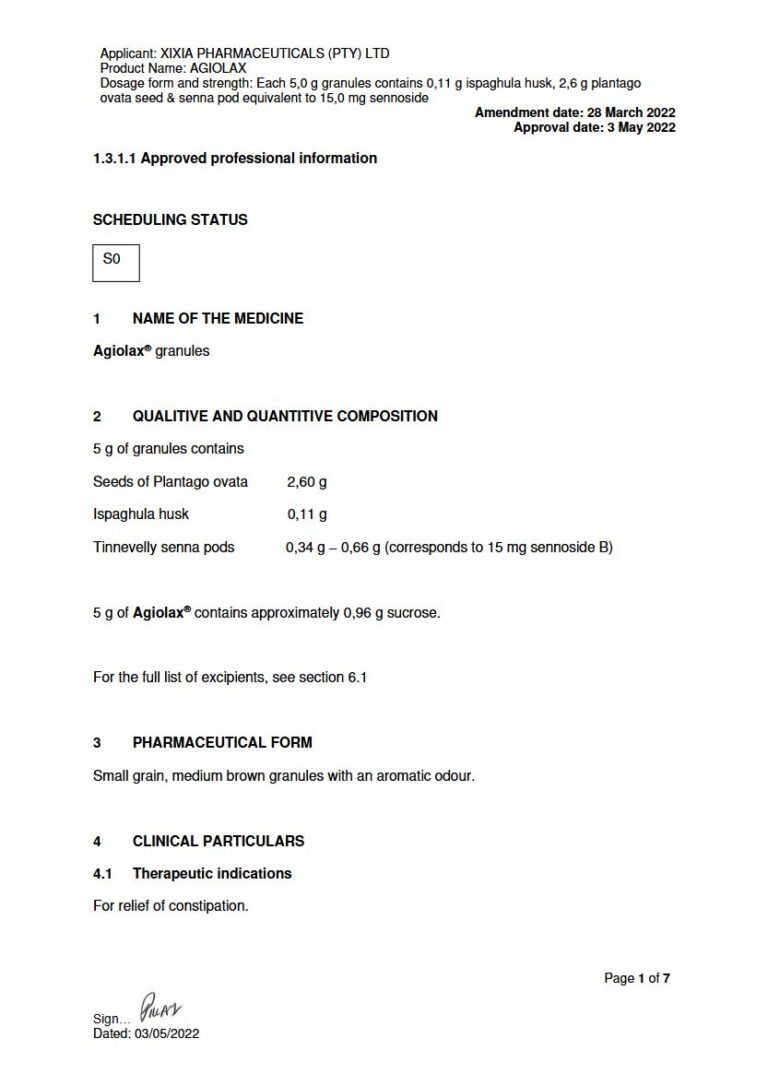
For relief of constipation.
4.2 Posology and method of administration
Posology
Adults and children 12 years and older: (5 g granules = 7 ml = approximately 1 heaped medicine measure.) 5 g to 10 g (half to one sachet) after the evening meal. If necessary, the same dose should be taken before breakfast. Note for diabetics: 5 g of Agiolax u00ae contains approximately 0,96 g sucrose.
Method of administration
Oral use. The granules should be swallowed with a full glass of liquid (preferably water). The granules should not be chewed or dissolved but swallowed whole.
4.3 Contraindications
- Hypersensitivity to the ingredients.
- Intestinal obstruction, or conditions likely to lead to intestinal obstruction.
- Undiagnosed abdominal symptoms.
4.4 Special warnings and precautions for use
Agiolax u00ae should not be used if there is abdominal pain, nausea or vomiting. Laxatives should not be taken by patients with intestinal obstruction or with undiagnosed abdominal symptoms. If a change in bowel habit occurs and persists for more than two weeks, a medical practitioner should be consulted to determine the cause.
Rectal bleeding or inability to have a bowel movement after the use of a laxative may indicate a serious condition. Discontinue use and consult a medical practitioner.
Inadequate fluid intake may cause obstruction of the bowel. Agiolax u00ae should be taken with adequate liquid to prevent faecal impaction and oesophageal obstruction. Agiolax u00ae lowers the transit time through the gut and could interfere with the absorption of other substances. Bulk laxatives increase flatulence and distension.
Agiolax u00ae should not be used for a period longer than one week, unless directed by a medical practitioner. Frequent of prolonged use of laxatives, including Agiolax u00ae , may result in loss of normal bowel function and dependence. Prolonged use of overdosage can result in diarrhoea with excessive loss of water and electrolytes, particularly potassium. Potassium loss can produce disorders of cardiac function and myasthenia, in particular of cardiac glycosides, diuretics and adrenocortical steroids are taken concurrently. In the case of chronic use, albuminuria and haematuria can occur. There is also the possibility of developing an atonic non-functioning colon.
Anthraquinone derivatives may colour the urine yellowish-brown at acid pH, and red at alkaline pH, and may interfere with diagnostic tests. Patients with inflammatory bowel disease must be monitored. Each 5 g Agiolax u00ae contains 1,04 g sucrose. Patients with rare hereditary conditions such as fructose intolerance, glucose-galactose mal-absorption or sucrase-isomaltase insufficiency should not take Agiolax u00ae .
Contains sucrose which may have an effect on the glycaemic control of patients with diabetes mellitus.
4.5 Interaction with other medicines and other forms of interaction
In cases of chronic use/abuse potassium deficiency may potentiate the action of cardiac glycosides and may affect the action of antidysrhythmic agents. Potassium loss may be aggravated in combination with certain medicines e.g. which increase the urine output (diuretics), cortisone and cortisone-like substances (adrenocortical steroids) and liquorice root. Intestinal absorption of medicines taken at the same time may be delayed or reduced. In insulin-dependent diabetics it may be necessary to reduce the insulin dose.
4.6 Fertility, pregnancy and lactation
Pregnancy: During the first three months of pregnancy, Agiolax u00ae should be used only if constipation cannot be remedied by a change in diet or with the aid of bulking agents. It should only be used after consultation with a medical practitioner.
Lactation: Breakdown products of senna pods, such as rhein have a laxative action and pass in small amounts into the maternal milk.
4.7 Effects on ability to drive and use machines
Agiolax u00ae does not affect the ability to drive or operate machinery.
4.8 Undesirable effects
a. Summary of the safety profile
Very rare (< 0,01 %): Hypersensitivity reactions to Plantago ovata, oesophagus obstructions, spasmodic gastro-intestinal complaints which as colic or cramps can be caused by senna, reversible pseudomelanosis coli following chronic use, which, as a rule, recedes after discontinuation of the preparation.
Reporting of suspected adverse reactions
Reporting suspected adverse reactions after authorisation of the medicine is important. It allows continued monitoring of the benefit/risk balance of the medicine. Healthcare professionals are asked to report any suspected adverse reactions to SAHPRA via the u201cReport Drug Reaction Processu201d, found online under SAHPRAu2019s safety publications: https://www.sahpra.org.za/
4.9 Overdose
Treatment is symptomatic and supportive.
