
Urotal 0,4 mg Capsule
PDF Leaflet Revision Date: 23 February 2023
Clinical Summary
Quick overview from the medicine insert
Indication
Treatment of functional symptoms of benign prostatic hyperplasia (BPH).
Dosage (summary)
One capsule daily after breakfast.
Special Populations
- Renal impairment
- Hepatic impairment
Pregnancy & Breastfeeding
Not indicated for use in women; ejaculation disorders may occur.
Key Drug Interactions
- Strong CYP3A4 inhibitors (e.g., ketoconazole)
- Moderate CYP3A4 inhibitors (e.g., erythromycin)
- Warfarin
Contraindications
- Hypersensitivity to tamsulosin
- Orthostatic hypotension
- Severe hepatic insufficiency
Common side effects
- Dizziness
- Drowsiness
- Ejaculation disorders
Counselling Points
- Take after the same meal daily
- Monitor for dizziness
- Report priapism immediately
Serious warnings
- Orthostatic hypotension
- Intraoperative Floppy Iris Syndrome (IFIS)
Important Disclaimer
The Urotal 0,4 mg Capsule professional information leaflet below is the property of Alkem Laboratories and is provided on Medinsert exactly as issued, with no.. alterations or editorial changes. We make every effort to keep content current by updating documents as soon as new versions become available. Medinsert serves as a trusted access point for healthcare professionals, but does not replace official sources or clinical judgement. For more details, please read our full disclaimer. read more>>
 Healthcare Professionals Only
This content is for registered healthcare professionals
Sign in or create a free account to read the full package insert.
Free for HPCSA-registered professionals. Powered by Medinsert.
Clinical Particulars
Section 4 of the official insert — extracted exactly as issued, no alterations
4.1 Therapeutic indications
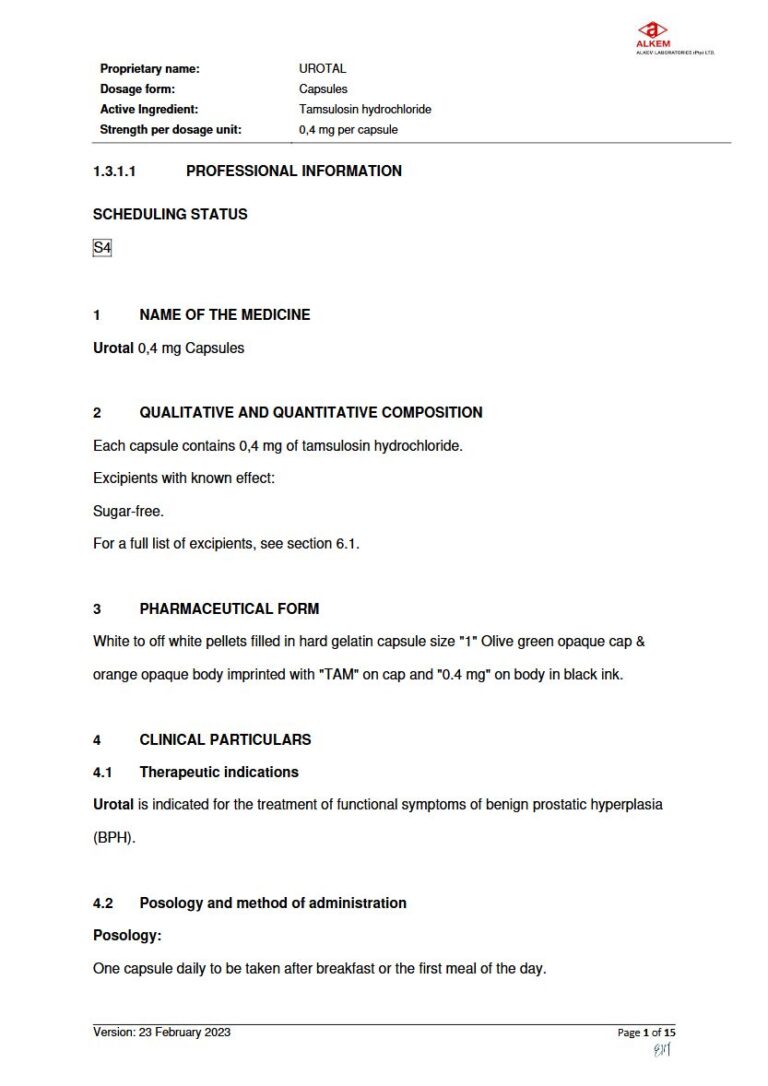
Urotal is indicated for the treatment of functional symptoms of benign prostatic hyperplasia (BPH).
4.2 Posology and method of administration
Posology: One capsule daily to be taken after breakfast or the first meal of the day.
Special populations
Renal Impairment: No dose adjustment is warranted in renal impairment.
Hepatic impairment: No dose adjustment is warranted in patients with mild to moderate hepatic insufficiency (see section 4.3).
Method of administration: For oral use. The capsule should be swallowed whole and should not be crunched or chewed, as this will interfere with the sustained release property of the active ingredient.
4.3 Contraindications
Urotal is contraindicated in:
- known hypersensitivity to tamsulosin hydrochloride, or to any of the excipients listed in section 6.1.
- a history of orthostatic hypotension.
- severe hepatic insufficiency.
- combination with strong inhibitors of CYP3A4, e.g. ketoconazole (see section 4.5)
4.4 Special warnings and precautions for use
Orthostatis: A reduction in blood pressure can occur during treatment with Urotal, as a result of which, orthostatic hypotension and syncope can occur. At the first signs of orthostatic hypotension (dizziness, weakness), the patient should sit or lie down until the symptoms have disappeared.
Before therapy with Urotal is initiated, the patient should be examined to exclude the presence of other conditions which can cause the same symptoms as benign prostatic hyperplasia. Digital rectal examination and when necessary, determination of prostate specific antigen (PSA) should be performed before treatment and at regular intervals afterwards.
The treatment of patients with severe renal impairment (creatinine clearances of < 10 mL/ min) should be approached with caution, as these patients have not been studied.
Intraoperative Floppy Iris Syndrome (IFIS): The u201cIntraoperative Floppy Iris Syndromeu201d (IFIS, a variant of small pupil syndrome) has been observed during cataract surgery in some patients previously treated with tamsulosin. IFIS may increase the risk of eye complications during and after the operation. Discontinuing tamsulosin 1 to 2 weeks prior to cataract surgery is anecdotally considered helpful, but the benefit of treatment discontinuation has not yet been established. IFIS has also been reported in patients who had discontinued tamsulosin as in Urotal for a longer period prior to cataract surgery. The initiation of therapy with tamsulosin in patients for whom cataract surgery is scheduled is not recommended. During pre-operative assessment cataract surgeons and ophthalmic teams should be consider whether patients scheduled for cataract surgery are being or have been treated with tamsulosin in order to ensure that appropriate measures will be in place to manage the IFIS during surgery.
Medicine interactions: Urotal should not be given in combination with strong inhibitors of CYP3A4 (e.g. ketoconazole) in patients with poor metaboliser CYP2D6 phenotype. Urotal should be used with caution in combination with moderate inhibitors of CYP3A4 (e.g. erythromycin). Urotal should be used with caution in combination with cimetidine, particularly at a dose higher than 0,4 mg. Urotal should not be used in combination with other alpha adrenergic blockers. Caution is advised when alpha adrenergic blockers including Urotal are co-administered with PDE5 inhibitors. Alpha adrenergic blockers and PDE5 inhibitors are both vasodilators that can lower blood pressure. Concomitant use of these two medicine classes can potentially cause symptomatic hypotension. Caution should be exercised with concomitant administration of warfarin and Urotal (see section 4.5).
Priapism: Urotal has been associated with priapism (persistent painful penile erection unrelated to sexual activity). Because this condition can lead to permanent impotence if not properly treated, patients must be advised about the seriousness of the condition (see section 4.8).
Screening for Prostate Cancer: Prostate cancer and BPH frequently co-exist; therefore, patients should be screened for the presence of prostate cancer prior to treatment with Urotal and at regular intervals afterwards.
Sulfa Allergy: In patients with sulfa allergy, allergic reaction to Urotal has been reported. If a patient reports a serious or life-threatening sulfa allergy, caution is warranted when taking Urotal.
4.5 Interaction with other medicines and other forms of interaction
Cytochrome P 450 inhibition: The free fraction of tamsulosin in human plasma is not changed by diazepam, propranolol, trichlormethiazide, chlormadinon, amitryptyline, diclofenac, glibenclamide, simvastatin or warfarin. Neither does tamsulosin change the free fraction of diazepam, propranolol, trichlormethazide or chlormadinone.
No interaction at the level of hepatic metabolism have been observed during in vitro studies with liver microsomal fractions (representative of the cytochrome P 450 linked medicine metabolism enzyme system), involving amitriptyline, glibenclamide and finasteride.
Strong and Moderate Inhibitors of CYP3A4 or CYP2D6: Urotal is extensively metabolized, mainly by CYP3A4 and CYP2D6 (see section 5.2). Concomitant treatment with ketoconazole (a strong inhibitor of CYP3A4) resulted in an increase in the C max and AUC of tamsulosin. The effects of concomitant administration of a moderate CYP3A4 inhibitor (e.g. erythromycin) on the pharmacokinetics of Urotal have not been evaluated. Concomitant treatment with paroxetine (a strong inhibitor of CYP2D6) resulted in an increase in the C max and AUC of tamsulosin that had increased by a factor of 1,3 and 1,6, respectively, but these increases are not considered clinically significant. A similar increase in exposure is expected in CYP2D6 poor metabolizers (PM) as compared to extensive metabolizers (EM). Since CYP2D6 PMs cannot be readily identified and the potential for significant increase in tamsulosin exposure exists when Urotal is co-administered with strong CYP3A4 inhibitors in CYP2D6 PMs, Urotal should not be used in combination with strong inhibitors of CYP3A4 (e.g., ketoconazole) (sections 4.3 and 4.4).
The effects of concomitant administration of a moderate CYP2D6 inhibitor (e.g., terbinafine) on the pharmacokinetics of Urotal have not been evaluated. The effects of co-administration of both a CYP3A4 and a CYP2D6 inhibitor Urotal have not been evaluated. However, there is a potential for significant increase in tamsulosin exposure when Urotal is co-administered with a combination of both CYP3A4 and CYP2D6 inhibitors. (see section 4.4).
Cimetidine: Treatment with cimetidine resulted in a significant decrease in the clearance of tamsulosin hydrochloride, which resulted in a moderate increase in tamsulosin hydrochloride AUC (see section 44).
Other u03b1 -Adrenergic Blockers: The pharmacokinetic and pharmacodynamic interactions between Urotal and other u03b1 - adrenergic blockers have not been determined; however, interactions between Urotal and other u03b1 -adrenergic blockers may be expected (see sections 4.4. and 5.2).
Warfarin: A definitive medicine interaction study between tamsulosin hydrochloride and warfarin was not conducted. Results from limited in vitro and in vivo studies are inconclusive. Caution should be exercised with concomitant administration of warfarin and tamsulosin (see section 4.4.). Warfarin may increase the elimination rate of tamsulosin.
Diclofenac: Diclofenac may increase the elimination rate of tamsulosin. Co-administration with other u03b1 1 - adrenocetor antagonist may lead to hypotensive effects.
Nifedipine, atenolol and enalapril: Dosage adjustments are not necessary when Urotal are administered concomitantly with nifedipine, atenolol, or enalapril.
Digoxin and theophylline: Dosage adjustments are not necessary when a Urotal is administered concomitantly with digoxin or theophylline.
Furosemide: Urotal had no effect on the pharmacodynamics (excretion of electrolytes) of furosemide. While furosemide produced a reduction in tamsulosin hydrochloride C max and AUC, these changes are expected to be clinically insignificant and do not require adjustment of the Urotal dosage.
4.6 Fertility, pregnancy and lactation
Urotal is not indicated for use in women.
Fertility: Ejaculation disorders have been observed in short- and long-term clinical studies with tamsulosin. Events of ejaculation disorder, retrograde ejaculation and ejaculation failure have been reported.
4.7 Effects on ability to drive and use machines
No studies on the effects of Urotal on the ability to drive and use of machines have been performed. However, dizziness has been reported and patients who experience these symptoms should be cautious while driving or operating machinery.
4.8 Undesirable effects
Summary of safety profile: Adverse reactions were usually mild and transient. The frequently observed adverse reactions are dizziness, drowsiness and lethargy.
Listed summary of adverse reactions: Adverse reactions are listed below by system organ class and frequency. Frequencies are defined as: Frequent, less frequent, frequency unknown.
Gastrointestinal disorders: Less frequent: Nausea, diarrhoea, vomiting and constipation. Frequency unknown: Dry mouth.
Endocrine disorders: Less frequent: Diaphoresis.
Cardiac disorders: Less frequent: Palpitations and tachycardia.
Vascular disorders: Less frequent: Orthostatic hypotension.
Nervous system disorders: Frequent: Dizziness, drowsiness, and lethargic. Less frequent: Headache, depression, nervousness, sleep disturbances, vertigo, hallucinations, paraesthesia, and syncope.
Eye disorders: Less frequent: Intra-operative Floppy Iris Syndrome (IFIS) in cataract surgery, and reddened sclera. Frequency unknown: Blurred vision and visual impairment.
Ear and labyrinth disorders: Less frequent: Tinnitus.
Respiratory, thoracic and mediastinal disorders: Less frequent: Nasal congestion, rhinitis, chest pain, dyspnoea, and epistaxis.
Reproductive system disorders: Frequent: Ejaculation disorders including retrograde ejaculation and ejaculation failure. Less frequent: Impotence and priapism.
Renal and urinary disorders: Less frequent: Urinary frequency and incontinence.
Skin and subcutaneous tissue disorders: Less frequent: Alopecia, arthralgia, skin rash, pruritus, urticaria, lichen planus, angioedema, and Stevens-Johnson syndrome. Frequency unknown: erythema multiforme and dermatitis exfoliative.
General disorder and administration site conditions: Less frequent: Asthenia.
Hepatobiliary disorders: Less frequent: Pancreatitis.
Investigations: Less frequent: Abnormal liver enzyme values.
Post-marketing experience: In addition to the adverse events listed above, atrial fibrillation, dysrhythmia, tachycardia and dyspnoea have been reported in association with use of tamsulosin as in Urotal.
Reporting of suspected adverse reactions: Reporting suspected adverse reactions after authorisation of the medicine is important. It allows continued monitoring of the benefit/risk balance of the medicine. Healthcare professionals are asked to report any suspected adverse reactions to SAHPRA via the u201c6.04 Adverse Drug Reactions Reporting Formu201d, found online under SAHPRAu2019s publications: https://www.sahpra.org.za/Publications/Index/8. Alternatively all adverse events can be reported to Alkem Laboratories vial the e-mail: [email protected].
4.9 Overdose
Symptoms: Overdosage with tamsulosin hydrochloride can potentially result in severe hypotensive effects (see section 4.8). Severe hypotensive effects have been observed at different levels of overdosing.
Treatment: In case of acute hypotension occurring after overdosage cardiovascular support should be given. Blood pressure can be restored, and heart rate brought back to normal by lying the patient down. If this does not help then volume expanders, and when necessary, vasopressors could be employed. Renal function should be monitored, and general supportive measures applied. Dialysis is unlikely to be of help as tamsulosin is very highly bound to plasma proteins. Measures, such as emesis, can be taken to impede absorption. When large quantities are involved, activated charcoal and an osmotic laxative, such as sodium sulfate, can be administered.
