
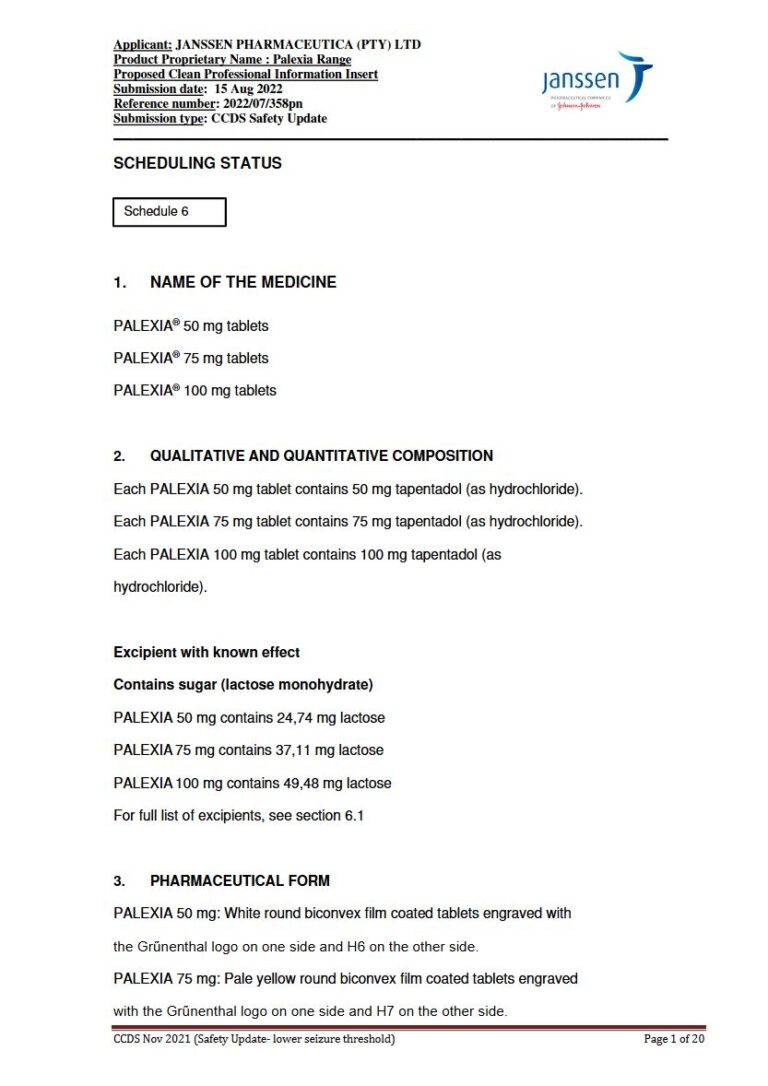
Palexia Range 50 mg. 75 mg. 100 mg Tablet.
PDF Leaflet Revision Date: 25 October 2022
Clinical Summary
Quick overview from the medicine insert
Indication
Short-term relief of acute moderately severe post-operative pain in adults.
Dosage (summary)
50 to 100 mg every 4 to 6 hours; max 600 mg/day.
Special Populations
- Renal impairment
- Hepatic impairment
- Elderly patients
Pregnancy & Breastfeeding
Contraindicated in pregnancy and lactation; may cause neonatal withdrawal syndrome.
Key Drug Interactions
- Serotonergic drugs
- CNS depressants
- MAO inhibitors
Contraindications
- Hypersensitivity to tapentadol
- Respiratory depression
- Severe renal impairment
- Severe hepatic impairment
- Acute pancreatitis
Common side effects
- Nausea
- Dizziness
- Somnolence
- Headache
Counselling Points
- Take with sufficient liquid.
- Monitor for signs of abuse.
- Avoid driving or operating machinery.
Serious warnings
- Potential for abuse
- Respiratory depression
- Seizure risk
Important Disclaimer
The Palexia Range 50 mg. 75 mg. 100 mg Tablet. professional information leaflet below is the property of Janssen Pharmaceutica and is provided on Medinsert exactly as issued, with no.. alterations or editorial changes. We make every effort to keep content current by updating documents as soon as new versions become available. Medinsert serves as a trusted access point for healthcare professionals, but does not replace official sources or clinical judgement. For more details, please read our full disclaimer. read more>>
 Healthcare Professionals Only
This content is for registered healthcare professionals
Sign in or create a free account to read the full package insert.
Free for HPCSA-registered professionals. Powered by Medinsert.
Clinical Particulars
Section 4 of the official insert — extracted exactly as issued, no alterations
4.1 Therapeutic indications
PALEXIA is indicated for the short-term relief of acute moderately severe post-operative pain in patients aged 18 years and older. The duration of therapy should not exceed 10 days. In clinical pharmacokinetic interaction studies with naproxen and probenecid there was an increase in AUC of tapentadol by 17 % and 57 %, respectively.
4.2 Posology and method of administration
The dosing regimen should be individualised according to the severity of pain being treated, the previous treatment experience and the ability to monitor the patient. The recommended oral dose is 50 to 100 mg PALEXIA every 4 to 6 hours depending upon the initial pain intensity. On the first day of dosing, a second dose may be taken as soon as one hour after the initial dose, if pain control is not achieved. Thereafter, the usual recommended dose is 50 to 100 mg PALEXIA every 4 to 6 hours and should be adjusted to maintain adequate analgesia with acceptable tolerability. Total daily doses greater than PALEXIA 600 mg have not been studied and are therefore, not recommended.
Discontinuation of treatment
Withdrawal symptoms could occur after abrupt discontinuation of treatment with PALEXIA (See Special warnings and precautions for use). When a patient no longer requires therapy with PALEXIA, it may be advisable to taper the dose gradually to prevent symptoms of withdrawal.
Special populations
Renal Impairment
No dosage adjustment is recommended in patients with mild or moderate renal impairment (See Pharmacokinetic properties). PALEXIA has not been studied in patients with severe renal impairment, therefore the use in this population is not recommended (See Special Warnings and precautions for use and Pharmacokinetic properties and Contraindications).
Hepatic Impairment
No dosage adjustment is recommended in patients with mild hepatic impairment (See Pharmacokinetic properties). PALEXIA should be used with caution in patients with moderate hepatic impairment. Treatment in these patients should be initiated at PALEXIA 50 mg and not be administered more frequently than once every 8 hours (maximum of three doses in 24 hours). Further treatment should reflect maintenance of analgesia with acceptable tolerability, to be achieved by either shortening or lengthening the dosing interval (See Special Warnings and precautions for use and Pharmacokinetic properties).
PALEXIA has not been studied in patients with severe hepatic impairment and, therefore, use in this population is not recommended (See Contraindications).
Elderly Patients (persons aged 65 years and over)
Recommended dosing for elderly patients with normal renal and hepatic function is the same as for younger adult patients with normal renal and hepatic function. Because elderly patients are more likely to have decreased renal and hepatic function, care should be taken in dose selection as recommended (See Pharmacokinetic properties).
Paediatric Patients
PALEXIA is not recommended for use in children below 18 years of age due to insufficient data on safety and efficacy in this population.
Method of administration
PALEXIA should be taken whole with sufficient liquid. PALEXIA may be administered with or without food.
4.3 Contraindications
PALEXIA is contraindicated:
- in patients with a known hypersensitivity to the active substance, tapentadol, or any component of the product;
- in situations where medicines with u03bc-opioid receptor agonist activity, such as PALEXIA, are contraindicated, i.e. patients with respiratory depression and patients with acute or severe bronchial asthma or hypercapnia;
- in patients with head injury;
- in severe renal impairment (CrCl < 30 ml/min);
- in severe hepatic impairment;
- in acute pancreatitis;
- in any patient who has or is suspected of having paralytic ileus;
- in patients with acute intoxication with alcohol, hypnotics, centrally acting analgesics, or psychotropic medicine (See Interaction with other medicines and other forms of interaction);
- in patients who are receiving MAO inhibitors or who have taken them within the last 14 days (See Interaction with other medicines and other forms of interaction);
- in pregnancy and lactation (See Fertility, Pregnancy and Lactation).
4.4 Special warnings and precautions for use
Potential for Abuse
PALEXIA has a potential for abuse. This should be considered when prescribing or dispensing PALEXIA in situations where there is concern about an increased risk of misuse, abuse, or diversion. Patients treated with PALEXIA should be carefully monitored for signs of abuse and addiction.
Respiratory Depression
PALEXIA may produce dose-related respiratory depression. Therefore, PALEXIA should not be administered to patients with impaired respiratory function (See Contraindications).
Head Injury and Increased Intracranial Pressure
PALEXIA should not be used in patients who may be susceptible to the intracranial effects of carbon dioxide retention, such as those with evidence of increased intracranial pressure, impaired consciousness, or coma. PALEXIA may obscure the clinical course of patients with head injury.
Seizures
PALEXIA has not been evaluated in patients with a seizure disorder. PALEXIA should be prescribed with care in patients with a history of a seizure disorder or any condition that would put the patient at risk of seizures. In addition, PALEXIA may increase the seizure risk in patients taking other medicinal products that lower the seizure threshold.
Renal impairment
PALEXIA has not been studied in efficacy studies in patients with severe renal impairment, therefore the use in this population is contraindicated (See Posology and method of administration and Pharmacokinetic properties).
Hepatic impairment
A study of PALEXIA in subjects with hepatic impairment showed higher serum concentrations than in those with normal hepatic function. PALEXIA should be used with caution in patients with moderate hepatic impairment (See Posology and method of administration and Pharmacokinetic properties).
Use in Pancreatic/Biliary Tract Disease
PALEXIA may cause spasm of the sphincter of Oddi. PALEXIA should be used with caution in patients with biliary tract disease. PALEXIA should not be used in patients with acute pancreatitis (See Contraindications).
Sleep-related breathing disorders
Opioids can cause sleep-related breathing disorders including central sleep apnea (CSA) and sleep-related hypoxemia. Opioid use increases the risk of CSA in a dose-dependent fashion. In patients who present with CSA, consider decreasing the total opioid dosage.
Lactose warning
PALEXIA contains lactose. Patients with rare hereditary problems of galactose intolerance, the Lapp lactase deficiency or glucose-galactose malabsorption should not take this medicine.
4.5 Interaction with other medicinal products and other forms of interaction
There have been reports of serotonin syndrome associated with the therapeutic use of PALEXIA in combination with serotoninergic medicinal products such as selective serotonin re-uptake inhibitors (SSRIs), serotonin-norepinephrine reuptake inhibitors (SNRIs) and tricyclic antidepressants. Serotonin syndrome is likely when one of the following is observed:
- Spontaneous clonus
- Inducible or ocular clonus with agitation or diaphoresis
- Tremor and hyperreflexia
- Hypertonia and body temperature > 38u00b0C and inducible clonus or ocular clonus.
Signs of serotonin syndrome may be for example confusion, agitation, fever, sweating, ataxia, hyperreflexia, myoclonus and diarrhoea. Withdrawal of the serotoninergic medicinal products usually brings about a rapid improvement. Treatment depends on the nature and severity of the symptoms.
There is no clinical data on the concomitant use of PALEXIA with mixed opioid agonist/antagonists (such as pentazocine, nalbuphine) or partial u03bc-opioid agonists. The analgesic effect provided by the u03bc-opioid component of PALEXIA may be reduced in such circumstances. Therefore, care should be taken when combining PALEXIA with these medicinal products.
PALEXIA can induce convulsions and increase the potential for selective serotonin reuptake inhibitors (SSRIs), serotonin-norepinephrine reuptake inhibitors (SNRIs), tricyclic antidepressants, antipsychotics and other medicinal products that lower the seizure threshold to cause convulsions. Patients receiving other u03bc-opioid receptor agonist analgesics, general anaesthetics, phenothiazines or other tranquilisers, sedatives, hypnotics or other CNS depressants (including alcohol and illicit drugs) concomitantly with PALEXIA may exhibit additive CNS depression. Interactive effects resulting in respiratory depression, hypotension, profound sedation, or coma may result if these substances are taken in combination with PALEXIA. When such combined therapy is contemplated, a reduction of dose of one or both medicines should be considered.
PALEXIA is contraindicated in patients who are receiving monoamine oxidase (MAO) inhibitors or who have taken them within the last 14 days due to potential additive effects on norepinephrine (noradrenaline) levels which may result in adverse cardiovascular events (See Contraindications).
4.6 Fertility, pregnancy and lactation
Pregnancy
PALEXIA should not be used during pregnancy (See Contraindications). Studies in animals have shown CNS depressive effects and delayed post-natal development. Long term maternal use of opioids during pregnancy co-exposes the foetus. The newborn may experience subsequent neonatal withdrawal syndrome (NOWS).
Labour and Delivery
The effect of PALEXIA on labour and delivery in humans is unknown. PALEXIA is not recommended for use in women during and immediately prior to labour and delivery. Due to the u03bc-opioid receptor agonist activity of PALEXIA, neonates whose mothers have been taking PALEXIA should be monitored for respiratory depression.
Lactation
PALEXIA should not be used by mothers who are breastfeeding their infants. PALEXIA is excreted in milk.
4.7 Effects on ability to drive and use machines
PALEXIA may have a major influence on the ability to drive and use machines due to the fact that it may adversely affect central nervous system functions (see Undesirable Effects). This has to be expected especially at the beginning of treatment, at any change of dosage as well as in connection with alcohol or tranquilisers. Patients should be cautioned as to whether driving or use of machines is permitted.
4.8 Undesirable effects
Clinical Trial Data
Approximately 65 % of PALEXIA treated patients in the placebo controlled studies experienced adverse reactions. The most frequent adverse reactions were in the gastrointestinal and central nervous system (nausea, dizziness, vomiting, somnolence, and headache). Approximately 9 % of PALEXIA treated patients with adverse reactions discontinued from clinical studies. The information below lists adverse reactions that were identified from clinical trials performed with PALEXIA and from post-marketing environment. They are listed by system organ class and frequency. The following terms and frequencies are applied: very common (u2265 1/10); common (u2265 1/100 to < 1/10); uncommon (u2265 1/1,000 to < 1/100); rare (u2265 1/10,000 to < 1/1,000); very rare (< 1/10,000); and not known (cannot be estimated from the available data).
ADVERSE DRUG REACTIONS
System Organ Class Frequency
Very common Common Uncommon Rare Unknown
Immune system disorders Medicine hypersensitivity
Metabolism and nutrition disorders Decreased appetite
Psychiatric disorders Anxiety, confusional state, hallucination, sleep disorder, abnormal dreams Depressed mood, disorientation, agitation, nervousness, restlessness, euphoric mood Abnormal thinking
Nervous system disorders Dizziness, somnolence, headache Tremor Disturbance in attention, memory impairment, presyncope, sedation, ataxia, dysarthria, hypoaesthesia, paraesthesia, involuntary muscle, Convulsion, depressed level of consciousness, abnormal coordination.
Eye disorders Visual disturbance.
Cardiac disorders Increased heart rate, palpitations. Decreased heart rate
Vascular disorders Flushing Decreased blood pressure
Respiratory, thoracic and mediastinal disorders Respiratory depression, decreased oxygen saturation, dyspnoea.
Gastrointestinal disorders Nausea, vomiting. Constipation, diarrhoea, dyspepsia, dry mouth. Abdominal discomfort Impaired gastric emptying
Skin and subcutaneous tissue disorders Pruritus, hyperhidrosis, rash. Urticaria.
Musculoskeletal and connective tissue disorder Muscle spasms. Sensation of heaviness.
Renal and urinary disorders Urinary hesitation, pollakiuria
General disorders and administration site conditions Asthenia, fatigue, Drug withdrawal syndrome, oedema, abnormal feeling, feeling drunk, irritability, feeling of relaxation.
Medical practitioners should be vigilant for symptoms of withdrawal and treat patients accordingly, should they occur.
Post-Marketing experience
Postmarketing data Adverse Reactions Identified During Postmarketing Experience Angioedema, anaphylaxis, anaphylactic shock, delirium and increased blood pressure have been reported. Suicidal ideation has been reported.
Reporting of side effects
If you get side effects, talk to your doctor, pharmacist or nurse. This includes any possible side effects not listed in this leaflet. You can also report side effects to SAHPRA via the u201c6.04 Adverse Drug Reaction Reporting Formu201d, found online under SAHPRAu2019s publications: https://www.sahpra.org.za/Publications/Index/8. By reporting side effects, you can help provide more information on the safety of PALEXIA.
4.9 Overdose
Symptoms include miosis, vomiting, cardiovascular collapse, consciousness disorders up to coma, convulsions and respiratory depression up to respiratory arrest.
Management of Overdosage
Management of overdose should be focused on treating the symptoms of u03bc-opioid receptor agonism. Primary attention should be given to re-establishment of a patent airway and institution of assisted or controlled ventilation when overdose of PALEXIA is suspected. Pure opioid antagonists such as naloxone, are specific antidotes to respiratory depression resulting from opioid overdose. Respiratory depression following an overdose may outlast the duration of action of the opioid antagonist. Administration of an opioid antagonist is not a substitute for continuous monitoring of airway, breathing, and circulation following an opioid overdose. If the response to opioid antagonists is suboptimal or only brief in nature, an additional antagonist should be administered as directed by the manufacturer of the product. Gastrointestinal decontamination may be considered in order to eliminate unabsorbed medicine. Gastrointestinal decontamination with activated charcoal may be considered within 2 hours after intake. Before attempting gastrointestinal decontamination, care should be taken to secure the airway.
