
Emten 300 mg, 200 mg. Tablets
PDF Leaflet Revision Date: 02 February 2023
Clinical Summary
Quick overview from the medicine insert
Indication
Treatment of HIV-1 infection and Pre-Exposure Prophylaxis (PrEP) in high-risk adults.
Dosage (summary)
One tablet once daily, with or without food.
Special Populations
- Renal impairment
- Hepatic impairment
Pregnancy & Breastfeeding
Not recommended during pregnancy; avoid breastfeeding to prevent HIV transmission.
Key Drug Interactions
- Nephrotoxic medicines
- Didanosine
- Atazanavir
- Lopinavir/ritonavir
Contraindications
- Hypersensitivity to components
- Moderate to severe renal failure
- Unknown or positive HIV-1 status
Common side effects
- Headache
- Dizziness
- Nausea
- Vomiting
- Diarrhoea
Counselling Points
- Monitor for signs of lactic acidosis
- Adhere to treatment compliance
- Regular follow-up for opportunistic infections
Serious warnings
- Lactic acidosis
- Severe hepatomegaly
- Immune Reconstitution Inflammatory Syndrome
Important Disclaimer
The Emten 300 mg, 200 mg. Tablets professional information leaflet below is the property of Emcure Pharmaceuticals Sa and is provided on Medinsert exactly as issued, with no.. alterations or editorial changes. We make every effort to keep content current by updating documents as soon as new versions become available. Medinsert serves as a trusted access point for healthcare professionals, but does not replace official sources or clinical judgement. For more details, please read our full disclaimer. read more>>
 Healthcare Professionals Only
This content is for registered healthcare professionals
Sign in or create a free account to read the full package insert.
Free for HPCSA-registered professionals. Powered by Medinsert.
Clinical Particulars
Section 4 of the official insert — extracted exactly as issued, no alterations
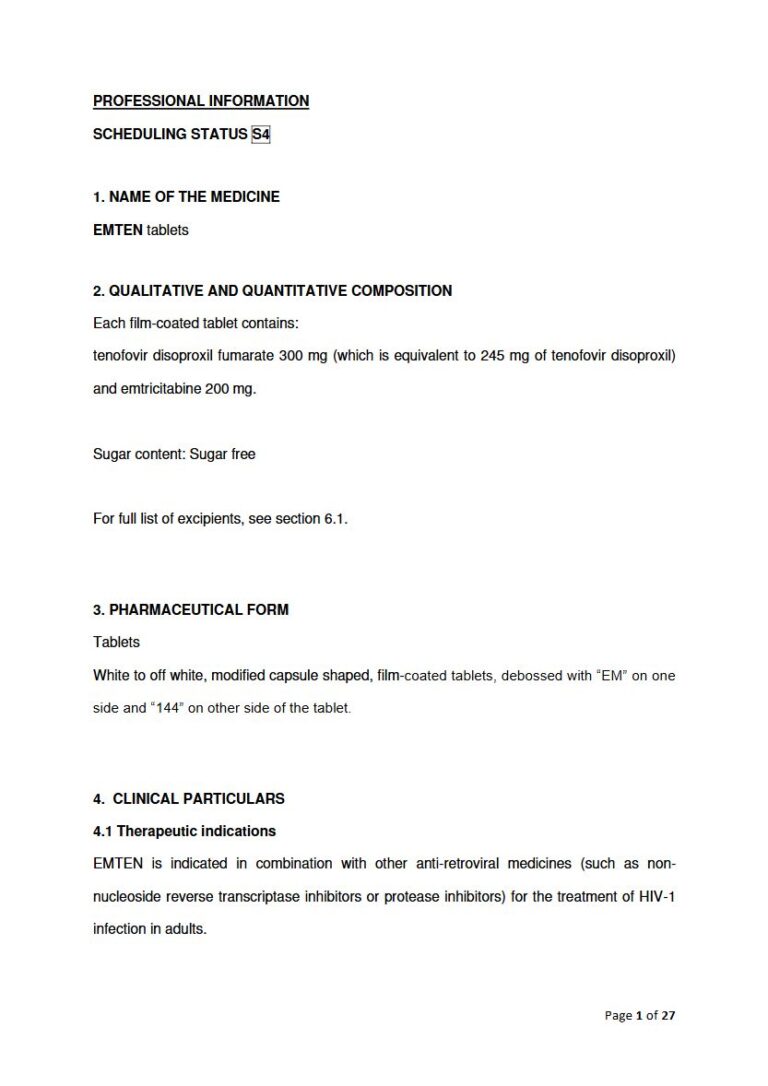
4.1 Therapeutic indications
EMTEN is indicated in combination with other anti-retroviral medicines (such as non-nucleoside reverse transcriptase inhibitors or protease inhibitors) for the treatment of HIV-1 infection in adults.
EMTEN is indicated in combination with safer sex practices for Pre-Exposure Prophylaxis (PrEP) in proven HIV-1 uninfected adults to reduce the risk of sexually acquired HIV-1 in adults at high risk, provided maximum treatment compliance can be monitored.
4.2 Posology and method of administration
Posology
The dose of EMTEN is one tablet once daily taken orally with or without food.
Dosage for Pre-Exposure Prophylaxis
The dose of EMTEN in HIV-1 uninfected adults is one tablet (containing 200 mg of emtricitabine and 300 mg of tenofovir disoproxil fumarate) once daily taken orally with or without food.
Renal impairment: Significantly increased exposure occurred when emtricitabine (200 mg) or tenofovir were administered to patients with moderate to severe renal impairment, therefore EMTEN (which is a fixed dose combination) should not be prescribed for patients requiring dosage adjustments (see section 4.3).
Method of administration
EMTEN is taken orally with or without food.
4.3 Contraindications
- EMTEN is contraindicated in patients with previously demonstrated hypersensitivity to tenofovir or emtricitabine or any of the components of the medicine.
- EMTEN is contraindicated in patients with moderate to severe uncontrolled renal failure.
- Creatinine CL < 60 ml/min when used for PrEP.
- Creatinine CL < 50 ml/min when used for treatment of HIV-1.
- EMTEN should not be used for Pre-Exposure Prophylaxis (PrEP) in individuals with unknown or positive HIV-1 status.
- EMTEN should not be used for PrEP in individuals not fully committed to full treatment compliance.
- Pregnancy and lactation (see section 4.6).
4.4 Special warnings and precautions for use
LACTIC ACIDOSIS AND SEVERE HEPATOMEGALY WITH STEATOSIS, INCLUDING FATAL CASES, HAVE BEEN REPORTED WITH THE USE OF NUCLEOSIDE ANALOGUES ALONE OR IN COMBINATION WITH OTHER ANTI-RETROVIRALS.
THE COMBINATION TABLET IS NOT INDICATED FOR THE TREATMENT OF CHRONIC HEPATITIS B VIRUS (HBV) INFECTION AND THE SAFETY AND EFFICACY OF THE COMBINATION TABLET HAVE NOT BEEN ESTABLISHED IN PATIENTS COINFECTED WITH HBV AND HIV. SEVERE ACUTE EXCERBATIONS OF HEPATITIS B HAVE BEEN REPORTED IN PATIENTS WHO HAVE DISCONTINUED EMTRICITABINE (200 MG) OR TENOFOVIR. HEPATIC FUNCTION SHOULD BE MONITORED CLOSELY WITH BOTH CLINICAL AND LABORATORY FOLLOW-UP FOR AT LEAST SEVERAL MONTHS IN PATIENTS WHO DISCONTINUE THE COMBINATION TABLET AND ARE COINFECTED WITH HIV AND HBV. IF APPROPRIATE, INITIATION OF ANTI-HEPATITIS B THERAPY MAY BE WARRANTED.
Lipodystrophy and metabolic abnormalities
Combination antiretroviral therapy has been associated with the redistribution/accumulation of body fat, including central obesity, dorso-cervical fat, enlargement (buffalo hump), peripheral wasting, facial wasting, breast enlargement, and elevated serum lipid and glucose levels in HIV patients. Clinical examination should include evaluation for physical signs of fat redistribution. Patients with evidence of lipodystrophy should have a thorough cardiovascular risk assessment.
Immune Reconstitution Inflammatory Syndrome
Immune reconstitution inflammatory syndrome (IRIS) is an immunopathological response resulting from the rapid restoration of pathogen-specific immune responses to pre-existing antigens combined with immune dysregulation, which occurs shortly after starting combination Anti-Retroviral Therapy (cART). Typically, such reaction presents by paradoxical deterioration of opportunistic infections being treated or with unmasking of an asymptomatic opportunistic disease, often with an atypical inflammatory presentation. IRIS usually develops within the first three months of initiation of ART and occurs more commonly in patients with low CD4 counts. Common examples of IRIS reactions to opportunistic diseases are tuberculosis, cytomegalovirus retinitis, and cryptococcal meningitis. Appropriate treatment of the opportunistic disease should be instituted or continued and ART continued. Inflammatory manifestations generally subside after a few weeks. Severe cases may respond to glucocorticoids, but there is only limited evidence for this in patients with tuberculosis IRIS. Autoimmune disorders (such as Graves' disease) have also been reported as IRIS reactions; however, the reported time to onset is more variable and these events can occur many months after initiation of treatment.
Osteonecrosis
Although the aetiology is considered to be multifactorial (including corticosteroid use, alcohol consumption, severe immunosuppression, higher body mass index), cases of osteonecrosis have been reported, particularly in patients with advanced HIV-disease and/or long-term exposure to combination antiretroviral therapy (cART). Patients should be advised to seek medical advice if they experience joint aches and pain, joint stiffness or difficulty in movement. Tenofovir disoproxil fumarate may be associated with reduction in bone density and patients bone mineral density should be monitored for evidence of bone abnormalities. Bone monitoring should be considered for patients with a history of bone fractures or those at risk of osteopenia.
Opportunistic infections
Patients receiving EMTEN should be advised that they may continue to develop opportunistic infections and other complications of HIV infection, and therefore they should remain under close observation by healthcare professionals experienced in the treatment of patients with associated HIV disease. Regular monitoring of viral load and CD4 counts needs to be done.
The risk of HIV transmission to others
Patients should be advised that current antiretroviral therapy, including EMTEN, does not prevent the risk of transmission of HIV to others through sexual contact or blood contamination. Appropriate precautions should continue to be employed.
Lactic acidosis / hyperlactataemia
Use of EMTEN can result in potentially fatal lactic acidosis as a consequence of mitochondrial dysfunction. Clinical features are non-specific, and include nausea, vomiting, abdominal pain, dyspnoea, fatigue and weight loss. In patients with suspicious symptoms or biochemistry, measure the venous lactate level (normal < 2 mmol/u2113) and the serum bicarbonate and respond as follows:
- Lactate 2-5 mmol /u2113 with minimum symptoms: switch to medicines that are less likely to cause lactic acidosis.
- Lactate 5-10 mmol/u2113 with symptoms and/or with reduced standard bicarbonate: Stop NRTIs and change treatment option. Once lactate has settled, use medicines that are less likely to cause lactic acidosis. Exclude other causes, (e.g. sepsis, uraemia, diabetic ketoacidosis, thyrotoxicosis and hyperthyroidism.
- Lactate > 10 mmol/u2113: STOP all therapy (80 % mortality). The above lactate values may not be applicable to paediatric patients. Caution should be exercised when administering EMTEN to patients with known risk factors for liver disease. Treatment with EMTEN should be suspended in any patient who develops clinical or laboratory findings suggestive of lactic acidosis or hepatotoxicity.
Mitochondrial dysfunction
Nucleoside and nucleotide analogues have been demonstrated in vitro and in vivo to cause a variable degree of mitochondrial damage. There have been reports of mitochondrial dysfunction in HIV negative infants exposed in utero and/or post-natally to nucleoside analogues. Apart from lactic acidosis/hyperlactataemia (see above) other manifestations of mitochondrial dysfunction include haematological disorders (anaemia, neutropenia), and peripheral neuropathy. Some late-onset neurological disorders have been reported (hypertonia, convulsion, abnormal behaviour). It is not known whether the neurological disorders are transient or permanent. Any foetus exposed in utero to nucleoside and nucleotide analogues, even HIV negative infants/children, should have clinical and laboratory follow-up and should be fully investigated for possible mitochondrial dysfunction in case of relevant sign and symptoms.
Pancreatitis
Pancreatitis has been observed in some patients receiving EMTEN. Pancreatitis must be considered whenever a patient develops abdominal pain, nausea, vomiting or elevated biochemical markers. Discontinue use of EMTEN until diagnosis of pancreatitis is excluded.
Patients with moderate to severe renal impairment
In patients with moderate to severe renal impairment, the terminal half-life of EMTEN is increased due to decreased clearance as the dose of EMTEN (fixed dose combination) cannot be adjusted. EMTEN should not be taken in patients with moderate to severe renal impairment (see section 4.3).
Liver disease
Use of EMTEN can result in hepatomegaly due to non-alcoholic fatty liver disease (hepatic steatosis). The safety and efficacy of EMTEN has not been established in patients with significant underlying liver disorders/diseases. In case of concomitant antiviral therapy for hepatitis B or C, please also consult the relevant package inserts for these medicines. Patients with pre-existing liver dysfunction including chronic active hepatitis have an increased frequency of liver function abnormalities during combination antiretroviral therapy and should be monitored. If there is evidence of worsening liver disease in such patients, temporary or permanent discontinuation of treatment must be considered.
Patients with HIV and hepatitis B or C virus co-infection
Patients with chronic hepatitis B or C and treated with antiretroviral therapy are at an increased risk for severe and potentially fatal hepatic adverse reactions. Medical practitioners should refer to current HIV treatment guidelines for the optimal management of HIV infection in patients co-infected with hepatitis B virus (HBV). In case of concomitant antiviral therapy for hepatitis B or C, please refer also to the relevant package inserts for these medicines. Patients co-infected with HIV and HBV who discontinue EMTEN should be closely monitored with both clinical and laboratory follow-up after stopping treatment. In patients with advanced liver disease or cirrhosis, treatment discontinuation is not recommended since post-treatment exacerbation of hepatitis may lead to hepatic decompensation.
Renal impairment
Emtricitabine and tenofovir are principally eliminated by the kidney. EMTEN should not be administered to patients with creatinine clearance < 30 ml/min or patients requiring haemodialysis. Renal impairment, including cases of acute renal failure and Fanconi syndrome (renal tubular injury with severe hypophosphataemia), has been reported in association with the use of tenofovir. EMTEN should be avoided with concurrent or recent use of a nephrotoxic medicine. Patients at risk for, or with a history of, renal dysfunction and patients receiving concomitant nephrotoxic medicines should be carefully monitored for changes in serum creatinine and phosphorus.
4.5 Interactions with other medicines and other forms of interaction
Interaction studies with EMTEN tablets have not been conducted. Emtricitabine and tenofovir disoproxil fumarate:
The steady state pharmacokinetic properties of emtricitabine and tenofovir as in EMTEN, remained unchanged when emtricitabine and tenofovir disoproxil fumarate were administered together versus each medicine given alone. In vitro and clinical pharmacokinetic medicine interaction studies have found that the potential of CYP450 mediated interactions involving emtricitabine and tenofovir, as in EMTEN, with other medicines is low. The kidneys are primarily responsible for the excretion of emtricitabine and tenofovir through a combination of glomerular filtration and active tubular secretion. Although no interactions due to competition for renal excretion have been observed, it is possible that, when EMTEN is co-administered with medicines that are eliminated by active tubular secretion, the concentrations of emtricitabine, tenofovir and/or the concomitant medicine may increase. Medicines that reduce renal function may increase emtricitabine and/or tenofovir concentrations. The use of tenofovir disoproxil fumarate with nephrotoxic medicines or with medicines eliminated by active tubular secretion is not recommended. If such use is unavoidable, renal function should be monitored weekly. Clinically significant medicine interactions have not been observed between emtricitabine, one of the active ingredients in EMTEN, and famciclovir, indinavir, stavudine and tenofovir disoproxil fumarate. Co-administration of tenofovir disoproxil fumarate 300 mg once daily for 7 days with emtricitabine, 200 mg once daily for 7 days, caused no changes in the C max or AUC of emtricitabine. However, C max of emtricitabine increased by 20 % [90 % confidence interval (CI) + 12 % to + 29 %]. The C max, AUC and C min of tenofovir were unchanged. Co-administration of single doses of indinavir 800 mg, famciclovir 500 mg and stavudine 40 mg with a single dose of emtricitabine 200 mg did not alter the C max or AUC of emtricitabine or the co-administered medicine. Similarly, clinically significant interactions have not been observed between tenofovir disoproxil fumarate, one of the active ingredients in EMTEN, and abacavir, adefovir dipivoxil, ribavirin, efavirenz, indinavir, lamivudine, lopinavir/ritonavir, methadone and oral contraceptives. Co-administration of a single dose abacavir 300 mg with tenofovir caused no changes in the C max or AUC of tenofovir. However, C max of abacavir increased by 12 % (90 % CI u2013 1 % to + 26 %), while the AUC remained unchanged. Concomitant administration of a single dose of adefovir dipivoxil 10 mg with tenofovir 300 mg did not result in any changes in the C max or AUC of tenofovir nor in the C max, C min or AUC of tenofovir nor in the C max or AUC of adefovir dipivoxil. Co-administration of atazanavir 400 mg once daily for 14 days with tenofovir 300 mg once daily resulted in a 14 % increase (90 % CI + 8 % to + 20 %) in tenofovir C max 24 % increase (+ 21 % to + 28 %) in tenofovir AUC and 22 % increase (+ 15 % to + 30 %) in tenofovir C min. Corresponding parameters for atazanavir showed a 21 % decrease (- 27 to u2013 14 %) in C max 25 % decrease (- 30 % to -19 %) in AUC and 40 % decrease (- 48 % to u2013 32 %) in C min. In HIV-infected patients, addition of tenofovir disoproxil fumarate to atazanavir 300 mg plus ritonavir 100 mg, resulted in AUC and C min values of atazanavir that were 2,3- and 4-fold higher than the respective values observed for atazanavir 400 mg when given alone. Concomitant administration of a single dose of enteric-coated didanosine 400 mg with tenofovir 300 mg did not result in any changes in the C max C min or AUC of tenofovir. The same holds true for the combination of buffered didanosine 250 or 400 mg once daily with tenofovir 300 mg once daily. When administered with multiple doses of tenofovir, the C max and AUC of didanosine 400 mg increased significantly. The mechanism of the interaction has not been identified. Concomitant administration of didanosine 250 mg enteric-coated capsules with tenofovir resulted in systematic exposures similar to those observed with the 400 mg enteric-coated capsules alone under fasted conditions. Tenofovir disoproxil fumarate: When tenofovir disoproxil fumarate was administered with didanosine the Cmax and AUC of didanosine administered as either the buffered or enteric-coated formulation increased significantly. The mechanism of this action is unknown. Higher didanosine concentrations could potentiate didanosine-associated adverse events, including pancreatitis, and neuropathy. In adults weighing > 60 kg, the didanosine dose should be reduced to 250 mg when it is co-administered with EMTEN. Data are not available to recommend a dose adjustment of didansine for patients weighing < 60 kg. When co-administered, EMTEN and didanosine may be taken under fasted conditions or with a light meal (< 400 kcal, 20 % fat). Co-administration of didanosine buffered tablet formulation with EMTEN should be under fasted conditions. Co-administration of EMTEN and didanosine should be undertaken with caution and patients receiving this combination should be monitored closely for didanosin-associated adverse events. Didanosine should be discontinued in patients who develop didansine-associated adverse events. Atazanavir and lopinavir/ritonavir have been shown to increase tenofovir concentrations. The mechanism of this action is unknown. Patients receiving atazanavir and lopinavir/ritonavir and EMTEN should be monitored for EMTEN-associated adverse events. EMTEN should be discontinued in patients who develop EMTEN associated adverse events. Tenofovir decreases the AUC and Cmin of atazanavir. When co-administered with EMTEN, it is recommended that atazanavir 300 mg is given with ritonavir 100 mg. Atazanavir without ritonavir should not be co-administered with EMTEN. Emtricitabine and tenofovir disoproxil fumarate:
Since emtricitabine and tenofovir are primarily eliminated by the kidneys, co-administration of EMTEN with medicines that reduce renal function or compete for active tubular secretion may increase serum concentrations of emtricitabine, tenofovir, and/or other renally eliminated medicines. Some examples include, but are not limited to adefovir, dipivoxil, cidofovir, acyclovir, valacyclovir, ganciclovir and valganciclovir. EMTEN is a fixed-dose combination of emtricitabine and tenofovir disoproxil fumarate. EMTEN should not be co-administered with (emtricitabine 200 mg) or tenofovir. Due to similarities between emtricitabine and lamivudine, EMTEN should not be co-administered with other medicines containing lamivudine, including lamivudine and zidovudine co-formulation, lamivudine for HIV, lamivudine for HBV, abacavir sulphate and lamivudine co-formulation or abacavir sulphate, lamivudine and zidovudine co-formulation.
4.6 Fertility, pregnancy and lactation
Pregnancy
A reliable method of contraceptive should be used to avoid pregnancy while taking EMTEN. There are no adequate and well-controlled studies of EMTEN in pregnant women. EMTEN should not be used during pregnancy (see section 4.3).
Lactation
It is recommended that HIV-infected mothers not breastfeed their infants to avoid risking postnatal transmission of HIV. Because of both the potential for HIV transmission and the potential for serious adverse reactions in nursing infants, mothers should be instructed not to breastfeed if they are receiving EMTEN.
4.7 Effects on ability to drive and use machines
Dizziness has been reported during treatment with both emtricitabine and tenofovir disoproxil fumarate, therefore caution should be exercised when driving or operating machinery.
4.8 Undesirable effects
a. Summary of the safety profile
Not Applicable
b. Tabulated summary of adverse reactions
Side-effects which have been associated with the individual components of EMTEN are listed below:
Emtricitabine
Nervous system disorders
Frequent: headache, dizziness.
Psychiatric disorders
Frequent: sleep disturbances (abnormal dreams, insomnia), depressive disorder.
Frequency unknown: neuropathy, paraesthesia, peripheral neuritis, asthenia.
Tenofovir disoproxil fumarate
Nervous system disorders
Frequent: headache, dizziness.
Psychiatric disorders
Frequent: sleep disturbances (abnormal dreams, insomnia), depressive disorder.
Frequency unknown: depression, asthenia, insomnia, peripheral neuropathy (including peripheral neuritis and neuropathy), anxiety.
Gastrointestinal disorders
Frequent: nausea, vomiting, diarrhoea, elevated amylase including elevated pancreatic amylase, elevated serum lipase, abdominal pain, dyspepsia.
Less frequent: pancreatitis, serum-amylase concentrations may be raised. Frequency unknown: abdominal pain.
Skin and subcutaneous tissue disorders
Frequent: rash event (including rash, pruritus, maculopapular rash, urticaria, vesiculobullous rash, pustular rash and allergic reaction).
Frequency unknown: skin discolouration manifested by hyperpigmentation on the palms and/or sole, but is generally mild.
Musculoskeletal, connective tissue and bone disorders
Less frequent: rhabdomyolysis, muscular weakness, osteomalacia (manifested as bone pain and infrequently contributing to fractures), myopathy.
Frequency unknown: myalgia, arthralgia.
Blood and lymphatic system disorders
Frequent: neutropenia.
Less frequent: anaemia.
Frequency unknown: neutropenia, haematuria.
Renal and urinary disorders
Frequent: elevated creatinine kinase.
Less frequent: increased creatinine, proteinuria, renal failure (acute and chronic), acute tubular necrosis, proximal renal tubulopathy including Fanconi syndrome, nephritis (including acute interstitial nephritis), nephrogenic diabetes insipidus.
Hepato-biliary disorders
Frequent: elevated serum aspartate aminotransferase (AST) and/or elevated serum alanine aminotransferase (ALT), hyperbilirubinaemia.
Less frequent: hepatic steatosis, hepatitis.
Frequency unknown: hepatic steatosis.
Respiratory, thoracic and mediastinal disorders
Frequency unknown: increased cough and rhinitis.
Metabolism and nutrition disorders
Frequent: hyperglycaemia, hypertriglyceridaemia.
Less frequent: hypokalaemia.
Frequency unknown: lactic acidosis, usually associated with severe hepatomegaly and steatosis, has been associated with nucleoside reverse transcriptase inhibitors.
4.9 Overdose
If overdose occurs, the patient should be monitored for evidence of toxicity, including monitoring of vital signs and observation of the patientu2019s clinical status. Standard supportive treatment should then be applied as necessary.
Emtricitabine: Haemodialysis treatment removes approximately 30 % of the emtricitabine dose over a 3-hour dialysis period starting within 1,5 hours of emtricitabine dosing (blood flow rate of 400 ml/min and a dialysate flow rate of 600 ml/min). It is not known whether emtricitabine can be removed by peritoneal dialysis.
Tenofovir disoproxil fumarate: Tenofovir is efficiently removed by haemodialysis with an extraction coefficient of approximately 54 %. Following a single 300 mg dose of tenofovir DF, a 4-hour haemodialysis session can remove approximately 10 % of the administered tenofovir dose.
