
Androgel 50 mg/5 g Transdermal gel
Clinical Summary
Quick overview from the medicine insert
Indication
Replacement therapy in males with hypogonadism.
Dosage (summary)
Apply 5 g of gel (equivalent to 50 mg of testosterone) once daily to clean, dry skin on the shoulders or upper arms.
Onset of Action / Duration
Effects may be observed within 2-4 weeks, with maximum effects typically seen after 3-6 months.
Special Populations
- Elderly patients
- Patients with hepatic impairment
- Patients with renal impairment
Pregnancy & Breastfeeding
Not recommended during pregnancy and lactation due to potential risk to the fetus or infant.
Key Drug Interactions
- Anticoagulants (may enhance anticoagulant effect)
- Corticosteroids (may increase the risk of edema)
- Insulin (may require dose adjustment)
Contraindications
- Known hypersensitivity to testosterone or any excipients
- Prostate cancer
- Breast cancer in males
- Severe hepatic impairment
Common side effects
- Acne
- Gynecomastia
- Increased hematocrit
- Mood changes
- Sleep apnea
Counselling Points
- Apply to clean, dry skin and allow to dry before dressing.
- Wash hands thoroughly after application.
- Avoid skin contact with others until the application site is dry.
- Report any signs of excessive testosterone levels, such as mood swings or increased aggression.
Serious warnings
- Monitor for signs of prostate enlargement or cancer.
- Use with caution in patients with cardiovascular disease.
- Potential for abuse and dependence.
Important Disclaimer
The Androgel 50 mg/5 g Transdermal gel professional information leaflet below is the property of Medi Challenge and is provided on Medinsert exactly as issued, with no.. alterations or editorial changes. We make every effort to keep content current by updating documents as soon as new versions become available. Medinsert serves as a trusted access point for healthcare professionals, but does not replace official sources or clinical judgement. For more details, please read our full disclaimer. read more>>
 Healthcare Professionals Only
This content is for registered healthcare professionals
Sign in or create a free account to read the full package insert.
Free for HPCSA-registered professionals. Powered by Medinsert.
Clinical Particulars
Section 4 of the official insert — extracted exactly as issued, no alterations
4.1 Therapeutic indications
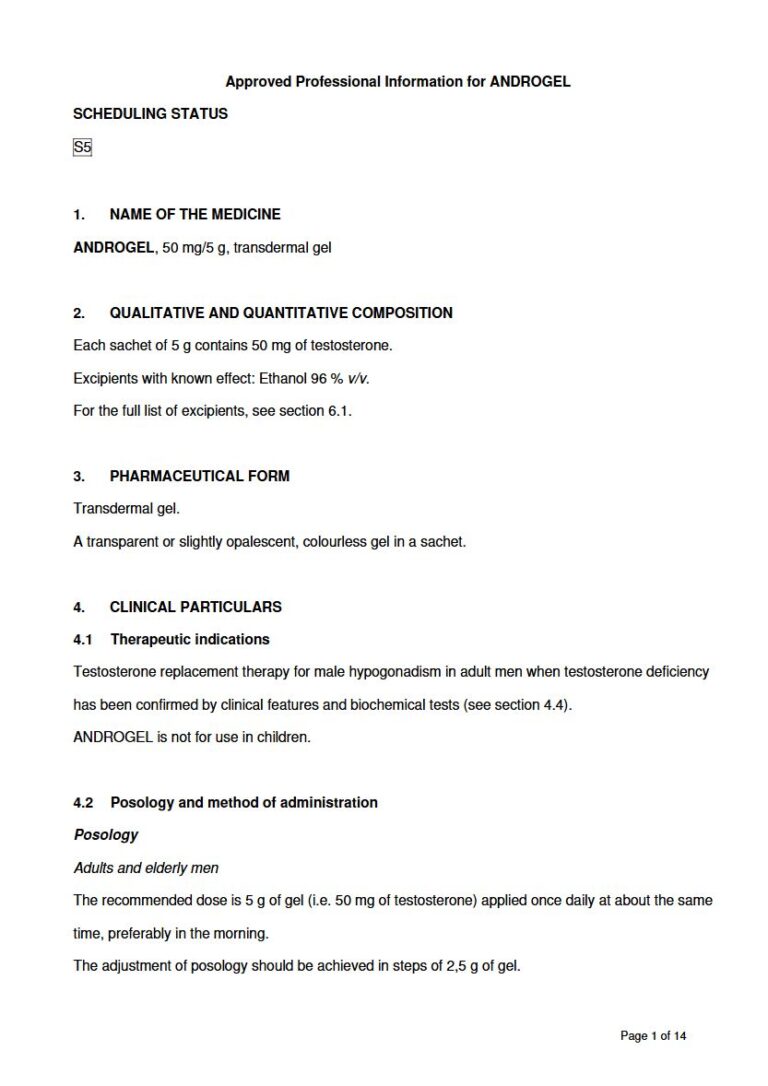
Testosterone replacement therapy for male hypogonadism in adult men when testosterone deficiency has been confirmed by clinical features and biochemical tests (see section 4.4). ANDROGEL is not for use in children.
4.2 Posology and method of administration
Posology
Adults and elderly men
The recommended dose is 5 g of gel (i.e. 50 mg of testosterone) applied once daily at about the same time, preferably in the morning. The adjustment of posology should be achieved in steps of 2,5 g of gel.
Steady state plasma testosterone concentrations are reached approximately on the 2nd day of treatment with ANDROGEL. In order to adjust the ANDROGEL dose, serum testosterone concentrations must be measured in the morning before application, from the 3rd day after starting treatment (one week is reasonable). The dose may be reduced if the plasma testosterone concentrations are raised above the desired level. If the concentrations are low, the dosage may be increased, but not exceeding 10 g of gel per day.
Children
ANDROGEL is not indicated for use in children.
Method of administration
Transdermal use. The application should be administered by the patient himself, onto clean, dry, healthy skin over both shoulders, both arms or abdomen. After opening the sachets, the total contents must be extracted from the sachet and applied immediately onto the skin. ANDROGEL should be gently spread on the skin, as a thin layer. It is not necessary to rub it on the skin. Allow drying for at least 3 u2013 5 minutes before dressing. Wash hands with soap and water after applications. Do not apply to the genital areas as the high alcohol content may cause local irritation.
4.3 Contraindications
ANDROGEL is contraindicated:
u2022 In cases of known hypersensitivity to testosterone or to any other ingredients of ANDROGEL (see section 6.1).
u2022 In cases of known or suspected prostatic cancer or breast carcinoma.
4.4 Special warnings and precautions for use
u2022 ANDROGEL is indicated for use only in men with primary or secondary hypogonadism resulting from certain medical conditions.
u2022 ANDROGEL should not be used for age-related hypogonadism.
u2022 Before initiating ANDROGEL, ensure that the diagnosis of hypogonadism has been confirmed with laboratory testing. Verify that serum testosterone concentrations have been measured on at least two separate mornings and are consistently below the normal range. Avoid measuring testosterone concentrations later in the day, when measurements can be low even in men who do not have hypogonadism.
u2022 Inform patients of the potential increased cardiovascular risk associated with ANDROGEL. Increases in myocardial infarction and stroke have been reported.
u2022 Encourage patients to read the patient information leaflet they receive with ANDROGEL. ANDROGEL should be used only if hypogonadism (hyper- and hypogonadotrophic) has been demonstrated and if other aetiology responsible for the symptoms has been excluded before treatment is initiated. Testosterone insufficiency should be clearly demonstrated by clinical features (regression of secondary sexual characteristics, change in body composition, asthenia, reduced libido, erectile dysfunction etc.) and confirmed by 2 separate blood testosterone measurements. Due to variability in laboratory values, all measures of testosterone should be carried out in the same laboratory.
Prior to ANDROGEL initiation, all patients must undergo a detailed examination in order to exclude a risk of pre-existing prostatic cancer. Careful and regular monitoring of the prostate gland and breasts must be performed in accordance with recommended methods (digital rectal examination and estimation of serum PSA) in patients receiving ANDROGEL therapy at least once yearly and twice yearly in elderly patients and at-risk patients (those with clinical or familial factors).
ANDROGEL may accelerate the progression of sub-clinical prostatic cancer and benign prostatic hyperplasia. ANDROGEL should not be used in cancer patients at risk of hypercalcaemia (and associated hypercalciuria), due to bone metastases. Regular monitoring of serum calcium concentrations is recommended in these patients.
In patients who have experienced myocardial infarction, suffering from severe cardiac, hepatic or renal insufficiency or ischaemic heart disease, treatment with ANDROGEL may cause severe complications characterised by oedema with or without congestive cardiac failure. In this case, treatment must be stopped immediately.
ANDROGEL may cause a rise in blood pressure and should be used with caution in men with hypertension. ANDROGEL should be used with caution in patients with thrombophilia or risk factors for venous thromboembolism (VTE), as there have been post-marketing studies and reports of thrombotic events (e.g. deep-vein thrombosis, pulmonary embolism, ocular thrombosis) in these patients during testosterone therapy. In thrombophilic patients, VTE cases have been reported even under anticoagulation treatment, therefore continuing testosterone treatment after first thrombotic event should be carefully evaluated. In case of treatment continuation, further measures should be taken to minimise the individual VTE risk.
The testosterone level should be monitored at baseline and at regular intervals during treatment. Health care practitioners should adjust the dosage individually to ensure maintenance of eugonadal testosterone levels. In patients receiving long-term ANDROGEL therapy, the following laboratory parameters should also be monitored regularly: haemoglobin, haematocrit (to detect polycythaemia), liver function tests, and lipid profile.
There is limited experience on the safety and efficacy of the use of ANDROGEL in patients over 65 years of age. Currently, there is no consensus about age-specific testosterone reference values. However, it should be taken into account that physiologically testosterone serum levels are lower with increasing age.
ANDROGEL should be used with caution in patients with epilepsy and migraine as these conditions may be aggravated.
There is an increased risk of sleep apnoea in hypogonadal patients treated with testosterone esters, such as ANDROGEL, especially in those with risk factors such as obesity and chronic respiratory disease.
Improved insulin sensitivity may occur in patients treated with ANDROGEL and may require a decrease in the dose of antidiabetic medicine (see section 4.5). Monitoring of the glucose level and HbA1c is advised for patients treated with ANDROGEL.
Certain clinical signs such as irritability, nervousness, weight gain, and prolonged or frequent erections may indicate excessive ANDROGEL exposure requiring dosage adjustment. If the patient develops a severe application site reaction, treatment should be reviewed and discontinued if necessary.
The attention of athletes is drawn to the fact that ANDROGEL contains an active substance (testosterone) which may produce a positive reaction in anti-doping tests.
ANDROGEL should not be used by women, due to its potential virilising effects.
Potential testosterone transfer
ANDROGEL can be transferred to other persons by close skin-to-skin contact, resulting in increased testosterone serum levels and possibly adverse effects (e.g. growth of facial and/or body hair, deepening of the voice, irregularities of the menstrual cycle) in case of repeated contact (inadvertent androgenisation). The health care practitioner should inform the patient carefully about the risk of testosterone transfer, for instance during close bodily contact between individuals including children and about safety instructions (see below). ANDROGEL should not be prescribed in patients with a major risk of non-compliance with safety instructions (e.g. severe alcoholism, drug abuse, severe psychiatric disorders). Transfer of ANDROGEL is avoided by wearing clothes covering the application area or showering prior to contact.
The following precautions are recommended:
For the patient
u2022 Wash hands with soap and water after applying the gel.
u2022 Cover the application area with clothing once the gel has dried.
u2022 Wash the application area before any situation in which close contact is foreseen.
For people not being treated with ANDROGEL
u2022 In the event of adventitious contact with ANDROGEL, the person affected should wash the affected area with soap and water, immediately.
u2022 Report the development of signs of excessive androgen exposure, such as acne or hair modification. Patients should wait at least 1 hour before showering or bathing after applying ANDROGEL. To guarantee partner safety the patient should be advised, for example, to observe a long interval between ANDROGEL application and sexual intercourse, to wear a T-shirt covering the application site during the contact period or to shower before sexual intercourse. Furthermore, it is recommended to wear a T-shirt covering the application site during any contact period with children, to avoid the risk of contaminating childrenu2019s skin. Pregnant women must avoid any contact with ANDROGEL application sites. In case of pregnancy of the partner, the patient must reinforce his attention to the precautions for use (see section 4.6). ANDROGEL is not a treatment for male sterility or impotence. ANDROGEL contains 96 % v/v ethanol (alcohol). It may cause burning sensation on damaged skin. ANDROGEL is flammable until dry.
4.5 Interaction with other medicines and other forms of interaction
Oral anticoagulants
Changes in anticoagulant activity (the increased effect of the oral anticoagulant by modification of hepatic synthesis of the coagulation factor and competitive inhibition of plasma protein binding): Increased monitoring of the prothrombin time and international normalised ratio (INR) determinations, are recommended. Patients receiving oral anticoagulants require close monitoring, especially when treatment with androgens are started or stopped.
Adrenocorticotropic hormone (ACTH) or corticosteroids
Concomitant administration of ANDROGEL and ACTH or corticosteroids may increase the risk of developing oedema. As a result, these medicines should be administered cautiously, particularly in patients suffering from cardiac, renal or hepatic disease.
Interaction with laboratory tests
ANDROGEL may decrease levels of thyroxin binding globulin, resulting in decreased T4 serum concentrations and increased resin uptake of T3 and T4. Free thyroid hormone levels, however, remain unchanged and there is no clinical evidence of thyroid insufficiency.
Diabetic medicine
Improved insulin sensitivity, glucose tolerance, glycaemic control, blood glucose and glycosylated haemoglobin levels have been reported with androgens. In diabetic patients, the dose of antidiabetic medicine may need reduction (see section 4.4).
4.6 Fertility, pregnancy and lactation
Fertility
Spermatogenesis may be reversibly suppressed with ANDROGEL.
Pregnancy
ANDROGEL is intended for use by men only. ANDROGEL is not indicated in pregnant women. No clinical trials have been conducted with the treatment of ANDROGEL in women. Pregnant women must avoid any contact with ANDROGEL application sites (see section 4.4). ANDROGEL may cause virilising effects on the fetus. In the event of contact, wash with soap and water as soon as possible.
Breastfeeding
ANDROGEL is not indicated in women who are breastfeeding.
4.7 Effects on ability to drive and use machines
No studies on the effects on the ability to drive and use machines have been performed.
4.8 Undesirable effects
Summary of the safety profile
The most frequently observed adverse drug reactions at the recommended dosage of gel per day were skin reactions: reaction at the application site, erythema, acne, dry skin.
Tabulated list of adverse reactions
Clinical trial data
Adverse reactions reported in 1 - < 10 % of patients treated with ANDROGEL in the controlled clinical trials are listed in the following table:
Adverse effects have been ranked under headings of frequency using the following convention: very common (u2265 1/10); common (u2265 1/100; < 1/10); uncommon (u2265 1/1 000; < 1/100); rare (u2265 1/10 000; < 1/1 000); very rare (< 1/10 000); frequency not known (cannot be estimated from the available data).
Adverse reactions u2013 Preferred term
MedDRA System organ class
Common adverse reactions (> 1/100; < 1/10)
Uncommon adverse reactions (u2265 1/1 000; < 1/100)
Psychiatric disorders Mood disorders
Nervous system disorders Dizziness, paraesthesia, amnesia, hyperaesthesia
Vascular disorders Hypertension
Arterial vasodilation
Respiratory, thoracic and mediastinal disorders Asthma
Gastro-intestinal disorders Diarrhoea
Nausea
Skin and subcutaneous tissue disorders Alopecia, urticaria
Pruritus
Musculoskeletal and connective tissue disorders Myalgia
Reproductive system and breast disorders Gynaecomastia (which may be persistent, is a common finding in patients treated for hypogonadism), mastodynia, prostatic disorders
Oligospermia
General disorders and administration site conditions Headache
Investigations Changes in laboratory tests (polycythaemia, lipids), increased: haematocrit, red blood count and haemoglobin.
Post-marketing experience
The following table includes adverse reactions identified during post-approval use of ANDROGEL in addition to other known undesirable effects reported in the literature following testosterone oral, injectable or transdermal treatment.
Adverse effects have been ranked under headings of frequency using the following convention: very common (u2265 1/10); common (u2265 1/100; < 1/10); uncommon (u2265 1/1 000; < 1/100); rare (u2265 1/10 000; < 1/1 000); very rare (<1/10 000); frequency not known (cannot be estimated from the available data).
MedDRA System organ class Adverse reactions u2013 Preferred term Frequency not known (cannot be estimated from the available data)
Common (u2265 1/100; < 1/10)
Rare (u2265 1/10 000; < 1/1 000)
Very rare (< 1/10 000)
Neoplasms benign, malignant and unspecified (including cysts and polyps) Prostate cancer (data on prostate cancer risk in association with testosterone therapy are inconclusive)
Hepatic neoplasm
Metabolism and nutrition disorders Increase in body mass, electrolyte changes (retention of sodium, chloride, potassium, calcium, inorganic phosphate and water) during high dose and/or prolonged treatment
Psychiatric disorders Nervousness, depression, hostility
Respiratory, thoracic and mediastinal disorders Sleep apnoea
Hepatobiliary disorders Jaundice
Skin and subcutaneous tissue disorders Acne, seborrhoea, balding
Musculoskeletal and connective tissue disorders Muscle cramps
Renal and urinary disorders Urinary obstructions
Reproductive system and breast disorders Libido changes, increased frequency of erections; therapy with high doses of testosterone preparations Priapism commonly reversibly interrupts or reduces spermatogenesis, thereby reducing the size of the testicles; prostate abnormalities
General disorders and administration site conditions High dose or long-term administration of testosterone occasionally increases the occurrences of water retention and oedema; hypersensitivity reactions may occur. Because of the alcohol contained in ANDROGEL, frequent applications to the skin may cause irritation and dry skin.
Investigations Increased: haematocrit, haemoglobin, red blood cell count Liver function test abnormalities
Reporting of suspected adverse reactions
Reporting suspected adverse reactions after authorisation of ANDROGEL is important. It allows continued monitoring of the benefit/risk balance of ANDROGEL. Health care providers are asked to report any suspected adverse reactions to SAHPRA via the u201c6.04 Adverse Drug Reaction Reporting Formu201d, found online under SAHPRAu2019s publications: https://www.sahpra.org.za/Publications/Index/8
4.9 Overdose
Symptoms
In overdose, side effects will be exacerbated and exaggerated (see section 4.8). Serum testosterone levels should be measured if clinical signs and symptoms indicative of overexposure to androgen are observed. Application site rash has also been reported in case reports of overdose with ANDROGEL.
Treatment
Treatment is symptomatic and supportive. Treatment of overdosage consists of washing the application site immediately and discontinuing treatment if advised by the treating health care practitioner.
