
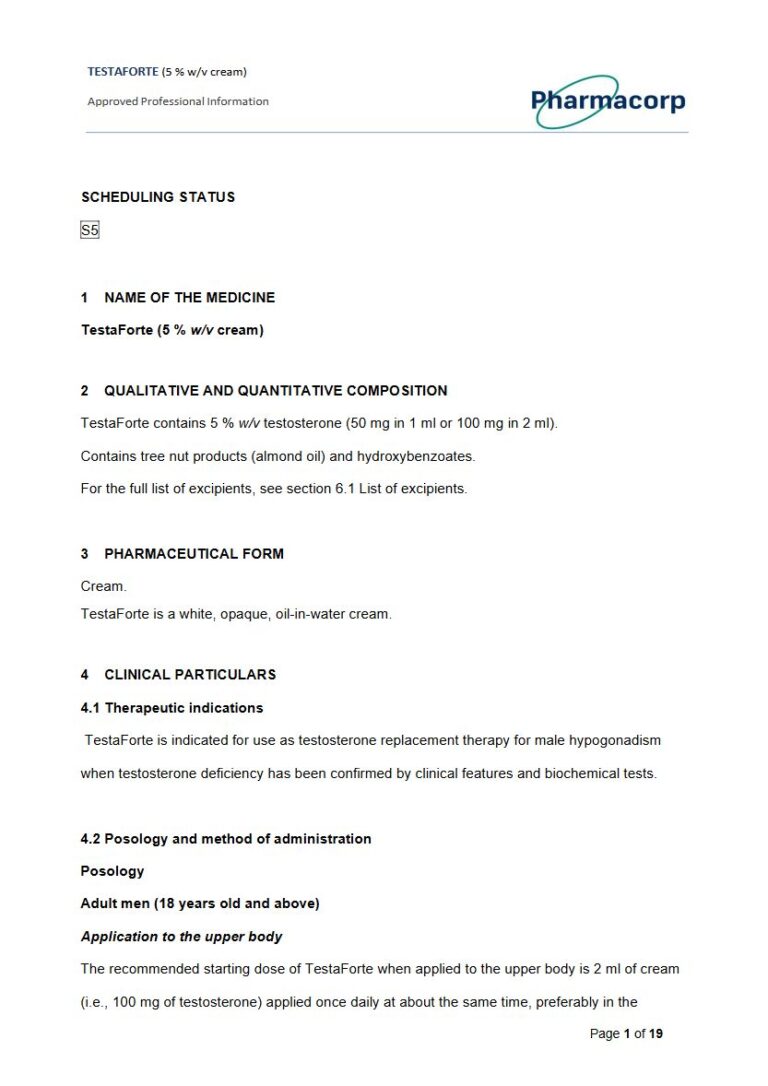
Testaforte 50 mg in 1 ml or 100 mg in 2 ml Cream.
PDF Leaflet Revision Date: 30 May 2023
Clinical Summary
Quick overview from the medicine insert
Indication
Testosterone replacement therapy for male hypogonadism.
Dosage (summary)
2 ml daily for upper body; 0.5 ml daily for scrotum, max 4 ml and 1 ml respectively.
Onset of Action / Duration
Onset: 24 hours, Duration: variable.
Special Populations
- Elderly
- Renal impairment
- Hepatic impairment
Pregnancy & Breastfeeding
Contraindicated in pregnancy and breastfeeding; avoid contact.
Key Drug Interactions
- Increased anticoagulant effects
- Altered insulin sensitivity
- Increased ciclosporin toxicity
Contraindications
- Sensitivity to testosterone or excipients
- Carcinoma of breast or prostate
Common side effects
- Skin reactions
- Gynecomastia
- Mood changes
Counselling Points
- Wash hands after application
- Avoid contact with children and pregnant women
- Monitor for excessive androgen exposure
Serious warnings
- Risk of prostate cancer progression
- Potential for transfer to others
- Caution in cardiac, hepatic, renal disease
Important Disclaimer
The Testaforte 50 mg in 1 ml or 100 mg in 2 ml Cream. professional information leaflet below is the property of Pharmacorp and is provided on Medinsert exactly as issued, with no.. alterations or editorial changes. We make every effort to keep content current by updating documents as soon as new versions become available. Medinsert serves as a trusted access point for healthcare professionals, but does not replace official sources or clinical judgement. For more details, please read our full disclaimer. read more>>
 Healthcare Professionals Only
This content is for registered healthcare professionals
Sign in or create a free account to read the full package insert.
Free for HPCSA-registered professionals. Powered by Medinsert.
Clinical Particulars
Section 4 of the official insert — extracted exactly as issued, no alterations
4.1 Therapeutic indications
TestaForte is indicated for use as testosterone replacement therapy for male hypogonadism when testosterone deficiency has been confirmed by clinical features and biochemical tests.
4.2 Posology and method of administration
Posology
Adult men (18 years old and above)
Application to the upper body
The recommended starting dose of TestaForte when applied to the upper body is 2 ml of cream (i.e., 100 mg of testosterone) applied once daily at about the same time, preferably in the morning. The daily dose should be adjusted by the doctor depending on the clinical and/or laboratory response in individual patients, not exceeding a maximum of 4 ml of cream per day. The adjustment of dosage should be achieved by 1 ml increments.
The application should be administered by the patient himself, onto clean, dry, healthy skin to the torso. The torso includes the abdomen and the sides of the body from the waist to just below the armpits. It is preferable to apply to areas with minimal hair and body fat.
Application to the scrotum
The recommended starting dose of TestaForte when applied to the entire scrotum is 0,5 ml of cream (i.e., 25 mg of testosterone) applied once daily at about the same time, preferably in the morning. The daily dose should be adjusted by the doctor depending on the clinical and/or laboratory response in individual patients, not exceeding 1 ml of cream per day. The adjustment of dosage should be achieved by 0,25 ml increments.
The application should be administered by the patient himself, onto clean, dry, healthy skin on the scrotum. The scrotum is not required to be shaved prior to application.
Method of administration
After opening the tube, the total contents must be extracted using the supplied dose measuring syringe and applied immediately onto the skin. The cream should be spread on the skin gently and massaged in until vanished. Typically, this takes 30 seconds or so. Wash hands with soap and water after applications. To clean the applicator after use, rinse in hot water.
Monitoring
Hypogonadal symptom control is the primary aim of testosterone therapy via achieving a serum testosterone concentration sufficient to restore physiological androgen status to that comparable with eugonadal men. Biochemistry is an adjunct indicator of treatment response together with the identification and monitoring of the manu2019s leading symptom. Trough testosterone levels should be within the lower limit of the reference interval for eugonadal men. Follow-up testosterone measurements should be made at intervals not exceeding one year.
Application to the upper body
Eugonadal serum testosterone concentrations are generally reached within 24 hours of a single dose of TestaForte. Absorption is variable between individuals. In order to adjust the testosterone dose, serum testosterone concentrations must be measured in the morning before application after the 15th day of starting treatment. Results of clinical and/or biochemical monitoring may prompt dose titration.
Application to the scrotum
Eugonadal serum testosterone concentrations are generally reached within 24 hours of a single dose of TestaForte applied scrotally. Absorption is variable between individuals and will have a different pharmacokinetic profile for men changing from non-scrotal testosterone medicines. In order to adjust the testosterone dose for scrotal application it is recommended that two (2) serum testosterone concentrations be measured at 3 hours (peak) and 24 hours (trough) from prior application after the 15th day of starting treatment. Results of clinical and/or biochemical monitoring may prompt dose titration.
Paediatric use
TestaForte is not indicated for use in children and has not been evaluated clinically in males under 18 years of age.
4.3 Contraindications
- TestaForte is contraindicated in patients with known sensitivity to testosterone, tree nuts (almond oil) or any of the excipients of TestaForte (see section 6.1).
- TestaForte is contraindicated in men with known or suspected carcinoma of the breast or prostate.
4.4 Special warnings and precautions for use
Androgens may accelerate the progression of sub-clinical prostate cancer and benign prostatic hyperplasia. TestaForte should not be used by women or children due to possible virilising effects. Prior to testosterone initiation, all patients must undergo a detailed examination in order to assess for pre-existing prostate cancer. Careful and regular monitoring of the prostate gland (digital rectal examination and estimation of serum Prostate Specific Antigen (PSA) and breast must be performed in accordance with recommended practice in patients receiving testosterone therapy at least once yearly and twice yearly in elderly and at risk patients (those with clinical or familial risk- factors). There is limited experience on the safety and efficacy of the use of the medicine in patients over 65 years of age. Androgens may accelerate the progression of sub-clinical prostatic cancer and benign prostatic hyperplasia. In patients suffering from severe cardiac, hepatic, or renal insufficiency or ischaemic heart disease, treatment with testosterone may cause severe complications characterised by oedema with or without congestive cardiac failure. In such case, treatment must be stopped immediately.
Testosterone should be used only if hypogonadism (hyper- and hypogonadotrophic) has been demonstrated and if other aetiology, responsible for the symptoms, has been excluded before treatment is started. Testosterone insufficiency should be clearly demonstrated by clinical features (regression of secondary sexual characteristics, change in body composition, asthenia, reduced libido, erectile dysfunction etc.) and confirmed by two separate blood testosterone measurements. Due to variability in laboratory values, all measures of testosterone should be carried out in the same laboratory.
Testosterone concentrations should be monitored when switching the patient from another testosterone medicine to TestaForte or when switching from TestaForte upper body application to scrotal application and vice versa.
Modest elevations of serum dihydrotestosterone (DHT) concentrations are commonly observed after scrotal and non-scrotal administration of testosterone, however there is no evidence to suggest that high circulating DHT concentrations have a deleterious effect on the prostate and cardiovascular safety profile.
In addition to monitoring the testosterone concentrations in patients on long-term androgen therapy the following laboratory parameters should be checked periodically: haemoglobin, haematocrit (to avoid the risk of polycythaemia), liver function tests, and lipid profile. Increases in haematocrit may require reductions in dose or discontinuation of testosterone therapy. Increased haematocrit may increase the risk for a thromboembolic event. Changes in serum lipid profile may require dose adjustment or discontinuation of testosterone therapy.
With specific reference to TestaForte, erythrocytosis and skin reactions are at the lowest end of the risk scale when transdermal testosterone is the mode of delivery. If the patient develops a severe application site reaction, treatment should be assessed and discontinued if necessary.
Testosterone is not a treatment for male sterility or impotence in men with normal serum testosterone levels.
With large doses of exogenous androgens, spermatogenesis may be suppressed through feedback inhibition of pituitary follicle-stimulating hormone (FSH) which could possibly lead to adverse effects on semen parameters including sperm count.
Certain clinical signs: irritability, nervousness, weight gain, prolonged or frequent erections may indicate excessive androgen exposure requiring dosage adjustment.
In patients suffering from severe cardiac, hepatic or renal insufficiency or ischemic heart disease, treatment with testosterone may cause severe complications characterised by oedema with or without congestive cardiac failure. In such case, treatment must be stopped immediately. There are no studies undertaken to demonstrate the efficacy and safety of TestaForte in patients with renal or hepatic impairment.
Patients with pre-existing cardiac, hepatic or renal diseases need to be monitored closely when undergoing androgen treatment. Because TestaForte is not taken orally hepatotoxicity is not a risk factor.
Gynecomastia occasionally develops and occasionally persists in patients being treated with androgens for hypogonadism. There are published reports of increased risk of sleep apnoea in hypogonadal men treated with testosterone, especially those with risk factors such as obesity or chronic lung disease.
Testosterone should be used with caution in patients with epilepsy and migraine as these conditions may be aggravated.
Testosterone should be used with caution in cancer patients at risk of hypercalcaemia (and associated hypercalciuria), due to bone metastases. Regular monitoring of serum calcium concentrations is recommended in these patients.
Testosterone may cause an increase in blood pressure and should be used with caution in patients with hypertension.
Changes in insulin sensitivity may occur in patients treated with androgens who achieve normal testosterone plasma concentrations following replacement therapy.
Athletes should be informed that TestaForte contains an active substance (testosterone), which may give positive results in an anti-doping test. Androgens are not indicated for enhancing muscular development in healthy individuals.
Potential for transfer
Transdermal testosterone cream can be transferred to other persons by close skin to skin contact, resulting in increased testosterone serum levels and, with repeated contact, possibly adverse effects. In women, this may cause growth of facial and/or body hair, deepening of the voice, irregularities of the menstrual cycle; in children this may cause premature puberty and genital enlargement, in case of repeat contact (inadvertent androgenisation). If virilisation occurs, testosterone therapy should be promptly discontinued until the cause has been identified.
The doctor should inform the patient carefully about the risk of testosterone transfer and about safety instructions (see below). TestaForte should not be prescribed to patients with a major risk of non-compliance with safety instructions (e.g., severe alcoholism, drug abuse and severe psychiatric disorders). The risk of transfer is substantially reduced by wearing clothes covering the application area. The majority of residual testosterone is removed from the skin surface by washing with soap and water prior to contact.
As a result, the following precautions are recommended:
For the patient:
- Wash hands thoroughly with soap and water after applying the cream.
- Cover the application area with clothing once the cream has dried.
- Wash before any situation in which skin-to-skin contact is foreseen.
- Clothing or items in contact with the area of application should be washed separately.
For people not being treated with TestaForte:
- In the event of contact with an application area which has not been washed or is not covered with clothing, wash the area of skin onto which testosterone may have been transferred as soon as possible, using soap and water.
- Report the development of signs of excessive androgen exposure such as acne or hair modification.
To improve partner safety the patient should be advised to wear a T-shirt covering the upper body application site during the contact period or to shower before sexual intercourse. To improve partner safety using scrotal application wash the genital area with a damp warm flannel before sexual intercourse. Furthermore, it is recommended to wear clothing covering the upper body application site during contact periods with children in order to avoid transference to children. Pregnant women must avoid any contact with TestaForte application sites. In case of pregnancy of the partner, the patient must be particularly careful to avoid potential transfer.
4.5 Interactions with other medicines and other forms of interaction
Changes in insulin sensitivity, glucose tolerance, glycaemic control, blood glucose and glycosylated haemoglobin have been reported with androgens. In diabetic patients, medication requirements may change.
When androgens are used simultaneously with anti-coagulants, the anti-coagulant effects may be increased. More frequent monitoring of INR and prothrombin time is recommended in patients taking anticoagulants, especially at the initiation and termination of androgen therapy.
The concurrent use of testosterone with ACTH or corticosteroids may result in increased fluid retention and should be monitored, particularly in patients with cardiac, renal or hepatic disease.
In diabetic patients, the metabolic effects of androgens may decrease blood glucose levels, and therefore, insulin requirements.
Concurrent administration of testosterone and bupropion may result in a lowered seizure threshold.
Concurrent administration with ciclosporin may result in increased ciclosporin toxicity and elevated ciclosporin blood levels.
Theoretically, in general, any substance which affects liver function should not be taken with testosterone, although this may not be as problematic with transdermal preparations such as TestaForte. Examples of herbal medicines include: ancreamica dahurica, chapparal, comfrey, eucalyptus, germander tea, Jin Bu Huan, kava, penny royal oil, skullcap, and valerian.
4.6 Fertility, pregnancy and lactation
Fertility
Fertility studies in rodents and primates have shown that treatment with testosterone can impair fertility by suppressing spermatogenesis in a dose dependent manner.
Pregnancy
Testosterone is contraindicated in women who are or who anticipate becoming pregnant. Pregnant women must avoid any contact with TestaForte application sites. Exposure of a foetus to androgens may result in varying degrees of virilisation. In the event of contact, women are advised to wash with soap and water as soon as possible.
Lactation
Testosterone should not be used by breastfeeding women. In the event of accidental contact, women are advised to immediately wash with soap and water.
4.7 Effects on ability to drive and use machines
No studies on the effects on the ability to drive and use machines have been performed.
4.8 Undesirable effects
According to the literature, additional undesirable events that are possibly or probably related to testosterone use are shown in Table 1.
Table 1
System Organ Class Adverse Events (Frequency unknown)
- Blood and lymphatic system disorders Changes in laboratory tests (polycythaemia, lipids), increased blood creatinine.
- Endocrine disorders Increase in male pattern hair distribution, hirsutism.
- Metabolism and nutrition disorders Electrolyte changes (retention of sodium, potassium, chloride, calcium, inorganic phosphate, water) during high dose or prolonged treatment, increased appetite, oedema.
- Psychiatric disorders Mood disorders, nervousness, hostility.
- Nervous system disorders Amnesia, hyperaesthesia, smell disorder, taste disorder.
- Vascular disorders Decreased blood pressure diastolic, flushing, vasodilation.
- Respiratory, thoracic and mediastinal disorders Worsening of sleep apnoea, dyspnoea.
- Gastrointestinal disorders Diarrhoea
- Hepatobiliary disorders Abnormal liver enzyme/liver function tests (including bilirubin)
- Skin and subcutaneous tissue disorders Alopecia, urticaria, discoloured hair, skin reactions including seborrhoea.
- Musculoskeletal and connective tissue disorders Muscle cramps, muscle pain.
- Renal and urinary disorders Prostatic disorders, worsening symptoms of benign prostatic hyperplasia (BPH), Impaired urination, urinary tract infections, urinary tract obstruction.
- Reproductive system and breast disorders Virilisation of foetuses, infants, children and women, foetal harm, suppression of lactation, gynaecomastia/mastodynia, sensitive nipples, libido changes, increased frequency of erections, suppression of spermatogenesis, reduction in the size of the testicles/testicular atrophy, priapism.
- General disorders and administration site conditions Hypersensitivity reactions, asthenia, malaise.
- Investigations Decreased high-density lipoprotein (HDL).
Reporting of suspected adverse reactions
Reporting suspected adverse reactions after authorisation of the medicine is important. It allows continued monitoring of the benefit/risk balance of the medicine. Health care providers are asked to report any suspected adverse reactions to SAHPRA via the u201c6.04 Adverse Drug Reactions & Quality Problem Reporting Formu201d, found online under SAHPRAu2019s publications: https://www.sahpra.org.za/Publications/Index/8
4.9 Overdose
No cases of overdose with TestaForte have been reported in clinical trials. Treatment of overdose would consist of discontinuation of TestaForte together with appropriate symptomatic and supportive care including determination of blood testosterone levels. Wash the skin with soap and water.
