
Mavik 0.5mg. 2mg. 4mg Capsules
PDF Leaflet Revision Date: 6 October 2006
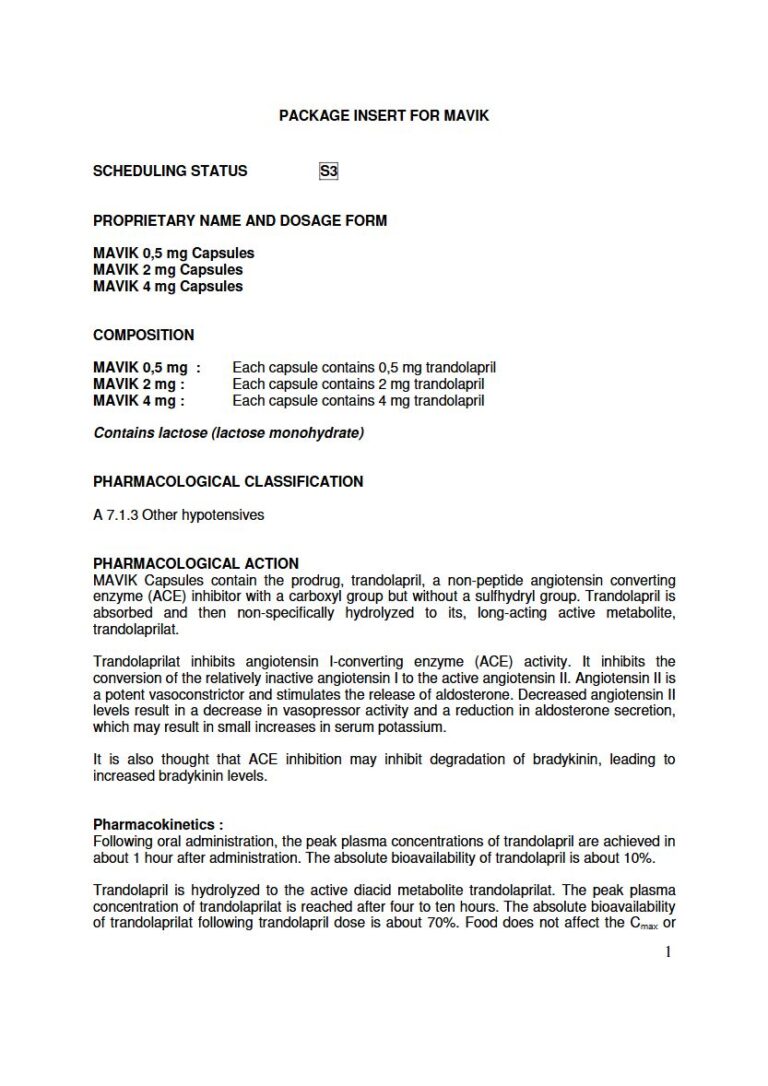
Clinical Summary
Quick overview from the medicine insert
Indication
Mild to moderate hypertension.
Dosage (summary)
Initial: 0.5 mg daily; Maintenance: 2-4 mg daily.
Onset of Action / Duration
Onset: 1 hour, Duration: 16-24 hours
Special Populations
- Renal impairment
- Hepatic impairment
- Elderly
Pregnancy & Breastfeeding
Contraindicated in pregnancy and lactation.
Key Drug Interactions
- Diuretics
- NSAIDs
- Potassium supplements
- Lithium
- Antidiabetic medications
Contraindications
- Angioedema history
- Aortic stenosis
- Pregnancy
- Lactation
- Renal artery stenosis
Common side effects
- Headache
- Dizziness
- Cough
- Nausea
Counselling Points
- Take at the same time daily
- Monitor blood pressure regularly
- Report any swelling or difficulty breathing
Serious warnings
- Risk of severe hypotension in volume-depleted patients
- Angioedema risk
- Monitor renal function
Important Disclaimer
The Mavik 0.5mg. 2mg. 4mg Capsules professional information leaflet below is the property of Abbott Laboratories Sa and is provided on Medinsert exactly as issued, with no.. alterations or editorial changes. We make every effort to keep content current by updating documents as soon as new versions become available. Medinsert serves as a trusted access point for healthcare professionals, but does not replace official sources or clinical judgement. For more details, please read our full disclaimer. read more>>
 Healthcare Professionals Only
This content is for registered healthcare professionals
Sign in or create a free account to read the full package insert.
Free for HPCSA-registered professionals. Powered by Medinsert.
Clinical Particulars
Section 4 of the official insert — extracted exactly as issued, no alterations
4.1 Therapeutic indications
Mild to moderate hypertension.
4.2 Posology and method of administration
May be taken with/without meals preferably at the same time every day. Adults: Initial dose is 0,5 mg as a single daily dose. The dose should be adjusted according to blood pressure response. The usual effective maintenance dose is 2 mg as a single daily dose with a maximum of 4 mg. If the patient is still unsatisfactory at a dose of 4mg MAVIK, combination therapy should be considered. The full therapeutic effect may take several weeks. Therefore, if the desired effect has not been achieved within 2 to 4 weeks the dose may be increased.
Dosing in high-risk individuals: Diuretic-treated patients: In patients who are at risk from a stimulated renin-angiotensin system (e.g., patients with water and sodium depletion), the diuretic should be discontinued two or three days before beginning therapy with 0.5 mg trandolapril to reduce the likelihood of symptomatic hypotension. The diuretic may be resumed later if required. Elderly: The dose in elderly patients is the same as in non-elderly adults. There is no need to reduce the dose in elderly patients with normal renal and hepatic function. Caution should be exercised in elderly patients with concomitant use of diuretics, congestive heart failure or renal or hepatic insufficiency. The dose should be titrated according to the need for the control of blood pressure. In these patients therapy should be initiated at a dose of 0,5 mg daily. Renal impairment: A lower dose is required. If creatinine clearance is 31 u2013 70 ml/min (moderate renal impairment) the usual adult dosage is recommended. The dose may be increased as needed according to therapeutic response, for patients with more severe renal impairment (creatinine clearance between 10 ml/min and 30 ml/minute), MAVIK should be initiated at a dose of 0.5 mg and increased if necessary. In patients with severe renal impairment (creatinine clearance less than 10 ml/min), the recommended daily dose is 0.5 mg, the daily maximum dose should not exceed 2 mg. In these patients, therapy should be under close medical supervision. Renovascular hypertension u2014 Treatment should be started in hospital under close medical supervision with low doses and careful dose titration. The patient should be monitored. Hepatic Impairment- In patients with severely impaired liver function a decrease in the metabolic clearance of the parent compound trandolapril and the active metabolite trandolaprilat results in a large increase in plasma trandolapril levels and to a lesser extent an increase in trandolaprilat levels. Treatment with MAVIK should therefore be initiated at a dose of 0,5 mg once daily under close medical supervision. Dialysis - It is not known if trandolapril or trandolaprilat are removed by dialysis. However, it would be expected that dialysis could remove the active moiety, trandolaprilat, from the circulation, resulting in a possible loss of control of blood pressure. Therefore careful monitoring of the patientu2019s blood pressure during dialysis is required and the dosage of trandolapril adjusted if needed.
4.3 Contraindications
- Sensitivity to any of the components of MAVIK.
- Patients with a history of angioedema related to previous ACE-inhibitor therapy or angiotensin receptor blocker.
- Hereditary or idiopathic angioedema.
- Aortic stenosis.
- Hypertrophic obstructive cardiomyopathy.
- Renal artery stenosis in patients with a single kidney.
- Pregnancy.
- Lactation.
- Concomitant therapy with potassium sparing diuretics such as spironolactone, triamterene, amiloride.
- Porphyria.
4.4 Special warnings and precautions for use
Should a woman become pregnant while receiving an ACE inhibitor, the treatment must be stopped promptly and changed to a different medicine. (SEE PREGNANCY AND LACTATION). Should a woman contemplate pregnancy, the doctor should consider alternative medication (SEE PREGNANCY AND LACTATION). MAVIK should be used with caution in the following conditions:
- Cerebrovascular disease or ischaemic heart disease u2013 Reduction in blood pressure could aggravate these conditions and may result in myocardial infarction and cerebro- vascular accidents.
- Impaired liver function -- As trandolapril is a prodrug metabolised to its active moiety in the liver, particular caution and close monitoring should be applied to patients with impaired liver function.
- Volume depleted patients (e.g. by diuretic therapy, dietary salt restriction, dialysis, diarrhoea or vomiting). Although it may occur in normo volumic patients, hypotension is more likely in volume depleted patients. A sudden reduction in angiotensin II may result in sudden and severe hypotension. There is also an increased risk of MAVIK induced renal failure, especially in those with congestive heart failure.
- Patients at a high risk of symptomatic hypotension, e.g. patients with salt or volume depletion with or without hyponatremia should have these conditions corrected before therapy with MAVIK. Monitoring is required after initiating therapy.
- Severe autoimmune disease, especially systemic lupus erythematosus, other collagen vascular disease or scleroderma increase the risk for development of neutropenia or agranulocytosis.
- In acute myocardial infarction, treatment with MAVIK should not be initiated in patients with evidence of renal dysfunction (serum creatinine concentrations exceeding 177 micromol/l or proteinuria exceeding 500 mg/24 hours). If renal dysfunction develops during treatment (serum creatinine concentrations exceeding 177 micromol/l or doubling of the pre-treatment value) then MAVIK may need to be withdrawn (see also Contra-indications).
- In acute myocardial infarction, patients may develop persistent hypotension and/or impaired renal function.
- Hypotension in acute myocardial infarction: Treatment with MAVIK must not be initiated in acute myocardial infarction patients who are at risk of further serious haemodynamic deterioration after treatment with a vasodilator. These include patients with systolic blood pressure of 13.33 kPa or lower or cardiogenic shock. During the first three days following the infarction, the dose should be reduced if the systolic blood pressure is 15.99 kPa or lower. Maintenance doses should be reduced to 0.5 mg if systolic blood pressure is 13.33 kPa or lower. If hypotension persists (systolic blood pressure less than 11.99 kPa or more than 1 hour) then MAVIK should be withdrawn.
- Bone marrow depression: Increased risk of agranulocytosis and neutropenia.
- Diabetes mellitus: Increased risk of hyperkalaemia, as well as hypoglycaemia may occur.
- Hyperkalaemia: MAVIK may cause an increase in serum potassium levels.
- Renovascular disease: MAVIK should not be used in patients with renovascular disease or suspected renovascular disease, but it may be used cautiously in severe resistant hypertension in such patients. In this instance, MAVIK should only be used under specialist supervision. The elderly, patients with peripheral vascular diseases or generalized atherosclerosis may have asymptomatic renovascular disease. (SEE DOSAGE AND DIRECTIONS).
- Renal artery stenosis, bilateral or in one kidney or renal transplant: Increased risk of renal function impairment may increase blood urea and serum creatinine concentrations, which may be reversible upon discontinuation of therapy. There is also an increased risk of agranulocytosis and neutropenia when immunosuppressants are concurrently administered.
- Renal function impairment: Decreased elimination of MAVIK resulting in an increased risk of hyperkalaemia. These patients may require lower doses.
- Anaphylactoid reactions have occurred in patients using ACE inhibitors during desensitising protocols involving for example, hymenoptera venom.
- Anaphylactoid reactions have been reported in patients exposed to either high-flux membrane dialysis or low-density lipoprotein apheresis with dextran sulfate absorption.
- Hypersensitivity / Angioedema: If angioedema of the face, extremities, lips, tongue, glottis and/or larynx is observed in patients with MAVIK, MAVIK should be discontinued promptly. These patients should be monitored to ensure complete resolution of symptoms.
- Angioedema associated with laryngeal oedema may be fatal. Where there is involvement of the tongue, glottis or larynx, likely to cause airway obstruction, appropriate emergency therapy should be administered. This may include the administration of adrenaline and/or the maintenance of a patient airway. The patient should be under close medical supervision until complete and sustained resolution of symptoms has occurred. These patients should never receive ACE inhibitor therapy again.
- ACE inhibitors have been shown to cause a higher rate of angioedema in black patients than in non-black patients.
- Porphyria.
- Safety and efficacy in children has not been established.
- Concomitant therapy with potassium sparing diuretics such as spironolactone, triamterene, amiloride may lead to hyperkalaemia, which may be severe and lead to cardiac conduction abnormalities, dysrrythmias and cardiac arrest (refer to u201cCONTRA - INDICATIONSu201d).
4.5 Interactions with other medicines
Concomitant use of MAVIK with:
- Diuretics, alcohol and hypotension-producing medications: The antihypertensive effect is additive. Dosage adjustments may be necessary during concurrent use or when one medicine is discontinued. Adrenergic-blocking drugs should only be combined with trandolapril under careful supervision.
- Loop, thiazide or related diuretics: u201cFirst dose hypotensionu201d may occur (SEE DOSAGE AND DIRECTIONS FOR USE).
- As with all antihypertensives, non-steroidal anti-inflammatory medicines (NSAIDs) may reduce the antihypertensive effects of MAVIK. Blood pressure monitoring should be increased when any NSAID is added or discontinued in a patient treated with MAVIK.
- Potassium supplements or potassium sparing diuretics such as spironolactone, triamterene or amiloride: may increase the risk of hyperkalemia, particularly in renal failure. Trandolapril may attenuate the potassium loss caused by thiazide-type diuretics. If concomitant use of these agents is indicated, they should be given with caution and serum potassium should be monitored regularly.
- Lithium: Increases in lithium concentrations have been reported. Frequent monitoring of serum lithium concentrations is recommended.
- Concomitant use of antidiabetic medicines (insulin or oral hypoglycemic agents) may cause an increased blood glucose lowering effect with greater risk of hypoglycemia.
- Anaphylactoid reactions to high-flux polyacrylonitrile membranes used in hemodialysis have been reported in patients treated with ACE inhibitors. This combination should be avoided when prescribing ACE inhibitors to renal dialysis patients.
- The hypotensive effects of certain inhalation anesthetics may be enhanced by ACE inhibitors.
- Cytostatic or immunosuppressive agents or systemic corticosteroids may increase the risk of leucopenia, if used concomitantly.
4.6 Fertility, pregnancy and lactation
MAVIK is contraindicated in pregnancy. Foetal exposure to ACE inhibitors during the second and third trimester can cause hypotension, renal failure, anuria, skull hypoplasia, hyperkalaemia and oliguria. Oligohydramnios may occur resulting in pulmonary hypoplasia, limb contractures and craniofacial deformation. Infants who have been exposed in utero to MAVIK should be closely monitored. It is not known if peritoneal dialysis may be of benefit in the clearance of MAVIK from the neonatal circulation. Safety in lactation has not been established (see CONTRA-INDICATIONS).
4.7 Effects on ability to drive and use machines
Caution when driving or performing tasks requiring alertness because of possible dizziness.
4.8 Undesirable effects
Side effects: The following adverse reactions have been reported in long-term clinical trials with MAVIK. The events are displayed by system organ class and frequency, using the following convention: common (> 1/100, 1/1000, < 1/100).
System Organ Class Frequency Adverse Event
- Nervous System disorders Common Headache, Dizziness
- Cardiac disorders Uncommon Palpitations
- Respiratory, thoracic and mediastinal disorders Common Cough
- Gastrointestinal disorders Uncommon Nausea
- Skin and subcutaneous tissue disorders Uncommon Pruritus, Rash
- General disorders and administration site conditions Common Uncommon Asthenia, Malaise
Reactions from Postmarketing Surveillance or Phase IV Clinical Trials Significant adverse events seen with MAVIK are listed below by body system:
System Organ Class Frequency Adverse Event
- Infections and infestations Unknown Bronchitis
- Blood and lymphatic system disorders Unknown Agranulocytosis, Leucopenia
- Immune system disorders Unknown Allergic hypersensitivity reactions including pruritus and rash
- Metabolism and nutrition disorders Unknown Hyperkalaemia
- Vascular disorders Unknown Orthostatic effects (including hypotension)
- Respiratory, thoracic and mediastinal disorders Unknown Dyspnoea
- Gastrointestinal disorders Unknown Nausea, vomiting, abdominal pain, diarrhoea, dry mouth, pancreatitis
- Skin and subcutaneous tissue disorders Unknown Angioedema, alopecia, sweating
- General disorders and administration site conditions Unknown Fever
- Investigations Unknown Increases in urea and serum creatinine, decreased platelets, elevated liver enzymes (including ALT and AST).
The following adverse events have been reported with ACE inhibitors as a class and may also occur with MAVIK:
System Organ Class Frequency Adverse Event
- Blood and lymphatic system disorders Pancytopenia, hemolytic anaemia, anaemia
- Metabolism and nutrition disorders Hyponatraemia
- Nervous system disorders Transient ischemic attacks, mood alterations, mental confusion, paraesthesia, vertigo, sleep disturbances
- Cardiac disorders Angina pectoris, myocardial infarction, AV block, bradycardia, cardiac arrest, tachycardia
- Vascular disorders Cerebral haemorrhage
- Respiratory Bronchospasm, rhinitis, sinusitis
- Gastrointestinal disorders Indigestion, taste disturbances
- Liver/hepatic Hepatitis (hepatocellular or cholestatic) jaundice, increases in serum bilirubin
- Skin and subcutaneous tissue disorders Urticaria, psoriasis, severe skin disorders including pemphigus, erythema multiforme, Stevens-Johnson syndrome, toxic epidermal necrolysis; photosensitivity or other dermatological manifestations may occur.
- Musculoskeletal and connective tissue disorders Myalgia
- Kidney/Genitourinary: Uraemia, oliguria, anuria, renal dysfunction, acute renal failure, impotence
- Investigations Decreased hemoglobin, decreased hematocrit
- Other A symptom complex has been reported which may include: vasculitis, myalgia, arthritis/arthralgia, a positive antinuclear antibodies (ANA), elevated erythrocyte sedimentation rate, eosinophilia and leucocytosis.
4.9 Overdose
Symptoms of overdose: Symptoms expected with ACE inhibitors are severe hypotension, shock, stupor, bradycardia, electrolyte disturbance and renal failure. Treatment of overdose: Treatment is symptomatic and supportive. Activated charcoal may be given in severe overdosage if the patient presents within 1 hour of ingestion. Treatment consists of volume expansion to correct hypotension and treating dehydration and electrolyte imbalances. It is not known for certain if trandolapril or trandolaprilat are removed by dialysis.
