
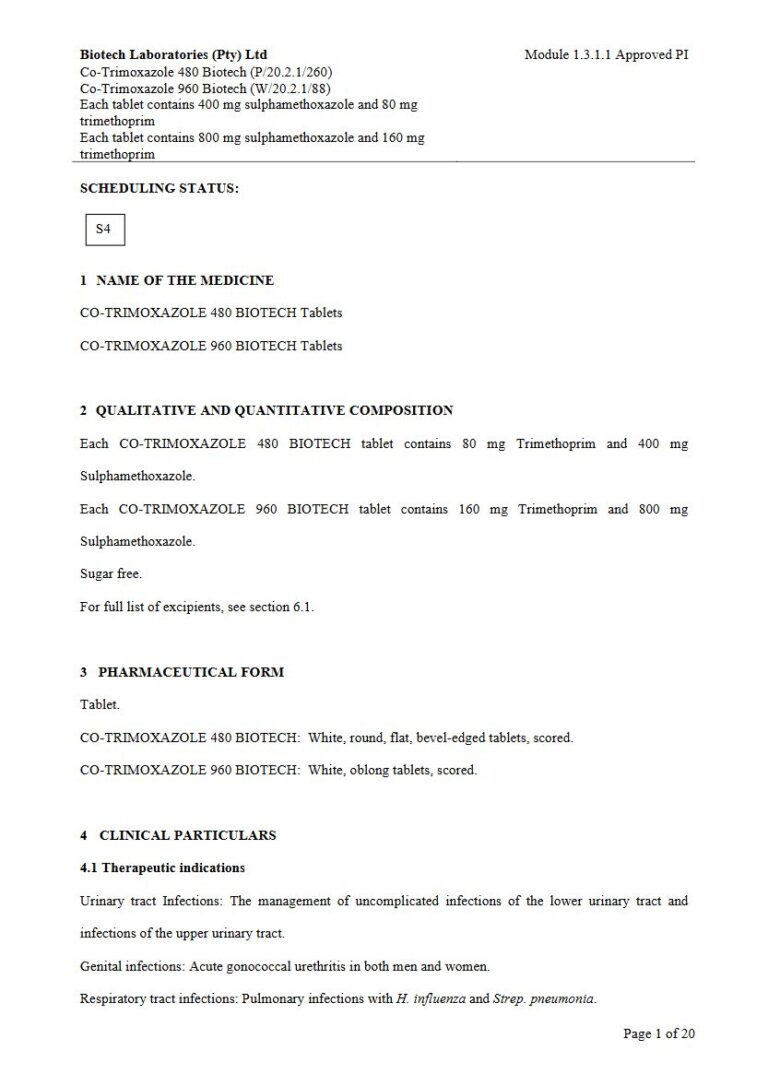
Co-Trimoxazole 400 mg/80 mg/800 mg/160 mg Tablets
PDF Leaflet Revision Date: 24 January 2024
Clinical Summary
Quick overview from the medicine insert
Indication
Management of urinary, genital, and respiratory tract infections.
Dosage (summary)
Adults: 2 CO-TRIMOXAZOLE 480 tablets or 1 CO-TRIMOXAZOLE 960 tablet twice daily after meals.
Special Populations
- Renal impairment
- Elderly patients
Pregnancy & Breastfeeding
Contraindicated in pregnancy and breastfeeding.
Key Drug Interactions
- Warfarin
- Phenytoin
- Zidovudine
Contraindications
- Hypersensitivity to sulphonamides or trimethoprim
- Porphyria
- Liver impairment
- Megaloblastic anaemia
- Renal failure
Common side effects
- Skin rash
- Nausea
- Headache
- Dizziness
Counselling Points
- Monitor for skin reactions.
- Maintain adequate fluid intake.
- Avoid sun exposure.
Serious warnings
- Severe skin reactions (SJS, TEN)
- Agranulocytosis
- Hepatic necrosis
Important Disclaimer
The Co-Trimoxazole 400 mg/80 mg/800 mg/160 mg Tablets professional information leaflet below is the property of Biotech Laboratories and is provided on Medinsert exactly as issued, with no.. alterations or editorial changes. We make every effort to keep content current by updating documents as soon as new versions become available. Medinsert serves as a trusted access point for healthcare professionals, but does not replace official sources or clinical judgement. For more details, please read our full disclaimer. read more>>
 Healthcare Professionals Only
This content is for registered healthcare professionals
Sign in or create a free account to read the full package insert.
Free for HPCSA-registered professionals. Powered by Medinsert.
Clinical Particulars
Section 4 of the official insert — extracted exactly as issued, no alterations
4.1 Therapeutic indications
Urinary tract Infections: The management of uncomplicated infections of the lower urinary tract and infections of the upper urinary tract.
Genital infections: Acute gonococcal urethritis in both men and women.
Respiratory tract infections: Pulmonary infections with H. influenza and Strep. pneumonia.
4.2 Posology and method of administration
Posology
Children 6 to 12 years: One CO-TRIMOXAZOLE 480 BIOTECH tablet every 12 hours after meals.
Adults and children over 12 years: Two CO-TRIMOXAZOLE 480 BIOTECH tablets (or one CO-TRIMOXAZOLE 960 BIOTECH) twice daily, morning and evening after meals.
Minimum dosage for long term treatment (more than 14 days): One CO-TRIMOXAZOLE 480 BIOTECH tablet twice daily.
Maximum dosage (for severe cases): Three CO-TRIMOXAZOLE 480 BIOTECH tablets twice a day.
In acute infections, CO-TRIMOXAZOLE BIOTECH should be given for at least 5 days or until the patients have been free from symptoms for 2 days.
Special populations
If CO-TRIMOXAZOLE BIOTECH is indicated for patients with renal impairment dosage must be reduced. The following dosage scheme based on creatinine clearance is suggested:
- Creatinine clearance:
- Above 25 mL/min u2013 standard dosage.
- 15 to 25 mL/min u2013 standard dosage for a maximum of 3 days followed by half the standard daily dose.
- CO-TRIMOXAZOLE BIOTECH should not be administered if creatinine clearance is less than 15 mL/min, unless facilities for haemodialysis are available.
Measurements of plasma concentrations of sulphamethoxazole at intervals of 2 days are recommended in samples obtained 12 hours after administration of CO-TRIMOXAZOLE BIOTECH. If the concentration of total sulphamethoxazole exceeds 150 u03bcg/mL, then treatment should be interrupted until the value falls below 120 u03bcg/mL. No information is available for children with renal failure.
Paediatric population
CO-TRIMOXAZOLE BIOTECH should not be given to children under the age of 6 years (see section 4.2).
Method of administration
Oral administration after meals
4.3 Contraindications
CO-TRIMOXAZOLE BIOTECH is contraindicated in:
- Hypersensitivity to the active substances, sulphonamides or trimethoprim, or to any of the excipients listed under section 6.1.
- Patients suffering from porphyria.
- Patients with impairment of the liver function, jaundice, and liver parenchymal damage.
- Patients with megaloblastic anaemia. It should be avoided in patients who may have megaloblastic bone-marrow changes or folic acid deficiency.
- Anaemia due to folic acid deficiency
- Impaired renal function
- CO-TRIMOXAZOLE BIOTECH should not be administered during pregnancy, to woman prior to delivery, or to nursing mothers.
- CO-TRIMOXAZOLE BIOTECH should not be given to premature or new-born infants within 1 to 2 months of birth.
- In patients receiving anticonvulsant medicines.
4.4 Special warnings and precautions for use
Life threatening adverse reactions
Fatalities have occurred due to severe reactions including Stevens-Johnson syndrome, toxic epidermal necrolysis, fulminant hepatic necrosis, agranulocytosis, aplastic anaemia, other blood dyscrasias and hypersensitivity of the respiratory tract.
- Life-threatening cutaneous reactions Stevens-Johnson syndrome (SJS), toxic epidermal necrolysis (TEN) and medicine reaction with eosinophilia and systemic symptoms have been reported with the use of CO-TRIMOXAZOLE BIOTECH
- Patients should be advised of the signs and symptoms and monitored closely for skin reactions. The highest risk for occurrence of SJS or TEN is within the first weeks of treatment.
- If symptoms or signs of SJS, TEN (e.g., progressive skin rash often with blisters or mucosal lesions) or medicine reaction with eosinophilia and systemic symptoms (DRESS e.g., fever, eosinophilia) are present, CO-TRIMOXAZOLE BIOTECH treatment should be discontinued (see section 4.8).
- The best results in managing SJS, TEN or DRESS come from early diagnosis and immediate discontinuation of any suspected medicine. Early withdrawal is associated with a better prognosis.
- If the patient has developed SJS, TEN or DRESS with the use of CO-TRIMOXAZOLE BIOTECH, treatment must not be re-started in this patient at any time.
- At the start of treatment, the occurrence of a generalised febrile erythema associated with pustules, should raise the suspicion of acute generalised exanthematous pustulosis (AGEP) (see section 4.8); it requires cessation of treatment and contraindicates any new administration of CO-TRIMOXAZOLE BIOTECH alone or in combination with other medicine.
- Patients should avoid direct exposure to sunlight as it facilitates development of sensitisation dermatitis (see section 4.8).
- A high incidence of side effects occurs in immunocompromised patients, such as those suffering from AIDS or patients receiving immunosuppressive therapy. The adverse effects include skin rash, recurrent fever, neutropenia, thrombocytopenia and raised liver enzymes.
Risk of fixed drug eruption
There is a plausible relationship between co-trimoxazole (e.g., CO-TRIMOXAZOLE BIOTECH) and fixed drug reaction. Although fixed drug eruptions are usually self-limiting, the mainstay of treatment involves identification and withdrawal of the culprit medicine (see section 4.8).
Elderly patients
Particular care is always advisable when treating elderly patients, because, as a group, they are more susceptible to adverse reactions and more likely to suffer serious effects as a result particularly when complicating conditions exist, e.g., impaired kidney and/ or liver function and/or concomitant use of other medicine. There also appears to be an increased risk of thrombocytopenia in elderly patients concurrently receiving diuretics, mainly thiazides.
Patients with renal impairment
CO-TRIMOXAZOLE BIOTECH should be used cautiously and in reduced dosage in patients with impaired renal function (see section 4.2).
Urinary output
An adequate fluid intake and urinary output should always be maintained due to the risk of developing crystalluria. If very large doses of CO-TRIMOXAZOLE BIOTECH are used it might be necessary to administer alkalis.
Folate
Regular monthly blood counts are advisable when CO-TRIMOXAZOLE BIOTECH is given for long periods, or to folate deficient patients or to the elderly since there exists a possibility of asymptomatic changes in haematological laboratory indices due to lack of available folate. Supplementation with folinic acid may be considered during treatment but this should be initiated with caution due to possible interference with antimicrobial efficacy (see section 4.5).
CO-TRIMOXAZOLE BIOTECH should also be used with caution in patients receiving pyrimethamine as they may develop megaloblastic anaemia due to the trimethoprim component (see section 4.5).
Patients with glucose-6-phosphate dehydrogenase deficiency
In glucose-6-phosphate dehydrogenase (G6PD) deficient patients, haemolysis may occur.
Patients with severe atopy or bronchial asthma
CO-TRIMOXAZOLE BIOTECH should be used with caution in patients with severe atopy or bronchial asthma.
Treatment of streptococcal pharyngitis due to Group A beta-haemolytic streptococci
CO-TRIMOXAZOLE BIOTECH should not be used in the treatment of streptococcal pharyngitis due to Group A beta-haemolytic streptococci; eradication of these organisms from the oropharynx is less effective than with penicillin.
Phenylalanine metabolism
Trimethoprim has been noted to impair phenylalanine metabolism but this is of no significance in phenylketonuric patients on appropriate dietary restriction.
Patients with or at risk of porphyria
The administration of CO-TRIMOXAZOLE BIOTECH to patients known or suspected to be at risk of porphyria should be avoided. Both trimethoprim and sulphonamides (although not specifically sulfamethoxazole) have been associated with clinical exacerbation of porphyria (see section 4.3).
Patients with hyperkalaemia and hyponatraemia
Close monitoring of serum potassium and sodium is warranted in patients at risk of hyperkalaemia and hyponatraemia.
Metabolic acidosis
CO-TRIMOXAZOLE BIOTECH has been associated with metabolic acidosis when other possible underlying causes have been excluded. Close monitoring is always advisable when metabolic acidosis is suspected.
Patients with serious haematological disorders
Except under careful supervision CO-TRIMOXAZOLE BIOTECH should not be given to patients with serious haematological disorders (see section 4.8). CO-TRIMOXAZOLE BIOTECH has been given to patients receiving cytotoxic therapy with little or no additional effect on the bone marrow or peripheral blood.
Blood tests
Blood tests should be made frequently particularly during prolonged treatment. The appearances of sore throat, fever, pallor, purpura or jaundice may be early indications of serious blood disorders.
Patients should avoid direct exposure to sunlight as it facilitates development of sensitisation dermatitis.
Respiratory toxicity
Very rare, severe cases of respiratory toxicity, sometimes progressing to Acute Respiratory Distress Syndrome (ARDS), have been reported during CO-TRIMOXAZOLE BIOTECH treatment. The onset of pulmonary signs such as cough, fever, and dyspnoea in association with radiological signs of pulmonary infiltrates, and deterioration in pulmonary function may be preliminary signs of ARDS. In such circumstances, CO-TRIMOXAZOLE BIOTECH should be discontinued, and appropriate treatment given.
Haemophagocytic lymphohistiocytosis (HLH)
Cases of HLH have been reported very rarely in patients treated with CO-TRIMOXAZOLE BIOTECH. HLH is a life-threatening syndrome of pathologic immune activation characterised by clinical signs and symptoms of an excessive systemic inflammation (e.g., fever, hepatosplenomegaly, hypertriglyceridaemia, hypofibrinogenaemia, high serum ferritin, cytopenias and haemophagocytosis). Patients who develop early manifestations of pathologic immune activation should be evaluated immediately. If diagnosis of HLH is established, CO-TRIMOXAZOLE BIOTECH treatment should be discontinued.
4.5 Interactions with other medicines and other forms of interaction
CO-TRIMOXAZOLE BIOTECH should be used with caution in patients receiving pyrimethamine. Patients receiving pyrimethamine at doses in excess of 25 mg weekly may develop megaloblastic anaemia when co-administered with CO-TRIMOXAZOLE BIOTECH.
High doses of CO-TRIMOXAZOLE BIOTECH may have a hypoglycaemic effect. The antidiabetic effect of the sulphonylureas may be enhanced by concomitant administration of CO-TRIMOXAZOLE BIOTECH.
The action of CO-TRIMOXAZOLE BIOTECH may be antagonised by para-aminobenzoic acid and compounds derived from it, particularly the procaine group of local anaesthetics.
Previous or simultaneous administration of diuretics (thiazides) with CO-TRIMOXAZOLE BIOTECH may carry an increased risk of thrombocytopenia (with or without purpura), especially in elderly patients with heart failure; death may occur.
The effect of sulphonamides may be enhanced by displacement from plasma binding sites by more highly bound acidic substances, such as phenylbutazone or sulpinpyrazone.
Concurrent use of CO-TRIMOXAZOLE BIOTECH with digoxin may increase the serum concentrations of digoxin.
Methenamine in combination with CO-TRIMOXAZOLE BIOTECH may increase the danger of crystalluria.
Trimethoprim has been reported to reduce the renal excretion and increase blood concentrations of zidovudine, zalcitabine and lamivudine.
Interaction with laboratory tests: trimethoprim (as contained in CO-TRIMOXAZOLE BIOTECH) may interfere with the estimation of serum/plasma creatinine when the alkaline picrate reaction is used. This may result in overestimation of serum/plasma creatinine of the order of 10 %. The creatinine clearance is reduced: the renal tubular secretion of creatinine is decreased from 23 % to 9 % whilst the glomerular filtration remains unchanged.
Zidovudine: concomitant treatment with zidovudine may increase the risk of haematological adverse reactions to CO-TRIMOXAZOLE BIOTECH. If concomitant treatment is necessary, consideration should be given to monitoring of haematological parameters.
Ciclosporin: reversible deterioration in renal function has been observed in patients treated with CO-TRIMOXAZOLE BIOTECH and ciclosporin following renal transplantation. CO-TRIMOXAZOLE BIOTECH should be used with caution in patients receiving immunosuppressive therapy.
Rifampicin: concurrent use of rifampicin and CO-TRIMOXAZOLE BIOTECH results in a shortening of the plasma half-life of trimethoprim after a period of about one week. This is not thought to be of clinical significance.
When trimethoprim (as contained in CO-TRIMOXAZOLE BIOTECH) is administered simultaneously with medicine that form cations at physiological pH and are also partly excreted by active renal secretion (e.g., procainamide, amantadine), there is the possibility of competitive inhibition of this process which may lead to an increase in plasma concentration of one or both of the medicines.
Warfarin: CO-TRIMOXAZOLE BIOTECH has been shown to potentiate the anticoagulant activity of warfarin via stereo-selective inhibition of its metabolism. Sulfamethoxazole may displace warfarin from plasma-albumin protein-binding sites in vitro. Careful control of the anticoagulant therapy during treatment with CO-TRIMOXAZOLE BIOTECH is advisable.
Phenytoin: CO-TRIMOXAZOLE BIOTECH prolongs the half-life of phenytoin and if co-administered could result in excessive phenytoin effect. Close monitoring of the patientu2019s condition and serum phenytoin levels are advisable.
Methotrexate: CO-TRIMOXAZOLE BIOTECH may increase the free plasma levels of methotrexate. If CO-TRIMOXAZOLE BIOTECH is considered appropriate therapy in patients receiving other anti-folate medicine such as methotrexate, a folate supplement should be considered (see section 4.4).
Trimethoprim interferes with assays for serum methotrexate when dihydrofolate reductase from Lactobacillus casei is used in the assay. No interference occurs if methotrexate is measured by radioimmuno assay.
Hyperkalaemia: caution should be exercised in patients taking any other medicine that can cause hyperkalaemia, for example ACE inhibitors, angiotensin receptor blockers and potassium-sparing diuretics such as spironolactone. Concomitant use of CO-TRIMOXAZOLE BIOTECH may result in clinically relevant hyperkalaemia.
Repaglinide: trimethoprim may increase the exposure of repaglinide which may result in hypoglycaemia.
Folinic acid: folinic acid supplementation has been shown to interfere with the antimicrobial efficacy of trimethoprim-sulfamethoxazole. This has been observed in Pneumocystis jirovecii pneumonia prophylaxis and treatment.
Contraceptives: oral contraceptive failures have been reported with antibiotics. The mechanism of this effect has not been elucidated. Women on treatment with antibiotics should temporarily use a barrier method in addition to the oral contraceptive or choose another method of contraception.
Azathioprine: There are conflicting clinical reports of interactions between azathioprine and trimethoprim-sulfamethoxazole, resulting in serious haematological abnormalities.
4.6 Fertility, pregnancy and lactation
Pregnancy
CO-TRIMOXAZOLE BIOTECH should not be given to pregnant women especially in early pregnancy and before delivery (see section 4.3).
Breastfeeding
CO-TRIMOXAZOLE BIOTECH is contraindicated in nursing mothers. Sulphonamides and trimethoprim are distributed into breast milk (see section 4.3).
4.7 Effects on the ability to drive and use machines
There have been no studies to investigate the effect of CO-TRIMOXAZOLE BIOTECH on driving performance or the ability to operate machinery. Dizziness and vertigo have been reported (see section 4.8). Caution is advised when driving or operating machinery.
4.8 Undesirable effects
Summary of the safety profile
Hypersensitivity reactions particularly involving the skin are among the most frequent adverse effects of CO-TRIMOXAZOLE BIOTECH and are usually due to the sulphamethoxazole component.
Tabulated list of adverse reaction
MedDRA System Organ Class Frequency Undesirable Effects
Infections and infestations Frequent Overgrowth fungal. Less frequent Pseudomembranous colitis.
Blood and the Lymphatic system Less frequent Leukopenia, neutropenia, thrombocytopenia, agranulocytosis, anaemia megaloblastic, aplastic anaemia, haemolytic anaemia, macrocytic anaemia, coagulation disorders, methaemoglobinaemia, granulocytopenia, purpura, sulphaemoglobinaemia, eosinophilia, haemolysis in certain susceptible G-6-PD deficient patients.
Endocrine disorders Less frequent Pancreatitis, goiter and hypothyroidism.
Immune system disorders Less frequent Serum sickness, anaphylactic reactions, allergic myocarditis, hypersensitivity vasculitis resembling Henoch-Schu00f6nlein purpura, periarteritis nodosa, systemic lupus erythematosus. Severe hypersensitivity reactions associated with PJP 2 & 3), rash, pyrexia, neutropenia, thrombocytopenia, hepatic enzyme increased, hyperkalaemia, hyponatraemia, rhabdomyolysis.
Metabolism and nutrition disorders Frequent Hyperkalaemia Less frequent Metabolic acidosis, anorexia hypoglycaemia, hyponatraemia, decreased appetite.
Psychiatric disorders Less frequent Depression, psychosis and hallucinations.
Nervous system disorders Frequent Headache, dizziness and fatigue. Less frequent Drowsiness, insomnia, nightmares, confusion, ataxia, peripheral neuritis, neuropathy peripheral, aseptic meningitis 2), seizure.
Ear and Labyrinth disorders Frequent Tinnitus. Less frequent Vertigo.
Eye disorders Less frequent Uveitis.
Respiratory, thoracic and mediastinal disorders Less frequent Cough 2), dyspnoea 2), lung infiltration 2).
Vascular disorders Frequency unknown Polyarteritis nodosa.
Gastrointestinal disorders Frequent Nausea, vomiting, glossitis, stomatitis and diarrhoea.
Hepato-biliary disorders Less frequent Hepatitis, jaundice cholestatic 2), hepatic necrosis 2), transaminase increased, blood bilirubin increased.
Skin and subcutaneous tissue disorder Frequent Exfoliative dermatitis, rashes and pruritus. Less frequent Photosensitivity reaction, angioedema, fixed drug eruption (FDE), erythema multiforme, Stevens-Johnson syndrome (SJS) 2) and toxic epidermal necrolysis (TEN) 2) (Lyell's syndrome). Acute generalised exanthematous pustulosis (AGEP). Frequency unknown Acute febrile neutrophilic dermatosis (Sweetu2019s syndrome), medicine reaction with eosinophilia and systemic symptoms (DRESS) 2).
Musculoskeletal, connective tissue and bone disorders Less frequent Lumbar pain and arthralgia. Rhabdomyolysis has been reported mainly in AIDS patients 2), myalgia.
Renal and urinary disorders Less frequent Toxic nephrosis, dysuria, haematuria, oliguria and anuria. Renal impairment, tubulointerstitial nephritis and uveitis syndrome, renal tubular acidosis. 1) Adverse effects on the blood may be more severe in malnourished or elderly patients.
2) see description of selected adverse reactions below 3) Pneumocystis jirovecii Pneumonitis (PJP)
Description of selected adverse reactions
Aseptic meningitis Aseptic meningitis was rapidly reversible on withdrawal of the CO-TRIMOXAZOLE BIOTECH but recurred in a number of cases on re-exposure to either co-trimoxazole or to trimethoprim alone.
Pulmonary hypersensitivity reactions Cough, dyspnoea, and lung infiltration may be early indicators of respiratory hypersensitivity which, while very rare, has been fatal.
Hepatobiliary disorders Jaundice cholestatic and hepatic necrosis may be fatal. Transient jaundice has been noted and appears to have the histological features of allergic cholestatic hepatitis. Most patients who have developed icterus have had a history or prior infectious hepatitis.
Severe cutaneous adverse reactions (SCARs) Stevens-Johnson syndrome (SJS), toxic epidermal necrolysis (TEN) and medicine reaction with eosinophilia and systemic symptoms (DRESS) have been reported to be life-threatening (see section 4.4) As with any other medicine, allergic reactions such as an itchy rash and hives may occur in patients with hypersensitivity to the components of the medicine. Very rare cases of acute generalised exanthematous pustulosis (AGEP) and fixed drug eruptions have been observed (see section 4.4).
Effects associated with Pneumocystis jirovecii Pneumonitis (PJP) management Severe hypersensitivity reactions, rash, pyrexia, neutropenia, thrombocytopenia, hepatic enzyme increases, hyperkalaemia, hyponatraemia, rhabdomyolysis. At the high dosages used for PJP management severe hypersensitivity reactions have been reported, necessitating cessation of therapy. Severe hypersensitivity reactions have been reported in PJP patients on re-exposure to CO-TRIMOXAZOLE BIOTECH, sometimes after a dosage interval of a few days. Rhabdomyolysis has been reported in HIV positive patients receiving CO-TRIMOXAZOLE BIOTECH for prophylaxis or treatment of PJP.
Reporting of suspected adverse reactions
Reporting suspected adverse reactions after authorisation of the medicine is important. It allows continued monitoring of the benefit/risk balance of the medicine. Health care providers are asked to report any suspected adverse reactions to SAHPRA via the u201c6.04 Adverse Drug Reactions Reporting Formu201d, found online under SAHPRAu2019s publications: https://www.sahpra.org.za/Publications/Index/8
4.9 Overdose
High doses may cause diarrhoea, nausea and vomiting. It may cause a depression of haemopoiesis due to interference of the drug in the metabolism of folic acid. Injections of calcium folinate may be given to counteract this interference.
Treatment
If vomiting has not occurred, induction of vomiting may be desirable. Absorption from the gastrointestinal tract is normally very rapid and complete within approximately two hours. This may not be the case in gross overdosage. Dependant on the status of renal function administration of fluids is recommended if urine output is low. Both trimethoprim and active sulfamethoxazole are moderately dialysable by haemodialysis. Peritoneal dialysis is not effective.
