
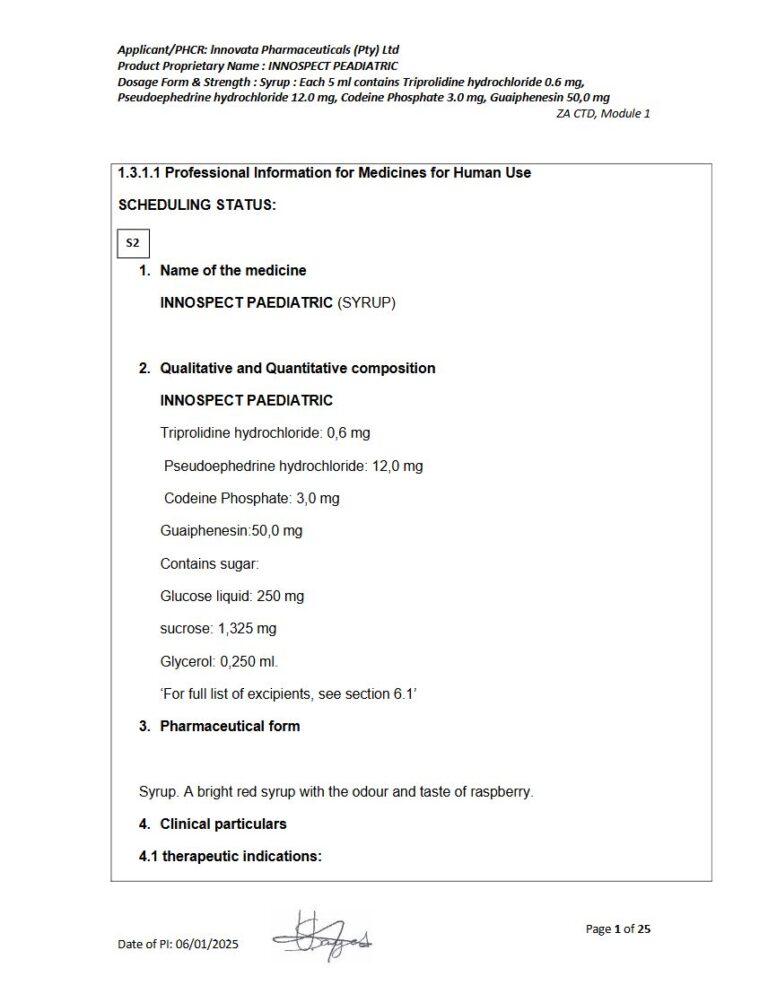
Innospect Paediatric 5 ml SYRUP
PDF Leaflet Revision Date: 09/12/2024
Clinical Summary
Quick overview from the medicine insert
Indication
Alleviation of cough.
Dosage (summary)
Children 6-12 years: 5-10 ml three times daily; 2-5 years: 2.5-5 ml three times daily.
Special Populations
- Elderly patients
- Renal impairment
- Hepatic impairment
Pregnancy & Breastfeeding
Contraindicated in pregnancy and lactation.
Key Drug Interactions
- CNS depressants
- MAOIs
- Anticholinergics
- Sympathomimetics
Contraindications
- Hypersensitivity to ingredients
- Children under 2 years
- Respiratory depression
- Severe hepatic impairment
Common side effects
- Drowsiness
- Dizziness
- Nausea
- Constipation
Counselling Points
- Avoid alcohol and CNS depressants
- Do not drive or operate machinery if affected
- Consult if cough persists for more than a week
Serious warnings
- Risk of dependency with prolonged use
- Caution in patients with respiratory conditions
Important Disclaimer
The Innospect Paediatric 5 ml SYRUP professional information leaflet below is the property of Lnnovata Pharmaceuticals and is provided on Medinsert exactly as issued, with no.. alterations or editorial changes. We make every effort to keep content current by updating documents as soon as new versions become available. Medinsert serves as a trusted access point for healthcare professionals, but does not replace official sources or clinical judgement. For more details, please read our full disclaimer. read more>>
 Healthcare Professionals Only
This content is for registered healthcare professionals
Sign in or create a free account to read the full package insert.
Free for HPCSA-registered professionals. Powered by Medinsert.
Clinical Particulars
Section 4 of the official insert — extracted exactly as issued, no alterations
4.1 Therapeutic indications
INNOSPECT is indicated for the alleviation of cough.
4.2 Posology and method of administration
Children:
- 6 to 12 years: Take 5 ml to 10 ml three times a day.
- 2 to 5 years: Take 2.5 ml to 5 ml three times a day.
Peadiatric population INNOSPECT is contraindicated in children under two years of age.
Method of administration INNOSPECT should be taken orally.
4.3 Contraindications
- Patients with hypersensitivity to the active ingredients or to any of the excipients in INNOSPECT (see section 6.1)
- Children under two years of age
- Patients using other sympathomimetic decongestants or beta-blockers.
- Pregnancy and lactation (see section 4.6)
- Comatose patients
- Patients with respiratory depression, especially in the presence of cyanosis and excessive bronchial secretion
- Acute alcoholism
- Head injuries and conditions in which intracranial pressure is raised
- After operations on the biliary tract.
- Conditions where inhibition of peristalsis is to be avoided.
- Where there is a risk of paralytic ileus.
- Acute diarrhoeal conditions such as acute ulcerative colitis or antibiotic associated colitis (e.g. pseudomembranous colitis).
- Paediatric patients (2 to 18 years of age) who undergo tonsillectomy and/or adenoidectomy for obstructive sleep apnoea syndrome.
- Adolescents (12 to 18 years) who have problems with breathing (see section 4.4).
- Patients known to be CYP2D6 ultra-rapid metabolisers.
- Patients with liver disease or severe hepatic dysfunction.
- Patients with:
- coronary thrombosis,
- severe or uncontrolled high blood pressure
- severe or acute chronic kidney disease
- Diabetes
- hyperthyroidism,
- closed-angle glaucoma
- hyper-excitability,
- phaeochromocytoma,
- urinary retention
- prostatic hypertrophy
- In persons under treatment with monoamine oxidase inhibitors, or within two weeks of stopping treatment.
- Patients with cardiovascular disease including ischaemic heart disease, and ocular vascular disease
4.4 Special warning and precautions for use
Triprolidine HCL
- Triprolidine, as contained in INNOSPECT, may lead to drowsiness and impaired concentration that may be aggravated by the simultaneous intake of alcohol or other central nervous system depressants. Patients should be advised, particularly at the initiation of therapy, against taking charge of vehicles or machinery or performing potentially hazardous tasks where loss of concentration could lead to accidents.
- Because of the antimuscarinic actions of triprolidine, as contained in INNOSPECT, INNOSPECT should be used with care in conditions such as angle-closure glaucoma, urinary retention, prostatic hyperplasia, or pyloroduodenal obstruction.
- INNOSPECT should be used with caution in patients with epilepsy, hepatic and renal impairment.
- Elderly patients are more susceptible to many of the adverse effects of antihistamines such as triprolidine as contained in INNOSPECT.
- Triprolidine HCl, as contained in INNOSPECT, may mask the warning symptoms of damage caused by ototoxic medicines and may affect the metabolism of medicines in the liver.
Pseudoephedrine HCl
- Exceeding the prescribed dose, together with prolonged and continuous use of INNOSPECT, may lead to dependency and addiction.
- INNOSPECT should be given with caution to patients with organic heart disease, cardiac decompensation or angina. In patients with prostatic enlargement, it may cause difficulty with micturition.
- Pseudoephedrine HCl, as contained in INNOSPECT increases the risk of posterior reversible encephalopathy syndrome (PRES) and reversible cerebral vasoconstriction syndrome (RCVS) (See section 4.8).
- INNOSPECT should not be used in patients with severe or uncontrolled high blood pressure.
- INNOSPECT should not be used in patients with acute or chronic kidney disease/failure.
- INNOSPECT is contraindicated in patients with severe hepatic impairment (see section 4.3).
- If any of the following occur, INNOSPECT should be stopped:
- Hallucinations.
- Restlessness.
- Sleep disturbances.
- INNOSPECT should not be used for persistent cough such as that which occurs with smoking, asthma, emphysema or where cough is accompanied by excessive secretions except under the advice and supervision of a doctor.
- A persistent cough may be a sign of a serious condition. If cough persists for more than one week, tends to recur or is accompanied by high fever, rash or persistent headache, consult a medical practitioner.
- Guaiphenesin, as contained in INNOSPECT, may interfere with diagnostic measurements of 5 hydroxy-indole acetic acid and vanillylmandelic acid.
- Use with caution in patients with a history of drug abuse. Discontinuation should be gradual in patients who may have developed physical dependence to avoid precipitating withdrawal symptoms.
- Use with caution or in reduced doses in asthma and decreased respiratory reserve, avoid use during an acute asthma attack (see section 4.3).
- INNOSPECT should only be used with caution or in reduced dose in elderly patients or debilitated patients, or in patients with:
- Hypotension
- Hypothyroidism
- Prostatic hypertrophy
- Adrenocortical insufficiency
- Inflammatory or obstructive bowel disorders
- Urethral stricture
- Shock
- Convulsive disorders
- Myasthenia gravis.
- INNOSPECT should be avoided, or the dose reduced in patients with renal or hepatic impairment (see section 4.3).
- Codeine, as contained in INNOSPECT, should be avoided in patients with biliary tract disorders or used in conjunction with an antispasmodic.
- Codeine, as contained in INNOSPECT, is metabolised by the liver enzyme CYP2D6 into morphine, its active metabolite. If a patient has a deficiency or is completely lacking this enzyme an adequate analgesic effect will not be obtained. however, if the patient is an extensive or ultrarapid metaboliser there is an increased risk of developing side effects of opioid toxicity even at commonly prescribed doses. These patients convert codeine into morphine rapidly resulting in higher than expected serum morphine levels. General symptoms of opioid toxicity include confusion, somnolence, shallow breathing, small pupils, nausea, vomiting, constipation and lack of appetite. In severe cases this may include symptoms of circulatory and respiratory depression, which may be life-threatening and fatal.
- Codeine, as contained in INNOSPECT, is not recommended for use in children in whom respiratory function might be compromised including neuromuscular disorders, severe cardiac or respiratory conditions, upper respiratory or lung infections, multiple trauma or extensive surgical procedures. These factors may worsen symptoms of morphine toxicity (see section 4.3).
- INNOSPECT contains glucose and sucrose which may have an effect on the glycaemic control of patients with diabetes mellitus.
- INNOSPECT contains sorbitol and may cause gastrointestinal discomfort and mild laxative effect.
Guaiphenesin
Codeine phosphate
Excipients
4.5 Interaction with other medicines and other forms of interaction
Triprolidine HCl
- Central nervous system depressants: INNOSPECT may enhance the sedative effects of CNS depressants including alcohol, barbiturates, hypnotics, opioid analgesics, anxiolytic sedatives, tranquillisers and antipsychotics.
- Anticholinergics: INNOSPECT has an additive anticholinergic action with other anticholinergic medicines, such as atropine and some antidepressants (both tricyclics and MAOIs).
- Aminoglycoside antibacterials: Some sedating antihistamines such as triprolidine, as contained in INNOSPECT, could mask the warning signs of damage caused by ototoxic medicines such as aminoglycoside antibacterials.
- Allergen tests: Antihistamines such as triprolidine, as contained in INNOSPECT, may suppress the cutaneous histamine response to allergen extracts and should be stopped several days before skin testing.
- Long term use of anticonvulsants and oral steroid contraceptives cause an increase in the first pass metabolism or clearance rate and may prevent attainments of therapeutic levels.
Pseudoephedrine HCl
- Caution should be exercised with patients receiving other sympathomimetic medicines (e.g. avoid use with apraclonidine), appetite suppressants or other amphetamine-like psychostimulants, as there is a risk of hypertension.
- INNOSPECT may antagonise the effects of antihypertensive medicines, such as adrenergic neurone blockers, and severe hypertension may occur in patients receiving beta-blockers.
- Hypertensive crisis may occur if INNOSPECT is co-administered with MAOIs. Concomitant use should be avoided with MAOIs (see section 4.3).
- There may be increased risk of dysrhythmias if INNOSPECT is given to patients receiving cardiac glycosides, quinidine, volatile anaesthetics such as cyclopropane, or halothane, or anticholinergic medicines such as tricyclic antidepressants.
- INNOSPECT also increases the risk of ergotism if used with ergot alkaloids, ergotamine and methysergide.
- The effects of INNOSPECT may be antagonised by antipsychotics and its absorption rate may be reduced by kaolin.
- The effects of INNOSPECT may be increased by doxapram and oxytocin (as there is a risk of hypertension) and its absorption may be increased by aluminium hydroxide.
- The antibacterial medicine, furazolidone is known to cause a dose related inhibition of monoamine oxidase.
- INNOSPECT and furazolidone should not be taken together.
- The effects of INNOSPECT due to pseudoephedrine HCl are diminished by guanethidine, reserpine and methyldopa.
Guaiphenesin
- Interferes with urine tests for 5-hydroxyndoleacetic acid (5-HIAA) and vanillylmandelic acid.
Codeine phosphate
- Alcohol: The hypotensive, sedative and respiratory depressive effects of alcohol may be enhanced.
- Anaesthetics: Concomitant administration of codeine and anaesthetics may cause increased CNS depression and/or respiratory depression and/or hypotension.
- Anti-dysrhythmics: Codeine delays the absorption of mexiletine. The analgesic activity of codeine is likely to be significantly impaired by quinidine which impairs codeine metabolism.
- Antidepressants: The depressant effects of codeine may be enhanced by tricyclic antidepressants.
- MAOIs taken with pethidine have been associated with severe CNS excitation or depression (including hypertension or hypotension). A similar interaction with codeine may occur and therefore the use of codeine should be avoided while the patient is taking MAOIs and for 2 weeks after MAOI discontinuation (see section 4.3).
- Antihistamines: Concomitant administration of codeine and antihistamines with sedative properties may cause increased CNS depression and/or respiratory depression and/or hypotension.
- Antipsychotics: Enhanced sedative and hypotensive effect.
- Anxiolytics and hypnotics: Enhanced sedative effect.
- Domperidone and metoclopramide: Codeine antagonises the effect of cisapride, metoclopramide and domperidone on gastrointestinal activity.
- Ulcer-healing medicines: Cimetidine may inhibit the metabolism of codeine resulting in increased plasma concentrations.
- Interference with laboratory tests: Opioids may interfere with gastric emptying studies as they delay gastric emptying and with hepatobiliary imaging using technetium Tc 99m disofenin as opioid treatment, including codeine treatment, may cause constriction of the sphincter of Oddi and increase biliary tract pressure.
4.6 Fertility, pregnancy, and lactation
The use of INNOSPECT is contraindicated in pregnancy and lactation (see section 4.3).
Pregnancy
The safety of INNOSPECT in pregnancy has not been established (see section 4.3).
Breastfeeding
The safety of INNOSPECT in lactation has not been established (see section 4.3).
Fertility
No data available
4.7 Effects on the ability to drive and use machines
INNOSPECT has moderate influence. Since adverse reactions such as drowsiness, dizziness, sedation and blurred vision have been reported in patients receiving INNOSPECT, patients should not drive, use machinery or perform any tasks that require concentration, until they are certain that INNOSPECT does not adversely affect their ability to do so (see section 4.8).
4.8 Undesirable effects
Tabulated summary of adverse reactions
| System organ class | Frequency | Side effects | ||
|---|---|---|---|---|
| Blood and the lymphatic system disorders | Less frequent | Blood disorders, including, agranulocytosis, leucopenia, haemolytic anaemia, and thrombocytopenia | ||
| Immune system disorders | Frequency unknown | Hypersensitivity reactions including bronchospasm, angioedema, anaphylaxis, cross-sensitivity to related medicines | ||
| Psychiatric disorders | Frequency unknown | Confusion, paradoxical stimulation especially at high doses and in children or the elderly, sleep disturbances, depression, nightmares | ||
| Nervous system disorders | Frequent | Frequency unknown | Sedation varying from slight drowsiness to deep sleep, lassitude, dizziness, incoordination, headache, psychomotor impairment, inability to concentrate. Convulsions, paraesthesia, extrapyramidal effects | |
| Eye disorders | Frequent | Blurred vision | ||
| Ear and labyrinth disorders | Frequency unknown | Tinnitus | ||
| Cardiac disorders | Less frequent | Palpitations, dysrhythmias | ||
| Vascular disorders | Frequency unknown | Hypotension, hypertension | ||
| Respiratory, thoracic and mediastinal disorders | Frequent | Frequency unknown | Thickened respiratory-tract secretions. Tightness of chest | |
| Gastrointestinal disorders | Frequent | Less frequent | Frequency unknown | Dry mouth, constipation, increased gastric reflux. Nausea, vomiting, diarrhoea, epigastric pain. Anorexia |
| Skin and subcutaneous tissue disorders | Frequency unknown | Rash, sweating, hair loss, lichenoid skin eruption | ||
| Musculoskeletal and connective tissue disorders | Frequency unknown | Myalgia, muscular weakness | ||
| Renal and urinary disorders | Frequent | Urinary difficulty, urinary retention |
4.9 Overdose
Triprolidine HCl
Overdosage with sedating antihistamines is associated with antimuscarinic, extrapyramidal, and CNS effects. When CNS stimulation predominates over CNS depression, which is more likely in children or the elderly, it causes ataxia, excitement, tremors, psychoses, hallucinations, and convulsions; hyperpyrexia may also occur. Coma and cardiorespiratory collapse may follow. In adults, CNS depression is more common with drowsiness, coma, and convulsions, progressing to respiratory failure and cardiovascular collapse.
Pseudoephedrine HCl
Symptoms The symptoms of overdose include irritability, nervousness, tremor, cardiac dysrhythmias, palpitations, tachycardia, convulsions, urinary retention and hypertension, restlessness, dry mouth, anxiety, insomnia, nausea, vomiting and possible tolerance to pseudoephedrine as contained in INNOSPECT.
Treatment Overdose should be treated by general supportive measures. Respiratory and circulatory function should be maintained by supportive measures. Catheterisation of the bladder may be required. The benefit of gastric decontamination is uncertain. Consider activated charcoal (charcoal dose: 50 g for adults; 1 g/kg for children). Optimal effects are within 1 hour of ingestion of more than a toxic dose. Monitor pulse, blood pressure and cardiac rhythm. Treat any hypertension or convulsions as necessary.
Guaiphenesin (see section 4.8) Treatment is symptomatic and supportive.
Codeine phosphate
Symptoms Respiratory depression, pinpoint pupils, dry mouth, sweating and facial flushing are symptoms of overdose. High doses of codeine, as contained in INNOSPECT, may produce hypotension, circulatory failure, sedation, coma, or excitement and, in children, convulsions may occur.
Treatment Treatment is symptomatic and supportive. In acute overdosage with respiratory depression or coma, naloxone is indicated.
