
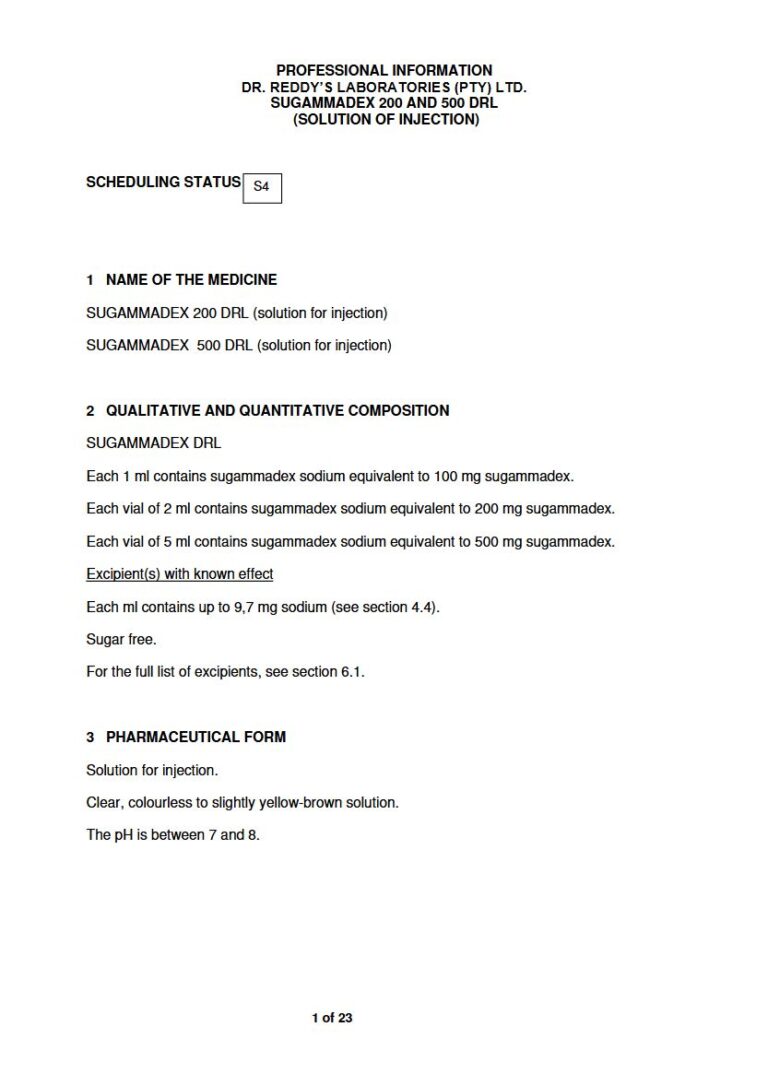
Sugammadex 200 & 500 Drl 200 mg, 500 mg Solution for injection
PDF Leaflet Revision Date: 29 August 2023
Clinical Summary
Quick overview from the medicine insert
Indication
Routine and immediate reversal of neuromuscular blockade induced by rocuronium or vecuronium.
Dosage (summary)
4 mg/kg for profound blockade, 2 mg/kg for shallow blockade, 16 mg/kg for immediate reversal.
Special Populations
- Renal impairment
- Hepatic impairment
- Elderly patients
- Obese patients
- Paediatric patients
Pregnancy & Breastfeeding
Safety in pregnancy not established; excretion in breast milk expected.
Key Drug Interactions
- Toremifene
- Fusidic acid
- Hormonal contraceptives
Contraindications
- Hypersensitivity to sugammadex or excipients
- Use with depolarising neuromuscular blockers
Common side effects
- Cough
- Airway complications
- Hypotension
- Dysgeusia
Counselling Points
- Monitor respiratory function post-administration
- Inform about potential hypersensitivity reactions
- Advise on contraceptive measures if applicable
Serious warnings
- Monitor for recurrence of neuromuscular blockade
- Marked bradycardia observed
- Caution in patients with coagulopathy
Important Disclaimer
The Sugammadex 200 & 500 Drl 200 mg, 500 mg Solution for injection professional information leaflet below is the property of Lnnovata Pharmaceuticals and is provided on Medinsert exactly as issued, with no.. alterations or editorial changes. We make every effort to keep content current by updating documents as soon as new versions become available. Medinsert serves as a trusted access point for healthcare professionals, but does not replace official sources or clinical judgement. For more details, please read our full disclaimer. read more>>
 Healthcare Professionals Only
This content is for registered healthcare professionals
Sign in or create a free account to read the full package insert.
Free for HPCSA-registered professionals. Powered by Medinsert.
Clinical Particulars
Section 4 of the official insert — extracted exactly as issued, no alterations
4.1 Therapeutic indications
SUGAMMADEX DRL is indicated for the routine reversal of neuromuscular blockade induced by rocuronium or vecuronium. SUGAMMADEX DRL is also indicated for the immediate reversal of neuromuscular blockade at 3 minutes after administration of rocuronium. For the paediatric population, SUGAMMADEX DRL is only recommended for routine reversal of rocuronium induced blockade in children above 7 years of age.
4.2 Posology and method of administration
Posology
SUGAMMADEX DRL Injection should be administered under the supervision of an anaesthetist. The use of an appropriate neuromuscular monitoring technique is recommended to monitor the recovery of the neuromuscular blockade (see section 4.4). When certain medicines that may cause displacement interactions are administered parenterally within 7,5 hours of SUGAMMADEX DRL, patients should be monitored for signs of recurrence of neuromuscular blockade. The recommended dose of SUGAMMADEX DRL depends on the level of neuromuscular blockade to be reversed. The recommended dose does not depend on the anaesthetic regimen. SUGAMMADEX DRL can be used to reverse different levels of rocuronium or vecuronium induced neuromuscular blockade.
Routine Reversal of Neuromuscular Blockade: A dose of 4 mg/kg SUGAMMADEX DRL is recommended if recovery has reached 1 to 2 post-tetanic counts (PTC) (profound blockade) following administration of rocuronium or vecuronium induced blockade (see section 4.4).
A dose of 2 mg/kg SUGAMMADEX DRL is only recommended if spontaneous recovery has reached the reappearance of T2 (shallow blockade) following rocuronium or vecuronium induced blockade (see section 4.4).
Immediate Reversal: If there is a clinical need for immediate reversal at 3 minutes following administration of rocuronium, a dose of 16 mg/kg SUGAMMADEX DRL is recommended. There is no data to recommend the use of SUGAMMADEX DRL for immediate reversal following vecuronium induced blockade.
Special populations
Renal Impairment: For mild and moderate renal impairment (creatinine clearance u2265 30 and < 80 ml/min): The dose recommendations are the same as for adults without renal impairment. The use of SUGAMMADEX DRL in patients with severe renal impairment including patients requiring dialysis (CrCI < 30 ml/min) is not recommended (see section 4.4). Studies in patients with severe renal impairment do not provide sufficient safety information to support the use of SUGAMMADEX DRL in these patients.
Elderly Patients: After administration of SUGAMMADEX DRL at reappearance of T2 following a rocuronium induced blockade, the median time to recovery of the T4/T1 ratio to 0,9 in adults (18 to 64 years) was 2,2 minutes, in elderly adults (65 to 74 years) it was 2,6 minutes and in very elderly adults (75 years or more) it was 3,6 minutes. Even though the recovery times in elderly tend to be slower, the same dose recommendation as for adults should be followed (see section 4.4).
Obese Patients: In obese patients, the dose of SUGAMMADEX DRL should be based on actual body weight. The same dose recommendations as for adults should be followed.
Hepatic Impairment: For mild to moderate hepatic impairment: As SUGAMMADEX DRL is mainly excreted renally no dose adjustments are required. Studies in patients with hepatic impairment have not been conducted. Caution should be exercised when considering the use of SUGAMMADEX DRL in patients with severe hepatic impairment or when hepatic impairment is accompanied by coagulopathy (see section 4.4).
Paediatric Population: The data for the paediatric population are limited (one study only for reversal of rocuronium induced blockade at reappearance of T2). There is insufficient information on the use of SUGAMMADEX DRL for children < 7 years of age. There is no information on SUGAMMADEX DRL use for neonates. Therefore, SUGAMMADEX DRL is not recommended for use in these populations. Children and Adolescents: For reversal of rocuronium induced blockade at reappearance of T2 in children and adolescents (7 to 17 years) 2 mg/kg SUGAMMADEX DRL is recommended. Immediate reversal in children and adolescents has not been investigated and is therefore not recommended. SUGAMMADEX DRL 100 mg/ml may be diluted to 10 mg/ml to increase the accuracy of dosing in the paediatric population, 7 years and older (see section 6.6).
Method of administration
SUGAMMADEX DRL injection should be administered intravenously as a single bolus injection. The bolus injection may be given rapidly, within 10 seconds, directly into a vein or into an existing IV line (see section 6.6). SUGAMMADEX DRL has only been administered as a single bolus injection in clinical trials.
4.3 Contraindications
SUGAMMADEX DRL is contraindicated in patients with known hypersensitivity to sugammadex sodium or to any of the excipients listed in section 6.1.
4.4 Special warnings and precautions for use
SUGAMMADEX DRL is not to be used to reverse depolarising neuromuscular blocking medicines. As is normal post-anaesthetic practice following neuromuscular blockade, it is recommended to monitor the patient in the immediate post-operative period for untoward events including recurrence of neuromuscular blockade. Monitoring respiratory function during recovery: Ventilatory support is mandatory for patients until adequate spontaneous respiration is restored following reversal of neuromuscular block. Even if recovery from neuromuscular blockade is complete, other medicines used in the peri- and post-operative period could depress respiratory function and therefore ventilatory support might still be required. Should neuromuscular blockade re-occur following extubation, adequate ventilation should be provided. Recurrence of neuromuscular blockade: In clinical studies with subjects treated with rocuronium or vecuronium, where sugammadex was administered using a dose labelled for the depth of neuromuscular blockade, an incidence of 0,20 % was observed for recurrence of neuromuscular blockade as based on neuromuscular monitoring or clinical evidence. The use of lower than recommended doses may lead to an increased risk of recurrence of neuromuscular blockade after initial reversal and is not recommended (see sections 4.2 and section 4.8). Effect on haemostasis: In a study in volunteers doses of 4 mg/kg and 16 mg/kg of sugammadex resulted in maximum mean prolongations of the activated partial thromboplastin time (aPTT) by 17 and 22 % respectively and prothrombin time international normalised ratio [PT(INR)] by 11 and 22 % respectively. These limited mean aPTT and PT(INR) prolongations were of short duration (u2264 30 minutes). Based on the clinical data-base (N=3,519) and on a specific study in 1184 patients undergoing hip fracture/major joint replacement surgery there was no clinically relevant effect of sugammadex 4 mg/kg alone or in combination with anticoagulants on the incidence of peri- or post-operative bleeding complications. In vitro experiments a pharmacodynamic interaction (aPTT and PT prolongation) was noted with vitamin K antagonists, unfractionated heparin, low molecular weight heparinoids, rivaroxaban and dabigatran. In patients receiving routine post-operative prophylactic anticoagulation this pharmacodynamic interaction is not clinically relevant. Caution should be exercised when considering the use of SUGAMMADEX DRL in patients receiving therapeutic anticoagulation for a pre-existing or co-morbid condition. An increased risk of bleeding cannot be excluded in patients: u2022 with hereditary vitamin K dependent clotting factor deficiencies; u2022 with pre-existing coagulopathies; u2022 on coumarin derivatives and at an INR above 3.5; u2022 using anticoagulants who receive a dose of 16 mg/kg SUGAMMADEX DRL. If there is a medical need to give SUGAMMADEX DRL to these patients the anaesthesiologist needs to decide if risk of bleeding complications taking into consideration the patients history of bleeding episodes and type of surgery scheduled. If SUGAMMADEX DRL is administered to these patients monitoring of haemostasis and coagulation parameters is recommended. Waiting times for re-administration with neuromuscular blocking medicines (NMBA) after reversal with SUGAMMADEX DRL: Re-administration of rocuronium or vecuronium after a recommended dose reversal (up to 4 mg/kg sugammadex): Minimum waiting time NMBA (e.g., Esmeron and Norcuron) and dose to be administered 5 minutes 1,2 mg/kg rocuronium 4 hours 0,6 mg/kg rocuronium or 0,1 mg/kg vecuronium The onset of neuromuscular blockade may be prolonged up to approximately 4 minutes, and the duration of neuromuscular blockade may be shortened up to approximately 15 minutes after re-administration of rocuronium 1,2 mg/kg within 30 minutes after SUGAMMADEX DRL administration. Based on PK modelling the recommended waiting time in patients with mild or moderate renal impairment for re-use of 0,6 mg/kg rocuronium or 0,1 mg/kg vecuronium after routine reversal with SUGAMMADEX DRL should be 24 hours. If a shorter waiting time is required, the rocuronium dose for a new neuromuscular blockade should be 1,2 mg/kg. Re-administration of rocuronium or vecuronium after immediate reversal (16 mg/kg SUGAMMADEX DRL): A waiting time of 24 hours is recommended. If neuromuscular blockade is required before the recommended waiting time has passed, a non-steroidal neuromuscular blocking medicine should be used. The onset of a depolarising neuromuscular blocking medicine might be slower than expected, because a substantial fraction of post-junctional nicotinic receptors may still be occupied by the neuromuscular blocking medicine. Renal Impairment: SUGAMMADEX DRL is not recommended for use in patients with severe renal impairment, creatinine clearance < 30 ml/min, including those requiring dialysis (see section 5.1). Because of the estimated prolonged half-life of sugammadex in severe renally impaired patients, a full neuromuscular blockade may not be achieved after re-use of 0,6 mg/kg rocuronium or 0,1 mg/kg vecuronium within 24 hours after SUGAMMADEX DRL reversal. Light anaesthesia: When neuromuscular blockade was reversed intentionally in the middle of anaesthesia in clinical trials, signs of light anaesthesia were noted occasionally (movement, coughing, grimacing and sucking of the tracheal tube). If neuromuscular blockade is reversed, while anaesthesia is continued, additional doses of anaesthetic and/or opioid should be given as clinically indicated. Marked bradycardia: Marked bradycardia has been observed within minutes after the administration of SUGAMMADEX DRL for reversal of neuromuscular blockade. Cases of bradycardia with cardiac arrest have been reported (see section 4.8). Patients should be closely monitored for haemodynamic changes during and after reversal of neuromuscular blockade. Treatment with anticholinergic medicines such as atropine should be administered if clinically significant bradycardia is observed. Hepatic Impairment: Sugammadex is not metabolised nor excreted by the liver; therefore, dedicated studies in patients with hepatic impairment have not been conducted. Patients with severe hepatic impairment should be treated with great caution. Hepatic impairment may be accompanied by coagulopathy (see the information on the "Effect on haemostasis"). Use in Intensive Care Unit (ICU): SUGAMMADEX DRL has not been investigated in patients receiving rocuronium or vecuronium in the ICU setting. Use for reversal of neuromuscular blocking medicines other than rocuronium or vecuronium: SUGAMMADEX DRL should not be used to reverse block induced by non-steroidal neuromuscular blocking medicines such as succinylcholine or benzylisoquinolinium compounds. SUGAMMADEX DRL should not be used for reversal of neuromuscular blockage induced by steroidal neuromuscular blocking medicines other than rocuronium or vecuronium, since there are no efficacy and safety data for these situations. Limited data are available for reversal of pancuronium induced blockage, but it is advised not to use SUGAMMADEX DRL in this situation. Delayed recovery: Conditions associated with prolonged circulation time such as cardiovascular disease, old age (see section 4.2 for the time to recovery in elderly), or oedematous state (e.g., severe hepatic impairment) may be associated with longer recovery times. Medicine hypersensitivity reactions: Medical practitioners should be prepared for the possibility of medicine hypersensitivity reactions (including anaphylactic reactions) and take the necessary precautions (see section 4.8). Patients on a controlled sodium diet: Each ml solution contains up to 9,7 mg sodium. A dose of 23 mg sodium is considered essentially 'sodium-free'. If more than 2,4 ml solution needs to be administered, this should be taken into consideration by patients on a controlled sodium diet.
4.5 Interactions with other medicines
The information reported in this section is based on binding affinity between SUGAMMADEX DRL and other medicines, non-clinical experiments, clinical studies and simulations using a model taking into account the pharmacodynamic effect of neuromuscular blocking medicines and sugammadex. Based on these data, no clinically significant pharmacodynamic interaction with other medicines is expected, with exception of the following: For toremifene and fusidic acid displacement interactions could not be excluded (no clinically relevant capturing interactions are expected). For hormonal contraceptives a clinically relevant capturing interaction could not be excluded (no displacement interactions are expected). Interactions potentially affecting the efficacy of sugammadex (displacement interactions): Due to the administration of certain medicines after sugammadex, theoretically rocuronium or vecuronium could be displaced from SUGAMMADEX DRL. As a result, recurrence of neuromuscular blockade might be observed. In this situation the patient must be ventilated. Administration of medicines which caused displacement should be stopped in case of an infusion. In situations when potential displacement interactions can be anticipated, patients should be carefully monitored for signs of re-occurrence of blockade (approximately up to 15 minutes), after parenteral administration of another medicine occurring within a period of 7,5 hours after SUGAMMADEX DRL administration. SUGAMMADEX DRL should be used cautiously when co-administered with: Toremifene: For toremifene, which has a relatively high affinity constant and relatively high plasma concentrations, some displacement of vecuronium or rocuronium from the complex with SUGAMMADEX DRL could occur. The recovery of the train of four ratio, T4/T1 to 0,9 could therefore be delayed in patients who have received toremifene on the same day of surgery (see section 4.4). Intravenous Administration of Fusidic Acid: The use of fusidic acid in the pre-operative phase may cause some delay in the recovery of the T4/T1 ratio to 0,9. No recurrence of neuromuscular blockade is expected in the post-operative phase, since the infusion rate of fusidic acid is over a period of several hours and the blood levels are cumulative over 2 to 3 days. For re-administration of SUGAMMADEX DRL see section 4.2. Interactions potentially affecting the efficacy of other medicines (capturing interactions): Due to the administration of SUGAMMADEX DRL, certain medicines could become less effective due to a lowering of the (free) plasma concentrations. If such a situation is observed, the medical practitioner is advised to consider the re-administration of the medicine, the administration of a therapeutically equivalent medicine (preferably from a different chemical class) and/or non-pharmacological interventions as appropriate. Hormonal Contraceptives: The interaction between 4 mg/kg SUGAMMADEX DRL and a progestogen was predicted to lead to a decrease in progestogen exposure (34% of AUC) similar to the decrease seen when a daily dose of an oral contraceptive is taken 12 hours too late, which might lead to a reduction in effectiveness. For oestrogens, the effect is expected to be lower. Therefore the administration of a bolus dose of SUGAMMADEX DRL is considered to be equivalent to one missed daily dose of oral contraceptive steroids (either combined or progestogen only). If SUGAMMADEX DRL, is administered at the same day as an oral contraceptive is taken reference is made to missed dose advice in the package leaflet of the oral contraceptive. In the case of non-oral hormonal contraceptives, the patient must use an additional non hormonal contraceptive method for the next 7 days and refer to the advice in the package leaflet of the product. In the case of non-oral hormonal contraceptives, the patient must use an additional non-hormonal contraceptive method for the next 7 days and refer to the advice in the package leaflet of the product. Interactions due to the lasting effect of rocuronium or vecuronium: When medicines which potentiate neuromuscular blockade are used in the post-operative period special attention should be paid to the possibility of recurrence of neuromuscular blockade. Please refer to the professional information of rocuronium or vecuronium for a list of the specific medicines which potentiate neuromuscular blockade. In case recurrence of neuromuscular blockade is observed, the patient may require mechanical ventilation and re-administration of SUGAMMADEX DRL (see section 4.2). Interference with laboratory tests: In general, sugammadex does not interfere with laboratory tests, with the possible exception of the serum progesterone assay. Interference with this test is observed at sugammadex plasma concentrations of 100 microgram/ml (peak plasma level following 8 mg/kg bolus injection).
4.6 Fertility, pregnancy and lactation
Pregnancy
The safety in pregnant women has not been established.
Breast-feeding
The excretion of sugammadex in human milk has not been studied, but can be expected based on the pre-clinical data.
Fertility
The effects with sugammadex on human fertility have not been investigated. Animal studies to evaluate fertility do not reveal harmful effects.
4.7 Effects on ability to drive and use machines
SUGAMMADEX DRL has no known influence on the ability to drive and use machines.
4.8 Undesirable effects
Summary of the safety profile
SUGAMMADEX DRL is administered concomitantly with neuromuscular blocking medicines and anaesthetics in surgical patients. The causality of adverse events is therefore difficult to assess. The most commonly reported adverse reactions in surgical patients were cough, airway complication of anaesthesia, anaesthetic complications, procedural hypotension and procedural complication.
Tabulated list of adverse reactions:
System organ class Frequencies Adverse reactions (Preferred terms)
Immune system disorders Less frequent Medicine hypersensitivity reactions (see section 4.4)
Nervous system disorders Frequent Dysgeusia
Respiratory, thoracic and mediastinal disorders Frequent Cough
Injury, poisoning and procedural complications Frequent Airway complication of anaesthesia Anaesthetic complication (see section 4.4) Procedural hypotension Procedural complication
Description of selected adverse reactions
Medicine hypersensitivity reactions: Hypersensitivity reactions, including anaphylaxis, have occurred in some patients and volunteers (for information on volunteers, see Information on healthy volunteers below). In clinical trials of surgical patients these reactions were reported uncommonly and for post-marketing reports the frequency is unknown. These reactions varied from isolated skin reactions to serious systemic reactions (i.e., anaphylaxis, anaphylactic shock) and have occurred in patients with no prior exposure to sugammadex. Symptoms associated with these reactions can include: flushing, urticaria, erythematous rash, (severe) hypotension, tachycardia, swelling of tongue, swelling of pharynx, bronchospasm and pulmonary obstruction.
Airway Complication of Anaesthesia: Airway complications of anaesthesia included bucking against the endotracheal tube, coughing, mild bucking, arousal reaction during surgery, coughing during the anaesthetic procedure or during surgery, or anaesthetic procedure-related spontaneous breath of patient.
Anaesthetic complications: Anaesthetic complications, indicative of the restoration of neuromuscular function, include movement of a limb or the body or coughing during the anaesthetic procedure or during surgery, grimacing, or suckling on the endotracheal tube. See section 4.4 light anaesthesia.
Procedural Complication: Procedural complications included coughing, tachycardia, bradycardia, movement, and increase in heart rate.
Marked bradycardia: In post-marketing, isolated cases of marked bradycardia and bradycardia with cardiac arrest have been observed within minutes after administration of sugammadex (see section 4.4).
Paediatric population
A limited database suggests that the safety profile of sugammadex (up to 4 mg/kg) in paediatric patients above 7 years old, was similar to that in adults.
Other special populations
Pulmonary patients: In post-marketing data and in one dedicated clinical trial in patients with a history of pulmonary complications, bronchospasm was reported as a possibly related adverse event. As with all patients with a history of pulmonary complications the medical practitioner should be aware of the possible occurrence of bronchospasm.
Morbidly obese patients: In one dedicated clinical trial in morbidly obese patients, the adverse reaction profile was generally similar to the profile in adult patients in pooled Phase 1 to 3 studies.
4.9 Overdose
SUGAMMADEX DRL can be removed using haemodialysis with a high-flux filter, but not with a low-flux filter. Based upon clinical studies, SUGAMMADEX DRL concentrations in plasma are reduced with a high-flux filter by about 70 % after a 3- to 6- hour dialysis session.
