
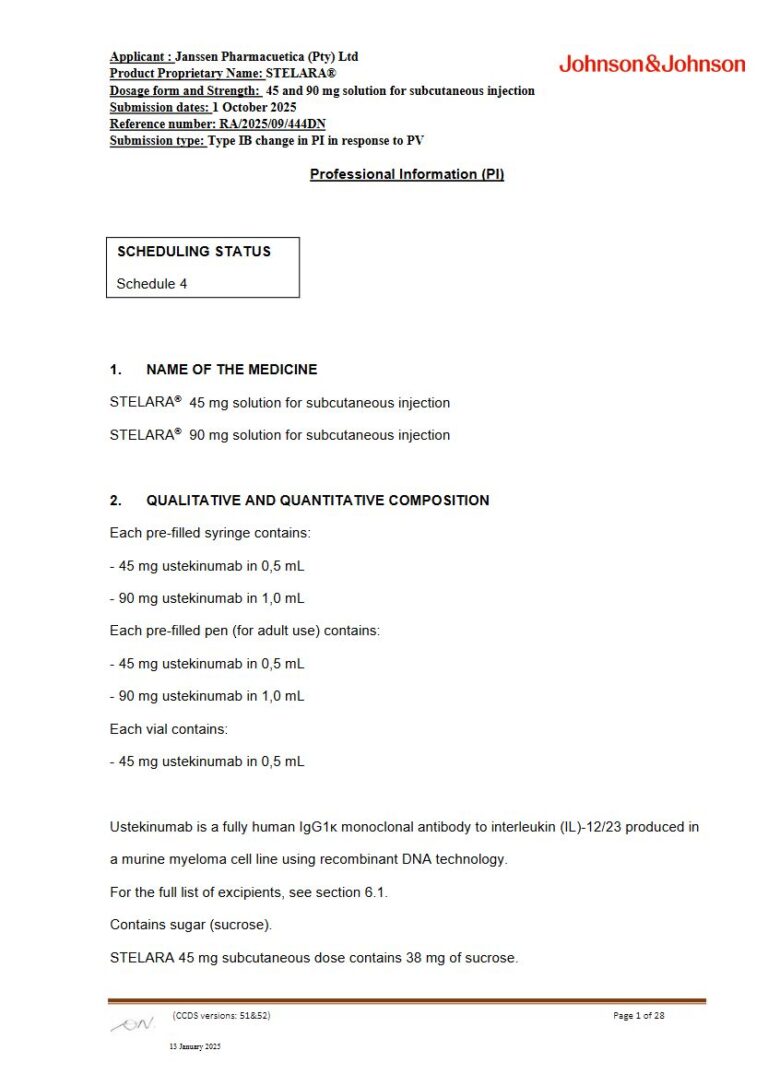
Stelara 90 Mg/45 mg Solution
PDF Leaflet Revision Date: 13 January 2026
Clinical Summary
Quick overview from the medicine insert
Indication
Moderate to severe plaque psoriasis, psoriatic arthritis, Crohnu2019s disease, and ulcerative colitis.
Dosage (summary)
Adults: 45 mg SC at Weeks 0 and 4, then every 12 weeks; 90 mg for >100 kg. Pediatric: 0.75 mg/kg for <60 kg, 45 mg for 60-100 kg, 90 mg for >100 kg.
Special Populations
- Elderly
- Renal impairment
- Hepatic impairment
Pregnancy & Breastfeeding
Use only if benefits outweigh risks; minimal excretion in breast milk.
Key Drug Interactions
- Live vaccines
- Immunosuppressants
Contraindications
- Hypersensitivity to ustekinumab
- Active tuberculosis
Common side effects
- Nasopharyngitis
- Headache
- Injection site reactions
Counselling Points
- Monitor for signs of infection
- Avoid live vaccines
- Report any serious allergic reactions
Serious warnings
- Increased risk of infections
- Serious hypersensitivity reactions
- Potential for malignancies
Important Disclaimer
The Stelara 90 Mg/45 mg Solution professional information leaflet below is the property of Janssen Pharmaceutica and is provided on Medinsert exactly as issued, with no.. alterations or editorial changes. We make every effort to keep content current by updating documents as soon as new versions become available. Medinsert serves as a trusted access point for healthcare professionals, but does not replace official sources or clinical judgement. For more details, please read our full disclaimer. read more>>
 Healthcare Professionals Only
This content is for registered healthcare professionals
Sign in or create a free account to read the full package insert.
Free for HPCSA-registered professionals. Powered by Medinsert.
Clinical Particulars
Section 4 of the official insert — extracted exactly as issued, no alterations
4.1 Therapeutic indications
Plaque psoriasis
STELARA is indicated for the treatment of moderate to severe plaque psoriasis in adult patients who are candidates for phototherapy or systemic therapy.
Paediatric plaque psoriasis
STELARA is indicated for the treatment of moderate to severe plaque psoriasis in children and adolescent patients from the age of 6 years and older, who are inadequately controlled by, or are intolerant to, other systemic therapies or phototherapies.
Psoriatic Arthritis (PsA)
STELARA, alone or in combination with methotrexate (MTX), is indicated for the treatment of moderate to severe active psoriatic arthritis in adults as second line treatment, when the response to previous Disease-Modifying Antirheumatic Drugs (DMARDS) was inadequate.
Crohnu2019s Disease
STELARA is indicated for the treatment of adult patients with moderately to severely active Crohnu2019s disease who have had an inadequate response with, lost response to, or were intolerant to either conventional therapy or a TNFu03b1 antagonist or have medical contraindications to such therapies.
Ulcerative colitis
STELARA is indicated for the treatment of adult patients with moderately to severely active ulcerative colitis who have had an inadequate response with, lost response to, or were intolerant to either conventional therapy or a biologic or have medical contraindications to such therapies.
4.2 Posology and method of administration
Posology
STELARA is intended for use under the guidance and supervision of medical practitioners experienced in the diagnosis and treatment of conditions for which STELARA is indicated.
Posology
Plaque psoriasis and psoriatic arthritis
For the treatment of plaque psoriasis and psoriatic arthritis, STELARA is administered by subcutaneous injection.
Adults (18-64 years): The recommended dose of STELARA is 45 mg administered subcutaneously at Weeks 0 and 4, then every 12 weeks thereafter. Alternatively, 90 mg may be used in patients with a body weight greater than 100 kg (see section 5.2, Pharmacokinetic Properties). In patients weighing > 100 kg, 45 mg was also shown to be efficacious. However, 90 mg resulted in greater efficacy in these patients. For patients with plaque psoriasis, who inadequately respond to dosing every 12 weeks, consideration may be given to treating every 8 weeks.
Consideration should be given to discontinuing treatment in patients who have shown no response up to 28 weeks of treatment.
Re-treatment: For patients with psoriasis, re-treatment with a dosing regimen of Weeks 0 and 4 after interruption of therapy has been shown to be safe and effective.
Crohnu2019s Disease and Ulcerative Colitis
In the treatment regimen, the first dose of STELARA is administered intravenously. For the posology of the intravenous dosing regimen, see section 4.2 of the STELARA 130 mg Concentrate for solution for infusion Professional information. The first subcutaneous administration of 90 mg STELARA should take place at week 8 after the intravenous dose. After this, dosing every 12 weeks is recommended. Patients who have not shown adequate response at 8 weeks after the first subcutaneous dose, may receive a second subcutaneous dose at this time. Patients who lose response on dosing every 12 weeks may benefit from an increase in dosing frequency to every 8 weeks. Patients may subsequently be dosed every 8 weeks or every 12 weeks according to clinical judgement. Consideration should be given to discontinuing treatment in patients who show no evidence of therapeutic benefit 16 weeks after the IV induction dose or 16 weeks after switching to the 8-weekly maintenance dose.
Immunomodulators and/or corticosteroids may be continued during treatment with STELARA. In patients who have responded to treatment with STELARA, corticosteroids may be reduced or discontinued in accordance with standard of care. In Crohn's disease or ulcerative colitis, if therapy is interrupted, resumption of treatment with subcutaneous dosing every 8 weeks is safe and effective.
Elderly (u2265 65 years)
In clinical studies, no major age-related differences in clearance or volume of distribution were observed and no overall differences in safety and efficacy in patients age 65 and older who received STELARA were observed compared to younger patients. The number of patients aged 65 and over is not sufficient to determine whether they respond differently from younger patients. No dose adjustment is needed for elderly patients (see section 4.4).
Renal and hepatic impairment
STELARA has not been studied in these patient populations. No dose recommendations can be made.
Paediatric population
The safety and efficacy of STELARA in children with psoriasis less than 6 years of age or in children with psoriatic arthritis less than 18 years of age have not yet been established. The safety and efficacy of STELARA in treatment of Crohnu2019s disease or ulcerative colitis in children less than 18 years of age have not been established.
Paediatric plaque psoriasis (6 years and older)
For the treatment of plaque psoriasis, STELARA should be administered by subcutaneous injection. The recommended dose of STELARA based on body weight is shown below (Tables 1 and 2). STELARA should be administered at Weeks 0 and 4, then every 12 weeks thereafter. The pre-filled pen is not recommended for use in paediatric patients.
Table 1: Recommended dose of STELARA for paediatric psoriasis
Weight Recommended dose Dosage form
< 60 kg 0,75 mg/kg* Vial
u2265 60 to u2264 100 kg 45 mg Pre-filled syringe, vial
>100 kg 90 mg Pre-filled syringe
* To calculate the volume of injection (mL) for patients < 60 kg, use the following formula: body weight (kg) x 0,0083 (mL/kg) or see Table 2. The calculated volume should be rounded to the nearest 0,01 mL and administered using a 1 mL graduated syringe. A 45 mg vial is available for paediatric patients who need to receive less than the full 45 mg dose.
Table 2 Injection volumes of STELARA for paediatric psoriasis patients < 60 kg
Body weight at time of dosing (kg) Dose (mg) Volume of injection (mL)
15 11.3 0.12
16 12.0 0.13
17 12.8 0.14
18 13.5 0.15
19 14.3 0.16
20 15.0 0.17
21 15.8 0.17
22 16.5 0.18
23 17.3 0.19
24 18.0 0.20
25 18.8 0.21
26 19.5 0.22
27 20.3 0.22
28 21.0 0.23
29 21.8 0.24
30 22.5 0.25
31 23.3 0.26
32 24.0 0.27
33 24.8 0.27
34 25.5 0.28
35 26.3 0.29
36 27.0 0.30
37 27.8 0.31
38 28.5 0.32
39 29.3 0.32
40 30.0 0.33
41 30.8 0.34
42 31.5 0.35
43 32.3 0.36
44 33.0 0.37
45 33.8 0.37
46 34.5 0.38
47 35.3 0.39
48 36.0 0.40
49 36.8 0.41
50 37.5 0.42
51 38.3 0.42
52 39.0 0.43
53 39.8 0.44
54 40.5 0.45
55 41.3 0.46
56 42.0 0.46
57 42.8 0.47
58 43.5 0.48
59 44.3 0.49
Consideration should be given to discontinuing treatment in patients who have shown no response up to 28 weeks of treatment.
Method of administration
STELARA 45 mg vials or 45 mg and 90 mg pre-filled syringes or pre-filled pens are for subcutaneous injection only. If possible, areas of the skin that show psoriasis should be avoided as injection sites.
After proper training in subcutaneous injection technique, patients or their caregivers may inject STELARA if a medical practitioner determines that it is appropriate. However, the medical practitioner should ensure appropriate follow-up of patients. The pre-filled pen has not been studied in the paediatric population and is not recommended for use in paediatric patients. Patients or their caregivers should be instructed to inject the prescribed amount of STELARA subcutaneously according to the directions provided in the Professional information. Comprehensive instructions for administration are given in the Patient Information Leaflet. For further instructions on the preparation and special precautions for handling, see section 6.6.
4.3 Contraindications
Hypersensitivity to the active substance, ustekinumab, or to any of the excipients listed in section 6.1.
Active tuberculosis (see section 4.4).
4.4 Special warnings and precautions for use
Infections
STELARA is a selective immunosuppressant and may have the potential to increase the risk of infections and reactivate latent infections. In clinical studies, serious bacterial, fungal, and viral infections were observed in patients receiving STELARA (see section 4.8: Infections). STELARA should not be given to patients with a clinically important, active infection.
Caution should be exercised when considering the use of STELARA in patients with a chronic infection or a history of recurrent infection. Prior to initiating treatment with STELARA, patients should be evaluated for tuberculosis infection. STELARA should not be given to patients with active tuberculosis (see section 4.3). Treatment of latent tuberculosis infection should be initiated prior to administering STELARA. Anti-tuberculosis therapy should also be considered prior to initiation of STELARA in patients with a past history of latent or active tuberculosis in whom an adequate course of treatment cannot be confirmed. Patients receiving STELARA should be monitored closely for signs and symptoms of active tuberculosis during and after treatment. Patients should be instructed to seek medical advice if signs or symptoms suggestive of an infection occur. If a patient develops a serious infection, they should be closely monitored and STELARA should not be administered until the infection resolves.
Malignancies
STELARA is a selective immunosuppressant. Immunosuppressive medicines, such as STELARA, have the potential to increase the risk of malignancy. Some patients who received STELARA in clinical studies developed cutaneous and non-cutaneous malignancies (see section 4.8: Malignancies). STELARA has not been studied in patients with a history of malignancy. Caution should be exercised when considering the use of STELARA in patients with a history of malignancy or when considering continuing treatment in patients who develop a malignancy.
All patients, in particular those older than 60 years of age, patients with a medical history of prolonged immunosuppressant therapy or those with a history of PUVA treatment, should be monitored for the appearance of skin cancer (see section 4.8: Malignancies).
Hypersensitivity reactions
In post-marketing experience, serious hypersensitivity reactions, including anaphylaxis and angioedema, have been reported. If an anaphylactic or other serious hypersensitivity reaction occurs, institute appropriate therapy and administration of STELARA should be discontinued (see section 4.8: Hypersensitivity reactions).
Latex sensitivity
The needle cover on the pre-filled syringe and the needle cover inside the bottom cap of the pre-filled pen contain dry natural rubber (a derivative of latex), which may cause allergic reactions in individuals sensitive to latex.
Immunisations
Live viral or live bacterial vaccines (such as Bacillus of Calmette and Guu00e9rin (BCG)) should not be given concurrently with STELARA. No data are available on the secondary transmission of infection by live vaccines in patients receiving STELARA. Caution is advised when administering some live vaccines to household contacts of patients receiving STELARA because of the potential risk for shedding from the household contact and transmission to the patient. Patients receiving STELARA may receive concurrent inactivated or non-live vaccinations. Long term treatment with STELARA does not suppress the humoral immune response to pneumococcal polysaccharide or tetanus vaccines.
Infant exposure in utero
For infants exposed in utero to ustekinumab, a six month waiting period following birth is recommended before the administration of live vaccines. Administration of a live vaccine prior to 6 months of age may be considered if ustekinumab dosing was limited to the first trimester of pregnancy when placental transport is minimal, or ustekinumab serum levels are undetectable in the infant, or the benefit of the vaccination clearly outweighs the theoretical risk of administration of live vaccines to the infant (see section 4.6 - Fertility, pregnancy and lactation).
Immunosuppression
In psoriasis studies, the safety and efficacy of STELARA in combination with immunosuppressive medicines or phototherapy have not been evaluated. In psoriatic arthritis studies, concomitant methotrexate (MTX) use did not appear to influence the safety or efficacy of STELARA. In Crohnu2019s disease and ulcerative colitis studies, concomitant use of immunomodulators (6-mercaptopurine (6-MP), azathioprine (AZA), methotrexate (MTX) or corticosteroids did not appear to influence the safety or efficacy of STELARA. Caution should be exercised when considering concomitant use of immunosuppressive medicines and STELARA or when transitioning from other biologic medicines. (see section 4.5).
Immunotherapy
STELARA has not been evaluated in patients who have undergone allergy immunotherapy. STELARA may affect allergy immunotherapy. Caution should be exercised in patients receiving or who have received allergy immunotherapy particularly for anaphylaxis.
Sucrose
STELARA contains sucrose. Patients with rare hereditary conditions such as fructose intolerance, glucose-galactose malabsorption or sucrose-isomaltase insufficiency should not use STELARA. In addition, sucrose may have an effect on the glycaemic control of patients with diabetes mellitus.
4.5 Interactions with other medicines
Live vaccines should not be given concurrently with STELARA. Recommendations for infants exposed to ustekinumab in utero are provided (see section 4.4). The effects of IL-12 or IL-23 on the regulation of CYP450 enzymes were evaluated in an in vitro study using human hepatocytes, which showed that IL-12 and/or IL-23 at levels of 10 ng/mL did not alter human CYP450 enzyme activities (CYP1A2, 2B6, 2C9, 2C19, 2D6, or 3A4). Results from a Phase 1 study in subjects with active Crohnu2019s disease suggest no clinically relevant drug interactions are likely. These results do not suggest the need for dose adjustments in patients who are receiving concomitant CYP450 substrates (see 5.2). In a population pharmacokinetic analysis, the effect of the most frequently used concomitant medicines in patients with psoriasis (including paracetamol, ibuprofen, acetylsalicylic acid, metformin, atorvastatin, naproxen, levothyroxine, hydrochlorothiazide, and influenza vaccine) on pharmacokinetics of ustekinumab was explored. There were no indications of an interaction with these concomitantly administered medicines. The pharmacokinetics of STELARA was not impacted by the prior use of MTX, NSAIDs, and oral corticosteroids, or prior exposure to anti-TNFu03b1 medicines in patients with psoriatic arthritis, Crohnu2019s disease or in patients with ulcerative colitis. In psoriasis studies, the safety and efficacy of STELARA in combination with immunosuppressive medicines, including biologics, or phototherapy have not been evaluated. Caution should be exercised when considering concomitant use of immunosuppressive medicines and STELARA.
4.6 Fertility, pregnancy and lactation
Pregnancy
Data from prospectively collected pregnancies following exposure to STELARA resulting in live birth with known outcomes, including more than 450 pregnancies exposed during the first trimester, do not indicate an increased risk of malformations in the newborn. Overall, data from observational studies, pharmacovigilance, and published case reports and cohort studies do not indicate an increase in the risk of major birth defects, pattern of major or minor anomalies, miscarriage, or adverse infant outcomes. STELARA should not be given to a pregnant woman except if the benefit clearly outweighs the risk.
Lactation
Limited data from published literature suggests that ustekinumab is excreted in human breast milk in very small amounts. While systemic exposure to the breastfed infant is expected to be low because ustekinumab is a large molecule and is degraded in the gastrointestinal tract, it is not known if STELARA is absorbed systemically after ingestion. Because of the potential for adverse reactions in breastfeeding infants from STELARA, a decision should be made whether to discontinue breastfeeding or to discontinue STELARA.
Fertility
The effect of STELARA on human fertility has not been evaluated (see section 5.3). It is not known whether STELARA can affect reproductive potential.
4.7 Effects on ability to drive and use machines
No studies on the effects on the ability to drive and use machines have been performed.
4.8 Undesirable effects
Clinical studies experience in adult patients
Summary of safety profile
The most common adverse reactions (> 5 %) in controlled periods of the adult psoriasis, psoriatic arthritis, Crohnu2019s disease and ulcerative colitis clinical studies with STELARA were nasopharyngitis and headache. Most were considered to be mild and did not necessitate discontinuation of study treatment. The most serious adverse reaction that has been reported for STELARA is serious hypersensitivity reactions including anaphylaxis (see section 4.4). The overall safety profile was similar for patients with psoriasis, psoriatic arthritis, Crohnu2019s disease and ulcerative colitis.
Tabulated list of adverse reactions
The safety data described below reflect exposure in adults to STELARA in 14 phase 2 and phase 3 studies in 6 710 patients (4 135 with psoriasis and/or psoriatic arthritis, 1 749 with Crohnu2019s disease and 826 patients with ulcerative colitis). This includes exposure to STELARA in the controlled and non-controlled periods of the clinical studies for at least 6 months or 1 year (4 577 and 3648 patients respectively with psoriasis, psoriatic arthritis, Crohnu2019s disease or ulcerative colitis) and exposure for at least 4 or 5 years (2194 and 1148 patients with psoriasis respectively).
Table 3 provides a list of adverse reactions from adult psoriasis, psoriatic arthritis, Crohnu2019s disease and ulcerative colitis clinical studies. The adverse reactions are classified by System Organ Class and frequency, using the following convention: Very common (u2265 1/10), Common (u2265 1/100 to < 1/10), Uncommon (u2265 1/1 000 to < 1/100), Rare (u2265 1/10 000 to < 1/1 000), Very rare (< 1/10 000), not known (cannot be estimated from the available data). Within each frequency grouping, adverse reactions are presented in order of decreasing seriousness.
Table 3: Summary of Adverse Reactions in Clinical Studies
System Organ Class Frequency: Adverse reaction
Infections and infestations Common : Upper respiratory tract infection, nasopharyngitis, sinusitis
Uncommon : Cellulitis, dental infections, herpes zoster, viral upper respiratory tract infection, vulvovaginal mycotic infection
Psychiatric disorders Uncommon : Depression
Nervous system disorders Common : Dizziness, headache
Respiratory, thoracic and mediastinal disorders Common : Oropharyngeal pain
Uncommon : Nasal congestion
Gastrointestinal disorders Common : Diarrhoea, nausea, vomiting
Skin and subcutaneous tissue disorders Common : Pruritus
Uncommon : Acne
Musculoskeletal and connective tissue disorders Common: Back pain, myalgia, arthralgia
General disorders and administration site conditions Common: Fatigue, injection site erythema, injection site pain
Uncommon : Injection site reactions (including haemorrhage, haematoma, induration, swelling and pruritus), asthenia
Physicians should consider the local disease background when treating patients with STELARA (see section 4.4).
Description of selected adverse reactions
Infections
In the placebo-controlled period of clinical studies of patients with psoriasis, psoriatic arthritis, Crohnu2019s disease and ulcerative colitis, the rate of infection was 1,36 per patient-year of follow-up in STELARA-treated patients, and 1,34 per patient follow-up in placebo-treated patients. Serious infections occurred at the same rate of 0,03 per patient-year of follow-up in STELARA and placebo treated patients (see section 4.4: Infections).
Malignancies
In the placebo controlled period of the psoriasis, psoriatic arthritis, Crohnu2019s disease and ulcerative colitis clinical studies, the incidence of malignancies excluding non-melanoma skin cancer was 0,11 per 100 patient-years of follow-up for STELARA-treated patients compared with 0,23 per 100 patient years of follow up for placebo-treated patients. The incidence of non-melanoma skin cancer was 0,43 per 100 patient-years of follow-up for STELARA-treated patients compared with 0,46 per 100 patient-years of follow up for placebo-treated patients. In the controlled and non-controlled periods of psoriasis, psoriatic arthritis, Crohnu2019s disease and ulcerative colitis clinical studies malignancies, excluding non-melanoma skin cancers were reported with an incidence of 0,50 per 100 patient-years of follow-up for STELARA-treated patients. This was comparable to the incidence expected in the general population (standardised incidence ratio = 0,94 [95% confidence interval: 0,73, 1,18]). The most frequently observed malignancies, other than non-melanoma skin cancer, were prostate, melanoma, colorectal and breast. The incidence of non-melanoma skin cancer was 0,49 per 100 patient-years of follow-up for STELARA-treated patients (see section 4.4: Malignancies).
Hypersensitivity
During the controlled periods of psoriasis and psoriatic arthritis clinical studies of STELARA, rash and urticaria have each been observed in < 1 % of patients.
Clinical studies experience in paediatric patients with psoriasis
The safety of STELARA has been studied in two Phase 3 studies of paediatric patients with moderate to severe plaque psoriasis. The first study was in 110 patients from 12 to 17 years of age treated for up to 60 weeks (CADMUS) and the second study was in 44 patients from 6 to 11 years of age treated for up to 56 weeks (CADMUS Jr.). In general, the adverse events reported in these two studies were similar to those seen in previous studies in adults with plaque psoriasis.
Postmarketing experience
Table 4: Adverse Reactions Identified During Postmarketing Experience with STELARA
Immune system disorders Hypersensitivity reactions (including rash, urticaria) Serious hypersensitivity reactions (including anaphylaxis, angioedema)
Infections and infestations Lower respiratory tract infection
Respiratory, thoracic and mediastinal disorders Allergic alveolitis, eosinophilic pneumonia
Skin and subcutaneous tissue disorders Pustular psoriasis, exfoliative dermatitis, erythrodermic psoriasis, hypersensitivity vasculitis
Reporting of suspected adverse reactions
Reporting suspected adverse reactions after authorisation of the medicinal product is important. It allows continued monitoring of the benefit/risk balance of the medicine. Health care providers are asked to report any suspected adverse reactions to SAHPRA via the Med Safety APP (Medsafety X SAHPRA) and eReporting platform (who-umc.org) found on SAHPRA website.
4.9 Overdose
In case of overdose, although no dose-dependent toxicity has been observed, theoretically, side effects could be exacerbated or exaggerated. It is recommended that the patient be monitored for any signs or symptoms of adverse reactions or effects and appropriate symptomatic treatment be instituted immediately.
