
Rolixird 450 mg FC Tablet
PDF Leaflet Revision Date: 12 May 2023
Clinical Summary
Quick overview from the medicine insert
Indication
Treatment of CMV retinitis in AIDS patients and prevention of CMV disease in solid organ transplant patients.
Dosage (summary)
900 mg twice daily for 21 days for induction; 900 mg once daily for maintenance.
Special Populations
- Renal impairment
- Hepatic impairment
- Elderly
- Paediatric patients
Pregnancy & Breastfeeding
Not established for pregnancy; contraindicated in breastfeeding.
Key Drug Interactions
- Imipenem-cilastatin
- Zidovudine
- Didanosine
- Probenecid
Contraindications
- Hypersensitivity to valganciclovir or ganciclovir
- Severe leucopenia or thrombocytopenia
Common side effects
- Neutropenia
- Anaemia
- Diarrhoea
- Fatigue
Counselling Points
- Take with food
- Monitor blood counts regularly
- Use effective contraception during treatment
Serious warnings
- Risk of severe haematological toxicity
- Potential teratogen and carcinogen
Important Disclaimer
The Rolixird 450 mg FC Tablet professional information leaflet below is the property of Aurogen Sa and is provided on Medinsert exactly as issued, with no.. alterations or editorial changes. We make every effort to keep content current by updating documents as soon as new versions become available. Medinsert serves as a trusted access point for healthcare professionals, but does not replace official sources or clinical judgement. For more details, please read our full disclaimer. read more>>
 Healthcare Professionals Only
This content is for registered healthcare professionals
Sign in or create a free account to read the full package insert.
Free for HPCSA-registered professionals. Powered by Medinsert.
Clinical Particulars
Section 4 of the official insert — extracted exactly as issued, no alterations
4.1. Therapeutic indications
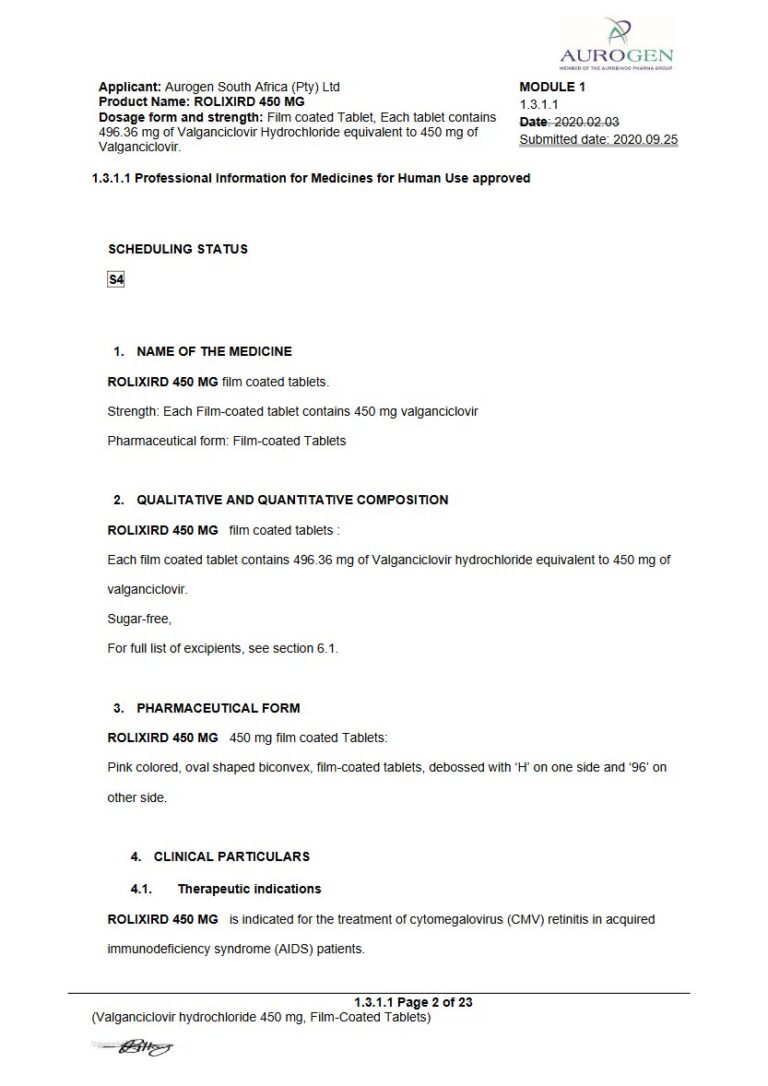
ROLIXIRD 450 MG is indicated for the treatment of cytomegalovirus (CMV) retinitis in acquired immunodeficiency syndrome (AIDS) patients.
The prevention of CMV disease in solid organ transplant patients at risk i.e. donor seropositive and recipient seronegative.
4.2. Posology and method of administration
Posology - Strict adherence to dosage recommendations is essential to avoid overdose. The bioavailability of ganciclovir from ROLIXIRD 450 MG is up to 10-fold higher than from ganciclovir capsules, therefore the dosage and administration of ROLIXIRD 450 MG should be closely followed.
Treatment of cytomegalovirus (CMV) retinitis
Standard dosage in adult patients
Induction treatment of CMV retinitis
For patients with active CMV retinitis, the recommended dose is 900 mg ROLIXIRD 450 MG twice a day for 21 days. Prolonged induction treatment may increase the risk of bone marrow toxicity.
Maintenance treatment of CMV retinitis
Following induction treatment, or in patients with inactive CMV retinitis, the recommended dose is 900 mg ROLIXIRD 450 MG once daily. Patients whose retinitis worsens may repeat induction treatment; however, consideration should be given to the possibility of viral drug resistance.
Prevention of CMV disease in solid organ transplantation
For kidney transplant patients, the recommended dose is 900 mg once daily depending on creatinine clearance, starting within 10 days of transplantation until 200 days post-transplantation. For patients who have received a solid organ transplant other than the kidney, the recommended dose is 900 mg once daily, starting within 10 days of transplantation until 100 days post transplantation.
Special Dosage instructions
Patients with renal impairment
Serum creatinine levels or creatinine clearance should be monitored carefully. Dosage adjustment is required for adult patients based on creatinine clearance, as shown in tables 2 and 3 below.
Creatinine clearance (mu2113/min) is calculated from serum creatinine by the following formulae:
CLCR (mL/min) = (140 u2013 age) x (Wt [kg]) x constant* / SCR [u03bcmol/u2113]
* Constant = 1,23 for males and 1,04 for females (0,85 x 1,23 = 1,04)
The South African Renal Society recommends simplifying the above formula by omitting the constant of 1,23 for males
CLCR (mu2113/min) = (140 u2013 age) x (Wt [kg]) x 0,85 (if female) / SCR [u03bcmol/u2113]
CLCR = creatinine clearance
SCR = serum creatinine
ROLIXIRD 450 MG film-coated tablet dose for renally impaired patients
CrCl (mL/min) Induction dose of ROLIXIRD 450 MG film-coated tablet Maintenance/Prevention dose of ROLIXIRD 450 MG film coated tablet
u2265 60 900 mg twice daily 900 mg once daily
40 u2013 59 450 mg twice daily 450 mg once daily
25 u2013 39 450 mg once daily 450 mg every 2 days (tablets)
10 u2013 24 450 mg every 2 days Not recommended
<10 Not recommended Not recommended
Patients undergoing haemodialysis
For patients on haemodialysis (CrCl < 10 mL/min) a dose recommendation cannot be given. Thus ROLIXIRD 450 MG film coated tablets should not be used in these patients (See sections 4.4 and 5.2).
Patients with severe leucopenia, neutropenia, anaemia, thrombocytopenia and pancytopenia
Patients with severe leucopenia, neutropenia, anaemia, thrombocytopenia and pancytopenia, bone marrow depression and aplastic anaemia have been observed in patients treated with ROLIXIRD 450 MG and ganciclovir. Therapy should not be initiated if the absolute neutrophil count is less than 500 Cells /u03bcu2113 or the platelet count is less than 25 000/u03bcu2113 or the haemoglobin is less than 8 g/du2113. (See section 4.4).
Elderly: Safety and efficacy have not been established.
Paediatric patients: Safety and efficacy have not been established in adequate and well-controlled clinical studies.
Method of administration
ROLIXIRD 450 MG is administered orally, and should be taken with food.
Precautions to be taken before handling or administering the medicine
The tablets should not be broken or crushed. Since Valganciclovir Teva is considered a potential teratogen and carcinogen in humans, caution should be observed in handling broken tablets (see section 4.4). Avoid direct contact of broken or crushed tablets with skin or mucous membranes. If such contact occurs, wash thoroughly with soap and water, rinse eyes thoroughly with sterile water, or plain water if sterile water is unavailable.
4.3. Contraindications
ROLIXIRD 450 MG is contraindicated in patients with known hypersensitivity to valganciclovir, ganciclovir or to any excipient of the product. Due to the similarity of the chemical structure of ROLIXIRD 450 MG and that of aciclovir and valaciclovir, a cross-hypersensitivity reaction between these medicines is possible.
4.4. Special warnings and precautions for use
Porphyria. The Drug Database for Acute Porphyria, compiled by the Norwegian Porphyria Centre (NAP O S) and the Porphyria Centre Sweden, classifies valganciclovir as not porphyrinogenic; it may be used as a drug of first choice and no precautions are needed.
Women of child-bearing potential must be advised to use effective contraception during treatment. Male patients should be advised to practice barrier contraception during, and for at least 90 days following treatment with ROLIXIRD 450 MG.
Severe leucopenia, neutropenia, anaemia, thrombocytopenia, pancytopenia, bone marrow depression and aplastic anaemia have been observed in patients treated with ROLIXIRD 450 MG and ganciclovir. Therapy should not be initiated if the absolute neutrophil count is less than 500 cells/u03bcu2113, or the platelet count is less than 25 000/u03bcu2113, or the haemoglobin level is less than 8 g/du2113.
When extending prophylaxis beyond 100 days the possible risk of developing leukopenia and neutropenia should be taken into account (see sections 4.2, 4.8 and 5.1). Valganciclovir should be used with caution in patients with pre-existing haematological cytopenias or a history of drug-related haematological cytopenia and in patients receiving radiotherapy.
It is recommended that complete blood counts and platelet counts be monitored during therapy. In patients with severe leucopenia, neutropenia, anaemia and/or thrombocytopenia, it is recommended that treatment with haematopoietic growth factors and/or dose interruption be considered. (See section 4.2)
Safety and efficacy in children have not been established in adequate and well-controlled clinical studies. (See section 4.2)
4.5. Interactions with other medicines
The following medicines, valaciclovir, didanosine, nelfinavir, ciclosporin, omeprazole and mycophenolate mofetil did not affect the permeability of valganciclovir (rat in-situ model). ROLIXIRD 450 MG is metabolised to ganciclovir.
Therefore, interactions associated with ganciclovir will be expected for ROLIXIRD 450 MG.
Imipenem-cilastatin: Convulsions have been reported in patients taking ganciclovir and imipenem-cilastatin concomitantly. These medicines should not be used concomitantly unless the potential benefit outweighs the potential risks. (See Section 4.4).
Probenecid: Probenecid given with oral ganciclovir resulted in statistically significant decreased renal clearance of ganciclovir (20 %) leading to statistically significantly increased exposure (40 %). These changes were consistent with a mechanism of interaction involving competition for renal tubular excretion. Therefore, patients taking probenecid and ROLIXIRD 450 MG should be closely monitored for Ganciclovir toxicity.
Zidovudine: When zidovudine was given in the presence of oral ganciclovir there was a small (17 %), but statistically significant increase in the AUC of zidovudine. There was also a trend towards lower ganciclovir concentrations when administered with zidovudine, although this was not statistically significant. However, since both zidovudine and ganciclovir have the potential to cause neutropenia and anaemia, some patients may not tolerate concomitant therapy at full dosage. (See: Section 4.4).
Didanosine: Didanosine plasma concentrations were found to be consistently raised when given with ganciclovir (both intravenous and oral). At ganciclovir oral doses of 3 and 6 g/day, an increase in the AUC of didanosine ranging from 84 to 124 % has been observed, and likewise at intravenous doses of 5 and 10 mg/kg/day, an increase in the AUC of didanosine ranging from 38 to 67 % has been observed. This increase cannot be explained by competition for renal tubular secretion, as there was an increase in the percentage of didanosine dose excreted. This increase could arise from either increased bioavailability or decreased metabolism. There was no clinically significant effect on ganciclovir concentrations. However, given the increase in didanosine plasma concentrations in the presence of ganciclovir, patients should be closely monitored for didanosine toxicity. (See: Section 4.4).
Mycophenolate Mofetil: Based on the results of a single dose administration study of recommended doses of oral mycophenolate mofetil (MMF) and intravenous ganciclovir and the known effects of renal impairment on the pharmacokinetics of MMF and ganciclovir, it is anticipated that co-administration of these agents (which have the potential to compete for renal tubular secretion) will result in increases in phenolic glucuronide of mycophenolic acid (MPAG) and ganciclovir concentration. No substantial alteration of mycophenolic acid (MPA) pharmacokinetics is anticipated and MMF dose adjustment is not required. In patients with renal impairment in which MMF and ganciclovir are co-administered, the dose recommendation of ganciclovir should be observed and patients monitored carefully.
Zalcitabine: Zalcitabine increased the AUC 0-8h of oral ganciclovir by 13 %. There were no statistically significant changes in any of the other pharmacokinetic parameters assessed. Additionally there were no clinical relevant changes in zalcitabine pharmacokinetics in the presence of oral ganciclovir although a small increase in the elimination rate constant was observed. Both ROLIXIRD 450 MG and zalcitabine have the potential to cause peripheral neuropathy and patients should be monitored for such events.
Stavudine: No statistically significant pharmacokinetic interactions were observed when stavudine and oral ganciclovir were given in combination.
Trimethoprim: Trimethoprim statistically significantly decreased the renal clearance of oral ganciclovir by 16,3 % and this was associated with a statistically significant decrease in the terminal elimination rate and the corresponding increase in half-life by 15 %. However, these changes are unlikely to be clinically significant, as AUC 0-8h and C max were unaffected. The only statistically significant change in trimethoprim pharmacokinetic parameters when co-administered with ganciclovir was a 12 % increase in C min. However, this is unlikely to be of clinical significance and no dose adjustment is recommended.
Ciclosporin: There was no evidence that introduction of ganciclovir affects the pharmacokinetics of ciclosporin based on the comparison of ciclosporin trough concentrations. However, there was some evidence of increases in the maximum serum creatinine value observed following initiation of ganciclovir therapy.
Other potential interactions: Toxicity may be enhanced when ganciclovir is co-administered with, or is given immediately before or after, other medicines that inhibit replication of rapidly dividing cell populations such as occur in the bone marrow, tested and germinal layers of the skin and gastrointestinal mucosa, or that are associated with renal impairment (such as dapsone, pentamidine, flucytosine, vincristine, vinblastine, adriamycin, amphotericin B, trimethoprim/sulfa combinations, nucleoside analogues and hydroxyurea). Therefore, these medicines should be considered for concomitant use with ROLIXIRD 450 MG only if the potential benefits outweigh the potential risks. (See: Section 4.4).
4.6. Fertility, pregnancy and lactation
Effects on fertility: No human data on the effect of valganciclovir on fertility are available. Fertility studies have not been repeated with valganciclovir because of the rapid and extensive conversion of valganciclovir to ganciclovir in the body. Ganciclovir is associated with impaired fertility in animal studies (see section 5.3).
Pregnancy
ROLIXIRD 450 MG active metabolite ganciclovir readily diffuses across the human placenta. The safety of ROLIXIRD 450 MG for use in pregnant women has not been established.
Breastfeeding
Pre-and postnatal development has not been studied with ROLIXIRD 450 MG, but the possibility of ganciclovir being excreted in breast milk and causing serious adverse reactions in the breast-fed infant. Women using ROLIXIRD 450 MG should not breastfeed their infants.
4.7. Effects on ability to drive and use machines
Convulsions, dizziness, and confusion have been reported with the use of ROLIXIRD 450 MG. If they occur, such effects may affect tasks requiring alertness, including the patient's ability to drive and operate machinery.
4.8. Undesirable effects
a. Summary of the safety profile
The most commonly reported adverse drug reactions following administration of ROLIXIRD 450 MG in adults are neutropenia, anaemia and diarrhoea. Adverse reactions are listed according to MedDRA system organ class. Frequency categories are defined using the following convention: very common (u2265 1/10), common (u2265 1/100 to < 1/10), uncommon (u2265 1/1,000 to < 1/100), rare (u2265 1/10,000 to < 1/1,000) and very rare (< 1/10,000).
The overall safety profile of valganciclovir is consistent in HIV and transplant populations except that retinal detachment has only been reported in patients with CMV retinitis. However, there are some differences in the frequency of certain reactions. Valganciclovir is associated with a higher risk of diarrhoea, Pyrexia, candida infections, depression, severe neutropenia (ANC <500/u03bcL) and skin reactions are reported more frequently in patients with HIV. Renal and hepatic dysfunction are reported more frequently in organ transplant recipients.
b. Tabulated list of adverse reactions
System Organ Class Frequency Category Infections and infestations: Candida infections including oral candidiasis. Frequent Upper respiratory tract infection Sepsis
Blood and lymphatic disorders: Neutropenia Frequent Anaemia Thrombocytopenia Leukopenia Pancytopenia Bone marrow failure Less Frequent Aplastic anaemia Agranulocytosis* Granulocytopenia*
Immune system disorders: Hypersensitivity Frequent Anaphylactic reaction* Less Frequent
Metabolic and nutrition disorders: Decreased appetite Frequent Weight decreased
Psychiatric disorders: Depression Frequent Confusional state Anxiety Agitation, Psychotic disorder, Less Frequent Psychotic disorder Thinking abnormal Hallucinations
Nervous system disorders: Headache Frequent Insomnia Neuropathy peripheral Dizziness Paraesthesia Hypoaesthesia Seizure Dysgeusia (taste disturbance) Tremor Less Frequent
Eye disorders: Visual impairment Frequent Retinal detachment** Vitreous floaters Eye pain Conjunctivitis Macular oedema
Ear and labyrinth disorders: Ear pain Frequent Deafness Less Frequent
Cardiac disorders: Dysrhythmias Less Frequent
Vascular disorders: Hypotension Frequent
Respiratory, thoracic and mediastinal disorders: Cough Frequent Dyspnoea
Gastrointestinal disorders: Diarrhoea Frequent Nausea Vomiting Abdominal pain Dyspepsia Flatulence Abdominal pain upper Constipation Mouth ulceration Dysphagia Abdominal distention Pancreatitis
Hepato-biliary disorders: Blood alkaline phosphatase increased Frequent Hepatic function abnormal Aspartate aminotransferase increased Alanine aminotransferase increased
Skin and subcutaneous tissues disorders: Dermatitis Frequent Night sweats Frequent Pruritus Rash Alopecia Dry skin Less Frequent Urticaria
Musculo-skeletal and connective tissue disorders: Spasms Frequent Myalgia
Renal and urinary disorders: Renal impairment Frequent Creatinine clearance renal decreased Blood creatinine increased Renal failure Less Frequent Haematuria
Reproductive system and breast disorders: Infertility male Less Frequent
General disorders and administration site conditions: Pyrexia Frequent Fatigue Pain, Chills, Malaise, Asthenia, Frequent Chills Malaise Asthenia Chest pain Less Frequent
c. Description of selected adverse reactions
The risk of neutropenia is not predictable on the basis of the number of neutrophils before treatment. Neutropenia usually occurs during the first or second week of induction therapy. The cell count usually normalises within 2 to 5 days after discontinuation of the drug or dose reduction (see section 4.4).
d. Thrombocytopenia
Patients with low baseline platelet counts (< 100,000 /u03bcL) have an increased risk of developing thrombocytopenia. Patients with iatrogenic immunosuppression due to treatment with immunosuppressive drugs are at greater risk of thrombocytopenia than patients with AIDS (see section 4.4). Severe thrombocytopenia may be associated with potentially life-threatening bleeding.
Influence of treatment duration or indication on adverse reactions
Severe neutropenia (ANC <500/u03bcL) is seen more frequently in CMV retinitis patients (14%) undergoing treatment with valganciclovir, intravenous or oral ganciclovir than in solid organ transplant patients receiving valganciclovir or oral ganciclovir. In patients receiving valganciclovir or oral ganciclovir until Day 100 post-transplant, the incidence of severe neutropenia was 5% and 3% respectively, whilst in patients receiving valganciclovir until Day 200 post-transplant the incidence of severe neutropenia was 10%.
There was a greater increase in serum creatinine seen in solid organ transplant patients treated until Day 100 or Day 200 post-transplant with both valganciclovir and oral ganciclovir when compared to CMV retinitis patients. However, impaired renal function is a feature common in solid organ transplantation patients.
The overall safety profile of ROLIXIRD 450 MG did not change with the extension of prophylaxis up to 200 days in high risk kidney transplant patients. Leukopenia was reported with a slightly higher incidence in the 200 days arm while the incidence of neutropenia, anaemia and thrombocytopenia were similar in both arms.
e. Other special population
Elderly patients Safety and efficacy have not been established.
f. Reporting of suspected adverse reactions
Reporting suspected adverse reactions after authorisation of the medicinal product is important. It allows continued monitoring of the benefit/risk balance of the medicinal product. Healthcare professionals are asked to report any suspected adverse reactions to SAHPRA via The u20186.04 Adverse Drug Reactions Reporting Formu2019. Found under SAHPRAu2019s publications: https://www/sahpra.org.za/Publications/Index/8
4.9. Overdose
It is expected that an overdose of ROLIXIRD 450 MG could also possibly result in increased renal toxicity.
Treatment
Haemodialysis and hydration may be of benefit in reducing blood plasma levels in patients who receive an overdose of ROLIXIRD 450 mg.
Overdose experience with IV ganciclovir: The majority of patients experienced one or more of the following adverse events: Haematological toxicity: pancytopenia, bone marrow depression, medullary aplasia, leucopenia, neutropenia, granulocytopenia. Hepatotoxicity: hepatitis, liver function disorder. Renal toxicity: worsening of haematuria in a patient with pre-existing renal impairment, acute renal failure, and elevated creatinine. Gastrointestinal toxicity: abdominal pain, diarrhoea, vomiting. Neurotoxicity: generalised tremor, convulsion.
