
Isoptin Sr 240 Mg Film-Coated Tablets
PDF Leaflet Revision Date: 05 August 2022
Clinical Summary
Quick overview from the medicine insert
Indication
Angina pectoris, hypertension, supraventricular tachydysrhythmia.
Dosage (summary)
240 mg to 360 mg daily; max 480 mg. Adjust for liver impairment.
Special Populations
- Renal impairment
- Hepatic impairment
- Elderly patients
Pregnancy & Breastfeeding
Not established safe in pregnancy; excreted in breast milk.
Key Drug Interactions
- CYP3A4 inhibitors/inducers
- Digoxin
- Beta blockers
Contraindications
- Hypersensitivity
- Cardiogenic shock
- AV block
- Sick sinus syndrome
- Congestive heart failure
Common side effects
- Headaches
- Dizziness
- Nausea
- Bradycardia
- Hypotension
Counselling Points
- Do not discontinue abruptly.
- Take with liquid after meals.
- Avoid grapefruit juice.
Serious warnings
- AV block risk
- Caution in heart failure
- Monitor for hypotension
Important Disclaimer
The Isoptin Sr 240 Mg Film-Coated Tablets professional information leaflet below is the property of Abbott Laboratories Sa and is provided on Medinsert exactly as issued, with no.. alterations or editorial changes. We make every effort to keep content current by updating documents as soon as new versions become available. Medinsert serves as a trusted access point for healthcare professionals, but does not replace official sources or clinical judgement. For more details, please read our full disclaimer. read more>>
 Healthcare Professionals Only
This content is for registered healthcare professionals
Sign in or create a free account to read the full package insert.
Free for HPCSA-registered professionals. Powered by Medinsert.
Clinical Particulars
Section 4 of the official insert — extracted exactly as issued, no alterations
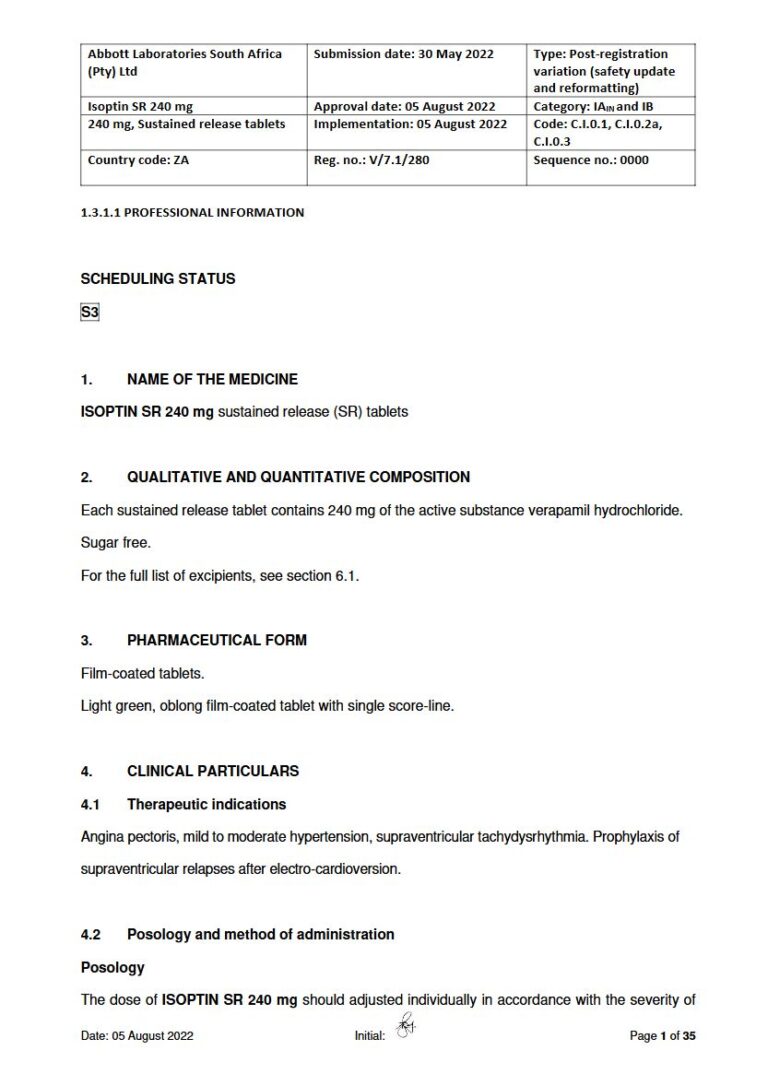
4.1 Therapeutic indications
Angina pectoris, mild to moderate hypertension, supraventricular tachydysrhythmia. Prophylaxis of supraventricular relapses after electro-cardioversion.
4.2 Posology and method of administration
Posology
The dose of ISOPTIN SR 240 mg should adjusted individually in accordance with the severity of disease. Long-standing clinical experience shows that the average dose in all indications is between 240 mg and 360 mg. The daily dose should not exceed 480 mg on a long-term basis. There is no limitation on the duration of use. ISOPTIN SR 240 mg should not be discontinued abruptly after long-term use. It is recommended to taper the dosage. In patients with impaired liver function, metabolism of the medicine is delayed to a greater or lesser extent depending on the severity of hepatic dysfunction, thus potentiating and prolonging the effects of verapamil hydrochloride. Therefore, the dosage needs to be adjusted with special caution in patients with impaired liver function and low doses should be given initially. Tablets should be taken whole without sucking or chewing, with sufficient liquid, preferably with or shortly after meals.
Angina pectoris and supraventricular dysrhythmia: Half to one tablet every 12 hours.
Hypertension: One tablet per day (preferably in the morning). If the desired response is not obtained in 7 days, the dose may be increased to one tablet in the morning, and half a tablet at night. The maximum recommended dose is one tablet every 12 hours.
4.3 Contraindications
ISOPTIN SR 240 mg is contraindicated in patients with:
u2022 Hypersensitivity to the verapamil hydrochloride or to any of the inactive ingredients listed in section 6.1.
u2022 Cardiogenic shock.
u2022 Acute myocardial infarction with complications.
u2022 Second- and third-degree atrioventricular (AV) block except in patients with a functioning artificial pacemaker.
u2022 Second- and third-degree sinoatrial (SA) block, except for patients fitted with a pacemaker.
u2022 Sick sinus syndrome, except in patients with a functioning artificial pacemaker.
u2022 Congestive heart failure.
u2022 Atrial fibrillation/flutter and concomitant presence of accessory pathways (e.g. Wolff-Parkinson-White or Lown-Ganong-Levine syndrome). In these patients, ISOPTIN SR 240 mg therapy poses an increased risk of ventricular tachycardia, including ventricular fibrillation.
u2022 Concomitant administration of ivabradine (see section 4.5). Beta receptor blockers should not be administered intravenously in conjunction with ISOPTIN SR 240 mg (except in intensive care medicine, see section 4.5).
4.4 Special warnings and precautions for use
Conduction disorder/first degree AV block/bradycardia/asystole: ISOPTIN SR 240 mg affects AV and sinus nodes and delays AV conduction. ISOPTIN SR 240 mg should be used with caution, since second- or third-degree AV block (see section 4.3) or unifascicular, bifascicular or trifascicular bundle branch block warrants discontinuation of treatment and the initiation of appropriate therapy, if required. ISOPTIN SR 240 mg affects AV and sinus nodes and may lead to asymptomatic first-, second- or third-degree AV block and transient bradycardia, sometimes accompanied by nodal escape rhythms or asystole. This is more likely to occur in patients with sick sinus syndrome, which is more common in older patients. PR interval prolongation is correlated with verapamil plasma concentrations, especially during the early titration phases of therapy. In patients not suffering from sick sinus syndrome, asystole is normally of short duration (a few seconds or less), with a spontaneous return to AV node or normal sinus rhythm. If this does not occur immediately, appropriate treatment should be initiated without delay (see section 4.8). Marked first-degree block or progressive development to second- or third-degree AV block requires a reduction in dosage or, in rare instances, discontinuation of the medicine.
Anti-dysrhythmics, beta blockers and inhalation anaesthetics: Anti-dysrhythmics (e.g. flecainide, disopyramide), beta receptor blockers (e.g. metoprolol, propranolol) and inhalation anaesthetics may mutually potentiate cardiovascular effects (severe AV block, severe drop in heart rate, onset of heart failure, marked hypotension) if administered concomitantly with ISOPTIN SR 240 mg (see section 4.5). Asymptomatic bradycardia (36 beats per minute) with a migrating atrial pacemaker was observed in one patient using eye drops containing timolol (a beta blocker) and taking verapamil hydrochloride, as contained in ISOPTIN SR 240 mg, concomitantly.
Digoxin: The digoxin dose should be reduced if taken concomitantly with verapamil hydrochloride, as contained in ISOPTIN SR 240 mg (see section 4.5).
Heart failure: ISOPTIN SR 240 mg has a negative inotropic effect, which, in most patients, is compensated by its afterload reduction (decreased systemic vascular resistance) properties without a net impairment of ventricular performance. In clinical experience with 4 954 patients, 87 (1,8 %) developed congestive heart failure or pulmonary oedema. Heart failure patients with an ejection fraction of over 35 % should be compensated before treatment begins. Adequate therapy should also be administered during treatment. ISOPTIN SR 240 mg should be avoided in patients with severe left ventricular dysfunction (e.g. ejection fraction less than 30 %, pulmonary wedge pressure above 20 mm Hg, or severe symptoms of heart failure) and in patients with any degree of ventricular dysfunction if they are receiving a beta-adrenergic blocker (see section 4.3). Patients with milder ventricular dysfunction should, if possible, be controlled with optimal doses of digitalis and/or diuretics before ISOPTIN SR 240 mg treatment.
HMG- CoA reductase inhibitors (u201cstatinsu201d): See section 4.5.
Hypotension: ISOPTIN SR 240 mg may occasionally produce symptomatic hypotension in normotensive patients. Particularly strict monitoring is required in the case of hypotension (less than 90 mm Hg systolic). In hypertensive patients, decreases in blood pressure below normal values are unusual.
Elevated liver enzymes: Elevation of transaminases with and without concomitant elevations in alkaline phosphatase and bilirubin has been reported. Such elevations are normally transient and may disappear even in the face of continued ISOPTIN SR 240 mg treatment.
Special populations
Use in patients with impaired renal function: About 70 % of an administered dose of ISOPTIN SR 240 mg is excreted as metabolites in the urine. Although comparative studies have reliably shown that impaired renal function in patients presenting end-stage renal failure has no effect on the pharmacokinetic profile of ISOPTIN SR 240 mg, individual case reports suggest that caution should be exercised and strict monitoring implemented (abnormal prolongation of the PR interval, ECG, blood pressure, and other signs of overdosage) when administering ISOPTIN SR 240 mg to patients with renal impairment. ISOPTIN SR 240 mg is not removed by haemodialysis.
Use in patients with impaired hepatic function: Since verapamil hydrochloride is highly metabolised by the liver, it should be administered cautiously to patients with impaired hepatic function. Severe liver dysfunction prolongs the elimination half-life of immediate-release ISOPTIN SR 240 mg to about 15 hours; hence, approximately 30 % of the dose given to patients with normal liver function should be administered to these patients. Careful monitoring for abnormal prolongation of the PR interval or other signs of excessive pharmacological effects should be carried out.
Accessory bypass tract (Wolff-Parkinson-White or Low-Ganong-Levine): Some patients with paroxysmal and/or chronic atrial fibrillation or atrial flutter and a coexisting accessory AV pathway have developed an increased anterograde conduction across the accessory pathway bypassing the AV node, producing a very rapid ventricular response or ventricular fibrillation after receiving intravenous verapamil (or digitalis). Although a risk of this occurring with oral verapamil hydrochloride, as contained in ISOPTIN SR 240 mg has not been established, such patients receiving oral ISOPTIN SR 240 mg may be at risk (see section 4.3).
Patients with hypertrophic cardiomyopathy (IHSS): A variety of serious adverse effects can occur in patients with hypertrophic cardiomyopathy - pulmonary oedema and/or severe hypotension, sinus bradycardia, AV block and sinus arrest. Most adverse effects respond well to dose reduction.
Use in patients with attenuated neuromuscular transmission: Caution should be exercised when prescribing ISOPTIN SR 240 mg for patients previously diagnosed with impaired neuromuscular transmission (Myasthenia gravis, Lambert-Eaton syndrome, progressive Duchenne muscular dystrophy). It has been reported that ISOPTIN SR 240 mg decreases neuromuscular transmission in patients with Duchenne's muscular dystrophy, and that ISOPTIN SR 240 mg prolongs recovery from the neuromuscular blocking agent vecuronium. It may be necessary to decrease the dosage of ISOPTIN SR 240 mg when it is administered to patients with attenuated neuromuscular transmission.
Excipient warning: ISOPTIN SR 240 mg contains 34 mg sodium per sustained release tablet, equivalent to 1,70 % of the WHO recommended maximum daily intake of 2 g sodium, for an adult.
4.5 Interactions with other medicines
In vitro metabolic studies indicate that verapamil is metabolized by cytochrome P450 CYP3A4, CYP1A2, CYP2C8, CYP2C9 and CYP2C18. Clinically significant interactions have been reported with inhibitors of CYP3A4 causing elevation of plasma levels of verapamil hydrochloride while inducers of CYP3A4 have caused a lowering of plasma levels of verapamil hydrochloride, therefore, patients should be monitored for medicine interactions.
Verapamil has been shown to be an inhibitor of CYP3A4 enzymes and P-glycoprotein (P-gp). Concomitant administration of verapamil and another medicine, mainly metabolised via CYP3A4 or representing a P-gp substrate, can increase the active substance concentration of the concomitant medicine, thus potentiating or prolonging the therapeutic effect and increasing the adverse events associated with the concomitant medicine.
Potential pharmacokinetic interactions are highlighted in the following table:
Potential interactions
Concomitant medicine Potential effect on ISOPTIN SR 240 mg or concomitant medicine Comment
Alpha blockers Prazosin u2191 prazosin C max (~40 %) with no effect on half-life Additive antihypertensive effect.
Terazosin u2191 terazosin AUC (~24 %) and C max (25 %)
Anti-dysrhythmics Flecainide Minimal effect on flecainide plasma clearance (<~10 %); no effect on verapamil plasma clearance Further information (see section 4.4 - Antidysrhythmics, beta receptor blockers and inhalation anaesthetics).
4.6 Fertility, pregnancy and lactation
Pregnancy
Verapamil hydrochloride, as contained in ISOPTIN SR 240 mg, crosses the placental barrier and can be detected in umbilical vein blood at delivery. The plasma concentration in umbilical vein blood amounts to 20 u2013 92 % of the plasma concentration in the maternal blood. Safety in pregnancy has not been established. There are no adequate data from the use of ISOPTIN SR 240 mg in pregnant women.
Breastfeeding
ISOPTIN SR 240 mg is excreted in human breast milk (milk concentration approximately 23 % of maternal plasma concentration). Breastfeeding should be discontinued during ISOPTIN SR 240 mg therapy.
4.7 Effects on ability to drive and use machines
Patients must be monitored regularly during ISOPTIN SR 240 mg therapy. Given the variation in individual reactions, the ability to react may be changed to such an extent that the ability to drive, use machines or work without secure footing is adversely affected. This applies in particular at the start of treatment, if the dosage is increased or the preparation changed, and in combination with alcohol. Blood alcohol levels may be increased and the elimination of alcohol slowed down, thus potentially enhancing the effects of alcohol.
4.8 Undesirable effects
As ISOPTIN SR 240 mg inhibits AV conduction, it may cause AV block. ISOPTIN SR 240 mg may also lead to a transient decrease in blood pressure, even in normotensive patients.
Summary of the safety profile
The most commonly reported undesirable effects were headaches, dizziness or giddiness, gastrointestinal disorders (nausea, constipation, abdominal discomfort), as well as bradycardia, tachycardia, palpitations, hypotension, flushes, peripheral oedema and fatigue.
Tabulated list of adverse effects:
The following undesirable effects have been reported in clinical trials, post-marketing studies or phase IV clinical trials; they are ranked according to system organ class. The frequency data are defined as follows:
Very common: may affect more than 1 in 10 patients treated
Common: may affect up to 1 in 10 patients treated
Uncommon: may affect up to 1 in 100 patients treated
Rare: may affect up to 1 in 1,000 patients treated
Very rare: may affect up to 1 in 10,000 patients treated
Unknown: frequency cannot be estimated from the available data
MedDRA system organ class Adverse reaction Frequency
Immune system Hypersensitivity Unknown
Nervous system disorders Dizziness or giddiness Headaches Neuropathy Common Paraesthesia Shakiness (tremor) Rare Extrapyramidal disorder Paralysis (tetraparesis) 1 Cramps Unknown
Metabolism and nutrition disorders Reduced glucose tolerance Uncommon Hyperkalaemia Unknown
Psychiatric disorders Anxiety Common Drowsiness Rare
Ear and labyrinth disorders Tinnitus Rare Vertigo Unknown
Cardiac disorders Bradycardia Heart failure may develop or existing heart failure may be exacerbated Excessive blood pressure reduction and/or orthostatic Common Palpitations Tachycardia Uncommon Atrioventricular block (1 st , 2 nd or 3 rd degree) Heart failure Sinus arrest Sinus bradycardia Asystole Unknown
Vascular disorders Flushing Hypotension Common
Respiratory, thoracic and mediastinal disorders Bronchospasm Dyspnoea Unknown
Gastrointestinal disorders Constipation Nausea Common Abdominal pain Uncommon Vomiting Rare Abdominal discomfort Gingival hyperplasia Unknown
Hepato-biliary disorders Probably allergy-induced hepatitis with reversible increase in liver-specific enzymes Uncommon
Skin and subcutaneous tissue disorders Erythromelalgia Common Hyperhidrosis Rare Photodermatitis Very rare Angioedema Stevens Johnson syndrome Erythema multiforme Alopecia Itching Pruritus Purpura Maculopapular exanthema Urticaria Unknown
Musculoskeletal and connective tissue disorders Aggravation of Myasthenia gravis, Lambert-Eaton syndrome and progressive Duchenne muscular dystrophy Very rare Arthralgia Unknown
Renal and urinary disorders Renal insufficiency Unknown
Reproductive system and breast disorders Galactorrhoea Gynaecomastia Impotence (erectile dysfunction) Unknown
General disorders and administration site conditions Peripheral oedema Common Fatigue Uncommon
Investigations Elevated blood prolactin levels Elevation of liver enzymes Unknown
1 There was a single post-marketing report on paralysis (tetraparesis) related to the concomitant administration of verapamil hydrochloride as contained in ISOPTIN SR 240 mg and colchicine. This could have been caused by the passage of colchicine through the blood-brain barrier following inhibition of CYP3A4 and P-gp by verapamil (see section 4.5).
Note: In patients fitted with pacemakers, an increase in the pacing and sensing threshold cannot be ruled out during verapamil hydrochloride therapy. In patients with a history of cardiovascular disease, e.g. severe cardiomyopathy, congestive heart failure or recent myocardial infarction, concomitant administration of intravenous beta blockers or disopyramide with intravenous verapamil hydrochloride increased the risk of severe side effects as since both substance classes have a cardiodepressive effect (see section 4.5).
4.9 Overdose
Symptoms: Symptoms of ISOPTIN SR 240 mg overdose progress depending on the amount ingested, the time at which detoxification measures are applied and the contractile functionality of the myocardium (age-dependent). The following symptoms have been observed with overdose: Serious hypotension, heart failure, bradycardia up to high degree AV block and sinus arrest or tachycardia dysrhythmia, potentially culminating in cardiovascular shock and cardiac arrest. Clouding of consciousness progressing to coma, hyperglycaemia, stupor, hypokalaemia, metabolic acidosis, hypoxia, cardiogenic shock with pulmonary oedema, impaired renal function and convulsions. Fatalities have occurred as a result of overdose.
Treatment: Detoxification and restoration of stable cardiovascular conditions are pre-requisite. Treatment of ISOPTIN SR 240 mg overdose depend on the time and method of ingestion, as well as the nature and severity of the overdose symptoms. If larger quantities of sustained-release preparations have been ingested, it should be noted that the active substance may be released and absorbed by the intestines even longer than 48 hours after intake. Therefore, patients may require observation and hospitalisation for up to 48 hours. If overdose with sustained-release preparations is suspected, extensive elimination measures are indicated, such as induced vomiting, aspiration of the contents of the stomach and small intestine under endoscopic guidance, intestinal lavage, evacuation, high enema. As ISOPTIN SR 240 mg cannot be dialysed, haemodialysis is not advisable, but haemofiltration and possibly plasmapheresis (high plasma protein binding of calcium channel blockers) are recommended. Standard intensive care resuscitation measures, such as extrathoracic cardiac massage, ventilation, defibrillation and/or pacemaker therapy. Specific measures: Elimination of cardiodepressive effects, hypotension and bradycardia. Bradycardia dysrhythmia is treated symptomatically with atropine and/or beta sympathomimetic medicines (isoprenaline, orciprenaline); in the case of life-threatening bradycardia dysrhythmia, temporary pacemaker therapy is required. Asystole should be treated by standard methods, including beta adrenergic stimulation (isoprenaline). Calcium is a specific antidote, repeated if necessary, or administered as a continuous drip infusion. Hypotension, as a result of cardiogenic shock and arterial vasodilation, is treated with dopamine, dobutamine, epinephrine or norepinephrine. Serum calcium should be maintained at high-normal to slightly elevated levels. Additional fluid replacement therapy is administered in the early stages due to arterial vasodilation (Ringer's or sodium chloride solution).
