
Zylovin 1 mg/mL Nasal Spray
PDF Leaflet Revision Date: July 2022
Clinical Summary
Quick overview from the medicine insert
Indication
Decongestion of nasopharyngeal mucosa.
Dosage (summary)
1 spray in each nostril, up to 3 times daily for adults and children over 12.
Onset of Action / Duration
Onset: a few minutes, Duration: several hours
Special Populations
- Children under 12 years
- Elderly
Pregnancy & Breastfeeding
Not advisable during pregnancy; use with caution in breastfeeding.
Key Drug Interactions
- MAO inhibitors
- Tricyclic antidepressants
Contraindications
- Hypersensitivity to xylometazoline
- Hyperthyroidism
- Narrow angle glaucoma
- Ischaemic heart disease
- Rhinitis sicca
- Recent MAO inhibitor use
Common side effects
- Headache
- Insomnia
- Dizziness
- Nausea
- Application site burning
Counselling Points
- Shake before use
- Prime pump before first use
- Avoid driving if dizzy
- Report any adverse reactions
Serious warnings
- Caution in cardiovascular disease
- Risk of rebound congestion
- Do not exceed 10 days of use
Important Disclaimer
The Zylovin 1 mg/mL Nasal Spray professional information leaflet below is the property of Lamar International and is provided on Medinsert exactly as issued, with no.. alterations or editorial changes. We make every effort to keep content current by updating documents as soon as new versions become available. Medinsert serves as a trusted access point for healthcare professionals, but does not replace official sources or clinical judgement. For more details, please read our full disclaimer. read more>>
 Healthcare Professionals Only
This content is for registered healthcare professionals
Sign in or create a free account to read the full package insert.
Free for HPCSA-registered professionals. Powered by Medinsert.
Clinical Particulars
Section 4 of the official insert — extracted exactly as issued, no alterations
4.1 Therapeutic indications
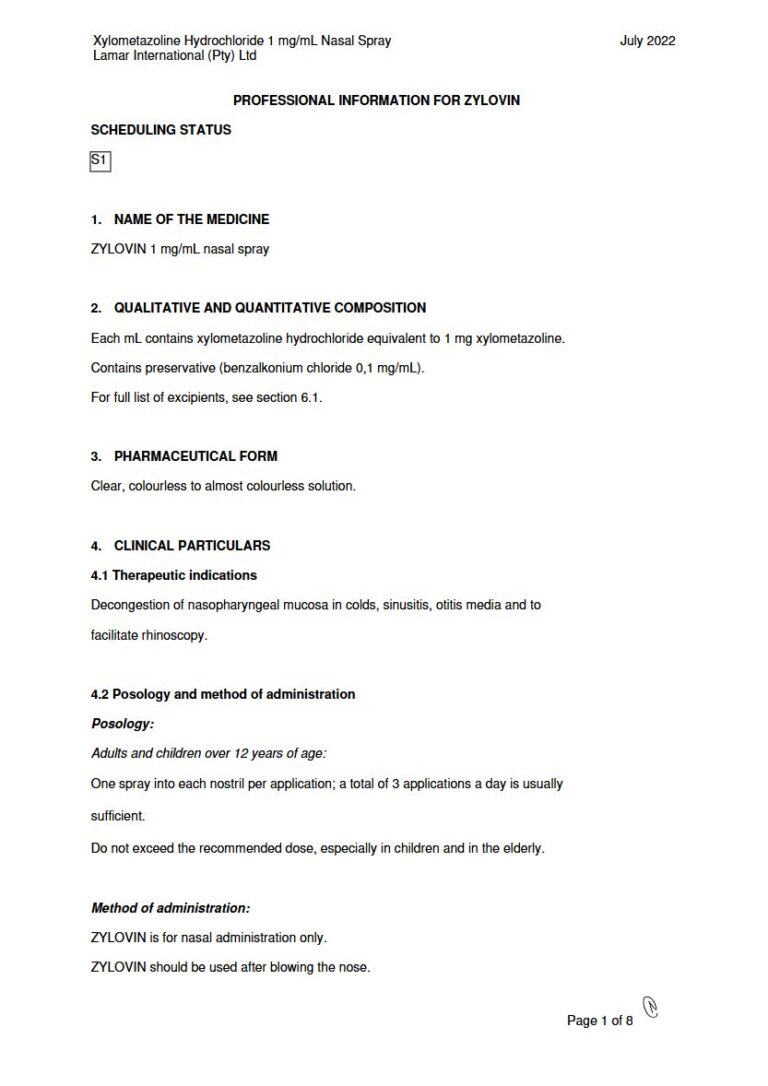
Decongestion of nasopharyngeal mucosa in colds, sinusitis, otitis media and to facilitate rhinoscopy.
4.2 Posology and method of administration
Posology: Adults and children over 12 years of age: One spray into each nostril per application; a total of 3 applications a day is usually sufficient. Do not exceed the recommended dose, especially in children and in the elderly.
Method of administration: ZYLOVIN is for nasal administration only. ZYLOVIN should be used after blowing the nose.
Instructions for use: Shake gently before each use. Before the first application, prime the pump by actuating 4 times. Once primed, the pump will normally remain charged throughout regular daily treatment periods. If the spray is not ejected during the full actuation stroke, or if the product has not been used for longer than 7 days, the pump will need to be re-primed with 4 actuations. Insert the nozzle into the nostril and press once firmly on the spray head and breathe in at the same time. Then withdraw the nozzle before releasing pressure. Repeat the operation in the other nostril. Clean and replace the protective cap.
4.3 Contraindications
- ZYLOVIN is contraindicated in cases of hypersensitivity to xylometazoline or to any of the ingredients of ZYLOVIN (see section 6.1).
- ZYLOVIN is contraindicated in the following conditions:
- Hyperthyroidism,
- Narrow angle glaucoma,
- Ischaemic heart disease,
- Rhinitis sicca or atrophic rhinitis,
- Patients being treated with monoamine oxidase (MAO) inhibitors or 10 days after stopping treatment.
- ZYLOVIN should not be employed in status post transsphenoidal hypophysectomy (or after trans-nasal or trans-oral surgical interventions in which the dura mater has been exposed).
- ZYLOVIN is contraindicated in children aged less than 12 years.
4.4 Special warnings and precautions for use
ZYLOVIN should be used with caution in patients showing a strong reaction to sympathomimetic medicines, as manifested by signs of insomnia, dizziness, tremor, cardiac dysrhythmias or elevated blood pressure. ZYLOVIN should be used with caution in patients with hypertension, cardiovascular disease, hyperthyroidism, diabetes mellitus, epistaxis, phaeochromocytoma, prostatic hypertrophy, monoamine oxidase inhibitors (MAOI) treatment or who have received them in the last two weeks (see section 4.5). Patients with long QT syndrome treated with xylometazoline may be at risk of serious ventricular dysrhythmias. Do not exceed the recommended dose, especially in children and in the elderly. ZYLOVIN should not be used for more than 10 consecutive days; prolonged or excessive use may cause rebound congestion and/or atrophy of the nasal mucosa.
Excipient warnings: ZYLOVIN contains 0,1 mg benzalkonium chloride in each mL. Long-term use may cause oedema of the nasal mucosa.
4.5 Interaction with other medicines and other forms of interaction
The concomitant use of xylometazoline as in ZYLOVIN with monoamine oxidase (MAO) inhibitors, tricyclic or tetracyclic antidepressants may cause an increase in blood pressure due to cardiovascular effects of these medicines (see section 4.4).
4.6 Fertility, pregnancy and lactation
Pregnancy: The use of xylometazoline as in ZYLOVIN during pregnancy is not advisable due to its potential systemic absorption resulting in vasoconstrictor effect.
Breastfeeding: It is not known if xylometazoline is excreted in breast milk. ZYLOVIN should be used with caution during breastfeeding and only under medical advice.
Fertility: No foetal toxicity or fertility studies have been carried out in animals.
4.7 Effects on ability to drive and use machines
ZYLOVIN may cause dizziness and visual disturbances (see section 4.8). Patients experiencing dizziness or visual disturbances should refrain from driving or operating machinery.
4.8 Undesirable effects
Tabulated list of adverse reactions:
System Organ Class Frequency Side effects
- Immune system disorders Less frequent Hypersensitivity reaction (angioedema, skin rash, pruritis)
- Nervous system disorders Frequent Frequency unknown Headache, Insomnia, dizziness
- Eye disorders Less frequent Transient visual disturbances
- Cardiac disorders Less frequent Heart rate irregular, heart rate increase (palpitations)
- Respiratory, thoracic and mediastinal disorders Frequency unknown Anosmia, epistaxis, rebound congestion after prolonged or excessive use, dryness of the nasal mucosa, a burning sensation in the nose and throat
- Gastrointestinal disorders Frequent Nausea
- Skin and subcutaneous tissue disorders Less frequent Skin rash
- General disorders and administration site conditions Frequent Application site burning, local irritation
Reporting of suspected adverse reactions: Reporting of suspected adverse reactions after authorisation of the medicine is important. It allows continued monitoring of the benefit/risk balance of the medicine. Health care providers are asked to report any suspected adverse reactions to SAHPRA via the u201c6.04 Adverse Drug Reactions Reporting Formu201d, found online under SAHPRAu2019s publications: https://www.sahpra.org.za/Publications/Index/8.
4.9 Overdose
Signs Excessive administration of ZYLOVIN or accidental ingestion may cause severe dizziness, perspiration, severely lowered body temperature, headache, bradycardia, hypertension, respiratory depression, coma, convulsions and sometimes consciousness clouding. Hypertension may be followed by hypotension. Small children are more sensitive to toxicity than adults.
In instances of accidental poisoning in children, the clinical picture may be marked chiefly by signs such as acceleration and irregularity of the pulse, elevated blood pressure and sometimes clouding of consciousness, sweating, drowsiness, coma, convulsions, circulatory collapse.
Treatment Symptomatic treatment under medical supervision is indicated.
