
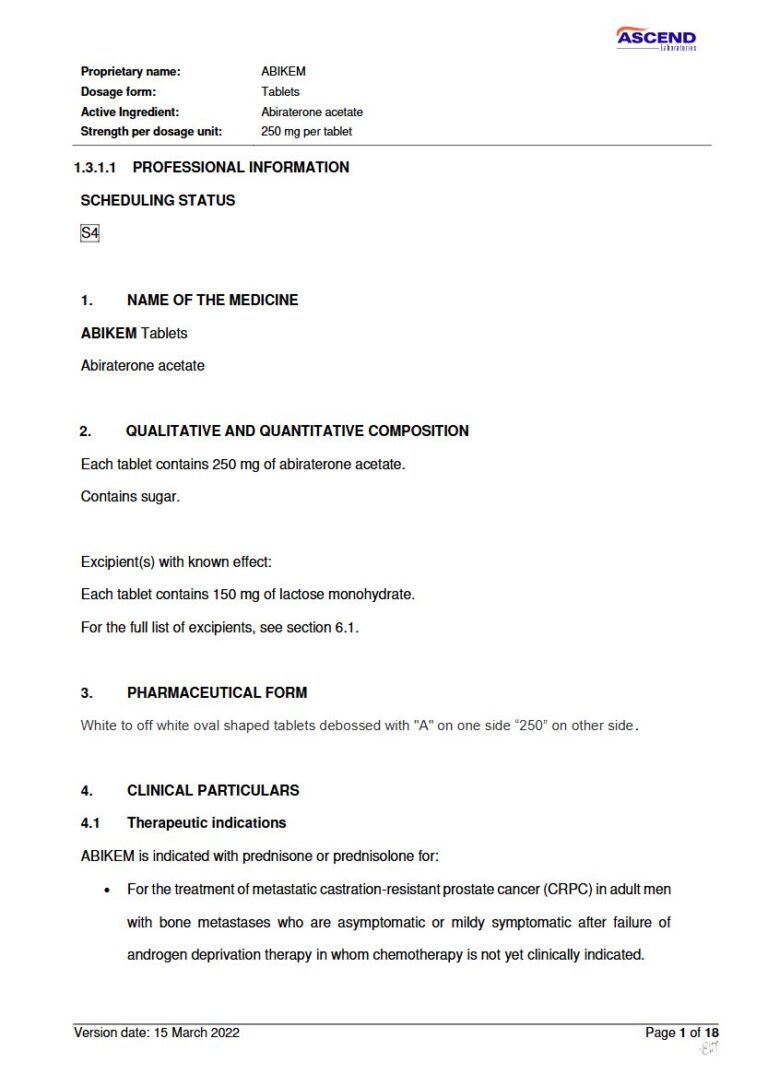
Abikem 250mg Tablets
PDF Leaflet Revision Date: 15 March 2022
Clinical Summary
Quick overview from the medicine insert
Indication
Treatment of metastatic castration-resistant prostate cancer.
Dosage (summary)
1,000 mg (four 250 mg tablets) once daily, taken without food.
Special Populations
- Hepatic impairment
- Renal impairment
Pregnancy & Breastfeeding
Contraindicated in pregnancy and lactation; may harm a developing fetus.
Key Drug Interactions
- Avoid strong CYP3A4 inducers
- Contraindicated with rifampicin
Contraindications
- Hypersensitivity
- Pregnancy
- Moderate to severe hepatic impairment
- Concomitant use with Ra-223
Common side effects
- Fluid retention
- Hypokalaemia
- Hypertension
- Increased liver enzymes
Counselling Points
- Take at least 2 hours after eating
- Monitor for signs of liver toxicity
- Use condoms if sexually active with women of childbearing age
Serious warnings
- May cause hypertension, hypokalaemia, fluid retention
- Risk of hepatotoxicity
Important Disclaimer
The Abikem 250mg Tablets professional information leaflet below is the property of Ascend Laboratories and is provided on Medinsert exactly as issued, with no.. alterations or editorial changes. We make every effort to keep content current by updating documents as soon as new versions become available. Medinsert serves as a trusted access point for healthcare professionals, but does not replace official sources or clinical judgement. For more details, please read our full disclaimer. read more>>
 Healthcare Professionals Only
This content is for registered healthcare professionals
Sign in or create a free account to read the full package insert.
Free for HPCSA-registered professionals. Powered by Medinsert.
Clinical Particulars
Section 4 of the official insert — extracted exactly as issued, no alterations
4.1 Therapeutic indications
ABIKEM is indicated with prednisone or prednisolone for:
- For the treatment of metastatic castration-resistant prostate cancer (CRPC) in adult men with bone metastases who are asymptomatic or mildly symptomatic after failure of androgen deprivation therapy in whom chemotherapy is not yet clinically indicated.
- The treatment of metastatic advanced prostate cancer (castration resistant prostate cancer) in adult patients who have received prior chemotherapy containing docetaxel.
4.2 Posology and method of administration
ABIKEM should be prescribed by an appropriate healthcare professional.
Posology
The recommended dose is 1,000 mg (four 250 mg tablets) as a single daily dose that must not be taken with food. Taking ABIKEM tablets with food increases systemic exposure to abiraterone (see sections 4.5 and 5.2). Patients should be maintained on ABIKEM until radiographic progression and symptomatic/clinical progression and until prostate specific antigen (PSA) progression (confirmed 25 % increase over the patient's baseline/nadir). ABIKEM is used with low dose prednisone or prednisolone. The recommended dose of prednisone or prednisolone is 10 mg daily. Serum transaminases and bilirubin should be measured, prior to starting treatment with ABIKEM, every two weeks for the first three months of treatment and monthly thereafter. Blood pressure, serum potassium and fluid retention should be monitored monthly. (see section 4.4). In the event of a missed daily dose of either ABIKEM, prednisone or prednisolone, treatment should be resumed the following day with the usual daily dose.
Special populations
Hepatic impairment
No dose adjustment is necessary for patients with pre-existing mild hepatic impairment, Child-Pugh Class A. There are no data on the clinical safety and efficacy of multiple doses of abiraterone acetate as in ABIKEM when administered to patients with moderate or severe hepatic impairment (Child-Pugh Class B or C). No dose adjustment can be predicted. ABIKEM should not be used in patients with moderate to severe hepatic impairment (see section 4.3). For patients who develop hepatotoxicity during treatment (alanine aminotransferase [ALT] increases or aspartate aminotransferase [AST] increases above 5 times the upper limit of normal [ULN]) or bilirubin increases above 3 times the upper limit of normal, treatment should be withheld immediately until liver functions normalise (see section 4.4). Re-treatment following return of liver function tests to the patientu2019s baseline may be given at a reduced dose of 500 mg (two tablets) once daily. For patients being re-treated, serum transaminases and bilirubin should be monitored at a minimum of every two weeks for three months and monthly thereafter. If hepatotoxicity recurs at the reduced dose of 500 mg daily, treatment should be discontinued. Reduced doses should not be taken with food. If patients develop severe hepatotoxicity (ALT or AST 20 times the ULN) anytime while on therapy, treatment should be discontinued and patients should not be re-treated with ABIKEM.
Renal impairment
No dose adjustment is necessary for patients with renal impairment (see section 5.2).
Paediatric population
There is no relevant use of ABIKEM in the paediatric population.
Method of administration
ABIKEM is for oral use. ABIKEM should be taken at least 2 hours after eating and no eating for at least 1 hour after taking ABIKEM. ABIKEM should be swallowed whole with water.
Precautions to be taken before handling or administering ABIKEM
Based on its mechanism of action, ABIKEM may harm a developing foetus; therefore, women (including healthcare professionals), who are pregnant or women who may be pregnant should not handle ABIKEM without protection, e.g. gloves (see section 4.6).
4.3 Contraindications
- Hypersensitivity to the abiraterone acetate or to any of the excipients in ABIKEM listed in section 6.1.
- Pregnancy and lactation (see section 4.6).
- Moderate to severe hepatic impairment [Child-Pugh Class B or C (see sections 4.2, 4.4 and 5.2)].
- Women should not use ABIKEM.
- Concomitant administration with rifampicin.
- ABIKEM with prednisone or prednisolone is contraindicated in combination with Ra-223.
4.4 Special warnings and precautions for use
Hypertension, hypokalaemia, fluid retention and cardiac failure due to mineralocorticoid excess
ABIKEM may cause hypertension, hypokalaemia and fluid retention (see section 4.8) as a consequence of increased mineralocorticoid levels resulting from CYP17 inhibition (see section 5.1). Co-administration of a corticosteroid suppresses adrenocorticotropic hormone (ACTH) drive, resulting in a reduction in incidence and severity of these adverse reactions. Caution is required in treating patients whose underlying medical conditions might be compromised by increases in blood pressure, hypokalaemia (e.g., those on digoxin), or fluid retention (e.g., those with heart failure, severe or unstable angina pectoris, recent myocardial infarction or ventricular dysrhythmia and those with severe renal impairment). ABIKEM should be used with caution in patients with a history of cardiovascular disease. Safety of ABIKEM in patients with left ventricular ejection fraction (LVEF) < 50 % or NYHA Class III or IV heart failure or NYHA Class II to IV heart failure has not been established (see sections 4.8 and 5.1). Before treating patients with a significant risk for congestive heart failure (e.g. a history of cardiac failure, uncontrolled hypertension, or cardiac events such as ischaemic heart disease), consider obtaining an assessment of cardiac function (e.g. echocardiogram). Before treatment with ABIKEM, cardiac failure should be treated and cardiac function optimised. Hypertension, hypokalaemia and fluid retention should be corrected and controlled. During treatment, blood pressure, serum potassium, fluid retention (weight gain, peripheral oedema), and other signs and symptoms of congestive heart failure should be monitored every 2 weeks for 3 months, then monthly thereafter and abnormalities corrected. QT prolongation has been observed in patients experiencing hypokalaemia in association with ABIKEM treatment. Assess cardiac function as clinically indicated, institute appropriate management and consider discontinuation of ABIKEM if there is a clinically significant decrease in cardiac function (see section 4.2).
Hepatotoxicity and hepatic impairment
Marked increases in liver enzymes leading to ABIKEM discontinuation or dose modification occurred in controlled clinical studies (see section 4.8). Serum transaminase levels should be measured prior to starting treatment with ABIKEM, every two weeks for the first three months of treatment, and monthly thereafter. If clinical symptoms or signs suggestive of hepatotoxicity develop, serum transaminases should be measured immediately. If at any time the ALT or AST rises above 5 times the ULN or bilirubin rises above 3 times ULN, treatment with ABIKEM should be interrupted immediately and liver function closely monitored. Re-treatment may take place only after return of liver function tests to the patientu2019s baseline and at a reduced dose level (see section 4.2). If patients develop severe hepatotoxicity (ALT or AST 20 times the ULN) anytime while on therapy, ABIKEM treatment should be discontinued and patients should not be re-treated with ABIKEM. Patients with active or symptomatic viral hepatitis were excluded from clinical trials; thus, there are no data to support the use of ABIKEM in this population. There are no data on the clinical safety and efficacy of multiple doses of abiraterone acetate when administered to patients with moderate or severe hepatic impairment (Child-Pugh Class B or C). ABIKEM should not be used in patients with moderate to severe hepatic impairment (see sections 4.2, 4.3 and 5.2). There have been post-marketing reports of acute liver failure and fulminant hepatitis, some with fatal outcome (see section 4.8).
Corticosteroid withdrawal and coverage of stress situations
Caution is advised and monitoring for adrenocortical insufficiency should occur if patients are withdrawn from prednisone or prednisolone. If ABIKEM is continued after corticosteroids are withdrawn, patients should be monitored for symptoms of mineralocorticoid excess (see information above). In patients on prednisone or prednisolone who are subjected to unusual stress, an increased dose of corticosteroids may be indicated before, during and after the stressful situation.
Bone density
Decreased bone density may occur in men with metastatic advanced prostate cancer. The use of ABIKEM in combination with a glucocorticoid could increase this effect.
Prior use of ketoconazole
Lower rates of response might be expected in patients previously treated with ketoconazole for prostate cancer.
Hyperglycaemia
The use of glucocorticoids could increase hyperglycaemia, therefore blood sugar should be measured frequently in patients with diabetes.
Use with chemotherapy
The safety and efficacy of concomitant use of ABIKEM with cytotoxic chemotherapy has not been established (see section 5.1).
Skeletal muscle effects
Cases of myopathy and rhabdomyolysis have been reported in patients treated with ABIKEM. Most cases developed within the first 6 months of treatment and recovered after ABIKEM withdrawal. Caution is recommended in patients concomitantly treated with medicines known to be associated with myopathy/rhabdomyolysis.
4.5 Interactions with other medicines
Strong inducers of CYP3A4 during treatment are to be avoided unless there is no therapeutic alternative, due to risk of decreased exposure to abiraterone (see section 4.5). Combination of abiraterone and prednisone/prednisolone with Ra-223 Treatment with abiraterone and prednisone/prednisolone in combination with Ra-223 is contraindicated (see section 4.3) due to an increased risk of fractures and a trend for increased mortality among asymptomatic or mildly symptomatic prostate cancer patients as observed in clinical trials. It is recommended that subsequent treatment with Ra-223 is not initiated for at least 5 days after the last administration of ABIKEM in combination with prednisone/prednisolone.
Excipient
Patients with rare hereditary problems of galactose intolerance, total lactase deficiency or glucose-galactose malabsorption should not take this medicine.
Effect of food on abiraterone acetate
Administration with food significantly increases the absorption of abiraterone acetate. The efficacy and safety when given with food have not been established therefore this medicine must not be taken with food (see sections 4.2 and 5.2).
Medicines that Inhibit or Induce CYP3A4 Enzymes
In a clinical pharmacokinetic interaction study of healthy subjects pretreated with a strong CYP3A4 inducer rifampicin, 600 mg daily for 6 days followed by a single dose of abiraterone acetate 1,000 mg, the mean plasma AUCu221e of abiraterone was decreased by 55 %.
Strong inducers of CYP3A4 (e.g., phenytoin, carbamazepine, rifampicin, rifabutin, rifapentine, phenobarbitone, St John's wort [Hypericum perforatum]) during treatment with ABIKEM are to be avoided. In a separate clinical pharmacokinetic interaction study of healthy subjects, co-administration of ketoconazole, a strong inhibitor of CYP3A4, had no clinically meaningful effect on the pharmacokinetics of abiraterone as in ABIKEM.
Effects of Abiraterone on Medicine Metabolising Enzymes
Abiraterone as in ABIKEM is an inhibitor of the hepatic medicine metabolising enzymes CYP2D6 and CYP2C8. In a study to determine the effects of abiraterone acetate (plus prednisone) on a single dose of the CYP2D6 substrate dextromethorphan, the systemic exposure (AUC) of dextromethorphan was increased approximately 200 %. The AUC 24 for dextrorphan, the active metabolite of dextromethorphan, increased approximately 33 %. Caution is advised when ABIKEM is administered with medicines activated by or metabolised by CYP2D6, particularly with medicines that have a narrow therapeutic index. Dose reduction of medicines with a narrow therapeutic index that are metabolised by CYP2D6 should be considered. Examples of medicines metabolised by CYP2D6 include metoprolol, propranolol, desipramine, venlafaxine, haloperidol, risperidone, propafenone, flecainide, codeine, oxycodone and tramadol (the latter three medicines requiring CYP2D6 to form their active analgesic metabolites).
In CYP2C8 interaction study in healthy subjects, the AUC of pioglitazone was increased by 46 % and the AUCs for M-III and M-IV, the active metabolites of pioglitazone, each decreased by 10 % when pioglitazone was given together with a single dose of 1,000 mg ABIKEM.
In the same study to determine the effects of ABIKEM (plus prednisone) on a single dose of the CYP1 A2 substrate theophylline, no increase in systemic exposure of theophylline was observed. Patients should be monitored for signs of toxicity related to a CYP2C8 substrate with a narrow therapeutic index if used concomitantly. In vitro, the major metabolites abiraterone sulphate and N-oxide abiraterone sulphate were shown to inhibit the hepatic uptake transporter OATP1B1 and as a consequence it may increase the concentrations of medicines eliminated by OATP1B1. There are no clinical data available to confirm transporter based interaction.
Use with medicines known to prolong QT interval
Since androgen deprivation treatment may prolong the QT interval, caution is advised when administering ABIKEM with medicines known to prolong the QT interval or medicines able to induce torsades de pointes such as class IA (e.g. quinidine, disopyramide) or class III (e.g. amiodarone, sotalol, dofetilide, ibutilide) antidysrhythmic medicines, methadone, moxifloxacin, antipsychotics, etc.
Use with Spironolactone
Spironolactone binds to the androgen receptor and may increase prostate specific antigen (PSA) levels. Use with ABIKEM is not recommended (see section 5.1).
4.6 Fertility, pregnancy and lactation
Women of child-bearing age
ABIKEM is not for use in women and thus is not recommended in women of child-bearing age. Maternal use of a CYP17 inhibitor is expected to produce changes in hormone levels that could affect development of the foetus.
Contraception in males and females
It is known whether abiraterone as in ABIKEM or its metabolites are present in semen. A condom is required if the patient is engaged in sexual activity with pregnant women. If the patient is engaged in sexual activity with a woman of child bearing age, a condom is required along with other effective contraceptive method until one week after the last dose of ABIKEM.
Pregnancy
ABIKEM is not for use in women, thus contraindicated during pregnancy.
Breast-feeding
ABIKEM is not for use in women, thus contraindicated during lactation.
Fertility
ABIKEM affected fertility of male or female rats, but these are reversible in 4 to 6 weeks after ABIKEM was stopped. It is recommended to store semen before starting treatment with ABIKEM in patients who might want to father a child.
4.7 Effects on ability to drive and use machines
ABIKEM has no or negligible influence on the ability to drive or use machines.
4.8 Undesirable effects
Summary of the safety profile
Adverse reactions that were observed were fluid retention (peripheral oedema), hypokalaemia, hypertension urinary tract infection, and increased alanine aminotransferase and/or increased aspartate aminotransferase. Other important adverse reactions include, cardiac disorders, hepatotoxicity, fractures, and allergic alveolitis. Concomitant use of a corticosteroid reduces the incidence and severity of these adverse reactions (see section 4.4).
The frequencies of adverse events are ranked according to the following: Frequent, Less frequent, and frequency unknown and listed in table below.
System Organ Class Adverse reaction and frequency
Infections and infestations Frequent: urinary tract infection, sepsis
Endocrine disorders Less frequent: adrenal insufficiency
Metabolism and nutrition disorders Frequent: hypokalaemia, hypertriglyceridaemia
Cardiac disorders Frequent: cardiac failure*, angina pectoris, atrial fibrillation, tachycardia Less frequent: other dysrhythmias Frequency unknown: myocardial infarction, QT prolongation (see sections 4.4 and 4.5)
Vascular disorders Frequent: hypertension
Respiratory, thoracic and mediastinal disorders Less frequent: allergic alveolitis
Gastrointestinal disorders Frequent: diarrhoea, dyspepsia
Hepatobiliary disorders Frequent: increased alanine aminotransferase and/or increased aspartate aminotransferase Less frequent: hepatitis fulminant, acute hepatic failure
Skin and subcutaneous tissue disorders Frequent: rash
Musculoskeletal and connective tissue disorders Less frequent: myopathy, rhabdomyolysis
Renal and urinary disorders Frequent: haematuria
General disorders and administration site conditions Frequent: peripheral oedema
Injury, poisoning and procedural complications Frequent: fractures**
* Cardiac failure also includes congestive heart failure, left ventricular dysfunction and ejection fraction decreased
** Fractures includes osteoporosis and all fractures with the exception of pathological fractures
a Spontaneous reports from post-marketing experience
b Increased Alanine aminotransferase and/or increased aspartate aminotransferase includes increased ALT, increased AST, and abnormal hepatic function.
Reporting of suspected adverse reactions
Reporting suspected adverse reactions after authorisation of the medicine is important. It allows continued monitoring of the benefit/risk balance of the medicine. Healthcare professionals are asked to report any suspected adverse reactions to SAHPRA via the u201c6.04 Adverse Drug Reactions Reporting Formu201d, found online under SAHPRAu2019s publications: https://www.sahpra.org.za/Publications/Index/8 Alternatively all adverse events can be reported to Alkem Laboratories via the e-mail: [email protected].
4.9 Overdose
Human experience of overdose with ABIKEM is limited. There is no specific antidote. In the event of an overdose, administration of ABIKEM should be withheld and general supportive measures undertaken, including monitoring for dysrhythmias, hypokalaemia and for signs and symptoms of fluid retention. Liver function also should be assessed. In case of overdose, side effects may be exacerbated and exaggerated.
