
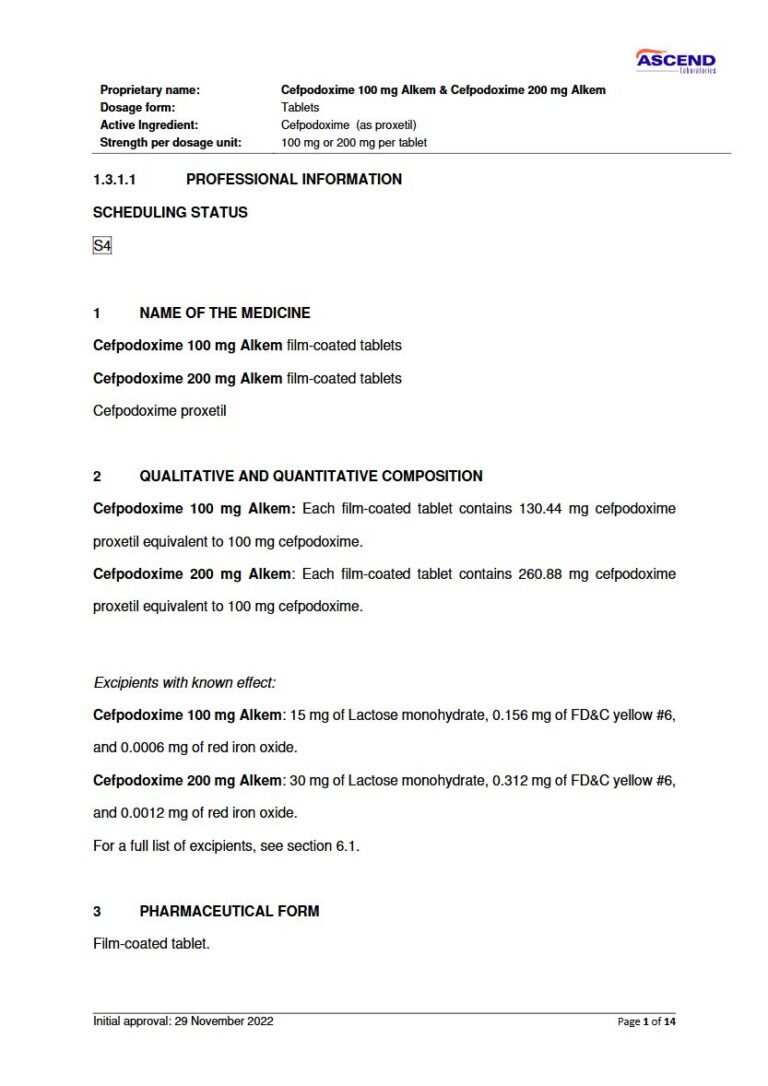
Alkem Cefpodoxime 100mg & 200mgTablets
PDF Leaflet Revision Date: 29 November 2022
Clinical Summary
Quick overview from the medicine insert
Indication
Short-term treatment of upper and lower respiratory tract infections.
Dosage (summary)
100 mg every 12 hours for tonsillitis/pharyngitis/acute bronchitis; 200 mg every 12 hours for sinusitis/pneumonia.
Special Populations
- Elderly
- Renal impairment
- Hepatic impairment
Pregnancy & Breastfeeding
Safety not established in pregnancy or breastfeeding.
Key Drug Interactions
- Probenecid reduces excretion
- Oestrogens may have reduced efficacy
- Increased anticoagulant effect with warfarin
Contraindications
- Hypersensitivity to cefpodoxime or cephalosporins
- History of severe hypersensitivity to beta-lactams
- Children under 1 year
Common side effects
- Eosinophilia
- Nausea
- Diarrhoea
- Dizziness
- Hypersensitivity reactions
Counselling Points
- Take with food for better absorption
- Report severe allergic reactions
- Monitor for gastrointestinal symptoms
Serious warnings
- Serious hypersensitivity reactions
- Risk of Clostridium difficile-associated colitis
- Monitor blood counts for prolonged use
Important Disclaimer
The Alkem Cefpodoxime 100mg & 200mgTablets professional information leaflet below is the property of Ascend Laboratories and is provided on Medinsert exactly as issued, with no.. alterations or editorial changes. We make every effort to keep content current by updating documents as soon as new versions become available. Medinsert serves as a trusted access point for healthcare professionals, but does not replace official sources or clinical judgement. For more details, please read our full disclaimer. read more>>
 Healthcare Professionals Only
This content is for registered healthcare professionals
Sign in or create a free account to read the full package insert.
Free for HPCSA-registered professionals. Powered by Medinsert.
Clinical Particulars
Section 4 of the official insert — extracted exactly as issued, no alterations
4.1 Therapeutic indications
Cefpodoxime Alkem is indicated, in adults, for the short-term treatment of upper and lower respiratory tract infections when caused by susceptible pathogens (sensitivity test is recommended):
- Acute sinusitis due to Haemophilus influenzae (u00df-lactamase and non-u00df-lactamase producing strains), Streptococcus pneumoniae, methicillin sensitive Staphylococcus aureus (penicillinase and non-penicillinase producing strains), Moraxella catarrhalis, (Branhamella catarrhalis) (u00df-lactamase and non-u00df-lactamase producing strains) and Haemophilus parainfluenza (u00df-lactamase and non-u00df-lactamase producing strains).
- Pharyngitis and tonsillitis due to Streptococci of Groups A (S. pyogenes), C and G.
- Acute bronchitis, relapses or exacerbation of chronic bronchitis due to Haemophilus influenzae (u00df-lactamase and non-u00df-lactamase producing strains), Streptococcus pneumoniae, methicillin sensitive Staphylococcus aureus (penicillinase and non-penicillinase producing strains), Moraxella catarrhalis, (Branhamella catarrhalis) (u00df-lactamase and non-u00df-lactamase producing strains) and Haemophilus parainfluenza (u00df-lactamase and non-u00df-lactamase producing strains).
- Bacterial pneumonia and community acquired pneumoniae due to Haemophilus influenzae (u00df-lactamase and non-u00df-lactamase producing strains), Streptococcus pneumoniae, Moraxella catarrhalis, (Branhamella catarrhalis) (u00df-lactamase producing strains) and Haemophilus parainfluenza (u00df-lactamase and non-u00df-lactamase producing strains).
4.2 Posology and method of administration
Posology: Adults: Each film-coated tablet contains 100 mg or 200 mg of cefpodoxime. The dosage depends on the condition being treated.
- Tonsillitis, pharyngitis and acute bronchitis: One Cefpodoxime 100 mg Alkem tablet every 12 hours with meals (200 mg/ day). A therapeutic dose must be administered for at least 10 days.
- Acute sinusitis, acute exacerbations of chronic bronchitis, pneumonia: One Cefpodoxime 200 mg Alkem tablet every 12 hours with meals (400 mg/day).
Special populations
- Elderly patients: Where renal function is normal, it is not necessary to adjust the dose.
- Hepatic insufficiency in adults and children: No dosage adjustment necessary.
- Renal insufficiency in adults and children: When the creatinine clearance is above 40 ml/min, it is not necessary to adjust the dose. For values below 40 ml/min, the daily dosage regimen should be reduced by half and administered as a single daily dose for values 10 - 39 ml/min, every second day for values below 10 ml/min and after each dialysis session for haemodialysis patients.
Method of administration: Route of administration: oral administration. The tablets should be taken with food for optimum absorption.
4.3 Contraindications
- Hypersensitivity to cefpodoxime, any other cephalosporins or to any of the excipients of Cefpodoxime Alkem listed in section 6.1.
- Previous history of immediate and / or severe hypersensitivity reaction (anaphylaxis) to penicillin or other beta-lactam antibiotic.
- Safety of use in pregnancy and lactation has not been established (see section 4.6).
- Children below 1 year of age.
4.4 Special warnings and precautions for use
Cefpodoxime Alkem is not a preferred antibiotic for the treatment of staphylococcal pneumonia and should not be used in the treatment of atypical pneumonia caused by organisms such as Legionella, Mycoplasma and Chlamydia. Cefpodoxime Alkem is not recommended for the treatment of pneumonia due to S. pneumoniae (see section 5.1).
Serious and occasionally fatal hypersensitivity reactions have been reported with beta-lactam antibacterial medicines. In case of severe hypersensitivity reactions, treatment with cefpodoxime must be discontinued immediately and adequate emergency measures must be initiated. Before beginning treatment, it should be established whether the patient has a history of severe hypersensitivity reactions to cefpodoxime, to other cephalosporins or to any other type of beta-lactam medicine. Caution should be used if cefpodoxime is given to patients with a history of non-severe hypersensitivity to other beta-lactam medicines.
In cases of severe renal insufficiency, it may be necessary to reduce the dosage regimen dependent on the creatinine clearance (see section 4.2).
Antibacterial medicine-associated colitis and pseudo-membranous colitis have been reported with nearly all anti-bacterial medicines, including cefpodoxime, and may range in severity from mild to life-threatening. Therefore, it is important to consider this diagnosis in patients who present with diarrhoea during or subsequent to the administration of Cefpodoxime Alkem (see section 4.8). Discontinuation of therapy with Cefpodoxime Alkem and the administration of specific treatment for Clostridium difficile should be considered. Medicines that inhibit peristalsis should not be given.
Cefpodoxime Alkem should always be prescribed with caution in patients with a history of gastrointestinal disease, particularly colitis. Neutropenia and more less frequently agranulocytosis may develop particularly during extended treatment. For cases of treatment lasting longer than 10 days, the blood count should be monitored and treatment discontinued if neutropenia is found.
Cephalosporins may be absorbed onto the surface of red cell membranes and react with antibodies directed against the medicine. This can produce a positive Coomb's test and less frequently, haemolytic anaemia. Cross-reactivity may occur with penicillin for this reaction.
Changes in renal function have been observed with cephalosporin antibiotics, particularly when given concurrently with potentially nephrotoxic medicines such as aminoglycosides and/or potential diuretics. In such cases, renal function should be monitored.
Prolonged use of cefpodoxime may result in the overgrowth of non-susceptible organisms (candida and Clostridium difficile), which may require interruption of treatment.
Interaction with laboratory tests: A false positive reaction for glucose in the urine may occur with Benedict's or Fehling's solutions or with copper sulphate test tablets, but not with tests based on enzymatic glucose oxidase reactions. Colourants in product may cause allergic reactions. Cefpodoxime Alkem contains lactose. Patients with rare hereditary problems of galactose intolerance, the total lactase deficiency or glucose-galactose malabsorption should not take this medicine.
4.5 Interaction with other medicines and other forms of interaction
Probenecid: Probenecid reduces the excretion of cephalosporins.
Oestrogens: Cephalosporins potentially reduce the contraceptive effect of oestrogens.
Oral anticoagulants: Cephalosporins potentially enhance the anticoagulant effect of coumarins. Simultaneous administration of Cefpodoxime Alkem with warfarin may augment its anti-coagulant effects. Patients receiving antibacterial medicines may experience increases in oral anticoagulant activity. The risk may vary with the underlying infection, age and general status of the patient so that the contribution of the cephalosporins to the increase in INR (international normalised ratio) is difficult to assess. It is recommended that the INR should be monitored frequently during and shortly after co-administration of cefpodoxime with an oral anti-coagulant medicine.
Antacids and H2-blockers: Histamine H2-antagonists and antacids reduce the bioavailability of Cefpodoxime Alkem. Bioavailability could decrease by approximately 30% when Cefpodoxime Alkem is administered with medicines which neutralise gastric pH or inhibit acid secretions. Therefore, such medicines as antacids of the mineral type and H2 blockers such as ranitidine, which can cause an increase in gastric pH, should be taken 2 to 3 hours after Cefpodoxime Alkem administration.
Positive Coombs test may occur during treatment with cephalosporins. Urinary glucose testing with non-specific reducing medicines, may yield a false-positive reaction in patients treated with cefpodoxime proxetil. This phenomenon is not seen when a glucose-oxydase specific method is used.
4.6 Fertility, pregnancy and lactation
Pregnancy: The safety and efficacy have not been established in pregnancy.
Breastfeeding: The safety and efficacy have not been established in breastfeeding.
4.7 Effects on ability to drive and use machines
Dizziness has been reported during treatment with Cefpodoxime Alkem and may affect the ability to drive and use machines.
4.8 Undesirable effects
Adverse reactions are listed below by system organ class and frequency. Frequencies are defined as: Frequent, less frequent, frequency unknown.
Blood and lymphatic system disorders: Frequent: Eosinophilia. Less frequent: Haematological disorders such as reduction in haemoglobin, thrombocytosis, thrombocytopenia, leucopenia, and haemolytic anaemia. Frequency unknown: Neutropenia, agranulocytosis.
Nervous system disorders: Less frequent: Headache, paraesthesia, dizziness.
Ear and labyrinth disorders: Less frequent: Tinnitus.
Gastrointestinal disorders: Frequent: Gastric pressure, nausea, vomiting, abdominal pain, flatulence, diarrhoea. Less frequent: Bloody diarrhoea can occur as a symptom of enterocolitis. The possibility of pseudomembranous enterocolitis should be considered if severe or persistent diarrhoea occurs during or after treatment (see section 4.4).
Metabolism and nutrition disorders: Frequent: Loss of appetite.
Immune system disorders: Frequent: Hypersensitivity reactions of all degrees of severity have been observed (see section 4.4). Less frequent: anaphylactic reactions, bronchospasm, purpura and angioedema.
Renal and urinary disorders: Less frequent: Slight increases in blood urea and creatinine.
Hepato-biliary disorders: Less frequent: Transient moderate elevations of AST, ALT and alkaline phosphatase and/or bilirubin. These laboratory abnormalities which may be explained by the infection, may rarely exceed twice the upper limit of the named range and elicit a pattern of liver injury, usually cholestatic and most often asymptomatic and liver damage.
Skin and subcutaneous tissue disorders: Less frequent: Hypersensitivity mucocutaneous reactions, rash, urticaria, pruritis, Stevens-Johnson syndrome, toxic epidermal necrolysis and erythema multiforme.
Infections and infestations: Less frequent: There can be multiplication of non-sensitive micro-organisms (see section 4.4).
General disorders and administration site conditions: Less frequent: Asthenia or malaise.
4.9 Overdose
In the event of overdosage with cefpodoxime, supportive and symptomatic therapy is indicated. In cases of overdosage, particularly in patients with renal insufficiency, encephalopathy may occur. The encephalopathy is usually reversible once cefpodoxime plasma levels have fallen. Convulsions have also been reported with high doses of Cefpodoxime in renally-impaired patients.
