
Acalabrutinib Cipla 100 mg Capsule
PDF Leaflet Revision Date: 04 July 2023
Clinical Summary
Quick overview from the medicine insert
Indication
Treatment of mantle cell lymphoma (MCL) and chronic lymphocytic leukaemia (CLL).
Dosage (summary)
100 mg (1 capsule) twice daily.
Special Populations
- Elderly
- Renal impairment
- Hepatic impairment
Pregnancy & Breastfeeding
Contraindicated in pregnancy; avoid breastfeeding during treatment and for 2 days after last dose.
Key Drug Interactions
- Strong CYP3A inhibitors
- Strong CYP3A inducers
- Gastric acid reducing medicines
Contraindications
- Hypersensitivity to acalabrutinib or excipients
Common side effects
- Infection
- Headache
- Diarrhoea
- Bruising
- Fatigue
Counselling Points
- Take at the same time each day
- Do not chew or open capsules
- Monitor for signs of bleeding or infection
Serious warnings
- Serious haemorrhagic events
- Serious infections
- Cytopenias
- Atrial fibrillation
Important Disclaimer
The Acalabrutinib Cipla 100 mg Capsule professional information leaflet below is the property of Cipla Medpro and is provided on Medinsert exactly as issued, with no.. alterations or editorial changes. We make every effort to keep content current by updating documents as soon as new versions become available. Medinsert serves as a trusted access point for healthcare professionals, but does not replace official sources or clinical judgement. For more details, please read our full disclaimer. read more>>
 Healthcare Professionals Only
This content is for registered healthcare professionals
Sign in or create a free account to read the full package insert.
Free for HPCSA-registered professionals. Powered by Medinsert.
Clinical Particulars
Section 4 of the official insert — extracted exactly as issued, no alterations
4.1 Therapeutic Indications
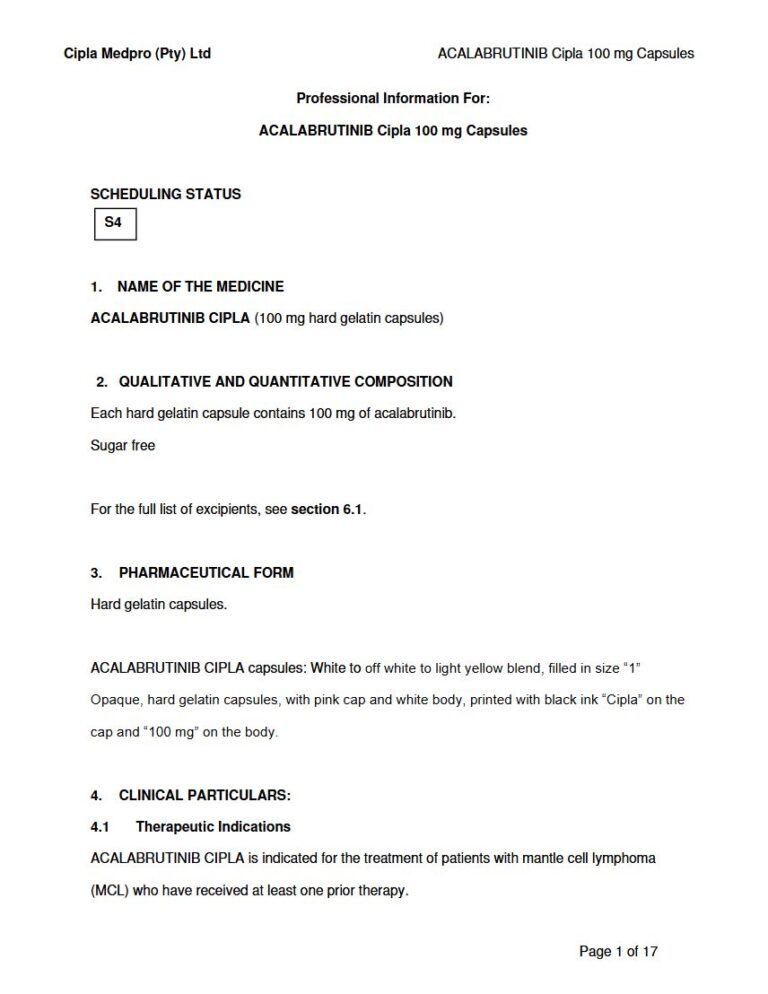
ACALABRUTINIB CIPLA is indicated for the treatment of patients with mantle cell lymphoma (MCL) who have received at least one prior therapy.
ACALABRUTINIB CIPLA is indicated for the treatment of patients with chronic lymphocytic leukaemia (CLL).
4.2 Posology and method of administration
Treatment with ACALABRUTINIB CIPLA should be initiated and supervised by a medical practitioner experienced in the use of anticancer therapies.
Posology
MCL
The recommended dose of ACALABRUTINIB CIPLA for the treatment of MCL is 100 mg (1 capsule) twice a day.
CLL
The recommended dose of ACALABRUTINIB CIPLA for the treatment of MCL is 100 mg (1 capsule) twice a day, either as monotherapy or in combination with Obinutuzumab. Refer to the Obinutuzumab prescribing information for recommended Obinutuzumab dosing information. Doses should be separated by approximately 12 hours.
Treatment with ACALABRUTINIB CIPLA should continue until disease progression or unacceptable toxicity.
Missed Dose
If a patient misses a dose of ACALABRUTINIB CIPLA by more than 3 hours, instruct the patient to take the next dose at its regularly scheduled time. Extra capsules of ACALABRUTINIB CIPLA should not be taken to make up for a missed dose.
Dose Adjustment
Recommended dose modifications of ACALABRUTINIB CIPLA for Grade u2265 3 adverse reactions are provided in Table 1.
Table 1. Recommended Dose Adjustments for Adverse Reactions
Adverse Reaction Occurrence
First and Second Restart at 100 mg twice daily
Third Restart at 100 mg daily.
Fourth Discontinue ACALABRUTINIB CIPLA
Table 2: Dose Modifications for use with CYP3A Inhibitors or Inducers and Gastric Acid Reducing medicines
Co-administered medicine
CYP3A Inhibitors
Strong CYP3A inhibitors Consider alternative therapies to strong CYP3A inhibitors. Monitor patients closely for adverse reactions if taking strong CYP3A inhibitors.
CYP3A Inducers
Strong CYP3A inducers Consider alternative therapies to strong CYP3A inducers. If these inducers cannot be avoided, increase ACALABRUTINIB CIPLA dose to 200mg twice daily.
Gastric Acid Reducing medicines
Proton Pump Inhibitors Avoid concomitant use.
H2-Receptor Antagonists Take ACALABRUTINIB CIPLA, 2 hours before taking a H2-receptor antagonist.
Antacids Separate dosing by at least 2 hours.
SPECIAL POPULATIONS
Elderly population
No dose adjustment is required for elderly patients aged u2265 65 years, see section 5.2.
Renal impairment
No dose adjustment is recommended in patients with mild to moderate renal impairment, [eGFR greater than or equal to 30 mL/min/1,73m2 as estimated by MDRD (modification of diet in renal disease equation)]
The pharmacokinetics and safety of ACALABRUTINIB CIPLA in patients with severe renal impairment (eGFR less than 29 mL/min/1,73m2) or end-stage renal disease have not been studied (see section 5.2).
Hepatic impairment
No dose adjustment is recommended in patients with mild or moderate hepatic impairment (Child-Pugh A, Child-Pugh B or total bilirubin between 1,5 to 3 times upper limit of normal [ULN] and any AST). It is not recommended to administer ACALABRUTINIB CIPLA in patients with severe hepatic impairment (Child-Pugh C, or total bilirubin between > 3 times the ULN and any AST) (see section 5.2).
Paediatric population
The safety and efficacy of ACALABRUTINIB CIPLA in children and adolescents aged less than 18 years have not been established.
Method of administration
Oral use. ACALABRUTINIB CIPLA should be swallowed whole with water at approximately the same time each day. ACALABRUTINIB CIPLA can be taken with or without food. The capsule should not be chewed, dissolved, or opened.
4.3. Contraindications
ACALABRUTINIB CIPLA is contraindicated for the following:
- Hypersensitivity to acalabrutinib or any of the excipients listed in section 6.1.
4.4. Special warnings and precautions for use
Haemorrhagic events
Serious haemorrhagic events, including fatal events, have been reported in patients with haematologic malignancies (n=1040) treated with acalabrutinib monotherapy. The mechanism for the bleeding events is not well understood. Patients receiving antithrombotic medicines may be at increased risk of haemorrhage. Use caution with antithrombotic medicines and consider additional monitoring for signs of bleeding when concomitant use is medically necessary.
Consider the benefit-risk of withholding ACALABRUTINIB CIPLA for at least 3 days pre- and post- surgery.
Infections
Serious infections (bacterial, viral or fungal), including fatal events have been reported in patients with haematologic malignancies (n=1040) treated with acalabrutinib monotherapy. Grade 3 or higher infections occurred in these patients. The most frequently reported Grade 3 or higher infection was pneumonia. Infections due to hepatitis B virus (HBV) reactivation, aspergillosis, and progressive multifocal leukoencephalopathy (PML) have occurred. Consider prophylaxis in patients who are at increased risk for opportunistic infections. Monitor patients for signs and symptoms of infection and treat as medically appropriate.
Cytopeniau2019s
Treatment-emergent Grade 3 or 4 cytopeniau2019s, including neutropenia, anaemia and thrombocytopenia based on laboratory measurements, has been reported in patients with haematologic malignancies (n=1040) treated with acalabrutinib monotherapy. Monitor complete blood counts as medically appropriate.
Second Primary Malignancies
Second primary malignancies, including non-skin cancers have been reported in patients treated with acalabrutinib. The most frequent second primary malignancy reported is skin cancer. Skin cancers should be monitored.
Atrial Fibrillation and Flutter
In patients with haematologic malignancies (n=1040) treated with acalabrutinib monotherapy, Grade 3 atrial fibrillation/flutter have been reported in 1% of patients, and Grade 1 or 2 in 3% of patients. Monitor for symptoms (e.g., palpitations, dizziness, syncope, chest pain, dyspnoea) of atrial fibrillation and atrial flutter and obtain an ECG as appropriate.
ACALABRUTINIB CIPLA contains sodium starch glycolate ACALABRUTINIB CIPLA contains less than 1 mmol sodium (23 mg) per dose, essentially 'sodium-free'.
4.5. Interaction with other medicines and other forms of interaction
Active substances that may increase acalabrutinib plasma concentrations
CYP3A Inhibitors
Co-administration of acalabrutinib with a strong CYP3A inhibitor (itraconazole) increases acalabrutinib plasma concentrations, which may result in increased toxicity. Consider alternative therapies that do not strongly inhibit CYP3A activity. Patients taking strong CYP3A inhibitors (e.g., ketoconazole, conivaptan, clarithromycin, indinavir, itraconazole, ritonavir, telaprevir, posaconazole, voriconazole) with ACALABRUTINIB CIPLA should be monitored more closely for adverse reactions.
Active substances that may decrease acalabrutinib plasma concentrations
CYP3A Inducers
Co-administration of acalabrutinib with a strong CYP3A inducer (rifampin) decreases acalabrutinib plasma concentrations, which may result in reduced ACALABRUTINIB CIPLA activity. Consider alternative therapies to strong inducers of CYP3A activity (e.g., phenytoin, rifampin, carbamazepine). Avoid St. Johnu2019s wort which may unpredictably decrease acalabrutinib plasma concentrations. If a strong CYP3A inducer cannot be avoided, increase the ACALABRUTINIB CIPLA dose to 200 mg twice daily.
Gastric Acid Reducing medicines
Acalabrutinib solubility decreases with increasing pH. Co-administration with a proton pump inhibitor (40 mg omeprazole for 5 days), decreased acalabrutinib AUC by 43%. If treatment with an acid reducing medicine is required, consider using an antacid (e.g., calcium carbonate), or an H2-receptor antagonist (e.g., ranitidine or famotidine). For use with antacids, separate dosing by at least 2 hours. For H2-receptor antagonists, take ACALABRUTINIB CIPLA 2 hours before taking the H2-receptor antagonist. Due to the long-lasting effect of proton pump inhibitors, separation of doses with proton pump inhibitors may not eliminate the interaction with ACALABRUTINIB CIPLA.
Active substances whose plasma concentrations may be altered by ACALABRUTINIB CIPLA
CYP3A Substrates
Based on in vitro data and PBPK modelling, no interaction with CYP substrates is expected at the clinically relevant concentrations (see section 5.2).
Effects of Acalabrutinib and its active metabolite, ACP-5862, on Drug Transport Systems
Acalabrutinib may increase exposure to co-administered BCRP substrates (e.g., methotrexate) by inhibition of intestinal BCRP (see section 5.2). ACP-5862 may increase exposure to co-administered MATE1 substrates (e.g., metformin) by inhibition of MATE1 (see section 5.2).
4.6. Fertility, pregnancy, and lactation
Women of childbearing potential
ACALABRUTINIB CIPLA should not be used by women of childbearing potential, and they should be advised to avoid becoming pregnant while receiving ACALABRUTINIB CIPLA.
Pregnancy
ACALABRUTINIB CIPLA should not be used during pregnancy.
Breastfeeding
No data are available regarding the presence of acalabrutinib or its active metabolite in human milk. Breastfeeding mothers should not breastfeed during treatment with ACALABRUTINIB CIPLA and for 2 days after receiving the last dose.
Fertility
There are no data on the effect of ACALABRUTINIB CIPLA on human fertility.
4.7. Effects on ability to drive and use machines
ACALABRUTINIB CIPLA has no or negligible influence on the ability to drive and use machines. However, during treatment with acalabrutinib, fatigue and dizziness have been reported and patients who experience these symptoms should be advised not to drive or use machines.
4.8. Undesirable effects
a) Summary of the safety profile
The most frequent reported adverse drug reactions of any grade in patients treated with acalabrutinib monotherapy, are infection, headache, diarrhoea, bruising, musculoskeletal pain, nausea, fatigue, and rash. The most frequently reported Grade u2265 3 adverse drug reactions are infection, neutropenia, and anaemia.
b) Tabulated list of adverse reactions
Tables 3 present the frequency category of adverse reactions observed in patients with Haematological malignancies treated with ACALABRUTINIB CIPLA.
System Organ Class
All Grades
Grade u2265 3 Adverse Reactions /Frequency
Infections and infestations
Frequent Infection
Frequent Infection
Neoplasms benign, malignant, and unspecified (including cysts and polyps)
Frequent Second primary malignancy
Non-melanoma skin cancer
Second primary malignancy excluding non-melanoma skin
Frequent Second primary malignancy
Second primary malignancy excluding non-melanoma skin
Less Frequent Non-melanoma skin cancer
Blood and lymphatic system disorders
Frequent Leukopenia
Neutropenia
Anaemia
Thrombocytopenia
Frequent Leukopenia
Neutropenia
Anaemia
Thrombocytopenia
Metabolism and nutrition disorders
Less Frequent Tumour Lysis Syndrome
Less Frequent Tumour Lysis Syndrome
Nervous system disorders
Frequent Headache
Dizziness
Frequent Headache
Less Frequent Dizziness
Cardiac disorders
Frequent Atrial fibrillation /Flutter
Frequent Atrial fibrillation /Flutter
Vascular disorders
Frequent Haemorrhage/ Hematoma
Less Frequent Haemorrhage/ Hematoma
Respiratory, thoracic, and mediastinal disorders
Frequent Epistaxis
Less Frequent Epistaxis
Gastrointestinal disorders
Frequent Diarrhoea
Nausea
Abdominal pain
Constipation
Vomiting
Frequent Diarrhoea
Nausea
Abdominal pain
Less Frequent Constipation
Vomiting
Skin and subcutaneous tissue disorders
Frequent Bruising
Rash
Less Frequent Rash
Musculoskeletal and connective tissue disorders
Frequent Arthralgia
Musculoskeletal Pain
Frequent Musculoskeletal Pain
Less Frequent Arthralgia
General disorders and administration site conditions
Frequent Fatigue
Asthenia
Frequent Fatigue
Less Frequent Asthenia
Investigations
Frequent Frequent
Decreased haemoglobin
Decreased platelets
Decreased absolute neutrophil count
Decreased haemoglobin
Decreased platelets
Decreased absolute neutrophil count
Other special populations
Elderly No clinically relevant differences in safety or efficacy observed between patients u2265 65 years and younger.
Reporting of suspected adverse reactions
Reporting suspected adverse reactions after authorisation of the medicine is important. It allows continued monitoring of the benefit/risk balance of the medicine. Health care providers are asked to report any suspected adverse reactions to SAHPRA via the u201c6.04 Adverse Drug Reactions Reporting Formu201d, found online under SAHPRAu2019s publications: https://www.sahpra.org.za/Publications/Index/8 or [email protected]
4.9. Overdose
There is no specific treatment for ACALABRUTINIB CIPLA overdose and symptoms of overdose have not been established. In the event of an overdose, patients must be closely monitored for signs or symptoms of adverse reactions and appropriate symptomatic treatment instituted.
