
Acitop 50 mg Cream
PDF Leaflet Revision Date: 03 February 2025
Clinical Summary
Quick overview from the medicine insert
Indication
Symptomatic treatment of herpes simplex infections of the lips.
Dosage (summary)
Apply 5 to 6 times daily for 5-10 days.
Special Populations
- Severely immune compromised patients
Pregnancy & Breastfeeding
Safety in pregnancy and lactation not established; acyclovir passes into breast milk.
Key Drug Interactions
- Probenecid increases acyclovir half-life
Contraindications
- Hypersensitivity to acyclovir or excipients
Common side effects
- Stinging, burning, erythema, contact dermatitis
Counselling Points
- Apply as soon as symptoms appear; avoid auto-inoculation.
Serious warnings
- Risk of DRESS and AGEP; avoid contact with mucous membranes
Important Disclaimer
The Acitop 50 mg Cream professional information leaflet below is the property of Cipla Medpro and is provided on Medinsert exactly as issued, with no.. alterations or editorial changes. We make every effort to keep content current by updating documents as soon as new versions become available. Medinsert serves as a trusted access point for healthcare professionals, but does not replace official sources or clinical judgement. For more details, please read our full disclaimer. read more>>
 Healthcare Professionals Only
This content is for registered healthcare professionals
Sign in or create a free account to read the full package insert.
Free for HPCSA-registered professionals. Powered by Medinsert.
Clinical Particulars
Section 4 of the official insert — extracted exactly as issued, no alterations
4.1 Therapeutic indications
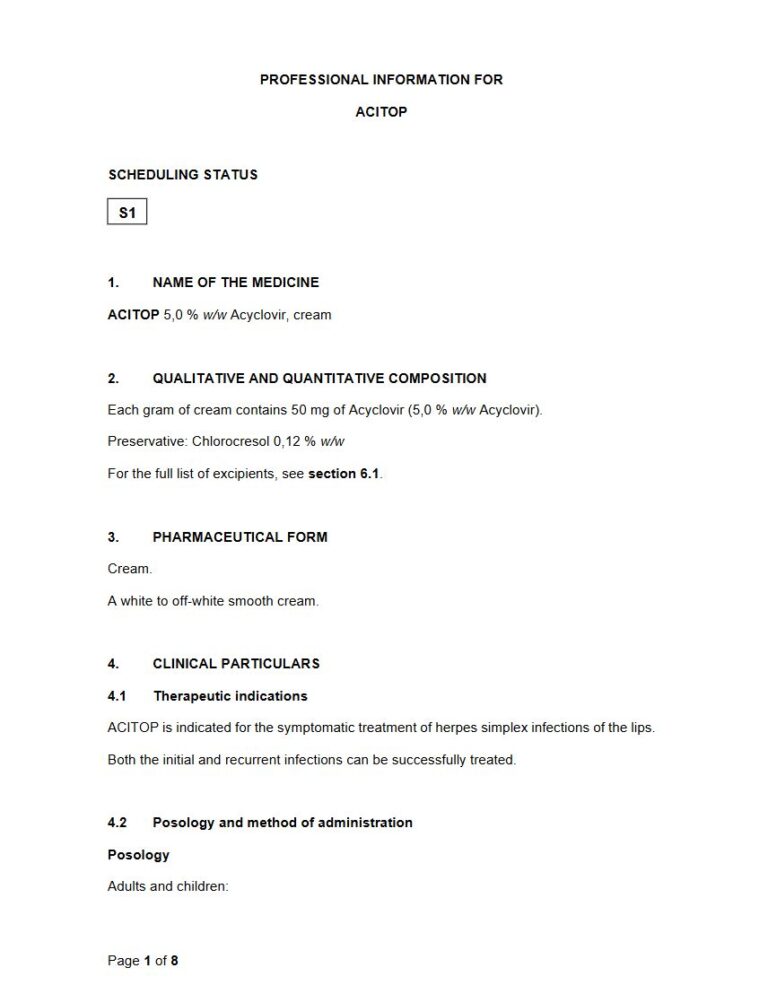
ACITOP is indicated for the symptomatic treatment of herpes simplex infections of the lips. Both the initial and recurrent infections can be successfully treated.
4.2 Posology and method of administration
Posology
Adults and children: Apply 5 to 6 times daily at four-hourly intervals. Therapy should be initiated as soon as possible following the onset of signs and symptoms of herpes simplex infection. This is particularly important in the treatment of recurrent episodes. Treatment should be continued for 5 days. If healing has not occurred, the treatment may be prolonged for up to 10 days. Do not exceed the recommended dose.
Method of administration
Cover all lesions adequately. Use a finger cot or a rubber glove to prevent auto inoculation.
4.3 Contraindications
ACITOP is contraindicated in:
u2022 Patients with known hypersensitivity to acyclovir, valacyclovir or propylene glycol or to any of the excipients used in ACITOP (see section 6.1).
4.4 Special warnings and precautions for use
In severely immune compromised patients (e.g., AIDS patients or bone marrow transplant recipients) topical ACITOP may be inappropriate. ACITOP is intended for cutaneous use only and is not recommended for application to mucous membranes, such as in the mouth, eye or vagina. Particular care should be taken to avoid accidental introduction into the eye. Resistance has been reported with varicella zoster virus. ACITOP contains chlorocresol and may cause allergic reactions.
ACITOP contains cetostearyl alcohol and may cause local skin reactions (e.g., contact dermatitis). ACITOP contains propylene glycol and may cause skin irritation. There is a risk of developing a drug reaction with eosinophilia and systemic symptoms (DRESS) and / or acute generalized exanthematous pustulosis (AGEP) with the use of ACITOP. DRESS and AGEP are considered serious cutaneous adverse reactions (SCARs) which are unpredictable and present a substantial risk to patients. If a patient develops these reactions during ACITOP use, treatment should be withdrawn immediately, and an alternative treatment considered (as appropriate). Treatment with ACITOP or any other acyclovir or valacyclovir containing medicines must not be restarted for the patient at any time.
4.5 Interaction with other medicines and other forms of interaction
Probenecid increases the acyclovir mean half-life and area under the plasma concentration curve. Other medicines affecting renal physiology could potentially influence the pharmacokinetics of acyclovir. However, clinical experience has not identified other drug interactions with acyclovir. No clinically significant interactions have been identified. Dilution: ACITOP contains a specially formulated base and should not be diluted or used as a base for incorporation of other medicaments.
4.6 Fertility, pregnancy and lactation
The safety of ACITOP in pregnancy and lactation has not been established. Limited human data show that acyclovir does pass into breast milk. There is no information on the effect of ACITOP on human female fertility. In a reported study of 20 male patients with normal sperm count, oral acyclovir administered at doses of up to 1 g per day for up to six months has been shown to have no clinically significant effect on sperm count, motility or morphology.
4.7 Effects on ability to drive and use machines
ACITOP has no influence on the ability to drive or operate machinery.
4.8 Undesirable effects
Tabulated summary of adverse reactions
The following adverse reactions have been classified according to the following categories, frequent, less frequent and frequency unknown.
MedDRA system organ Class Frequency Side effects
Skin and subcutaneous tissue disorders Less frequent Transient stinging, burning or erythema may occur. Mild drying and flaking of the skin may occur. Itching. Contact dermatitis following application. Where sensitivity tests have been conducted, the reactive substances have most often been shown to be components of the cream rather than acyclovir. Frequency unknown Drug reaction with eosinophilia and systemic symptoms (DRESS), acute generalized exanthematous pustulosis (AGEP). [together these are referred to as serious cutaneous adverse reactions (SCARs) u2013 see section 4.4].
Immune system disorders Less frequent Immediate hypersensitivity reactions including angioedema.
4.9 Overdose
Treatment is symptomatic and supportive if accidental ingestion has occurred. Acyclovir is dialysable (See section 4.8 and section 4.4).
