
Actilyse 50mg Injection
PDF Leaflet Revision Date: 19 November 2024
Clinical Summary
Quick overview from the medicine insert
Indication
Fibrinolytic therapy for acute myocardial infarction and massive pulmonary embolism.
Dosage (summary)
15 mg IV bolus, followed by 50 mg IV infusion over 30 mins, then 35 mg over 60 mins (max 100 mg). Adjust for weight < 65 kg.
Special Populations
- Elderly
- Renal impairment
- Hepatic impairment
Pregnancy & Breastfeeding
Limited safety data; use only if benefits outweigh risks. Caution in breastfeeding.
Key Drug Interactions
- Anticoagulants
- ACE inhibitors
Contraindications
- Hypersensitivity to alteplase
- Active bleeding disorders
- Recent major surgery
- Uncontrolled hypertension
- Intracranial hemorrhage
Common side effects
- Bleeding
- Intracranial hemorrhage
- Dysrhythmias
Counselling Points
- Report any signs of bleeding immediately.
- Avoid other anticoagulants for 24 hours post-treatment.
- Ensure resuscitation equipment is available during administration.
Serious warnings
- Risk of serious bleeding
- Use only by experienced doctors
- Monitor blood pressure closely
Important Disclaimer
The Actilyse 50mg Injection professional information leaflet below is the property of Ingelheim Pharmaceuticals and is provided on Medinsert exactly as issued, with no.. alterations or editorial changes. We make every effort to keep content current by updating documents as soon as new versions become available. Medinsert serves as a trusted access point for healthcare professionals, but does not replace official sources or clinical judgement. For more details, please read our full disclaimer. read more>>
 Healthcare Professionals Only
This content is for registered healthcare professionals
Sign in or create a free account to read the full package insert.
Free for HPCSA-registered professionals. Powered by Medinsert.
Clinical Particulars
Section 4 of the official insert — extracted exactly as issued, no alterations
4.1 Therapeutic indications
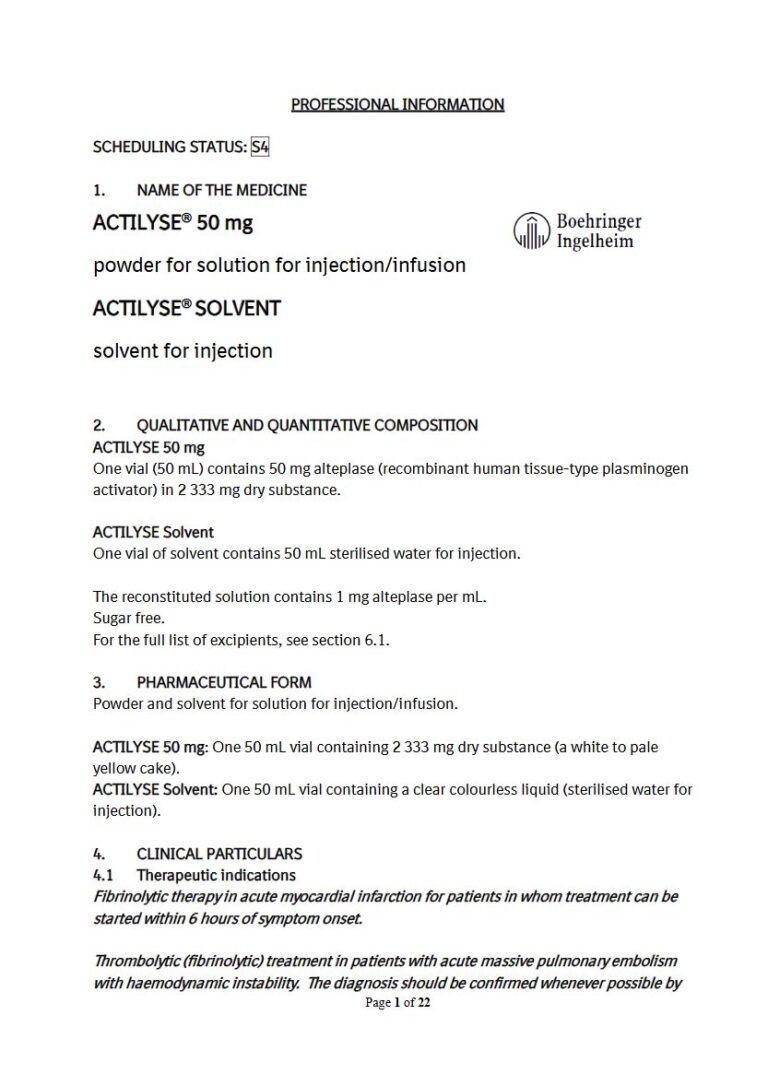
Fibrinolytic therapy in acute myocardial infarction for patients in whom treatment can be started within 6 hours of symptom onset. Thrombolytic (fibrinolytic) treatment in patients with acute massive pulmonary embolism with haemodynamic instability. The diagnosis should be confirmed whenever possible by objective means such as pulmonary angiography or non-invasive procedures such as lung scanning. There is no evidence for positive effects on mortality and late morbidity related to pulmonary embolism in haemodynamically stable patients. Thrombolytic (fibrinolytic) treatment of acute ischaemic stroke. Treatment must be started as early as possible, but within 4.5 hours after onset of stroke symptoms and after exclusion of intracranial haemorrhage by appropriate imaging techniques (e.g. cranial computerised tomography or other diagnostic imaging method sensitive for the presence of haemorrhage) (see section 4.3). The treatment effect is time-dependent; therefore earlier treatment increases the probability of a favourable outcome.
4.2 Posology and method of administration
Posology ACTILYSE should be given as early as possible after symptom onset. Acute myocardial infarction In patients with acute myocardial infarction, in whom treatment can be started within 6 hours after symptom onset, ACTILYSE should be administered according to the following dose regimen in patients with a body weight u2265 65 kg:
- 15 mg as an intravenous bolus, immediately followed by
- 50 mg as an intravenous infusion over the first 30 minutes, immediately followed by an intravenous infusion of 35 mg over 60 minutes until the maximum total dose of 100 mg.
In patients with a body weight < 65 kg the total dose should be weight adjusted with:
- 15 mg as an intravenous bolus, immediately followed by
- 0.75 mg/kg body weight as an intravenous infusion over the first 30 minutes (maximum 50 mg), immediately followed by an intravenous infusion of 0.5 mg/kg over 60 minutes (up to a maximum of 35 mg).
The total dose should not exceed 1.5 mg/kg in patients with a body weight below 65 kg. Adjunctive therapy Antithrombotic adjunctive therapy is recommended according to the current guidelines for the management of patients with ST-elevation myocardial infarction.
Acute massive pulmonary embolism In patients with a body weight u2265 65 kg: A total dose of 100 mg should be administered in two hours. The most experience available is with the following dose regimen:
- 10 mg as an intravenous bolus over 1 - 2 minutes, immediately followed by
- 90 mg as an intravenous infusion over 2 hours until the maximum total dose of 100 mg.
In patients with a body weight < 65 kg:
- 10 mg as an intravenous bolus over 1 - 2 minutes, immediately followed by
- an intravenous infusion over 2 hours up to a maximum total dose of 1.5 mg/kg body weight.
The total dose should not exceed 1.5 mg/kg in patients with a body weight below 65 kg. Adjunctive therapy After treatment with ACTILYSE, heparin therapy should be initiated (or resumed) when activated partial thromboplastin time (aPTT) values are less than twice the upper limit of normal. The infusion should be adjusted to maintain an activated partial thromboplastin time (aPTT) between 50 - 70 seconds (1.5 to 2.5 fold of the reference value).
Acute ischaemic stroke Only to be used by doctors experienced in the treatment of ischaemic stroke. The recommended total dose is 0.9 mg/kg body weight (maximum of 90 mg) starting with 10 % of the total dose administered as an initial intravenous bolus, immediately followed by the remainder of the total dose infused intravenously over 60 minutes. Treatment should be initiated as early as possible, but within 4.5 hours of symptom onset. The treatment effect is time-dependent; therefore earlier treatment increases the probability of a favourable outcome.
Dosing table for acute ischaemic stroke Weight (kg) Total Dose (mg) Bolus Dose (mg) Infusion Dose a (mg) 40 36.0 3.6 32.4 42 37.8 3.8 34.0 44 39.6 4.0 35.6 46 41.4 4.1 37.3 48 43.2 4.3 38.9 50 45.0 4.5 40.5 52 46.8 4.7 42.1 54 48.6 4.9 43.7 56 50.4 5.0 45.4 58 52.2 5.2 47.0 60 54.0 5.4 48.6 62 55.8 5.6 50.2 64 57.6 5.8 51.8 66 59.4 5.9 53.5 68 61.2 6.1 55.1 70 63.0 6.3 56.7 72 64.8 6.5 58.3 74 66.6 6.7 59.9 76 68.4 6.8 61.6 78 70.2 7.0 63.2 80 72.0 7.2 64.8 82 73.8 7.4 66.4 84 75.6 7.6 68.0 86 77.4 7.7 69.7 88 79.2 7.9 71.3 90 81.0 8.1 72.9 92 82.8 8.3 74.5 94 84.6 8.5 76.1 96 86.4 8.6 77.8 98 88.2 8.8 79.4 100+ 90.0 9.0 81.0 a given in a concentration of 1 mg/mL over 60 min. Adjunctive therapy The safety and efficacy of this regimen with concomitant administration of heparin or platelet aggregation inhibitors such as acetylsalicylic acid during the first 24 hours after the symptom onset has not been investigated sufficiently. Therefore, administration of intravenous heparin or platelet aggregation inhibitors such as acetylsalicylic acid should be avoided in the first 24 hours after treatment with ACTILYSE due to an increased haemorrhagic risk. If heparin is required for other indications (e.g. prevention of deep vein thrombosis) the dose should not exceed 10 000 IU per day, administered subcutaneously.
Paediatric population There is limited experience with the use of ACTILYSE in children and adolescents. Actilyse is contraindicated for the treatment of acute ischaemic stroke in children and adolescents under 16 years of age (see section 4.3). The dose for adolescents 16-17 years old is the same as for adults (see section 4.4 for recommendations on prior imaging techniques to be used).
Method of administration The reconstituted solution should be administered intravenously and is for immediate use. For reconstitution instructions prior to administration, see section 6.6. For exact dosing, administration of ACTILYSE with perfusors/pumps is preferable; however, a drip infusion set can be used instead. To provide the patient with the maximum benefit of ACTILYSE, residual volume remaining in the I.V. application devices should be kept to a minimum.
4.3 Contraindications
Hypersensitivity to the active substance alteplase or any of the excipients listed in section 6.1. The following contraindications apply in general: ACTILYSE should not be used in cases where there is a high risk of haemorrhage such as:
- Significant bleeding disorder at present or within the past 6 months or known haemorrhagic diathesis
- Patients receiving effective oral anticoagulant treatment, e.g. warfarin sodium with INR > 1.3 and direct oral anticoagulants (DOACs) (see section 4.4, subsection u201cBleedingu201d)
- Any history of central nervous system damage, (i.e. neoplasm, aneurysm, intracranial or spinal surgery, ischaemic stroke in the past 3 months)
- History or evidence or suspicion of intracranial haemorrhage including sub-arachnoid haemorrhage
- Uncontrolled arterial hypertension, systolic BP u2265 180 mm Hg, diastolic BP u2265 110 mm Hg
- Major surgery, major biopsy, major fracture or significant trauma in the past 6 weeks (this includes any trauma associated with the current acute myocardial infarction), recent trauma to head or cranium
- Cardiopulmonary resuscitation (> 2 minutes), obstetrical delivery within the past 10 days, recent puncture of a non-compressible blood vessel (e.g. subclavian and jugular vein puncture)
- Haemorrhagic stroke or stroke of unknown origin at any time
- Severe liver disease, including hepatic failure, cirrhosis, portal hypertension (oesophageal varices) and active hepatitis
- Infective endocarditis, pericarditis
- Acute pancreatitis
- Documented ulcerative gastrointestinal disease during the last 3 months, oesophageal varices
- Arterial aneurisms, arterial/venous (A-V) malformations, dissecting aortic aneurism
- Intracranial neoplasm, known or suspected
- Neoplasm with increased bleeding risk
In the indications of acute myocardial infarction and acute massive pulmonary embolism the following additional contraindications apply:
- Ischaemic stroke or transient ischaemic attack (TIA) in the preceding 3 months, except current acute ischaemic stroke within 4.5 hours
In the indication acute ischaemic stroke the following contraindications apply in addition:
- Symptoms of ischaemic attack that began more than 4.5 hours prior to infusion start or when time of symptom onset is unknown
- Symptoms of acute ischaemic stroke that were either rapidly improving or minor before start of infusion
- Severe stroke as assessed clinically (e.g. National Institute of Health Stroke Scale (NIHSS) > 25) and/or by appropriate imaging techniques
- Seizure at the onset of stroke
- History of previous stroke or serious head-trauma within three months
- A combination of previous stroke and diabetes mellitus
- Administration of heparin within 48 hours preceding the onset of stroke with an elevated activated partial thromboplastin time (aPTT) at presentation
- Platelet count of less than 100 000/mm3
- Systolic blood pressure > 180 mm Hg or diastolic blood pressure > 110 mm Hg, or aggressive management (I.V. medication) necessary to reduce blood pressure to these limits
- Blood glucose 22.2 mmol/L
Use in children and adolescents ACTILYSE is not indicated for the treatment of acute ischaemic stroke in children under 16 years of age (for adolescents u2265 16 years of age see section 4.4).
4.4 Special warnings and precautions for use
ACTILYSE should be used by doctors experienced in the use of thrombolytic treatment and with the facilities to monitor that use. It is recommended that when ACTILYSE is administered, standard resuscitation equipment and medication be available in all circumstances.
Traceability In order to improve traceability of biological medicinal products, the trade name and the batch number of the administered product should be clearly recorded in the patient file. Each patient being considered for therapy with ACTILYSE should be carefully evaluated and anticipated benefits weighed against potential risks associated with therapy.
Hypersensitivity No sustained antibody formation to the recombinant human tissue-type plasminogen activator molecule has been observed after treatment. There is no systematic experience with re-administration of ACTILYSE. Immune-mediated hypersensitivity reactions associated with the administration of ACTILYSE can be caused by the active substance alteplase or any of the excipients (see also section 4.3). There is also a risk of hypersensitivity reactions mediated through a non-immunological mechanism. Angio-oedema represents the most common hypersensitivity reaction reported with ACTILYSE. This risk may be enhanced in the indication acute ischaemic stroke and/or by concomitant treatment with ACE inhibitors (see Section 4.5). Patients treated for any authorised indication should be monitored for angio-oedema during and for up to 24 hours after infusion. If a severe hypersensitivity reaction (e.g. angio-oedema) occurs, the infusion should be discontinued and appropriate treatment promptly initiated. This may include intubation.
Bleeding The most common complication encountered during ACTILYSE therapy is bleeding. The concomitant use of other active substances affecting coagulation or platelet function may contribute to bleeding. As fibrin is lysed during ACTILYSE therapy, bleeding from recent puncture sites may occur. Therefore, thrombolytic therapy requires careful attention to all potential bleeding sites (including catheter insertion sites, arterial and venous puncture sites, cut down sites and needle puncture sites). ACTILYSE is intended for administration by intravenous infusion only. Intramuscular injections and non-essential handling of the patient should be avoided during treatment with ACTILYSE. Venepunctures should be performed carefully and only as required.
Should an arterial puncture be necessary during an infusion of ACTILYSE it is preferable to use an upper extremity vessel that is accessible to manual compression. Pressure should be applied for at least 30 minutes, a pressure dressing applied and the puncture site checked frequently for evidence of bleeding. Should serious bleeding (not controllable by local pressure) occur, in particular cerebral haemorrhage, the infusion of ACTILYSE and any concomitant heparin should be terminated immediately. Administration of protamine should be considered if heparin has been administered within 4 hours before the onset of bleeding. In patients who fail to respond to the conservative measures, judicious use of transfusion products may be indicated. Transfusion of cryoprecipitate, fresh frozen plasma, and platelets should be considered with clinical and laboratory assessment after each administration. A target fibrinogen level of 1g/L is desirable with cryoprecipitate infusion. Antifibrinolytic agents should also be considered. A dose exceeding 100 mg of ACTILYSE (90 mg in acute ischaemic stroke) should not be given because it has been associated with an increase in intracranial bleeding. The use of ACTILYSE therapy has to be carefully evaluated in order to balance the potential risks of bleeding with expected benefits under the following conditions:
- Haemostatic defects including those secondary to severe hepatic or renal disease
- Recent intramuscular injection or recent traumas, such as biopsies, puncture of major vessels, cardiac massage for resuscitation
- Septic thrombophlebitis or occluded AV cannula at the seriously infected site
- Conditions with an increased risk of haemorrhage, which are not mentioned under section 4.3
- Patients receiving oral anticoagulant treatment: The use of ACTILYSE may be considered when appropriate test(s) of anticoagulant activity for the product(s) concerned show no clinically relevant activity.
For the treatment of acute myocardial infarction and acute massive pulmonary embolism the following special warnings and precautions apply in addition:
- Systolic blood pressure > 160 mm Hg, see also section 4.3
- Advanced age, which may increase the risk of intracerebral haemorrhage. As the therapeutic benefit is also positive in elderly patients, the risk-benefit evaluation should be carried out carefully.
For the treatment of acute myocardial infarction the following special warnings and precautions apply in addition:
Dysrhythmias Coronary thrombolysis may result in dysrhythmias associated with reperfusion. These dysrhythmias (such as sinus bradycardia, accelerated idioventricular rhythm, ventricular premature depolarisations, ventricular tachycardia) are not different from those often seen in the ordinary course of acute myocardial infarction. Reperfusion dysrhythmias may lead to cardiac arrest, can be life threatening and may require the use of anti-dysrhythmic medicines. It is recommended that anti-dysrhythmic therapy for bradycardia and/or ventricular irritability be available when infusions of ACTILYSE are administered.
Glycoprotein IIb/IIIa receptor antagonists The concomitant use of GPIIb/IIIa receptor antagonists increases the risk of bleeding.
Thrombo-embolism The use of thrombolytics can increase the risk of thrombo-embolic events in patients with left heart thrombus e.g. mitral stenosis or atrial fibrillation.
For the treatment of acute ischaemic stroke the following special warnings and precautions apply in addition:
Treatment must be performed under the supervision of a doctor trained and experienced in neurological care. For the verification of treatment indication, remote diagnostic measures may be considered as appropriate (see section 4.1, subsection u201cThrombolytic (fibrinolytic) treatment of acute ischaemic strokeu201d).
Bleeding Intracerebral haemorrhages represents the major adverse event (up to approximately 15 % of patients). However, this had not shown an increased overall morbidity or mortality. Compared with other indications patients with acute ischaemic stroke treated with ACTILYSE have a significantly increased risk of intracranial haemorrhage as the bleeding occurs predominantly into the infarcted area. This applies in particular in the following cases:
- All situations listed in section 4.3 and in general in all situations involving a high risk of haemorrhage
- Late time-to-treatment onset
- Patients pre-treated with acetylsalicylic acid (ASA) may have a greater risk of intracerebral haemorrhage, particularly if ACTILYSE treatment is delayed.
- Compared to younger patients, patients of advanced age (over 80 years) may have a somewhat poorer outcome independent of treatment. They are also more likely to have more severe strokes which are associated with a higher absolute risk of intracerebral haemorrhage when thrombolysed compared with milder strokes when thrombolysed or with non-thrombolysed patients. Although available data indicate that the net benefit of ACTILYSE in patients over 80 years is smaller compared with younger patients, ACTILYSE can be used in patients over 80 years on an individual benefit-risk basis. Patients of advanced age should be selected very carefully taking into account both the general health and the neurological status.
Treatment must not be initiated later than 4.5 hours after the onset of symptoms because of unfavourable benefit-risk ratio mainly based on the following:
- Positive treatment effects decrease over time
- Particularly in patients with prior ASA treatment the mortality rate increases
- Increased risk of symptomatic haemorrhage
Blood pressure monitoring Blood pressure (BP) monitoring during treatment administration and up to 24 hours is necessary; intravenous antihypertensive therapy is recommended if systolic BP > 180 mm Hg or diastolic BP > 105 mm Hg.
Special patient groups at reduced benefit-risk The therapeutic benefit is reduced in patients who have had a prior stroke (see also section 4.3) or in whom uncontrolled diabetes exists. The benefit-risk ratio is considered less favourable, although still positive in these patients. Patients with extensive infarctions are at greater risk of poor outcome including severe haemorrhage and death. In such patients, the benefit-risk ratio should be thoroughly considered. In stroke patients the likelihood of a favourable outcome decreases with longer time to treatment from onset of symptoms, increasing age, increasing stroke severity and increased levels of blood glucose on admission while the likelihood of severe disability and death or symptomatic intracranial bleeding increases, independently of treatment.
Cerebral oedema Reperfusion of the ischaemic area may induce cerebral oedema in the infarcted zone. The use of rigid catheters should be avoided.
Paediatric population As yet, there is only limited experience with the use of ACTILYSE in children. When Actilyse is considered for the treatment of acute ischaemic stroke in carefully selected adolescents u2265 16 years of age the benefit should be weighed carefully against the risks on an individual basis and discussed with the patient and parent/guardian as appropriate. Adolescents u2265 16 years of age should be treated according to the instruction in the label for the adult population after imaging by appropriate techniques to rule out stroke mimics and confirming arterial occlusion corresponding to the neurological deficit.
4.5 Interactions with other medicines
No formal interaction studies with ACTILYSE and medicinal products commonly administered in patients with acute myocardial infarction have been performed.
Medicines affecting coagulation/platelet function Medicinal products that affect coagulation or those that alter platelet function may increase the risk of bleeding prior to, during or after ACTILYSE therapy, and should be avoided in the first 24 hours after treatment for acute ischaemic stroke, see section 4.3.
ACE inhibitors Concomitant treatment with ACE inhibitors may enhance the risk of suffering a hypersensitivity reaction (see section 4.4).
4.6 Fertility, pregnancy and lactation
Safety in pregnancy and lactation has not been established.
Pregnancy There is very limited experience with the use of ACTILYSE during pregnancy. Nonclinical studies performed with alteplase in doses higher than human doses exhibited foetal immaturity and/or embryotoxicity, secondary to the known pharmacological activity of the medicine. Alteplase is not considered to be teratogenic. In cases of an acute life-threatening disease the benefit has to be evaluated against the potential risk.
Lactation It is not known whether alteplase is excreted into breast milk. Caution should be exercised when ACTILYSE is administered to a nursing woman and a decision must be made whether breast-feeding should be discontinued for the first 24 hours after administration of ACTILYSE.
Fertility Clinical data on fertility are not available for ACTILYSE. Nonclinical studies performed with alteplase showed no adverse effect on fertility.
4.7 Effects on ability to drive and use machines
Not relevant.
4.8 Undesirable effects
Side effects listed below are classified according to frequency and system organ class. Frequency groupings are defined according to the following convention: Very common (u2265 1/10), Common (u2265 1/100 to < 1/10), Uncommon (u2265 1/1 000 to < 1/100), Rare (u2265 1/10 000 to < 1/1 000), Very rare (< 1/10 000); not known (cannot be estimated from the available data).
Indications u2013 acute myocardial infarction, acute massive pulmonary embolism and acute ischaemic stroke The most frequent adverse reaction associated with ACTILYSE is bleeding (common: major bleeds; very common: any haemorrhage) resulting in a fall in haematocrit and/or haemoglobin values. Haemorrhage at any site or body cavity can occur and may result in life-threatening situations, permanent disability or death. The type of bleeds associated with thrombolytic therapy can be divided into two broad categories:
- Superficial bleeding, normally from punctures or damaged blood vessels
- Internal bleeding at any site or body cavity. Intracranial haemorrhage may be associated with neurological symptoms such as somnolence, aphasia, hemiparesis and convulsions.
The number of patients treated in clinical trials in the indications acute massive pulmonary embolism and acute ischaemic stroke (within the 0 u2013 4.5 hours time window) was very small in comparison to the number in the trial for acute myocardial infarction. Therefore, small numerical differences observed in comparison with the number in acute myocardial infarction were presumably attributable to the small sample size. Except for intracranial haemorrhage as a side effect in the indication acute ischaemic stroke and reperfusion dysrhythmias in the indication acute myocardial infarction, there is no medical reason to assume that the qualitative and quantitative side effect profile of ACTILYSE in the indications acute massive pulmonary embolism and acute ischaemic stroke is different from the profile in the indication acute myocardial infarction.
Immune system disorders Rare: Anaphylactoid reactions, which are usually mild, but can be life threatening. They may appear as
- rash
- urticaria
- bronchospasm
- angio-oedema
- hypotension
- shock or any other symptom associated with hypersensitivity
Eye disorders Rare: eye haemorrhage
Cardiac disorders Rare: pericardial haemorrhage
Vascular disorders Very common: haemorrhage, such as haematoma Rare: embolism (arterial, venous and both), which may lead to corresponding consequences in the organs concerned
Respiratory, thoracic and mediastinal disorders Uncommon: pharyngeal haemorrhage, haemoptysis, epistaxis Rare: pulmonary haemorrhage
Gastrointestinal disorders Gastrointestinal haemorrhage, such as Common:
- gastric haemorrhage
- gastric ulcer haemorrhage
- rectal haemorrhage
- haematemesis
- melaena
- mouth haemorrhage
- gingival bleeding
Rare:
- nausea
- retroperitoneal haemorrhage, such as retroperitoneal haematoma
Skin and subcutaneous tissue disorders Common: ecchymosis
Renal and urinary disorders Common: urogenital haemorrhage, such as
- haematuria
- haemorrhage urinary tract
General disorders and administration site conditions Common: injection site haemorrhage, puncture site haemorrhage, such as
- catheter site haematoma
- catheter site haemorrhage
Investigations Uncommon: decreased blood pressure
4.9 Overdose
Symptoms If the maximum recommended dose is exceeded the risk of intracranial bleeding increases. A clinically significant reduction in fibrinogen and other blood coagulation components may occur after overdosage.
Therapy In most cases it is sufficient to await the physiological regeneration of these factors after the ACTILYSE therapy has been terminated. If however, severe bleeding results, the infusion of fresh frozen plasma or fresh blood is recommended and, if necessary, synthetic antifibrinolytics may be administered.
