
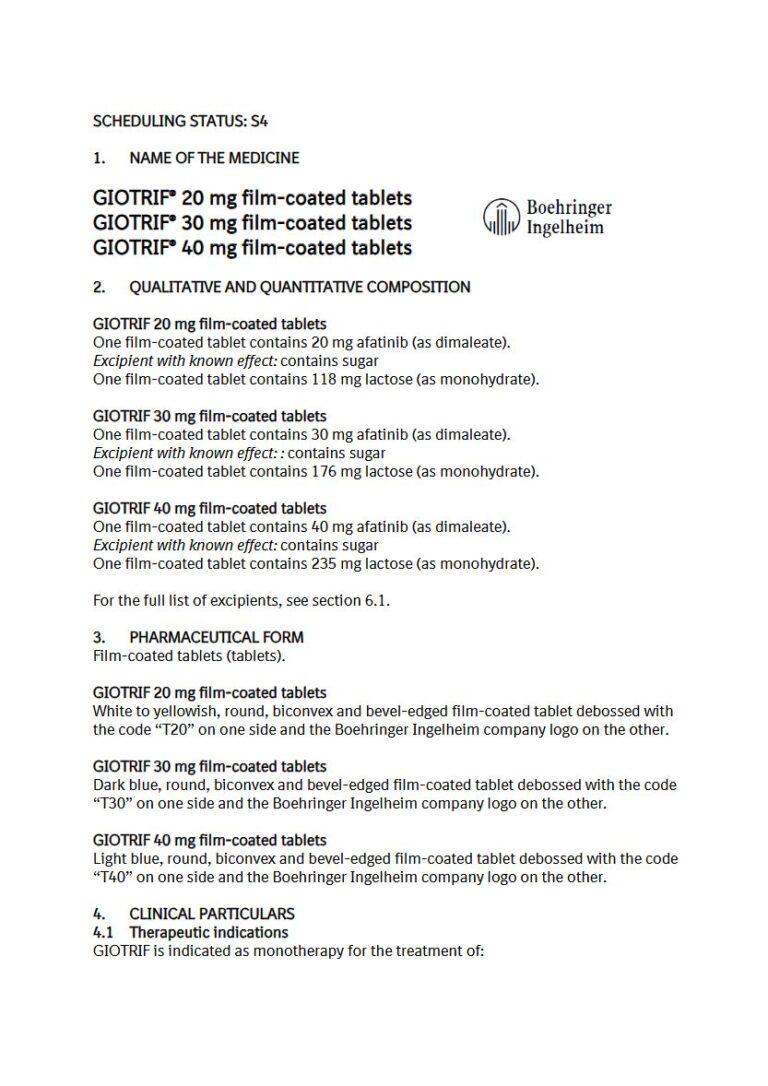
Giotrif 20 mg, 30 mg, 40 mg, 50 mg Film-coated tablets (tablets).
PDF Leaflet Revision Date: 8 August 2025
Clinical Summary
Quick overview from the medicine insert
Indication
Treatment of locally advanced or metastatic NSCLC with EGFR mutations.
Dosage (summary)
40 mg once daily, can escalate to 50 mg if tolerated.
Special Populations
- Renal impairment
- Hepatic impairment
Pregnancy & Breastfeeding
Contraindicated in pregnancy and breastfeeding; potential fetal harm.
Key Drug Interactions
- P-glycoprotein inhibitors
- Strong P-glycoprotein inducers
Contraindications
- Hypersensitivity to afatinib
- Severe hepatic impairment
- Severe ocular conditions
Common side effects
- Diarrhoea
- Rash
- Stomatitis
- Nausea
- Vomiting
Counselling Points
- Take without food; avoid pregnancy; monitor for diarrhoea and skin reactions.
Serious warnings
- Interstitial Lung Disease
- Severe skin reactions
- Gastrointestinal perforations
Important Disclaimer
The Giotrif 20 mg, 30 mg, 40 mg, 50 mg Film-coated tablets (tablets). professional information leaflet below is the property of Ingelheim Pharmaceuticals and is provided on Medinsert exactly as issued, with no.. alterations or editorial changes. We make every effort to keep content current by updating documents as soon as new versions become available. Medinsert serves as a trusted access point for healthcare professionals, but does not replace official sources or clinical judgement. For more details, please read our full disclaimer. read more>>
 Healthcare Professionals Only
This content is for registered healthcare professionals
Sign in or create a free account to read the full package insert.
Free for HPCSA-registered professionals. Powered by Medinsert.
Clinical Particulars
Section 4 of the official insert — extracted exactly as issued, no alterations
4.1 Therapeutic indications
GIOTRIF is indicated as monotherapy for the treatment of:
- Epidermal Growth Factor Receptor (EGFR) tyrosine kinase inhibitor (TKI) treatment- nau00efve adult patients with locally advanced or metastatic non-small cell lung cancer (NSCLC) of adenocarcinoma histology of the lungs (stage IIIB or IV) with Epidermal Growth Factor Receptor mutations(s) Del19 or L858R. Efficacy in EGFR-negative tumours has not been established.
- Adult patients with locally advanced or metastatic NSCLC of squamous histology progressing on or after platinum-based chemotherapy (see section 5.1).
4.2 Posology and method of administration
Treatment with GIOTRIF should be initiated and supervised by a doctor experienced in the use of anticancer therapies. EGFR mutation status should be established prior to initiation of GIOTRIF therapy (see section 4.4).
Posology
The recommended dose is 40 mg once daily. GIOTRIF should be taken without food. Food should not be consumed for at least 3 hours before and at least 1 hour after taking this GIOTRIF (see sections 4.5 and 5.2). GIOTRIF treatment should be continued until disease progression or until no longer tolerated by the patient (see Table 1 below).
Dose escalation
A dose escalation to a maximum of 50 mg/day may be considered in patients who tolerate a 40 mg/day starting dose (i.e. absence of diarrhoea, skin rash, stomatitis, and other adverse reactions with CTCAE Grade > 1) in the first cycle of treatment (21 days for EGFR mutation positive NSCLC and 28 days for squamous NSCLC). The dose should not be escalated in any patients with a prior dose reduction. The maximum daily dose is 50 mg.
Dose adjustment for adverse reactions
Symptomatic adverse reactions (e.g. severe/persistent diarrhoea or skin related adverse reactions) may be successfully managed by treatment interruption and dose reductions or treatment discontinuation of GIOTRIF as outlined in Table 1 (see sections 4.4 and 4.8).
Table 1: Dose adjustment information for adverse reactions
| CTCAE a | Adverse reactions | Recommended dosing |
|---|---|---|
| Grade 1 or Grade 2 | No interruption b | No dose adjustment |
| Grade 2 (prolonged c or intolerable) or Grade > 3 | Interrupt until Grade 0/1 b | Resume with dose reduction by 10 mg decrements d |
a NCI Common Terminology Criteria for Adverse Events
b In case of diarrhoea, anti-diarrhoeal medicines (e.g. loperamide) should be taken immediately and continued for persistent diarrhoea until loose bowel movements cease.
c > 48 hours of diarrhoea and/or > 7 days of rash
d If patient cannot tolerate 20 mg/day, permanent discontinuation of GIOTRIF should be considered
Interstitial Lung Disease (ILD) should be considered if a patient develops acute or worsening of respiratory symptoms in which case treatment should be interrupted pending evaluation. If ILD is diagnosed, GIOTRIF should be discontinued and appropriate treatment initiated as necessary (see sections 4.3 and 4.4).
Missed dose
If a dose is missed, it should be taken within the same day as soon as the patient remembers. However, if the next scheduled dose is due within 8 hours then the missed dose must be skipped.
Use of P-glycoprotein (P-gp) inhibitors
If P-gp inhibitors need to be taken, they should be administered using staggered dosing, i.e. the P-gp inhibitor dose should be taken as far apart in time as possible from the GIOTRIF dose. This means preferably 6 hours (for P-gp inhibitors dosed twice daily) or 12 hours (for P-gp inhibitors dosed once daily) apart from GIOTRIF (see section 4.5).
Special populations
Patients with renal impairment
Exposure to afatinib was found to be increased in patients with moderate or severe renal impairment (see section 5.2). Adjustments to the starting dose are not necessary in patients with mild (eGFR 60 - 89 mL/min/1,73 mu00b2), moderate (eGFR 30-59 mL/min/1,73 mu00b2) or severe (eGFR 15 - 29 mL/min/1,73 mu00b2) renal impairment. Monitor patients with severe renal impairment (eGFR 15 - 29 mL/min/1,73 mu00b2) and adjust GIOTRIF dose if not tolerated. GIOTRIF treatment in patients with eGFR < 15 mL/min/1,73 mu00b2 or on dialysis is not recommended.
Patients with hepatic impairment
Exposure to afatinib is not significantly changed in patients with mild (Child Pugh A) or moderate (Child Pugh B) hepatic impairment (see section 5.2). Adjustments to the starting dose are not necessary in patients with mild or moderate hepatic impairment. This medicine has not been studied in patients with severe (Child Pugh C) hepatic impairment. Treatment in this population is not recommended (see section 4.4).
Paediatric population
There is no relevant use of GIOTRIF in the paediatric population in the indication of NSCLC. Therefore, treatment of children or adolescents with this medicine is not recommended.
Method of administration
GIOTRIF is for oral use. The tablets should be swallowed whole with water. If swallowing of whole tablets is not possible, these can be dispersed in approximately 100 ml of non-carbonated drinking water. No other liquids should be used. The tablet should be dropped into the water without crushing it, and stirred occasionally for up to 15 min until it is broken up into very small particles. The dispersion should be consumed immediately. The glass should be rinsed with approximately 100 ml of water which should also be consumed. The dispersion can also be administered through a gastric tube.
4.3 Contraindications
Hypersensitivity to afatinib or to any of the excipients listed in section 6.1.
Severe (Child Pugh C) hepatic impairment (see section 4.4).
Pregnancy and lactation (see section 4.6).
Ocular/eye conditions/diseases/disorders with severe impairment of vision/eye sight.
4.4 Special warnings and precautions for use
Assessment of EGFR mutation status
When assessing the EGFR mutation status of a patient, it is important that a well-validated and robust methodology is chosen to avoid false negative or false positive determinations.
Diarrhoea
Diarrhoea, including severe diarrhoea, has been reported during treatment with GIOTRIF (see section 4.8). Diarrhoea may result in dehydration with or without renal impairment, and fatal outcomes have been reported. Diarrhoea usually occurred within the first 2 weeks of treatment. Grade 3 diarrhoea most frequently occurred within the first 6 weeks of treatment.
Proactive management of diarrhoea including adequate hydration combined with anti-diarrhoeal medicines especially within the first 6 weeks of the treatment is important and should start at first signs of diarrhoea. Antidiarrhoeal medicines (e.g. loperamide) should be used and if necessary their dose should be escalated to the highest recommended approved dose. Anti-diarrhoeal medicines should be readily available to the patients so that treatment can be initiated at first signs of diarrhoea and continued until loose bowel movements cease for 12 hours. Patients with severe diarrhoea may require interruption and dose reduction or discontinuation of therapy with GIOTRIF (see section 4.2). Patients who become dehydrated may require administration of intravenous electrolytes and fluids.
Skin related adverse events
Rash/acne has been reported in patients treated with GIOTRIF (see section 4.8). In general, rash manifests as a mild or moderate erythematous and acneiform rash, which may occur or worsen in areas exposed to sun. For patients who are exposed to sun, protective clothing, and use of sunscreen is advisable. Early intervention (such as emollients, antibiotics) of dermatologic reactions can facilitate continuous GIOTRIF treatment. Patients with severe skin reactions may also require temporary interruption of therapy, dose reduction (see section 4.2), additional therapeutic intervention, and referral to a specialist with expertise in managing these dermatologic effects.
Bullous, blistering and exfoliative skin conditions have been reported including cases suggestive of Stevens-Johnson syndrome and toxic epidermal necrolysis. Treatment with GIOTRIF should be interrupted or discontinued if the patient develops severe bullous, blistering or exfoliating conditions (see section 4.8).
Female gender, lower body weight, and underlying renal impairment
Higher exposure to afatinib has been observed in female patients, patients with lower body weight and those with underlying renal impairment (see section 5.2). This could result in a higher risk of developing adverse reactions in particular diarrhoea, rash/acne and stomatitis. Closer monitoring is recommended in patients with these risk factors.
Interstitial Lung Disease (ILD)
There have been reports of ILD or ILD-like adverse reactions (such as lung infiltration, pneumonitis, acute respiratory distress syndrome, allergic alveolitis), including fatalities, in patients receiving GIOTRIF for treatment of NSCLC. ILD-like adverse reactions were reported in 0,7 % of patients treated with GIOTRIF across all clinical trials (including 0,5 % of patients with CTCAE Grade u2265 3 ILD-like adverse reactions). Patients with a history of ILD have not been studied.
Careful assessment of all patients with an acute onset and/or unexplained worsening of pulmonary symptoms (dyspnoea, cough, fever) should be performed to exclude ILD. Treatment with GIOTRIF should be interrupted pending investigation of these symptoms. If ILD is diagnosed, GIOTRIF should be permanently discontinued and appropriate treatment initiated as necessary (see section 4.2).
Severe hepatic impairment
Hepatic failure, including fatalities, has been reported during treatment with GIOTRIF in less than 1 % of patients. In these patients, confounding factors have included pre-existing liver disease and/or comorbidities associated with progression of underlying malignancy. Periodic liver function testing is recommended in patients with pre-existing liver disease. Dose interruption may become necessary in patients who experience worsening of liver function (see section 4.2). In patients who develop severe hepatic impairment while taking GIOTRIF, treatment should be discontinued.
Gastrointestinal perforations
Gastrointestinal perforation, including fatalities, has been reported during treatment with GIOTRIF in 0,2 % of patients across all randomized controlled clinical trials. In the majority of cases, gastrointestinal perforation was associated with other known risk factors, including concomitant medications such as corticosteroids, NSAIDs, or anti-angiogenic agents, an underlying history of gastrointestinal ulceration, underlying diverticular disease, age, or bowel metastases at sites of perforation. In patients who develop gastrointestinal perforation while taking GIOTRIF, treatment should be permanently discontinued.
Keratitis
Symptoms such as acute or worsening eye inflammation, lacrimation, light sensitivity, blurred vision, eye pain and/or red eye should be referred promptly to an ophthalmology specialist. If a diagnosis of ulcerative keratitis is confirmed, treatment should be interrupted or discontinued. GIOTRIF should be used with caution in patients with a history of keratitis, ulcerative keratitis or severe dry eye. Contact lens use is also a risk factor for keratitis and ulceration (see section 4.8).
Left ventricular function
Left ventricular dysfunction has been associated with HER2 inhibition. GIOTRIF has not been studied in patients with abnormal left ventricular ejection fraction (LVEF) or those with significant cardiac history. In patients with cardiac risk factors and those with conditions that can affect LVEF, cardiac monitoring, including an assessment of LVEF at baseline and during treatment, should be considered. In patients who develop relevant cardiac signs/symptoms during treatment, cardiac monitoring including LVEF assessment should be done. In patients with an ejection fraction below the institutionu2019s lower limit of normal, cardiac consultation as well as treatment interruption or discontinuation should be considered.
P-glycoprotein (P-gp) interactions
Concomitant treatment with strong inducers of P-gp may decrease exposure to afatinib (see section 4.5).
Lactose
GIOTRIF contains lactose. Patients with rare hereditary conditions of galactose intolerance (e.g. galactosaemia), total lactase deficiency or glucose-galactose malabsorption should not take this medicine.
4.5 Interaction with other medicines and other forms of interaction
Interactions with medicine transport systems
Effects of P-gp and breast cancer resistance protein (BCRP) inhibitors on afatinib
In vitro studies have demonstrated that afatinib is a substrate of P-gp and BCRP. When the strong P-gp and BCRP inhibitor ritonavir (200 mg twice a day for 3 days) was administered 1 hour before a single dose of 20 mg GIOTRIF, exposure to afatinib increased by 48 % (area under the curve (AUC 0- u221e )) and 39 % (maximum plasma concentration (C max )). In contrast, when ritonavir was administered simultaneously or 6 hours after 40 mg GIOTRIF, the relative bioavailability of afatinib was 119 % (AUC 0- u221e ) and 104 % (C max ) and 111 % (AUC 0- u221e ) and 105 % (C max ), respectively. Therefore, it is recommended to administer strong P-gp inhibitors (including but not limited to ritonavir, ciclosporin A, ketoconazole, itraconazole, erythromycin, verapamil, quinidine, tacrolimus, nelfinavir, saquinavir, and amiodarone) using staggered dosing, preferably 6 hours or 12 hours apart from GIOTRIF (see section 4.2).
Effects of P-gp inducers on afatinib
Pre-treatment with rifampicin (600 mg once daily for 7 days), a potent inducer of P-gp, decreased the plasma exposure to afatinib by 34 % (AUC 0- u221e ) and 22 % (C max ) after administration of a single dose of 40 mg GIOTRIF. Strong P-gp inducers (including but not limited to rifampicin, carbamazepine, phenytoin, phenobarbitone or St. Johnu2019s wort (Hypericum perforatum)) may decrease exposure to afatinib (see section 4.4).
Effects of afatinib on P-gp substrates
Based on in vitro data, afatinib is a moderate inhibitor of P-gp. However, based on clinical data it is considered unlikely that GIOTRIF treatment will result in changes of the plasma concentrations of other P-gp substrates.
Interactions with BCRP
In vitro studies indicated that afatinib is a substrate and an inhibitor of the transporter BCRP. GIOTRIF may increase the bioavailability of orally administered BCRP substrates (including but not limited to rosuvastatin and sulfasalazine).
Food effect on afatinib
Co-administration of a high-fat meal with GIOTRIF resulted in a significant decrease of exposure to afatinib by about 50 % in regard to C max and 39 % in regard to AUC 0- u221e . GIOTRIF should be administered without food (see sections 4.2 and 5.2).
4.6 Fertility, pregnancy and lactation
Women of childbearing potential
Women of childbearing potential should be advised to avoid becoming pregnant while receiving treatment with GIOTRIF. Adequate contraceptive methods should be used during therapy and for at least 1 month after the last dose (see section 4.3).
Pregnancy
GIOTRIF should not be used by women who are pregnant or who are planning to become pregnant. Mechanistically, all EGFR targeting medicines, such as GIOTRIF, have the potential to cause foetal harm. If a patient becomes pregnant while or after receiving GIOTRIF, she should be informed of the potential harm to the foetus.
Breastfeeding
Women on treatment with GIOTRIF should not breastfeed their infants. Afatanib is excreted in milk of animals and it is likely that afatinib is excreted in human milk and harm to the baby cannot be excluded.
Fertility
Non-clinical toxicology data have shown effects on reproductive organs at higher doses. Therefore, an adverse effect of GIOTRIF on human fertility cannot be excluded.
4.7 Effects on ability to drive and use machines
Treatment with GIOTRIF may affect the ability to drive and use machines. Patients should not drive and use machines until they know how treatment with GIOTRIF affects them. Ocular adverse reactions (conjunctivitis, dry eye, keratitis) have been reported (see section 4.8) which may affect the ability to drive or use machines.
4.8 Undesirable effects
Summary of the safety profile
The types of adverse reactions (ADRs) were generally associated with the EGFR inhibitory mode of action of afatinib. The most frequent ADRs were diarrhoea and skin related adverse events (see section 4.4) as well as stomatitis and paronychia. Overall, dose reduction (see section 4.2) led to a lower frequency of common adverse reactions.
Tabulated list of adverse reactions reported during clinical trials
The safety evaluation of GIOTRIF is based on the data from more than 3 800 patients, including more than 1 638 NSCLC patients treated with a daily dose of GIOTRIF 50 mg monotherapy and more than 497 NSCLC patients who received GIOTRIF 40 mg monotherapy once daily.
Adverse Drug Reactions (ADRs) classified by System Organ Class (SOC) and Medical Dictionary for Regulatory Activities (MedDRA) preferred terms reported from any GIOTRIF dosing group per population of all NSCLC trials with daily starting doses of 40 mg and 50 mg GIOTRIF are shown in the Table 2.
Frequency classes: very common ( u2265 1/10); common ( u2265 1/100 to < 1/10); uncommon ( u2265 1/1 000 to < 1/100); rare ( u2265 1/10 000 to < 1/1 000); very rare (< 1/10 000).
Table 2: Side effects identified from all NSCLC trials with daily starting doses of 40 and 50 mg GIOTRIF monotherapy:
| System Organ Class (SOC) | MedDRA preferred term | Frequency |
|---|---|---|
| Infections and infestations | paronychia | very common |
| cystitis | common | |
| Metabolism and nutrition disorders | decreased appetite | very common |
| dehydration | common | |
| hypokalaemia | common | |
| Nervous system disorders | dysgeusia | common |
| Eye disorders | conjunctivitis | common |
| dry eye | common | |
| keratitis, photophobia, lacrimation, blurred vision, eye pain, aberrant eyelash growth | uncommon | |
| Respiratory, thoracic and mediastinal disorders | epistaxis | very common |
| rhinorrhoea | common | |
| interstitial lung disease | uncommon | |
| Gastrointestinal disorders | diarrhoea | very common |
| stomatitis | very common | |
| nausea | very common | |
| vomiting | very common | |
| cheilitis | common | |
| dyspepsia | common | |
| pancreatitis | uncommon | |
| gastrointestinal perforation | uncommon | |
| Hepatobiliary disorders | increased alanine aminotransferase | common |
| increased aspartate aminotransferase | common | |
| hepatotoxicity including hepatic failure | uncommon | |
| Skin and subcutaneous tissue disorders | rash | very common |
| acneiform dermatitis | very common | |
| pruritus | very common | |
| dry skin | very common | |
| nail disorders | common | |
| palmar-plantar erythrodysaesthesia syndrome | common | |
| Musculoskeletal and connective tissue disorders | muscle spasms | common |
| Renal and urinary disorders | renal impairment/renal failure | common |
| General disorders and administration site conditions | pyrexia | common |
| Investigations | decreased weight | common |
1 Includes paronychia, nail infection, nail bed infection
2 Frequency observed in squamous NSCLC is uncommon
3 Frequency observed in squamous NSCLC is common
4 Includes stomatitis, aphthous stomatitis, mucosal inflammation, mouth ulceration, oral mucosa erosion, mucosal erosion, mucosal ulceration
5 Frequency observed in squamous NSCLC is common
6 Frequency observed in squamous NSCLC is uncommon
7 Frequency observed in squamous NSCLC is uncommon
8 Includes group of rash preferred terms
9 Includes acne, acne pustular, dermatitis acneiform
10 Includes pruritus, pruritus generalised
11 Includes dry skin, skin chapped
12 Frequency observed in squamous NSCLC is common
13 Includes nail disorder, onycholysis, nail toxicity, onychoclasis, ingrowing nail, nail pitting, onychomadesis, nail discoloration, nail dystrophy, nail ridging, and onychogryphosis
14 Frequency observed in squamous NSCLC is uncommon
Post-marketing experience
The following adverse reactions have been identified during post-approval use of GIOTRIF. Because these reactions are reported voluntarily from a population of uncertain size, it is not always possible to reliably estimate their frequency or establish a causal relationship to drug exposure.
- Toxic epidermal necrolysis
- Stevens Johnson syndrome
Reporting of suspected adverse reactions
Reporting suspected adverse reactions after authorisation of the medicine is important. It allows continued monitoring of the benefit/risk balance of the medicine. Healthcare providers are requested to report any suspected adverse drug reactions to SAHPRA via the Med Safety APP (Medsafety X SAHPRA) and eReporting platform (who-umc.org) found on SAHPRA website. Suspected adverse reactions can also be reported directly to the holder of the certificate of registration using the email address [email protected].
4.9 Overdose
Symptoms
In overdose side effects can be precipitated and/or be of increased severity. Overdosage has been associated with gastrointestinal events (especially diarrhoea, nausea, vomiting), asthenia, dizziness, headache, abdominal pain and elevated amylase (< 1,5 times ULN). Dermatological events (rash/acne) have also been reported.
Treatment
There is no specific antidote for overdose with GIOTRIF. In cases of suspected overdose, GIOTRIF should be withheld and supportive and symptomatic care initiated.
