
Adco Magnesium Sulphate 50% Injection
Clinical Summary
Quick overview from the medicine insert
Indication
Used for the treatment of severe hypomagnesemia, eclampsia, and as a tocolytic agent in preterm labor.
Dosage (summary)
Administer 2 mL (1 g) intravenously or intramuscularly, may repeat as necessary based on clinical response.
Onset of Action / Duration
Onset of action is typically within 30 minutes; duration of effect varies based on indication.
Special Populations
- Elderly patients
- Patients with renal impairment
- Patients with cardiac disease
Pregnancy & Breastfeeding
Use in pregnancy only if clearly needed; magnesium sulfate crosses the placenta. Caution advised during lactation.
Key Drug Interactions
- May enhance the effects of neuromuscular blocking agents.
- Caution with concomitant use of other CNS depressants.
Contraindications
- Severe renal impairment
- Heart block
- Myasthenia gravis
Common side effects
- Flushing
- Sweating
- Hypotension
- Respiratory depression
- Nausea
Counselling Points
- Inform patients about the potential for drowsiness and dizziness.
- Advise to report any signs of allergic reactions, such as rash or difficulty breathing.
- Encourage patients to stay hydrated.
Serious warnings
- Monitor serum magnesium levels during therapy.
- Caution in patients with pre-existing heart conditions.
- Risk of hypermagnesemia, especially in patients with renal impairment.
Important Disclaimer
The Adco Magnesium Sulphate 50% Injection professional information leaflet below is the property of Adcock Ingram Critical Care and is provided on Medinsert exactly as issued, with no.. alterations or editorial changes. We make every effort to keep content current by updating documents as soon as new versions become available. Medinsert serves as a trusted access point for healthcare professionals, but does not replace official sources or clinical judgement. For more details, please read our full disclaimer. read more>>
 Healthcare Professionals Only
This content is for registered healthcare professionals
Sign in or create a free account to read the full package insert.
Free for HPCSA-registered professionals. Powered by Medinsert.
Clinical Particulars
Section 4 of the official insert — extracted exactly as issued, no alterations
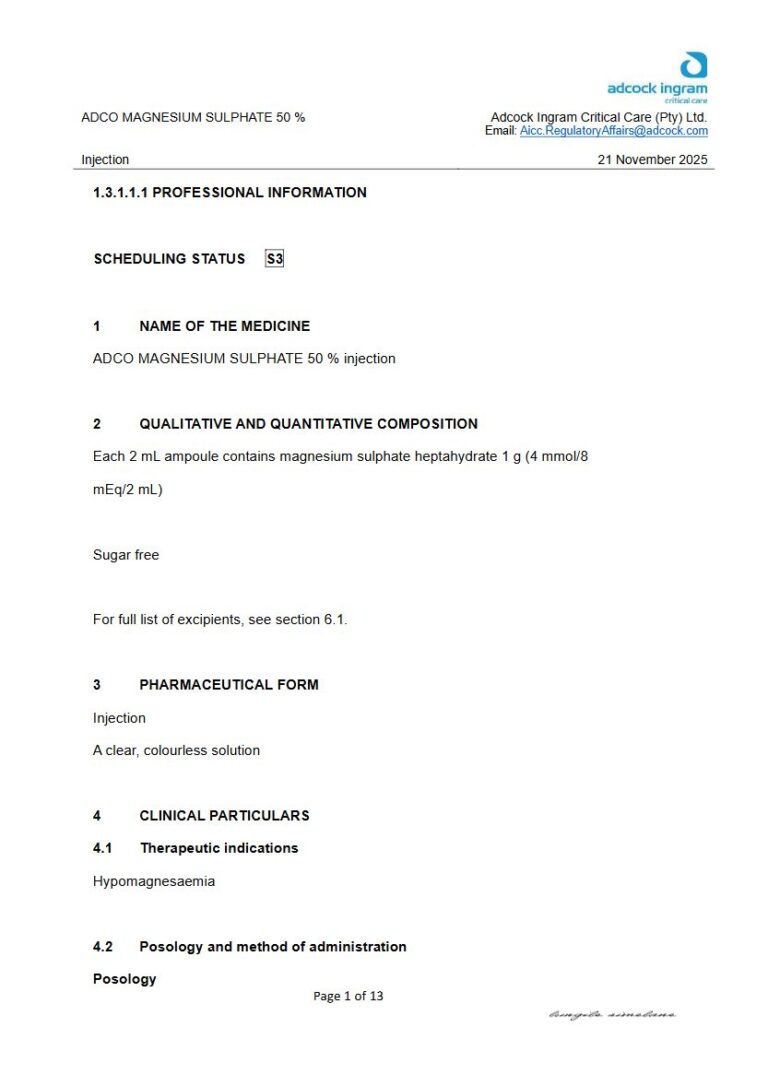
4.1 Therapeutic indications
Hypomagnesaemia
4.2 Posology and method of administration
Posology
In the treatment of magnesium deficiency tetany, 2 to 4 mL of the 50 % solution every 4 hours is recommended.
Method of administration
It can be administered either intramuscularly or intravenously. Intravenously 1 to 4 g may be given as a 10 or 20 % solution at a rate not exceeding 150 mg per minute. It may also be given by infusion. The blood pressure should be monitored during each injection.
4.3 Contraindications
- Hypersensitivity to the active substance or to any of the excipients listed in section 6.1
- Patients with impaired renal function (can produce toxic blood levels), severe renal impairment (glomerular filtration rate < 25 mL/h), renal failure, anuria
- Patients with intracranial pathology
- Children with intestinal parasitic diseases
- Hepatic encephalopathy, hepatic failure
- Patients with heart block (class I - III) or myocardial damage and myasthenia gravis
4.4 Special warnings and precautions for use
If administered intravenously, it must be given slowly.
ADCO MAGNESIUM SULPHATE 50 % should not be used in hepatic coma if there is a risk of renal failure. Serum calcium levels and serum magnesium levels should be routinely monitored in patients receiving ADCO MAGNESIUM SULPHATE 50 %. The absence of respiratory depression should be monitored: the breath rate should not be under 16 breaths/min. The excretion of urine should not be under 25 mL/h, as it could lead to hypermagnesaemia. The presence of the patellar reflex should be checked. ADCO MAGNESIUM SULPHATE 50 % should be administered with caution if flushing and sweating occurs. An antidote of injectable calcium gluconate solution should be immediately available. ADCO MAGNESIUM SULPHATE 50 % should not be administered into muscles which are emaciated or atrophied. For intramuscular administration, the dorsogluteal muscle and sciatic nerve should be avoided. If the total dose to be administered exceeds 5 mL, the injection volume should be divided between more than one deep muscular injection site. Use caution in older or thin patients who may only tolerate up to 2 mL in a single injection. Do not use an injection site that has evidence of infection or injury. If repeating an intramuscular dose, rotate injection sites to avoid injury or discomfort to the muscles.
4.5 Interaction with other medicines and other forms of interaction
Muscle relaxants
The action of non-depolarising muscle relaxants is potentiated and prolonged by ADCO MAGNESIUM SULPHATE 50 %. ADCO MAGNESIUM SULPHATE 50 % enhances non-depolarising muscle relaxant vecuronium action at adult muscle type nicotinic acetylcholine receptor.
Nifedipine
Profound hypotension may occur.
Calcium channel blockers or diuretics
There is a risk of cardiopulmonary events when intravenous ADCO MAGNESIUM SULPHATE 50 % is used concomitantly with calcium channel blockers or diuretics (such as thiazides and furosemide).
Calcium salts
Calcium salts may reduce the efficacy of ADCO MAGNESIUM SULPHATE 50 %. Several magnesium activated enzymes are inhibited by calcium.
Digitalis glycosides
ADCO MAGNESIUM SULPHATE 50 % should also be administered with caution to those patients receiving digitalis glycosides. Magnesium has been shown to block the transient inward current carried by calcium, which digitalis glucosides generate. However, ADCO MAGNESIUM SULPHATE 50 % given intravenously in adequate quantities (2 to 3 g in one minute followed by 2 g/h for 4 to 5 hours) is effective in controlling ventricular irritability caused by toxic levels of digitalis preparations.
Neuromuscular blocking medicines
Parenteral administration of ADCO MAGNESIUM SULPHATE 50 % may enhance the effects of neuromuscular blocking medicines. The neuromuscular blocking effects of parenteral ADCO MAGNESIUM SULPHATE 50 % and aminoglycoside antibacterial medicines may be additive.
CNS depressants
When barbiturates, narcotics or other hypnotics (or systemic anaesthetics) are to be given in conjunction with ADCO MAGNESIUM SULPHATE 50 %, their dosage should be adjusted with caution because of additive depressant effects of ADCO MAGNESIUM SULPHATE 50 % and the risk of respiratory depression.
Medicine transporters
ADCO MAGNESIUM SULPHATE 50 % co-administration with cisplatin may reduce platina accumulation by regulating the expression of the renal transporters, rOct2 and rMate1 and, thereby, attenuate cisplatin (CDDP)-induced nephrotoxicity (CIN).
4.6 Fertility, pregnancy and lactation
Pregnancy
ADCO MAGNESIUM SULPHATE 50 % easily crosses the placenta, and foetal serum levels will closely mirror maternal estimations. Sufficient amount of magnesium may cross the placenta in mothers treated with high doses, causing hypotonia and respiratory depression in newborns. When used in pregnant women, foetal heart rate should be monitored and use within 2 hours of delivery should be avoided. ADCO MAGNESIUM SULPHATE 50 % can cause skeletal adverse effects when administered continuously for more than 5 to 7 days to pregnant women. If prolonged or repeated exposure to ADCO MAGNESIUM SULPHATE 50 % occurs during pregnancy, monitoring of neonates for abnormal calcium or magnesium levels and skeletal adverse effects should be considered. Serum magnesium levels in preterm infants are higher than adult levels.
Breastfeeding
Safety during breastfeeding has not been established.
Fertility
No effects of ADCO MAGNESIUM SULPHATE 50 % on male and female fertility are anticipated.
4.7 Effects on ability to drive and use machines
ADCO MAGNESIUM SULPHATE 50 % is unlikely to affect the ability to drive or to operate machinery. However, on the basis of the potential adverse effects, some people may feel dizzy or drowsy after receiving ADCO MAGNESIUM SULPHATE 50 %. Patients should be advised not to drive or operate machinery, or execute tasks or activities requiring mental alertness, judgment and/or sound coordination and vision.
4.8 Undesirable effects
a. Summary of the safety profile
Excessive administration of ADCO MAGNESIUM SULPHATE 50 % may lead to the development of symptoms of hypermagnesaemia which may include the adverse reactions listed in the table below.
b. Tabulated list of adverse reactions
System organ class Frequency Adverse reaction
Immune system disorders Frequency unknown Hypersensitivity reactions
Metabolism and nutrition disorders Frequency unknown Electrolyte/fluid abnormalities (hypophosphataemia, hypertonic dehydration) There have been isolated reports of maternal and foetal hypocalcaemia with high doses
Nervous system disorders Frequency unknown Respiratory depression, nausea, vomiting, drowsiness, confusion, coma, slurred speech, double vision, loss of tendon reflexes due to neuromuscular blockade
Cardiac disorders Frequency unknown Cardiac arrhythmias, cardiac arrest, ECG abnormal (prolonged PR, QRS and QT intervals), bradycardia
Vascular disorders Frequency unknown Flushing of the skin and hypotension due to peripheral vasodilatation
Musculoskeletal and connective tissue disorders Frequency unknown Muscle weakness
General disorders and administration site conditions Frequency unknown Thirst
c. Description of selected adverse reactions
Injection/infusion-related effects: Too rapid administration: quickly developing vasodilatation, reduced blood pressure. Local: irritant to veins, extravasation may cause tissue damage. Intramuscular: pain, redness, swelling or warmth at the injection site, drainage at the injection site, prolonged bleeding, cellulitis, sterile abscess, signs of an allergic reaction, such as difficulty breathing or facial swelling, injury to nearby structures (blood vessels, bones, or nerves), inadvertent intravascular or intra-ostial injection, tissue necrosis, poor absorption due to high injection volume have been described for other magnesium sulfate solutions for injection.
Reporting of suspected adverse reactions
Reporting suspected adverse reactions after authorisation of the medicine is important. It allows continued monitoring of the benefit/risk balance of the medicine. Healthcare providers are asked to report any suspected adverse reactions to SAHPRA via the Med Safety APP (Medsafety X SAHPRA) and eReporting platform (who-umc-org) found on SAHPRA website. For reporting of side effects directly to the Holder of the Certificate of Registration, contact +27 11 635 0134 or email [email protected]
4.9 Overdose
Symptoms
Intravenous magnesium infusions can result in hypermagnesaemia even in the presence of normal kidney function. Clinical signs of overdose will be those of hypermagnesaemia. Patients with renal failure and metabolic derangements develop toxicity at lower doses. Disappearance of the deep tendon reflex is a useful clinical sign to detect the onset of magnesium intoxication. Magnesium intoxication is manifested by a sharp drop in blood pressure and respiratory paralysis. The potential symptoms of hypermagnesaemia are as follows:
Magnesium levels Manifestation of overdose symptoms mg/dL mEq/L mmol/L
< 1,2 < 1 < 0,5 Tetany, seizures, arrhythmias
1,2 u2013 1,8 1,0 u2013 1,5 0,5 u2013 0,75 Neuromuscular irritability, hypocalcaemia, hypokalaemia
1,8 u2013 2,5 1,5 u2013 2,1 0,75 u2013 1,05 Normal magnesium level
2,5 u2013 5,0 2,1 u2013 4,2 1,05 u2013 2,1 Typically asymptomatic
5,0 u2013 7,0 4,2 u2013 5,8 2,1 u2013 2,9 Lethargy, drowsiness, flushing, nausea and vomiting, diminished deep tendon reflex
7,0 u2013 12 5,8 u2013 10 2,9 u2013 5 Somnolence, loss of deep tendon reflexes, hypotension, ECG changes
> 12 > 10 > 5 Complete heart arrest, apnoea, paralysis, coma
Treatment: In symptomatic hypermagnesaemia, administration of calcium, usually at a dose of 100 to 200 mg intravenously over 5 to 10 min, antagonises the toxic effects of magnesium. In patients with severe renal dysfunction, peritoneal dialysis or haemodialysis will rapidly and effectively lower serum magnesium levels.
