
Aklief 50 μg Cream
Clinical Summary
Quick overview from the medicine insert
Indication
Topical treatment of acne vulgaris in patients aged 9 years and older.
Dosage (summary)
Apply a thin layer of Aklief cream to the affected areas once daily in the evening.
Onset of Action / Duration
Improvement may be seen within 12 weeks of treatment.
Special Populations
- Pediatric patients aged 9 years and older
- Geriatric patients
- Patients with sensitive skin
Pregnancy & Breastfeeding
Use during pregnancy only if the potential benefit justifies the potential risk to the fetus. It is not known if Trifarotene is excreted in human milk; caution should be exercised when administering to nursing mothers.
Key Drug Interactions
- Avoid use with other topical retinoids or products that may cause skin irritation.
- Caution with concomitant use of other topical medications.
Contraindications
- Hypersensitivity to Trifarotene or any of the excipients in the formulation.
- Pregnancy (unless benefits outweigh risks).
Common side effects
- Skin irritation
- Dryness
- Erythema
- Peeling
- Burning sensation
Counselling Points
- Instruct patients to apply the cream only to affected areas.
- Advise patients to avoid exposure to sunlight and use sunscreen.
- Inform patients about the potential for skin irritation and to report any severe reactions.
Serious warnings
- Not for ophthalmic, oral, or intravaginal use.
- Use caution in patients with a history of eczema or other skin conditions.
Important Disclaimer
The Aklief 50 μg Cream professional information leaflet below is the property of Galderma Laboratories South Africa and is provided on Medinsert exactly as issued, with no.. alterations or editorial changes. We make every effort to keep content current by updating documents as soon as new versions become available. Medinsert serves as a trusted access point for healthcare professionals, but does not replace official sources or clinical judgement. For more details, please read our full disclaimer. read more>>
 Healthcare Professionals Only
This content is for registered healthcare professionals
Sign in or create a free account to read the full package insert.
Free for HPCSA-registered professionals. Powered by Medinsert.
Clinical Particulars
Section 4 of the official insert — extracted exactly as issued, no alterations
4.1 Therapeutic indications
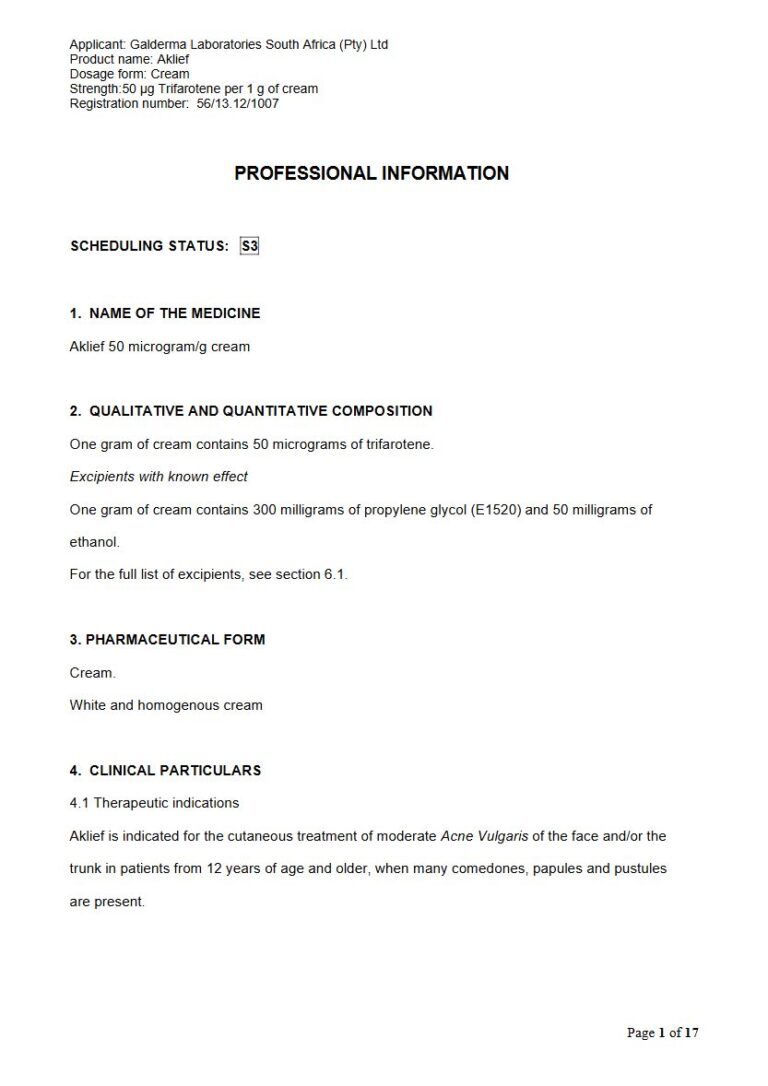
Aklief is indicated for the cutaneous treatment of moderate Acne Vulgaris of the face and/or the trunk in patients from 12 years of age and older, when many comedones, papules and pustules are present.
4.2 Posology and method of administration
Posology
Apply a thin layer of Aklief cream to the affected areas of the face and/or trunk once a day, in the evening, on clean and dry skin. It is recommended that the medical practitioner assesses the continued improvement of the patient after three months of treatment.
Special populations
- Renal and Hepatic impairment: Aklief has not been studied in patients with renal and hepatic impairment.
- Elderly patients: The safety and efficacy of Aklief in elderly patients aged 65 years and above have not been established.
- Paediatric population: The safety and efficacy of Aklief in children below 12 years old have not been established.
Method of administration
Cutaneous use only. Before using the pump for the first time, prime it by pressing down several times until a small amount of medicine is dispensed (up to 10 times maximum). The pump is now ready to use. Apply a thin layer of Aklief cream to the affected areas of the face (forehead, nose, chin and right and left cheeks) and all affected areas of the trunk once a day, in the evening, on clean and dry skin:
- One pump actuation should be enough to cover the face (i.e. forehead, cheeks, nose, and chin).
- Two pump actuations should be enough to cover the upper trunk (i.e. reachable upper back, shoulders and chest). One additional pump actuation may be used for middle and lower back if acne is present.
Patients should be instructed to avoid contact with the eyes, eyelids, lips and mucous membranes and to wash their hands after applying Aklief. The use of a moisturiser is recommended as needed from the initiation of treatment, while allowing sufficient time before and after the application of Aklief cream to allow the skin to dry.
4.3 Contraindications
- Hypersensitivity to the active substance or to any of the excipients listed in section 6.1.
- Pregnancy (see section 4.6)
- Women planning a pregnancy
4.4 Special warnings and precautions for use
Erythema, scaling, dryness, and stinging/burning may be experienced with use of Aklief cream (see section 4.8). To mitigate the risk of such reactions, patients should be instructed to use a moisturiser from the initiation of treatment, and, if appropriate, reduce the frequency of application of Aklief cream, or suspend use temporarily. Despite mitigation measures, if severe reactions persist the treatment may be discontinued.
Aklief should not be applied to cuts, abrasions, eczematous or sunburned skin. Use of u201cwaxingu201d as a depilatory method should be avoided on skin treated with Aklief. If a reaction suggesting sensitivity to any component of the formula occurs, the use of Aklief should be discontinued. Caution should be exercised if cosmetics or acne medicines with desquamative, irritant or drying effects are concomitantly used with Aklief, as they may produce additive irritant effects.
Aklief should not come into contact with the eyes, eyelids, lips, or mucous membranes. If the product enters the eye, wash immediately and abundantly with lukewarm water.
Excessive exposure to sunlight, including sunlamps or phototherapy should be avoided during the treatment. Use of a broad-spectrum, water-resistant sunscreen with a Sun Protection Factor (SPF) of 30 or higher and protective clothing over treated areas is recommended when exposure cannot be avoided.
Aklief cream contains propylene glycol (E1520) that may cause skin irritation. Aklief also contains 50 mg alcohol (ethanol) in each gram which is equivalent to 5% w/w. It may cause burning sensation on damaged skin.
4.5 Interaction with other medicines and other forms of interaction
Effect of Aklief cream on other medicines
A clinical drug-drug interaction study has shown that topical application of trifarotene did not affect the circulating concentrations of hormonal contraceptives (ethinyl estradiol and levonorgestrel) administered by oral route.
Effect of other medicines on Aklief cream
No clinical drug-drug interaction studies were performed to assess effects of other medicines on trifarotene systemic levels (see section 5.2). There is no data on the pharmacodynamic interaction potential of trifarotene.
Caution should be exercised if cosmetics or acne medicines with desquamative, irritant or drying effects are concomitantly used with Aklief as they may produce additive irritant effects (see section 4.4).
4.6 Fertility, pregnancy and lactation
Pregnancy
Aklief is contraindicated (see section 4.3) during pregnancy or in women planning a pregnancy. Studies in animals with trifarotene by the oral route have shown reproductive toxicity at high systemic exposure (see section 5.3). If Aklief is used during pregnancy, or if the patient becomes pregnant while taking Aklief, treatment should be discontinued.
Breastfeeding
It is unknown whether trifarotene or its metabolites are excreted in human milk. Available pharmacodynamic/toxicological data in animals have shown excretion of trifarotene/metabolites in milk (for details see 5.3). A risk to the suckling child cannot be excluded. Use of Aklief during breastfeeding is not recommended. To avoid the risk of ingestion by, and/or contact exposure of, an infant, nursing women should not apply Aklief cream to the chest or breast area.
Fertility
No human fertility studies were conducted with Aklief. No effects of trifarotene on fertility were found in rats in reproductive studies of oral administration. However, after oral administration to dogs, findings of Germ cell degeneration were observed, see section 5.3.
4.7 Effects on ability to drive and use machines
Aklief has no or negligible influence on the ability to drive and use machines.
4.8 Undesirable effects
Summary of the safety profile
Local cutaneous reactions such as erythema, scaling, dryness, and stinging/burning) were collected separately from other adverse events as a measure of local tolerance. These cutaneous reactions are very common and of mild, moderate and severe intensity for up to 39%, 29.7% and 6.2% of patients, respectively on the face. On the trunk, up to 32.9%, 18.9%, 5.2% of patients had mild, moderate and severe reactions respectively. The maximum severity typically occurred at Week 1 for the face, and at Week 2 to 4 for the trunk, and decreased with continued use of the medication (see section 4.4).
The most u201ccommonlyu201d reported adverse reactions as described below in Table 1 are application site irritation, application site pruritus and sunburn, occurring in 1.2% to 6.5% of patients treated with Aklief cream in clinical studies.
Tabulated summary of adverse reactions
Adverse reactions reported in the 12-week vehicle-controlled Phase 3 studies in 1220 patients treated with Aklief cream (and for which the rate for Aklief cream exceeds the rate for vehicle cream) are presented in Table 1.
4.9 Overdose
Aklief is for once-daily cutaneous use only. If the medicine is applied excessively, no more rapid or better results will be obtained and marked redness, scaling, or skin discomfort may occur. In this event, discontinue use and wait until the skin has recovered. In case of accidental ingestion, appropriate symptomatic measures should be taken. Chronic ingestion of Aklief may lead to the same side effects as those associated with excessive oral intake of vitamin A.
