
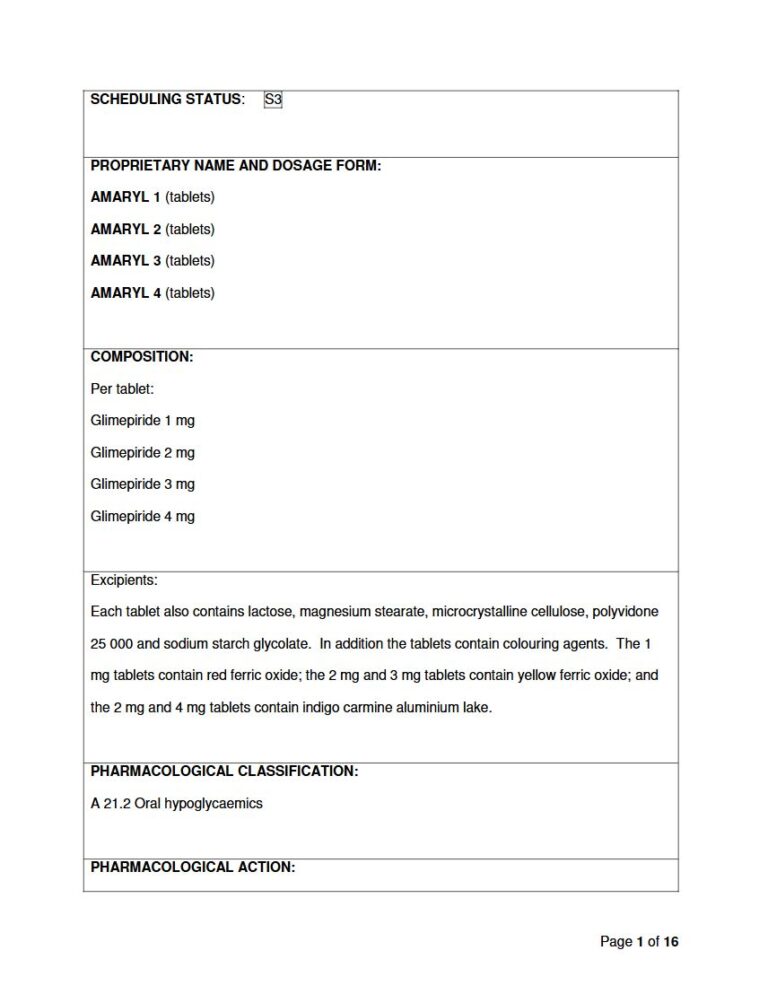
Amaryl Tablets
PDF Leaflet Revision Date: 27 July 2012
Clinical Summary
Quick overview from the medicine insert
Indication
Adjunct to diet and exercise for Type 2 diabetes mellitus.
Dosage (summary)
Initial: 1 mg once daily, max: 8 mg.
Onset of Action / Duration
Onset: 30 mins, Duration: 5-8 hours
Special Populations
- Renal impairment
- Hepatic impairment
- Elderly
Pregnancy & Breastfeeding
Not recommended during pregnancy or breastfeeding.
Key Drug Interactions
- CYP2C9 inducers/inhibitors
- Insulin
- MAO-inhibitors
- ACE-inhibitors
Contraindications
- Hypersensitivity to glimepiride
- Pregnancy
- Breastfeeding
- Impaired liver function
- Type 1 diabetes
Common side effects
- Hypoglycaemia
- Nausea
- Diarrhoea
- Rashes
Counselling Points
- Monitor blood glucose regularly
- Take before meals
- Carry glucose for hypoglycaemia
Serious warnings
- Increased risk of cardiovascular mortality
- Serious hypoglycaemia risk
Important Disclaimer
The Amaryl Tablets professional information leaflet below is the property of Sanofi-Aventis and is provided on Medinsert exactly as issued, with no.. alterations or editorial changes. We make every effort to keep content current by updating documents as soon as new versions become available. Medinsert serves as a trusted access point for healthcare professionals, but does not replace official sources or clinical judgement. For more details, please read our full disclaimer. read more>>
 Healthcare Professionals Only
This content is for registered healthcare professionals
Sign in or create a free account to read the full package insert.
Free for HPCSA-registered professionals. Powered by Medinsert.
Clinical Particulars
Section 4 of the official insert — extracted exactly as issued, no alterations
4.1 Therapeutic indications
AMARYL is indicated as an adjunct to diet and exercise to lower the blood glucose in patients with non-insulin-dependent (Type 2) diabetes mellitus (NIDDM) whose hyperglycaemia cannot be controlled by diet and exercise alone.
Combination therapy with Metformin: In patients not adequately controlled with the maximum daily dose of either glimepiride or metformin, combination therapy with both oral antidiabetic agents may be initiated.
4.2 Posology and method of administration
The dosage of AMARYL is determined by the desired blood glucose level. The dosage of glimepiride must be the lowest which is sufficient to achieve the desired metabolic control. During treatment with AMARYL, glucose levels in blood and urine must be measured regularly. In addition, it is recommended that regular determinations of the proportion of glycated haemoglobin be carried out.
If a patient forgets to take a dose, this must never be corrected by subsequently taking a larger dose. Measures for dealing with such situations (in particular forgetting a dose or skipping a meal) where a dose cannot be taken at the prescribed time must be discussed and agreed between physician and patient beforehand. If it is discovered that too high a dose or an extra dose of AMARYL has been taken, a physician must be notified immediately.
Initial dose and dose titration: The usual initial dose is 1 mg AMARYL once daily. If necessary, the daily dose can be increased. It is recommended that the increase be guided by regular blood glucose monitoring, and that the dose be increased gradually, i.e. at intervals of one to two weeks and according to the following dose steps: 1 mg - 2 mg - 3 mg - 4 mg - 6 mg. Daily doses of more than 6 mg are more effective only in a minority of patients. A maximum of 8 mg per day may not be exceeded.
In patients not adequately controlled with the maximum daily dose of glimepiride, combination therapy with metformin may be initiated. The additional metformin treatment is started with a low dose, which is then titrated up depending on the desired level of metabolic control up to a maximum daily dose. The combination therapy should be initiated under close medical supervision.
Distribution of doses: Timing and distribution of doses are to be decided by the medical practitioner, taking into consideration the patient's current life-style. Normally a single daily dose of AMARYL is sufficient to provide metabolic control over 24 hours. It is recommended that this dose be taken immediately before a substantial breakfast or, if none is taken, immediately before the first main meal. It is very important not to skip meals after the tablet(s) have been taken.
Secondary dosage adjustment: An improvement in the control of diabetes is associated with higher insulin sensitivity, therefore glimepiride requirements may fall as treatment proceeds. To avoid hypoglycaemia, dose reduction or cessation of AMARYL therapy must therefore be considered, in time. Correction of dosage must also be considered, whenever the patient's weight changes, the patient's lifestyle changes or other factors arise which cause an increased susceptibility to hypoglycaemia or hyperglycaemia (refer to SPECIAL PRECAUTIONS).
Duration of treatment: Treatment with AMARYL is normally long-term therapy. Change-over from other oral antidiabetics to AMARYL: There is no exact dosage relationship between AMARYL and other oral antidiabetics. When substituting AMARYL for other oral antidiabetics, it is recommended that the procedure be the same as for initial dosage, starting with daily doses of 1 mg. This applies even in cases where the patient is being switched from the maximum dose of another oral antidiabetic.
Administration: AMARYL tablets must be swallowed whole with approximately half a glass of water.
Special Populations: Renal Insufficiency: There is limited information available on the use of AMARYL in renal insufficiency. Patients with impaired renal function may be more sensitive to the glucose-lowering effect of AMARYL.
Children: Data are insufficient to recommend paediatric use of AMARYL.
4.3 Contraindications
AMARYL must not be used in patients hypersensitive to glimepiride, other sulphonylureas, sulfonamides, or any of the excipients (risk of hypersensitivity reactions), in pregnant or breastfeeding women as safety has not been shown, impaired liver function, and children. AMARYL is not suitable for the treatment of insulin-dependent (Type 1) diabetes mellitus.
4.4 Special warnings and precautions for use
SPECIAL WARNING ON INCREASED RISK OF CARDIOVASCULAR MORTALITY. The administration of oral hypoglycaemic medicines has been reported to be associated with increased cardiovascular mortality as compared to treatment with diet alone or diet plus insulin. This warning is based on the study conducted by the University Group Diabetes Program (UGDP), a long-term, prospective clinical trial designed to evaluate the effectiveness of glucose-lowering medicines in preventing or delaying vascular complications in patients with non-insulin-dependent diabetes. The study involved 823 patients who were randomly assigned to one of four treatment groups (Diabetes, 19 supp. 2: 747-830, 1970). UGDP reported that patients treated for 5 to 8 years with diet plus a fixed dose of tolbutamide (1,5 grams per day) had a rate of cardiovascular mortality approximately 2 to 2u00bd times that of patients treated with diet alone. A significant increase in total mortality was not observed, but the use of tolbutamide was discontinued based on the increase in cardiovascular mortality, thus limiting the opportunity for the study to show an increase in overall mortality. Despite controversy regarding the interpretation of these results, the findings of the UGDP study provide an adequate basis for this warning. The patient should be informed of the potential risks and advantages of AMARYL (glimepiride tablets) and of alternative modes of therapy. Although only one medicine in the sulphonylurea class (tolbutamide) was included in this study, it is prudent from a safety standpoint to consider that this warning may also apply to other oral hypoglycaemic medicines in this class, in view of their close similarities in mode of action and chemical structure. In exceptional stress situations (e.g. trauma, surgery, febrile infections) blood glucose regulation may deteriorate, and a temporary change to insulin may be necessary to maintain good metabolic control.
4.5 Interactions with other medicines
Patients who take or discontinue taking certain other medicines while undergoing treatment with AMARYL may experience changes in blood glucose control. Glimepiride is metabolised by cytochrome P450 2C9 (CYP2C9). This should be taken into account when AMARYL is co-administered with inducers (e.g. rifampicin) or inhibitors (e.g. fluconazole) of CYP 2C9.
The following interactions must be considered: Potentiation of the blood-glucose-lowering effect and thus, in some instances, hypoglycaemia may occur when one of the following medicines is taken, for example:
- insulin and other oral antidiabetics
- MAO-inhibitors
- ACE-inhibitors
- miconazole
- anabolic steroids and male sex hormones
- para-aminosalicyclic acid
- chloramphenicol
- pentoxifylline (high dose parenteral)
- coumarin derivatives
- phenylbutazone, azapropazone, oxyphenbutazone
- cyclophosphamide
- disopyramide
- quinolones
- salicylates
- sulphinpyrazone
- fibrates
- sulfonamide antibiotics
- fluoxetine
- tetracyclines
- guanethidine
- ifosfamide
- fluconazole
- clarithromycin
Weakening of the blood-glucose-lowering effect and, thus raised glucose levels may occur when one of the following medicines is taken, for example:
- acetazolamide
- laxatives (after protracted use)
- barbiturates
- nicotinic acid (in high doses)
- corticosteroids
- oestrogens and progestogens
- diazoxide
- phenothiazines
- diuretics
- phenytoin
- epinephrine (adrenaline) and other sympathomimetic agents
- rifampicin
- glucagon
- thyroid hormones
H2-receptor antagonists, beta-blockers, clonidine and reserpine may lead to either potentiation or weakening of the blood-glucose-lowering effect. Under the influence of sympatholytic medicines such as beta-blockers, clonidine, guanethidine and reserpine, the signs of adrenergic counter-regulation to hypoglycaemia may be reduced or absent. Both acute and chronic alcohol intake may potentiate or weaken the blood-glucose-lowering action of AMARYL in an unpredictable fashion. The anticoagulant effect of coumarin derivatives may be potentiated or weakened.
4.6 Fertility, pregnancy and lactation
AMARYL must not be used in pregnant or breastfeeding women, as safety has not been shown.
4.7 Effects on ability to drive and use machines
Alertness and reactions may be impaired due to hypo- or hyperglycaemia, especially when beginning or after altering treatment or when AMARYL is not taken regularly. This may affect the ability to drive or to operate machinery.
4.8 Undesirable effects
The following frequency rating has been used: Very common: ( u2265 1/10); Common: ( u2265 1/100, < 1/10); Uncommon: ( u2265 1/1000, < 1/100); Rare: ( u2265 1/10 000, < 1/1000); Very rare: (< 1/10 000), including isolated reports.
Metabolism disorders: Very common: Hypoglycaemia (sometimes life-threatening) may occur as a result of the blood-glucose-lowering action of AMARYL. This happens when there is an imbalance between AMARYL dosage, carbohydrate intake (diet), physical exercise and other factors influencing metabolism. Possible symptoms of hypoglycaemia include headache, ravenous hunger, nausea, vomiting, lassitude, sleepiness, sleep disorders, restlessness, aggressiveness, impaired concentration, impaired alertness and reactions, depression, confusion, speech disorders, aphasia, visual disorders, tremor, paresis, sensory disturbances, dizziness, helplessness, loss of self-control, delirium, cerebral convulsions, somnolence and loss of consciousness up to and including coma, shallow respiration and bradycardia. In addition, signs of adrenergic counter-regulation may be present such as sweating, clammy skin, anxiety, tachycardia, hypertension, palpitations, angina pectoris, and cardiac dysrhythmias. The clinical picture of a severe hypoglycaemic attack may resemble that of a stroke. The symptoms of hypoglycaemia may persist if hypoglycaemia is corrected.
Eye disorders: Common: Especially at the start of treatment, there may be temporary visual impairment due to the change in blood glucose levels. The cause is a temporary alteration in the turgidity and hence the refractive index of the lens, this being dependent on blood glucose level.
Gastrointestinal disorders: Common: nausea or diarrhoea Uncommon: vomiting, sensations of pressure or fullness in the epigastrium or abdominal pain
Hepato-biliary disorders: Frequency unknown: hepatitis, elevation of liver enzyme levels and/or cholestasis and jaundice, which may progress to life-threatening liver failure
Blood and lymphatic system disorders: Frequency unknown: potentially life-threatening changes in the blood picture may occur, such as thrombocytopenia and, in isolated cases, leucopenia, haemolytic anaemia, erythrocytopenia, granulocytopenia, agranulocytosis or pancytopenia may develop
Local and systemic allergic reactions: Common: rashes Uncommon: itching or urticaria These mild reactions may develop into serious and even life-threatening reactions with dyspnoea and a fall in blood pressure, sometimes progressing to shock. In the event of urticaria a physician must therefore be notified immediately.
General disorders: Frequency unknown: a decrease in serum sodium concentration has been seen and allergic vasculitis or hypersensitivity of the skin to light may occur. If any of these reactions occur a doctor should be consulted.
4.9 Overdose
Please refer to SPECIAL PRECAUTIONS and SIDE EFFECTS. Treatment is symptomatic and supportive. After acute glucose replacement has been completed it is usually necessary to give an intravenous glucose/dextrose infusion in lower concentration so as to ensure that the hypoglycaemia does not recur. The patientu2019s blood glucose level should be carefully monitored for at least 24 hours. In severe cases with a protracted course, the danger of ongoing or recurring hypoglycaemia, may persist for several days.
