
Lantus 3.64mg / 1ml Injection
PDF Leaflet Revision Date: 30 September 2016
Clinical Summary
Quick overview from the medicine insert
Indication
For treatment of diabetes mellitus in patients requiring insulin.
Dosage (summary)
Subcutaneous injection once daily, at the same time each day.
Onset of Action / Duration
Onset: Slow, Duration: 24 hours
Special Populations
- Elderly
- Renal impairment
- Hepatic impairment
Pregnancy & Breastfeeding
Not recommended during pregnancy or breastfeeding.
Key Drug Interactions
- Oral antidiabetic agents
- ACE inhibitors
- Corticosteroids
- Beta-blockers
Contraindications
- Hypersensitivity to LANTUS
- Children < 6 years
Common side effects
- Hypoglycaemia
- Injection site reactions
- Lipohypertrophy
Counselling Points
- Monitor blood glucose regularly.
- Rotate injection sites.
- Be aware of hypoglycaemia symptoms.
Serious warnings
- Risk of severe hypoglycaemia
- Not for diabetic ketoacidosis
Important Disclaimer
The Lantus 3.64mg / 1ml Injection professional information leaflet below is the property of Sanofi-Aventis and is provided on Medinsert exactly as issued, with no.. alterations or editorial changes. We make every effort to keep content current by updating documents as soon as new versions become available. Medinsert serves as a trusted access point for healthcare professionals, but does not replace official sources or clinical judgement. For more details, please read our full disclaimer. read more>>
 Healthcare Professionals Only
This content is for registered healthcare professionals
Sign in or create a free account to read the full package insert.
Free for HPCSA-registered professionals. Powered by Medinsert.
Clinical Particulars
Section 4 of the official insert — extracted exactly as issued, no alterations
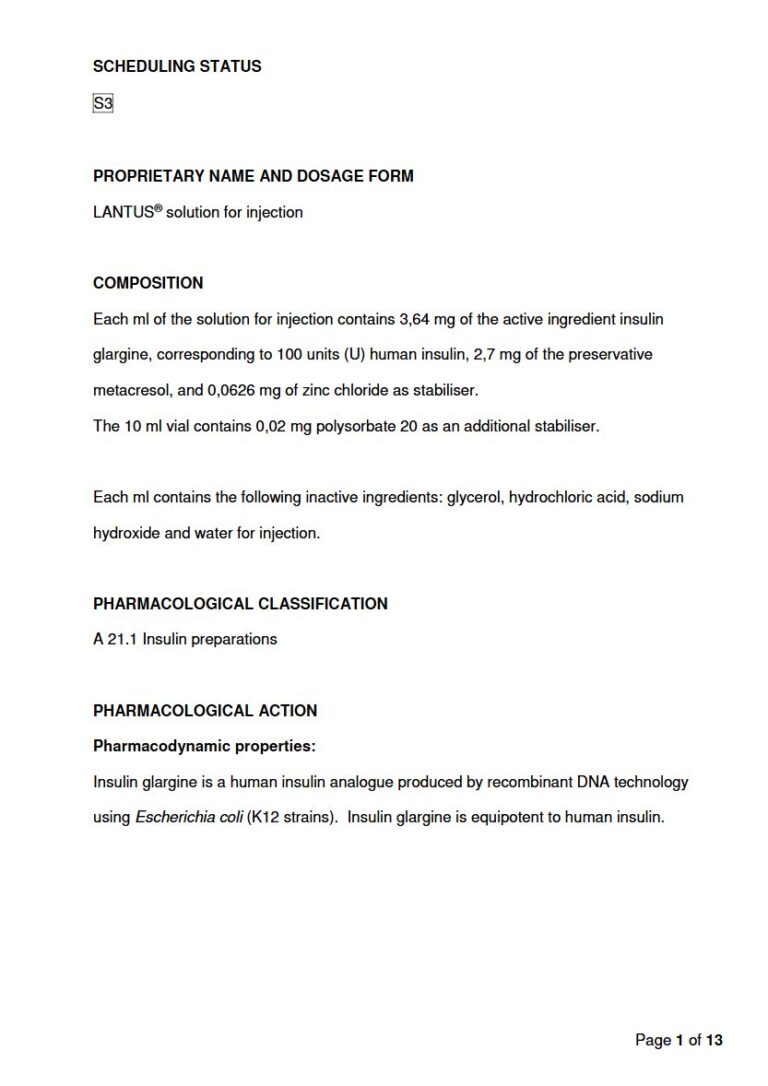
4.1 Therapeutic indications
For the treatment of adults, adolescents and children 6 years and older with diabetes mellitus, where treatment with insulin is required.
4.2 Posology and method of administration
General: LANTUS is given subcutaneously once daily. It may be administered at any time during the day, however, at the same time every day. The desired blood glucose levels as well as the doses and the timing of any antidiabetic medication, including LANTUS, must be determined and adjusted individually. Dose adjustment may also be required, for example, if the patient's weight or lifestyle changes, change in timing of the LANTUS dose or other circumstances arise that increase susceptibility to hypo- or hyperglycaemia (refer to u201cWARNINGS AND SPECIAL PRECAUTIONSu201d). Any change to the LANTUS dose should be made cautiously and only under medical supervision.
Administration: LANTUS is administered by subcutaneous injection. LANTUS is not intended for intravenous administration. The prolonged duration of action of LANTUS is dependent on its injection into subcutaneous tissue. Intravenous administration of the usual subcutaneous dose could result in severe hypoglycaemia. Injection sites must be rotated within a given injection area from one injection to the next. LANTUS must not be mixed with any other insulin or diluted. Mixing or diluting can change its time/action profile and mixing can cause precipitation. Since LANTUS is a solution, it does not require resuspension before use. Inspect the vial or cartridge before use. It must only be used if the solution is clear, colourless with no solid particles visible, and if it is of water-like consistency. Before insertion of the cartridge into the reusable pen, the cartridge must be stored at room temperature for 1 to 2 hours. Air bubbles must be removed from the cartridge before injection. The instructions for using the disposable pens and reusable pens must be followed carefully. Empty cartridges must not be refilled. If the reusable pen malfunctions, the solution may be drawn from the cartridge into a syringe (suitable for an insulin with 100 units per ml) and injected.
Geriatric use: In elderly patients with diabetes, it is recommended that the initial dosing, dose increments, and maintenance dosage be conservative to avoid hypoglycaemic reactions. Hypoglycaemia may be difficult to recognise in the elderly (refer to either u201cSIDE EFFECTSu201d or u201cWARNINGS AND SPECIAL PRECAUTIONSu201d).
Changeover to LANTUS: The initial dose of LANTUS should be determined individually, depending on the desired blood glucose levels. When changing from a treatment regimen with an intermediate or long-acting insulin to a regimen with LANTUS, a change of the dose of the basal insulin is often required and the concomitant antidiabetic treatment may need to be adjusted (dose and timing of additional regular insulins or fast-acting insulin analogues or the dose of oral antidiabetic agents). When patients are transferred from twice-daily NPH insulin to LANTUS administered once daily, to reduce the risk of hypoglycaemia, the initial dose should usually be reduced by approximately 20 % (daily units of LANTUS compared to total daily units of NPH insulin) and then the regimen should be adjusted individually. A programme of close metabolic monitoring is recommended during changeover and in the initial weeks thereafter. This is particularly true for patients on human insulin receiving high doses due to the production of human insulin antibodies. With improved metabolic control and resulting increase in insulin sensitivity, a further adjustment in dosage regimen may become necessary. Dose adjustment may also be required, for example, if the patientu2019s weight or lifestyle changes or other circumstances arise that increase susceptibility to hypo- or hyperglycaemia (refer to u201cWARNINGS AND SPECIAL PRECAUTIONSu201d).
4.3 Contraindications
LANUTS must not be used in:
- Patients hypersensitive to LANTUS or any of its excipients.
- Children < 6 years, as in this group efficacy and safety have not been demonstrated.
4.4 Special warnings and precautions for use
LANTUS should not be used for the treatment of diabetic ketoacidosis. Instead, intravenous regular insulin is recommended in such cases.
Hypoglycaemia: The time of occurrence of hypoglycaemia depends on the action profile of the insulins used and may, therefore, change when the treatment regimen is changed. Particular caution should be exercised, and intensified blood glucose monitoring is advisable in patients in whom sequelae of hypoglycaemic episodes might be of particular clinical relevance, such as in patients with significant stenoses of the coronary arteries or of the blood vessels supplying the brain (risk of cardiac or cerebral complications of hypoglycaemia) as well as in patients with proliferative retinopathy, particularly if not treated with photocoagulation (risk of transient amaurosis following hypoglycaemia). Patients should be made aware of circumstances where warning symptoms of hypoglycaemia are diminished. Such situations may result in severe hypoglycaemia (and possibly loss of consciousness) prior to the patientu2019s awareness of hypoglycaemia. The prolonged effect of subcutaneous LANTUS may delay recovery from hypoglycaemia. The warning symptoms of hypoglycaemia may be changed, be less pronounced or be absent in certain conditions. These include patients:
- in whom glycaemic control is markedly improved
- in whom hypoglycaemia develops gradually
- who are elderly
- in whom an autonomic neuropathy is present
- with a long history of diabetes
- suffering from a psychiatric illness
- receiving concurrent treatment with certain other medicinal products (refer to u201cINTERACTIONSu201d).
In patients with renal impairment, insulin requirements may be diminished due to reduced insulin metabolism. In the elderly, progressive deterioration of renal function may lead to a steady decrease in insulin requirements. In patients with severe hepatic impairment, insulin requirements may be diminished due to reduced capacity for gluconeogenesis and reduced insulin metabolism.
Pens to be used with LANTUS cartridges: The LANTUS cartridges should only be used with the following pen: Autopen 24. They should not be used with any other reusable pen as the dosing accuracy has only been established with the listed pen.
4.5 Interactions with other medicines
A number of substances affect glucose metabolism and may require dose adjustment of LANTUS. Substances that may increase the blood glucose lowering effect and increase susceptibility to hypoglycaemia include: oral antidiabetic agents; ACE inhibitors; disopyramide; fibrates; fluoxetine; MAO inhibitors; pentoxifylline; propoxyphene; salicylates and sulfonamide antibiotics. Substances that may reduce the blood glucose lowering effect include: corticosteroids; danazol; diazoxide; diuretics; glucagon; isoniazid; oestrogens and progestogens (e.g. in oral contraceptives); protease inhibitors and atypical antipsychotic medications (e.g. olanzapine and clozapine); phenothiazine derivatives; somatropin; sympathomimetic agents (e.g. epinephrine {adrenaline}, salbutamol, terbutaline) and thyroid hormones. Beta-blockers, clonidine, lithium salts or alcohol may either potentiate or weaken the blood glucose lowering effect of LANTUS. Pentamidine may cause hypoglycaemia, which may sometimes be followed by hyperglycaemia. In addition, under the influence of sympatholytic medicinal products such as beta-blockers, clonidine, guanethidine and reserpine, the signs of adrenergic counter-regulation may be reduced or absent.
4.6 Fertility, pregnancy and lactation
LANTUS should not be used in pregnancy and mothers on LANTUS should not breastfeed their babies.
4.7 Effects on ability to drive and use machines
The patientu2019s ability to concentrate and react may be impaired as a result of hypoglycaemia or hyperglycaemia or, for example, as a result of visual impairment. This may constitute a risk in situations where these abilities are of special importance (e.g. driving a car or operating machinery). Patients should be advised to take precautions to avoid hypoglycaemia whilst driving. This is particularly important in those who have reduced or absent awareness of the warning symptoms of hypoglycaemia or have frequent episodes of hypoglycaemia. The advisability of driving should be considered in these circumstances.
4.8 Undesirable effects
The following frequency rating has been used: Very common: (u2265 1/10); Common: (u2265 1/100, < 1/10); Uncommon: (u2265 1/1000, < 1/100); Rare: (u2265 1/10 000, < 1/1000); Very rare: (< 1/10 000), including rare isolated cases.
Immune system disorders Rare: Systemic allergic reactions Immediate-type allergic reactions to LANTUS are rare. Such reactions to LANTUS or the excipients may, for example, be associated with generalised skin reactions, angioedema, bronchospasm, hypotension and shock, and may be life-threatening.
Endocrine disorders: Very common: Hypoglycaemia Hypoglycaemia, in general is the most frequent adverse reaction of LANTUS therapy and may occur if the LANTUS dose is too high in relation to the insulin requirement. The following side effects have been reported and the frequencies are unknown: LANTUS administration may cause neutralising insulin antibodies to form. The presence of such insulin antibodies may necessitate adjustment of the LANTUS dose in order to correct a tendency to hyper- or hypoglycaemia.
General disorders and administration site conditions: Common: Injection site reactions and local hypersensitivity reactions In clinical studies, reactions at the injection site were observed in 3 to 4 % of patients. Such reactions include redness, pain, itching, hives, swelling or inflammation. Most minor reactions to insulin usually resolve in a few days to a few weeks.
Skin and subcutaneous tissue disorders: Common: Lipohypertrophy Lipohypertrophy was observed in 1 to 2 % of patients. Uncommon: Lipoatrophy Lipoatrophy was uncommon. Continuous rotation of the injection site within the given injection area may help to reduce or prevent these reactions (lipodystrophy).
Eye disorders: The following side effects have been reported and the frequencies are unknown. A marked change in glycaemic control may cause visual impairment, due to temporary alteration in the turgidity and refractive index of the lens. Intensification of LANTUS therapy with abrupt improvement in glycaemic control may be associated with temporary worsening of diabetic retinopathy.
Metabolism disorders: Rare: LANTUS may cause sodium retention and oedema, particularly if previously poor metabolic control is improved by intensified LANTUS therapy.
4.9 Overdose
Symptoms: LANTUS overdose may lead to severe and sometimes prolonged and life-threatening hypoglycaemia.
Management: Mild episodes of hypoglycaemia can usually be treated with oral carbohydrates. Adjustments in drug dosage, meal patterns, or physical activity may be needed. More severe episodes with coma, seizure, or neurologic impairment may be treated with intramuscular/subcutaneous glucagon or concentrated intravenous glucose. Sustained carbohydrate intake and observation may be necessary because hypoglycaemia may recur after apparent clinical recovery.
