
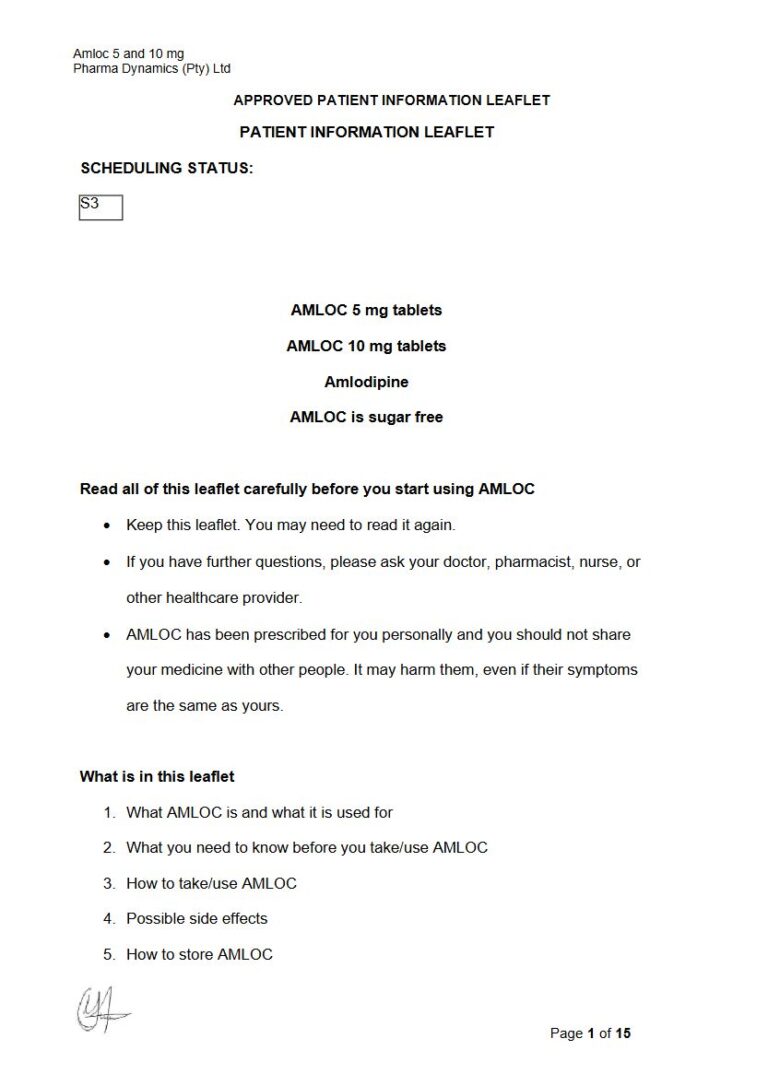
Amloc 5 or 10 mg Tablets
PDF Leaflet Revision Date: 17 January 2025
Clinical Summary
Quick overview from the medicine insert
Indication
Used to treat hypertension and angina pectoris.
Dosage (summary)
Starting dose: 5 mg once daily; max: 10 mg once daily.
Special Populations
- Elderly
- Renal impairment
- Hepatic impairment
Pregnancy & Breastfeeding
Contraindicated in pregnancy and breastfeeding.
Key Drug Interactions
- Grapefruit juice
- Ritonavir
- Ketoconazole
- Simvastatin
Contraindications
- Hypersensitivity to amlodipine
- Cardiogenic shock
- Recent heart attack
- Unstable angina
- Severe hypotension
- Aortic stenosis
Common side effects
- Headache
- Dizziness
- Nausea
- Swelling
- Fatigue
Counselling Points
- Take at the same time daily
- Avoid grapefruit juice
- Do not stop abruptly
- Report any severe side effects immediately
Serious warnings
- May cause severe allergic reactions
- Monitor for hypotension
- Risk of worsening chest pain if stopped suddenly
Important Disclaimer
The Amloc 5 or 10 mg Tablets professional information leaflet below is the property of Pharma Dynamics and is provided on Medinsert exactly as issued, with no.. alterations or editorial changes. We make every effort to keep content current by updating documents as soon as new versions become available. Medinsert serves as a trusted access point for healthcare professionals, but does not replace official sources or clinical judgement. For more details, please read our full disclaimer. read more>>
 Healthcare Professionals Only
This content is for registered healthcare professionals
Sign in or create a free account to read the full package insert.
Free for HPCSA-registered professionals. Powered by Medinsert.
Clinical Particulars
Section 4 of the official insert — extracted exactly as issued, no alterations
4.1 Therapeutic indications
AMLOC is used:
- to treat high blood pressure (hypertension)
- to treat angina pectoris, which is characterised by chest pain and discomfort
- to restore blood flow to the heart or another organ and prevent hospitalisation after the arteries have become clogged with cholesterol plaque.
- to reduce the risk of fatal and non-fatal heart disease or stroke.
4.2 Posology and method of administration
Adults: The usual starting dose is 5 mg of AMLOC once a day, taken at the same time every day, with or without food. The tablets should be swallowed whole, with a glass of water. If no improvement is seen after 10 - 14 days, your doctor may increase the dose to the maximum of 10 mg AMLOC per day (taken as a single dose).
Elderly: The usual adult dose is recommended.
Patients with kidney problems: The normal adult dose can be used. If you are undergoing dialysis speak to your doctor or pharmacist before taking AMLOC.
Patients with liver problems: A lower starting dose may need to be taken. Your doctor will decide on the dose depending on your condition.
Children: The usual starting dose for children aged 6 u2013 17 years is 2,5 mg increased to 5 mg once a day. Safety and efficacy of AMLOC in children less than 6 years of age has not been established.
Your doctor will tell you how long your treatment with AMLOC will last. Do not stop treatment early because your condition may return, and you may experience unwanted serious side effects.
If you have the impression that the effect of AMLOC is too strong or too weak, tell your doctor or pharmacist.
4.3 Contraindications
Do not use AMLOC:
- if you are hypersensitive (allergic) to amlodipine, other calcium antagonists, or to any of the ingredients of AMLOC (listed in section 6).
- if you have had shock which could include cardiogenic shock (this is the term used when blood pressure becomes so low that your heart stops working properly, and medical treatment is required).
- if you recently (within the past 28 days) suffered a heart attack.
- if you have unstable angina (chest pain which may occur when you are resting).
- if you are pregnant or breastfeeding your baby (see Pregnancy and breastfeeding).
- in combination with grapefruit juice.
- if you have severe low blood pressure (hypotension).
- if you have narrowing of the aortic heart valve (aortic stenosis).
4.4 Special warnings and precautions for use
Take special care with AMLOC:
- If you are diagnosed as having a hypertensive crisis.
- If you are taking other medicines such anti-fungal medicines (ketoconazole, itraconazole) or protease inhibitors used to treat HIV (ritonavir). Using these medicines together with AMLOC may decrease the blood pressure even further (see Other medicines and AMLOC).
- If you are more than 65 years of age.
- If you suffer from severe kidney problems.
- If you suffer from liver problems.
- If you suffer from heart failure.
- If you have porphyria (a group of disorders that result in a build-up of chemicals called porphyrins in your body).
- If you have low blood pressure or other heart conditions.
- If you experience chest pain when taking AMLOC.
- If you suffer from diabetes.
- If you are to have any laboratory tests as AMLOC may interfere with the results.
Do not stop taking AMLOC without consulting your doctor as your symptoms may worsen.
Children: Do not give AMLOC to children under the age of 6 years, because safety and efficacy of AMLOC in children less than 6 years of age has not been established.
4.5 Interactions with other medicines
Always tell your healthcare provider if you are taking any other medicine. (This includes all complementary or traditional medicines.)
Medicine that may influence AMLOC:
- Medicines used to treat viral, fungal, and bacterial infections (such as clarithromycin, erythromycin, ketoconazole, itraconazole, or rifampicin), as these may lead to either increased or decreased levels of AMLOC in the blood.
- Ritonavir used in the treatment of HIV infections, as this may lead to increased levels of AMLOC in the blood.
- Rifampicin and/or St Johnu2019s Wort (Hypericum perforatum), may give a lower plasma concentration of AMLOC in the blood.
- Dantrolene (a muscle relaxant) may affect potassium levels in the blood.
- Medicines that alter the heart rate (such as quinidine or procainamide).
- Aldesleukin used in the treatment of kidney cancer and skin melanoma, or medicines used to treat mental conditions (antipsychotics), as this may increase the levels of AMLOC in the blood.
- Certain medicines used to treat fits (carbamazepine, phenobarbital, phenytoin), as these may reduce the effect of AMLOC.
- Sodium valproate (used for epilepsy), as this may increase AMLOC blood levels.
- Discuss with your doctor if you are unsure.
- Cholesterol-lowering medicine (simvastatin) as your dose of simvastatin will need to be controlled.
- Tacrolimus, sirolimus, temsirolimus, and everolimus (medicine used to alter the way your immune system works).
- Ciclosporin (an immunosuppressant used to prevent organ rejection in people who have received a liver, kidney, or heart transplant).
- Lithium, as this may result in toxic blood concentrations if used in combination with AMLOC.
- Other medicines for hypertension (high blood pressure) or angina (chest pains) such as nitro-glycerine tablets under the tongue, long-acting nitrates, beta-blockers, or calcium channel blockers (such as verapamil, diltiazem), as this may increase the levels of AMLOC in the blood.
4.6 Fertility, pregnancy and lactation
If you are pregnant or breastfeeding, think you may be pregnant or are planning to have a baby, please consult your doctor, pharmacist, or other healthcare provider for advice before taking this medicine. Do not take AMLOC if you are pregnant, suspect that you are pregnant or breastfeeding your baby (see Do not take AMLOC).
4.7 Effects on ability to drive and use machines
AMLOC can cause dizziness, make you feel sick or tired, or give you a headache. Do not drive or operate heavy machines until you know how AMLOC will affect you. It is not always possible to predict to what extent AMLOC may interfere with the daily activities of a patient. Patients should ensure that they do not engage in the above activities until they are aware of the measure to which AMLOC affects them.
4.8 Undesirable effects
AMLOC can have side effects. Not all side effects reported for AMLOC are included in this leaflet. Should your general health worsen, or if you experience any untoward effects while using AMLOC, please consult your healthcare provider for advice.
If any of the following happens, stop using AMLOC and tell your doctor immediately or go to the casualty department at your nearest hospital:
- swelling of the hands, feet, ankles, face, lips, mouth, or throat, which may cause difficulty in swallowing or breathing
- rash or itching
- fainting
These are all very serious side effects. If you have them, you may have had a serious allergic reaction to AMLOC. You may need urgent medical attention or hospitalisation.
Tell your doctor immediately or go to the casualty department at your nearest hospital if you notice any of the following:
- slow heartbeat (bradycardia) or rapid heartbeat (tachycardia), palpitations, heart attack, abnormal heart beat, chest pain
- low blood pressure (hypotension) with symptoms such as fainting or light-headedness
- high blood sugar levels (hyperglycaemia)
- jaundice (yellow discolouration of the skin and eyes)
- hepatitis, a liver condition, with symptoms such as stomach pain, fever, nausea, vomiting or loss of appetite
- weakness, fatigue, weight loss, headache (symptoms of a condition called vasculitis)
- kidney problems (passing less urine than is normal for you)
- pancreatitis (inflammation of the pancreas with symptoms such as stomach pain, increased heart rate and fever)
- severe skin reactions including blistering of the skin, mouth, eyes, and genitals, as these may be due to a serious allergic reaction known as Stevens-Johnson Syndrome (SJS) or toxic epidermal necrolysis (TEN).
These are all serious side effects. You may need urgent medical attention.
Tell your doctor if you notice any of the following:
Frequent side effects:
- headache, dizziness, excess sleepiness
- flushing, swelling in any part of the body
- nausea, stomach pain
- ankle swelling, muscle cramps
- facial or arm oedema (fluid retention), fatigue, abnormal physical weakness, or lack of energy.
Less frequent side effects:
- abnormal blood test results (decreased numbers of white blood cells, decrease in blood platelets which may result in unusual bruising or easy bleeding)
- mood changes, anxiety, depression, sleeplessness, confusion
- increased muscle tension, reduced sense of touch or sensation (numbness), tingling sensation in hands, feet, or lips (feeling of pins and needles), involuntary trembling (tremors), increased sweating, change taste perception (including loss of taste)
- blurred vision, worsening eyesight, double vision
- ringing in the ears (tinnitus)
- cough, inflammation of the mucous membrane in the nose (rhinitis), shortness of breath
- vomiting, dry mouth, swelling of the gums, altered bowel habits, constipation, diarrhoea, indigestion
- skin conditions such as rash, excessive skin pigmentation, hives, itchy skin, hair loss, erythema multiforme (large, symmetrical red blotches that appear all over the skin in a circular pattern)
- joint pain, back pain, muscle pain, muscle cramps or weakness, abnormal physical weakness, or lack of energy
- disorder in passing urine, increased need to urinate at night, increased number of times of passing urine
- problems with sexual performance, breast enlargement in men
- general feeling of discomfort, illness, or unease, general pain
- weight gain or loss.
If you notice any side effects not mentioned in this leaflet, please inform your doctor or pharmacist.
4.9 Overdose
In the event of overdosage, consult your doctor or pharmacist. If neither is available, contact the nearest hospital or poison centre. Symptoms of overdose may include:
- severe dizziness and fainting, shock and in rare cases death has been reported
- difficulty breathing, extreme shortness of breath, feeling of suffocating or drowning, cough that produces frothy sputum that may have blood in it, rapid, irregular heartbeat, anxiety, restlessness, cold and clammy skin, wheezing.
