
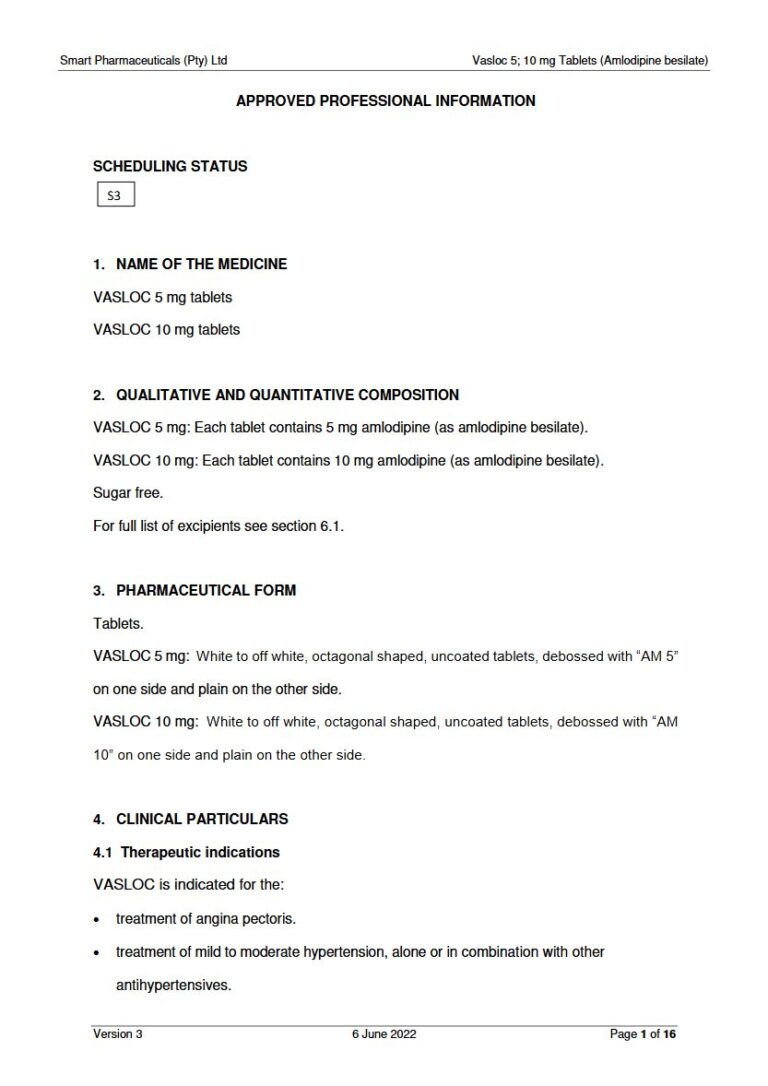
Vasloc 5mg; 10 mg Tablets.
PDF Leaflet Revision Date: 6 June 2022
Clinical Summary
Quick overview from the medicine insert
Indication
Treatment of angina pectoris and mild to moderate hypertension.
Dosage (summary)
Initial dose 5 mg once daily, may increase to 10 mg after 10-14 days.
Onset of Action / Duration
Onset: 6-12 hours, Duration: 24 hours
Special Populations
- Elderly
- Renal impairment
- Hepatic impairment
Pregnancy & Breastfeeding
Contraindicated in pregnancy and breastfeeding.
Key Drug Interactions
- CYP3A4 inhibitors
- CYP3A4 inducers
- Grapefruit juice
- Lithium
Contraindications
- Hypersensitivity to amlodipine
- Severe hypotension
- Shock
- Obstruction of left ventricle outflow
- Unstable angina
- Pregnancy and lactation
Common side effects
- Dizziness
- Headache
- Fatigue
- Nausea
- Ankle swelling
Counselling Points
- Monitor blood pressure regularly
- Avoid sudden discontinuation
- Caution when driving or operating machinery
Serious warnings
- Caution in heart failure
- Risk of hypotension
- Gradual withdrawal recommended
Important Disclaimer
The Vasloc 5mg; 10 mg Tablets. professional information leaflet below is the property of Smart Pharmaceuticals and is provided on Medinsert exactly as issued, with no.. alterations or editorial changes. We make every effort to keep content current by updating documents as soon as new versions become available. Medinsert serves as a trusted access point for healthcare professionals, but does not replace official sources or clinical judgement. For more details, please read our full disclaimer. read more>>
 Healthcare Professionals Only
This content is for registered healthcare professionals
Sign in or create a free account to read the full package insert.
Free for HPCSA-registered professionals. Powered by Medinsert.
Clinical Particulars
Section 4 of the official insert — extracted exactly as issued, no alterations
4.1 Therapeutic indications
VASLOC is indicated for the:
- treatment of angina pectoris.
- treatment of mild to moderate hypertension, alone or in combination with other antihypertensives.
4.2 Posology and method of administration
Hypertension and Angina Pectoris
Adults
An initial dose of 5 mg VASLOC once daily is recommended which may be increased to 10 mg once a day after 10 - 14 days of therapy if there is no improvement. No dose reduction is required when adding VASLOC to thiazide diuretics, beta blockers, or angiotensin-converting enzyme inhibitors.
Special populations
Elderly
Lower initial doses of VASLOC may be used in elderly patients (see section 4.4).
Patients with renal impairment
Changes in amlodipine plasma concentrations are not correlated with degree of renal impairment, therefore the normal dosage is recommended. VASLOC is not dialysable.
Patients with hepatic impairment
The pharmacokinetics of amlodipine have not been studied in hepatic impairment. VASLOC should be initiated at the lowest dose and titrated slowly in patients with severe hepatic impairment.
Paediatric population
The safety and efficacy of VASLOC in children have not been established (see section 4.3).
Method of administration
For oral administration. VASLOC can be administered with or without the intake of food.
4.3 Contraindications
- Hypersensitivity to amlodipine, dihydropyridines or to any of the ingredients of VASLOC.
- Severe hypotension.
- Shock, including cardiogenic shock.
- Obstruction of the outflow tract of the left ventricle (e.g. high grade aortic stenosis).
- Haemodynamically unstable heart failure after acute myocardial infarction (during the first 28 days).
- Unstable angina pectoris.
- Should not be used for acute reduction of blood pressure.
- Pregnancy and lactation (see section 4.6).
- Safety in children has not been established.
4.4 Special warnings and precautions for use
The safety and efficacy of amlodipine in hypertensive crisis has not been established.
Patients with cardiac failure
Patients with heart failure should be treated with caution. Studies in patients with severe heart failure (New York Heart Association (NYHA) class III and IV) have reported a higher incidence of pulmonary oedema in patients treated with amlodipine in comparison to placebo.
Calcium channel blockers, including VASLOC, should be used with caution in patients with congestive heart failure, as they may increase the risk of future cardiovascular events and mortality. The area under the curve (AUC) of VASLOC may increase in patients with heart failure. VASLOC may have a negative inotropic effect. In patients with severe aortic stenosis, VASLOC may increase the risk of developing heart failure.
Patients with hepatic impairment
The half-life of VASLOC is prolonged and AUC values are higher in patients with impaired liver function; dosage recommendations have not been established. VASLOC should therefore be initiated at the lower end of the dosing range and caution should be used, both on initial treatment and when increasing the dose. Slow dose titration and careful monitoring may be required in patients with severe hepatic impairment.
Elderly patients
The clearance of VASLOC is reduced (40 u2013 60 %) in the elderly, resulting in prolongation of the elimination half-life and higher AUC values. Therefore, elderly patients should start VASLOC therapy at a lower dose and increase of the dosage should take place with care (see sections 4.2 and 5.2).
Patients with renal impairment
VASLOC may be used in patients with renal impairment at normal doses. Changes in VASLOC plasma concentrations are not associated with the degree of renal impairment. VASLOC is not dialysable.
Lithium-induced neurotoxicity
The use of lithium with VASLOC may cause lithium induced neurotoxicity in the form of nausea, vomiting, diarrhoea, ataxia, tremors and/or tinnitus. Caution is recommended.
General
Sudden withdrawal of VASLOC might be associated with an exacerbation of angina. A gradual decrease of dosage with medical practitioner supervision is recommended. VASLOC should be stopped in patients who have ischaemic pain after use. VASLOC should be used with caution in patients with hypotension.
Diabetes mellitus
VASLOCu2019s effect on insulin and glucose responses may require antidiabetic therapy to be adjusted.
Interference with diagnostic tests
Calcium channel blockers such as VASLOC interfere with plasma aldosterone and renin ratios in laboratory tests.
Porphyria
Safety has not been established.
Paediatric population
Safety and efficacy have not been established.
4.5 Interactions with other medicines and other forms of interactions
Effects of other medicines on VASLOC
Cytochrome (CYP) 3A4 inhibitors
The concomitant use of VASLOC with strong or moderate CYP3A4 inhibitors, may result in a significant increase in VASLOC exposure, increasing the risk of hypotension. The clinical translation of these pharmacokinetic (PK) variations may be more pronounced in the elderly. Clinical monitoring and dose adjustment may be required in the co-administration of VASLOC with one of the following:
- protease inhibitors (such as ritonavir)
- azole antifungals
- macrolides, such as erythromycin or clarithromycin
- verapamil
- diltiazem.
CYP3A4 inducers
The concomitant use of VASLOC with CYP3A4 inducers may result in varying plasma concentration of VASLOC. The monitoring of blood pressure and dose regulation is advised during and after the concomitant use of VASLOC and a CYP3A4 inducing medicine, particularly a strong CYP3A4 inducing medicine (such as rifampicin and St. Johnu2019s wort). The effects of VASLOC may be reduced in combination with enzyme-inducing anti-epileptic medicines such as carbamazepine, phenobarbitone and phenytoin. In contrast, sodium valproate has been reported to increase plasma concentrations.
Grapefruit juice
Administration of VASLOC with grapefruit or grapefruit juice is not recommended as bioavailability may be increased in some patients resulting in increased blood pressure lowering effects.
Dantrolene infusion
The co-administration of calcium channel blocking medicine (such as VASLOC) and dantrolene infusion may result in hyperkalaemia and should be avoided in patients susceptible to malignant hyperthermia, as well as in the management of malignant hyperthermia.
Effects of VASLOC on other medicines
Antihypertensive medicine
The blood pressure lowering effects of VASLOC adds to the blood-pressure lowering effects of other medicines with antihypertensive properties. VASLOC will not protect against the consequences of abrupt beta-blocker withdrawal. Gradual beta-blocker dose reduction is recommended.
Tacrolimus
Although the pharmacokinetic mechanism remains uncertain, there is a risk of increased tacrolimus blood levels when tacrolimus is used concomitantly with VASLOC. In order to avoid toxicity of tacrolimus, monitoring of blood levels and appropriate dose adjustments of tacrolimus is advised when co-administered with VASLOC.
Mechanistic target of Rapamycin (mTOR) inhibitors
Caution is advised with the concomitant use of VASLOC and mTOR inhibitors (such as temsirolimus, everolimus and sirolimus). VASLOC is a weak CYP3A inhibitor and as mTOR inhibitors are CYP3A substrates, the concomitant use with VASLOC may increase the exposure of mTOR inhibitors.
Ciclosporin
In renal transplant patients, the co-administration of ciclosporin and amlodipine resulted on variable trough concentration increases of ciclosporin (0 % u2013 40 %). Monitoring and appropriate dose adjustments of ciclosporin is advised in renal transplant patients with concomitant administration of VASLOC. No drug interaction studies have been conducted with ciclosporin and VASLOC in healthy volunteers or any other populations.
Simvastatin
When compared to the administration of simvastatin alone, studies have shown that the concomitant use of 80 mg simvastatin and 10 mg VASLOC in multiple doses resulted in a 77 % increase of simvastatin exposure. It is advised to limit the dose of simvastatin to 20 mg per day when co-administered with VASLOC. Clinical interaction studies have shown that VASLOC does not affect the pharmacokinetics of atorvastatin, digoxin and warfarin.
CYP3A4 substrates
VASLOC is extensively metabolised in the liver by the cytochrome P450 isoenzyme CYP3A4 and interactions may occur with other medicines, such as quinidine or procainamide, sharing the same metabolic pathway, since both groups possess negative inotropic properties.
Antianginal medicines
Concurrent administration of sublingual nitro-glycerine, long acting nitrates, or other antianginal medicines with VASLOC may produce additive antihypertensive and antianginal effects. Sublingual nitro-glycerine may be used as needed to abort acute angina attacks during VASLOC therapy. Nitrate medicine may be used during VASLOC therapy for angina prophylaxis.
4.6 Fertility, pregnancy and lactation
Pregnancy
The safety of VASLOC during pregnancy has not been established. VASLOC is contraindicated during pregnancy (see section 4.3). Animal studies have reported reproductive toxicity at high doses of VASLOC.
Breastfeeding
VASLOC is excreted in human milk. The use of VASLOC during breastfeeding is contraindicated (see section 4.3). The proportion of the maternal dose received by the infant has been estimated with an interquartile range of 3 u2013 7 %, with a maximum of 15 %. The effect of amlodipine on infants is unknown.
Fertility
There have been reports of reversible biochemical changes in the head of spermatozoa in patients receiving calcium channel blocker medicines, such as VASLOC. Clinical data regarding the potential effect of VASLOC on human fertility are insufficient.
4.7 Effects on ability to drive and use machines
VASLOC can have a minor or moderate influence on the ability to drive and use machines. Side effects such as dizziness, headache, fatigue or nausea may impair the ability to react. Caution is advised before driving a vehicle or operating machinery until the effects of VASLOC are known, especially at the start of treatment.
4.8 Undesirable effects
The most frequently reported adverse reactions during treatment are somnolence, dizziness, headache, palpitations, flushing, abdominal pain, nausea, ankle swelling, oedema and fatigue.
The following adverse reactions have been reported during treatment with VASLOC:
System Organ Class Frequency
- Blood and lymphatic system disorders Less frequent Leukocytopenia, thrombocytopenia, purpura, haemorrhage, blood dyscrasias
- Immune system disorders Less frequent Hypersensitivity reactions (pruritus, rash, angioedema, erythema multiforme)
- Metabolism and nutrition disorders Less frequent Hyperglycaemia
- Pshychiatric disorders Less frequent Depression, mood changes (including anxiety), insomnia, confusion
- Nervous system disorders Frequent Somnolence, dizziness, headache (especially at the beginning of treatment)
- Less frequent Tremor, dysgeusia, syncope, hypoesthesia, paraesthesia, hypertonia, peripheral neuropathy
- Eye disorders Less frequent Visual disturbance (including diplopia)
- Ear and labyrinth disorders Less frequent Tinnitus
- Cardiac disorders Frequent Palpitations
- Less frequent Dysrhythmia (including bradycardia, ventricular tachycardia and atrial fibrillation), myocardial infarction
- Vascular disorders Frequent Flushing
- Less frequent Hypotension (including orthostatic hypotension), syncope, vasculitis
- Respiratory, thoracic and mediastinal disorders Frequent Dyspnoea
- Less frequent Cough, rhinitis
- Gastrointestinal disorders Frequent Abdominal pain, nausea, dyspepsia, altered bowel habits (including diarrhoea and constipation)
- Less frequent Vomiting, dry mouth, pancreatitis, gastritis, gingival hyperplasia
- Hepatobiliary disorders Less frequent Hepatitis, jaundice, hepatic enzymes increased (mostly consistent with cholestasis)
- Skin and subcutaneous tissue disorders Less frequent Alopecia, skin discolouration, hyperhidrosis, pruritus, rash, exanthema, urticaria, angioedema, erythema multiforme, exfoliative dermatitis, Stevens-Johnson syndrome, Quincke oedema, photosensitivity
- Frequency unknown Toxic epidermal necrolysis
- Musculoskeletal and connective tissue disorders Frequent Ankle swelling, muscle cramps
- Less frequent Arthralgia, myalgia, back pain
- Renal and urinary disorders Less frequent Micturition disorder, nocturia, increased urinary frequency
- Reproductive system and breast disorders Less frequent Impotence, gynaecomastia
- General disorders and administration site conditions Frequent Oedema, fatigue, asthenia, peripheral oedema
- Less frequent Chest pain, pain, malaise, taste perversion
- Investigations Less frequent Weight increase, weight decrease
Exceptional cases of extrapyramidal syndrome have been reported.
Reporting of suspected adverse reactions
Reporting of suspected adverse reactions after authorisation of VASLOC is important. It allows continued monitoring of the benefit/risk balance of the medicine. Health care providers are asked to report any suspected adverse reactions to SAHPRA via the u201c6.04 Adverse Drug Reactions Reporting Formu201d, found online under SAHPRAu2019s publications: https://www.sahpra.org.za/Publications/Index/8
4.9 Overdose
Symptoms of overdose
In overdose side effects may be exaggerated and exarcebated. Available data suggest that large overdosage could result in excessive peripheral vasodilatation, and possible reflex tachycardia. Marked and probably prolonged systemic hypotension up to and including shock with fatal outcome have been reported.
Management of overdose
Clinically significant hypotension due to VASLOC overdosage requires active cardiovascular support, including frequent monitoring of cardiac and respiratory function, elevation of extremities and attention to circulating fluid volume and urine output. A vasoconstrictor may be helpful in restoring vascular tone and blood pressure, provided that there is no contraindication to its use. Intravenous calcium gluconate may be beneficial in reversing the effects of calcium channel blockade. In healthy volunteers the use of charcoal up to 2 hours after administration of VASLOC 10 mg has been shown to reduce the absorption rate of amlodipine. Since VASLOC is highly protein-bound, dialysis is not likely to be of benefit.
