
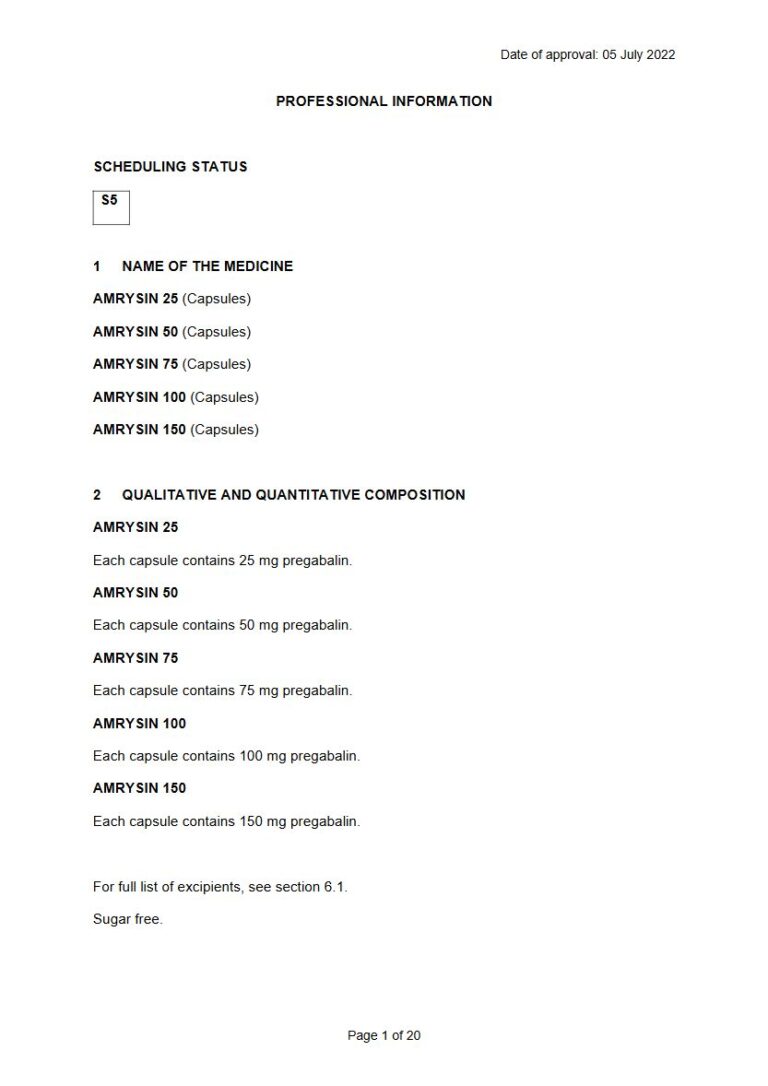
Amrysin Capsules
Clinical Summary
Quick overview from the medicine insert
Indication
Management of neuropathic pain, generalized anxiety disorder, and as an adjunctive therapy for partial seizures.
Dosage (summary)
Initial dose of 150 mg/day, which may be increased to a maximum of 600 mg/day based on clinical response.
Onset of Action / Duration
Analgesic effects may be observed within 1 week; maximum effect may take several weeks.
Special Populations
- Elderly patients
- Patients with renal impairment
- Patients with hepatic impairment
Pregnancy & Breastfeeding
Pregabalin should be used during pregnancy only if the potential benefit justifies the potential risk to the fetus. It is excreted in breast milk; caution is advised when administered to nursing mothers.
Key Drug Interactions
- CNS depressants (e.g., opioids, benzodiazepines) may enhance sedative effects.
- Antidiabetic medications may require monitoring as Pregabalin can cause weight gain.
Contraindications
- Hypersensitivity to Pregabalin or any of its components
- Severe renal impairment (CrCl < 30 mL/min) without dose adjustment
Common side effects
- Dizziness
- Somnolence
- Dry mouth
- Edema
- Weight gain
- Blurred vision
Counselling Points
- Advise patients to avoid abrupt discontinuation to prevent withdrawal symptoms.
- Inform patients about the potential for dizziness and sedation; caution when driving or operating machinery.
- Encourage patients to report any signs of mood changes or suicidal thoughts.
Serious warnings
- Risk of misuse, abuse, and dependence.
- May cause angioedema; seek immediate medical attention for swelling of the face, lips, or throat.
- Monitor for signs of serious skin reactions.
Important Disclaimer
The Amrysin Capsules professional information leaflet below is the property of Strides Pharma Sa and is provided on Medinsert exactly as issued, with no.. alterations or editorial changes. We make every effort to keep content current by updating documents as soon as new versions become available. Medinsert serves as a trusted access point for healthcare professionals, but does not replace official sources or clinical judgement. For more details, please read our full disclaimer. read more>>
 Healthcare Professionals Only
This content is for registered healthcare professionals
Sign in or create a free account to read the full package insert.
Free for HPCSA-registered professionals. Powered by Medinsert.
Clinical Particulars
Section 4 of the official insert — extracted exactly as issued, no alterations
4.1 Therapeutic indications
AMRYSIN is indicated for the treatment of neuropathic pain due to Herpes Zoster infection and diabetes in adult patients.
4.2 Posology and method of administration
Posology
The recommended starting dose is 75 mg twice daily (150 mg/day). Based on individual patient response and tolerability, the dose may be increased to 150 mg twice daily after an interval of 3 to 7 days.
Discontinuation of Pregabalin
In accordance with current clinical practice, if AMRYSIN must be discontinued, it is recommended this should be done gradually over a minimum of 1 week.
Special populations
Patients with renal impairment: AMRYSIN is eliminated unchanged from the systemic circulation primarily by renal excretion. As AMRYSIN clearance is directly proportional to creatinine clearance (see section 5.2), dosage reduction in patients with compromised renal function must be individualised according to creatinine clearance (CLCr), as indicated in Table 1 determined using the following formula:
CLCr (ml/min) = (140 - age) x Weight (kg) / (0.82 x Serum creatinine (u03bcmol/l))
*For females multiply the CLCr by 0.85
AMRYSIN is removed effectively from plasma by haemodialysis (50 % of pregabalin in 4 hours). For patients receiving haemodialysis, the AMRYSIN daily dose should be adjusted based on renal function. In addition to the daily dose, a supplementary dose should be given immediately following every 4 hour haemodialysis treatment (see Table 1).
Table 1. AMRYSIN dose adjustment based on renal function
| Creatinine Clearance (CLCr) (ml/min) | Total AMRYSIN Daily Dose (mg/day)* | Starting dose (mg/day) | Maximum dose (mg/day) |
|---|---|---|---|
| u2265 60 | 150 | 300 | Two divided doses |
| 30 u2013 60 | 75 | 150 | Once daily or in two divided doses |
| 15 - 30 | 25 - 50 | 75 | Once daily or in two divided doses |
| < 15 | 25 | 25 - 50 | Once daily |
Supplementary dosage following haemodialysis (mg)u2020
25
50
Single dose
*Total daily dose (mg/day) should be divided as indicated by dose regimen to provide mg/dose
u2020Supplementary dose is a single additional dose
Use in patients with hepatic impairment: No dosage adjustment is required for patients with hepatic impairment (see section 5.2).
Use in the elderly (over 65 years of age): No dosage adjustment is necessary for elderly patients unless their renal function is compromised, see Table 1.
Paediatric population
The safety and effectiveness of AMRYSIN in patients below the age of 18 years has not been established.
Method of administration
AMRYSIN is given orally with or without food.
4.3 Contraindications
AMRYSIN is contraindicated in patients with hypersensitivity to pregabalin or to any of the excipients (see section 6.1).
4.4 Special warnings and precautions for use
Hypersensitivity reactions
There have been reports in the post-marketing reports of hypersensitivity reactions in patients shortly after initiation of treatment with pregabalin as in AMRYSIN, including cases of angioedema and urticaria. AMRYSIN should be discontinued immediately if symptoms of angioedema, such as facial, perioral or upper airway swelling occur.
Dizziness, somnolence, loss of consciousness, confusion and mental impairment
AMRYSIN treatment has been associated with dizziness and somnolence, which could increase the occurrence of accidental injury (fall) in the elderly population. There have been post-marketing reports of loss of consciousness, confusion, and mental impairment. Therefore, patients should be advised to exercise caution until they are familiar with the potential effects of the medication.
Withdrawal symptoms
After discontinuation of short-term and long-term treatment with AMRYSIN, withdrawal symptoms have been observed in some patients. The following events have been reported: insomnia, headache, nausea and diarrhoea.
Renal failure
Cases of renal failure have been reported and in some cases discontinuation or the dose reduction of pregabalin did show reversibility of this adverse reaction.
Congestive heart failure
There have been post-marketing reports of congestive heart failure or deterioration of heart failure in some patients receiving AMRYSIN. AMRYSIN should be used with caution in patients with congestive heart failure.
Diabetic patients
Diabetic patients who gain weight on AMRYSIN treatment may need to adjust hypoglycaemic medicinal products.
Suicidal ideation and behaviour
Patients treated with anti-epileptic medicines have reported suicidal ideation and behaviour. Studies of anti-epileptic medicines has shown a slight increased risk of suicidal ideation and behaviour.
Reduced lower gastrointestinal tract function
Reduced lower gastrointestinal tract function (e.g. intestinal obstruction, paralytic ileus, constipation) has been reported when pregabalin, as contained in AMRYSIN was given with medications such as opioid analgesics. If pregabalin and opioids are to be used in combination, measures to prevent constipation may be considered (especially in female patients and the elderly).
Misuse, abuse potential or dependence
Patients on AMRYSIN should be monitored for symptoms of misuse, abuse or dependence as cases of the dose escalation, drug-seeking behaviour and development of tolerance have been reported. Caution should be used in patients with a history of substance abuse.
Encephalopathy
Cases of encephalopathy have been reported, mostly in patients with underlying conditions that may cause encephalopathy.
4.5 Interaction with other medicines and other forms of interaction
Since AMRYSIN is predominantly excreted unchanged in the urine, undergoes negligible metabolism in humans (< 2 % of a dose recovered in urine as metabolites), does not inhibit medicine metabolism in vitro, and is not bound to plasma proteins, AMRYSIN is unlikely to produce, or be subject to, pharmacokinetic interactions.
No clinically relevant pharmacokinetic interactions were observed in studies, between AMRYSIN and phenytoin, carbamazepine, valproic acid, lamotrigine, gabapentin, lorazepam, oxycodone or ethanol. Population pharmacokinetic analysis indicated that oral anti-diabetics, diuretics insulin, phenytoin, carbamazepine, valproic acid, lamotrigine, phenobarbitone, tiagabine and topiramate, had no clinically significant effect on pregabalin clearance.
Central nervous system influencing medical products
AMRYSIN appears to be additive in the impairment of cognitive and gross motor function caused by oxycodone. AMRYSIN may potentiate the effects of ethanol and lorazepam. In post-marketing experience, there are reports of respiratory failure and coma in patients taking AMRYSIN and other central nervous system (CNS) depressant medications.
Oral contraceptives norethisterone and/or ethinyl oestradiol
Co-administration of AMRYSIN with the oral contraceptives norethisterone and/or ethinyl oestradiol does not influence the steady-state pharmacokinetics of either substance.
4.6 Fertility, pregnancy and lactation
Women of childbearing potential/Contraception in males and females
As the potential risk of AMRYSIN to humans is unknown, effective contraception must be used in women of child-bearing potential.
Pregnancy
There isnu2019t adequate data on the use of AMRYSIN in pregnant women. Studies in animals have shown reproductive toxicity. The potential risk to humans is unknown. Therefore, AMRYSIN should not be used during pregnancy.
Breast feeding
Pregabalin is excreted in the breast milk of humans, however, it was found to be present in the milk of rats. Therefore, breastfeeding is not recommended.
Fertility
There is no clinical data on the effects of pregabalin on female fertility.
4.7 Effects on ability to drive and use machines
AMRYSIN frequently causes dizziness, somnolence, blurred vision and other CNS signs and symptoms. Patients are advised not to drive, operate complex machinery or engage in other potentially hazardous activities until it is known whether AMRYSIN affects their ability to perform activities (see section 4.4).
4.8 Undesirable effects
a. Tabulated summary of adverse reactions
MedDRA system organ class Frequency Adverse reactions
Blood and lymphatic system disorders Less frequent Neutropenia
Metabolism and nutrition disorders Frequent Increased appetite Less frequent Hypoglycaemia, anorexia
Psychiatric disorders Frequent Euphoric mood, confusion, decreased libido, irritability Less frequent Depersonalisation, anorgasmia, restlessness, depression, agitation, mood swings, insomnia, depressed mood, word finding difficulty, hallucination, abnormal dreams, increased libido, panic attack, apathy, disinhibition, elevated mood
Nervous system disorders Frequent Dizziness, somnolence, ataxia, disturbance in attention, abnormal coordination, memory impairment, tremor, dysarthria, paraesthesia Less frequent Cognitive disorder, hypoaesthesia, visual field defect, nystagmus, speech disorder, myoclonus, hyporeflexia, dyskinesia, psychomotor hyperactivity, dizziness postural, hyperaesthesia, ageusia, burning sensation, intention tremor, stupor, syncope
Frequency unknown Headache, loss of consciousness, mental impairment, reversible paralysis
Eye disorders Frequent Vision blurred, diplopia Less frequent Visual disturbance, dry eye, eye swelling, visual acuity reduced, eye pain, asthenopia, increased lacrimation, photopsia, eye irritation, mydriasis, oscillopsia, altered visual depth perception, peripheral vision loss, strabismus, visual brightness
Ear and labyrinth disorders Frequent Vertigo Less frequent Hyperacusis
Cardiac disorders Less frequent Tachycardia, atrioventricular block first degree, sinus tachycardia, sinus bradycardia Frequency unknown Congestive heart failure
Vascular disorders Less frequent Flushing, hot flushes, hypotension, peripheral coldness, hypertension
Respiratory, thoracic and mediastinal disorders Less frequent Dyspnoea, nasal dryness, nasopharyngitis, cough, nasal congestion, epistaxis, rhinitis, snoring, throat tightness
Gastrointestinal disorders Frequent Dry mouth, constipation, vomiting, flatulence Less frequent Abdominal distension, salivary hypersecretion, gastroesophageal reflux disease, hypoaesthesia oral, ascites, dysphagia, pancreatitis
Frequency unknown Rare cases of swollen tongue have been reported, diarrhoea, nausea
Hepatobiliary disorders Less frequent Alanine aminotransferase increased (ALT) and aspartate aminotransferase increased (AST), jaundice, hepatic failure, hepatitis
Skin and subcutaneous tissue disorders Less frequent Sweating, rash papular, cold sweat, urticaria Frequency unknown Rare cases of face swelling have been reported, pruritus
Musculoskeletal and connective tissue disorders Less frequent Muscle twitching, joint swelling, muscle cramp, myalgia, arthralgia, back pain, pain in limb, muscle stiffness, cervical spasm, neck pain, rhabdomyolysis
Renal and urinary disorders Less frequent Dysuria, urinary incontinence, oliguria, renal failure Frequency unknown Urinary retention
Reproductive system and breast disorders Frequent Erectile dysfunction Less frequent Ejaculation delayed, sexual dysfunction, amenorrhoea, breast pain, breast discharge, dysmenorrhoea, breast hypertrophy
Immune system disorders Frequency unknown Angioedema, allergic reaction, hypersensitivity
General disorders and administration site conditions Frequent Fatigue, peripheral oedema, feeling drunk, oedema, gait abnormal Less frequent Asthenia, fall, thirst, chest tightness, pain exacerbated, anasarca, pyrexia, rigors
Investigations Frequent Weight increase Less frequent Blood creatine phosphokinase increased, platelet count decreased, blood glucose increased, blood creatinine increased, blood potassium decreased, weight decreased, white blood cell count decreased.
Reporting of suspected adverse reactions
Reporting suspected adverse reactions after authorisation of the medicine is important. It allows continued monitoring of the benefit/risk balance of the medicine. Health care providers are asked to report any suspected adverse reactions to SAHPRA via the u201c6.04 Adverse Drug Reactions Reporting Formu201d, found online under SAHPRAu2019s publications: https://www.sahpra.org.za/Publications/Index/8
4.9 Overdose
There were no unexpected adverse reactions reported in overdoses up to 15 g. In post-marketing experiences, the following adverse events were commonly reported when AMRYSIN was taken in overdose: affective disorder, somnolence, confused state, agitation and restlessness. Treatment of AMRYSIN overdose should include general supportive measures and may include haemodialysis if necessary (see section 4.2).
