
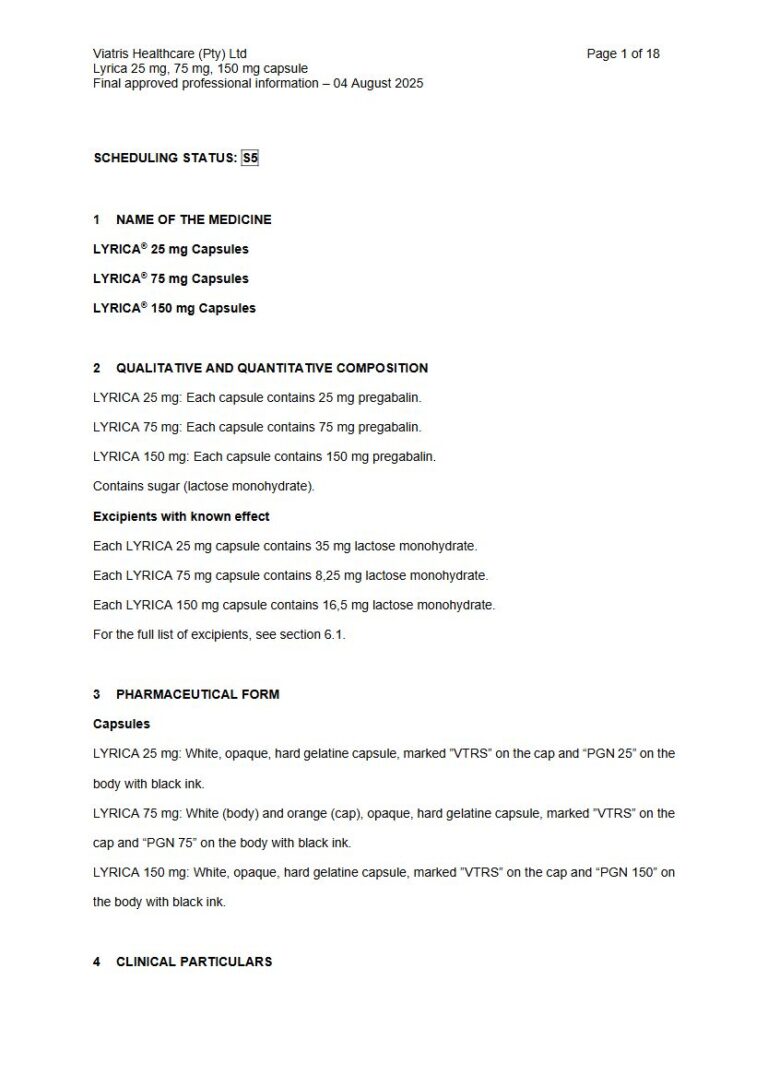
Lyrica 25 mg, 75 mg, 150 mg Capsule
PDF Leaflet Revision Date: 04 August 2025
Clinical Summary
Quick overview from the medicine insert
Indication
Treatment of neuropathic pain due to Herpes zoster and diabetes.
Dosage (summary)
Starting dose: 75 mg twice daily; may increase to 150 mg twice daily after 3-7 days.
Special Populations
- Renal impairment
- Hepatic impairment
- Elderly
Pregnancy & Breastfeeding
Not recommended during pregnancy; use effective contraception. Breastfeeding not recommended.
Key Drug Interactions
- CNS depressants
- Opioids
Contraindications
- Hypersensitivity to pregabalin or excipients
Common side effects
- Dizziness
- Somnolence
- Blurred vision
Counselling Points
- Monitor for signs of misuse or dependence.
- Avoid driving until effects are known.
- Gradual discontinuation recommended.
Serious warnings
- Risk of suicidal ideation
- Severe respiratory depression
- Severe cutaneous adverse reactions
Important Disclaimer
The Lyrica 25 mg, 75 mg, 150 mg Capsule professional information leaflet below is the property of Viatris Healthcare and is provided on Medinsert exactly as issued, with no.. alterations or editorial changes. We make every effort to keep content current by updating documents as soon as new versions become available. Medinsert serves as a trusted access point for healthcare professionals, but does not replace official sources or clinical judgement. For more details, please read our full disclaimer. read more>>
 Healthcare Professionals Only
This content is for registered healthcare professionals
Sign in or create a free account to read the full package insert.
Free for HPCSA-registered professionals. Powered by Medinsert.
Clinical Particulars
Section 4 of the official insert — extracted exactly as issued, no alterations
4.1 Therapeutic indications
Neuropathic pain
LYRICA is indicated for the treatment of adult patients with neuropathic pain due to Herpes zoster infections and diabetes.
4.2 Posology and method of administration
Posology
The recommended starting dose for LYRICA is 75 mg twice daily (150 mg/day), with or without food. Based on individual patient response and tolerability, the dose may be increased to 150 mg twice daily after an interval of 3 to 7 days.
In accordance with current clinical practice, if LYRICA has to be discontinued, it is recommended this should be done gradually over a minimum of 1 week.
Special populations
Renal impairment
LYRICA is eliminated from the systemic circulation primarily by renal excretion as unchanged medicine. As LYRICA clearance is directly proportional to creatinine clearance (see section 5.2, Pharmacokinetics in special populations u2013 Renal impairment), dosage reduction in patients with compromised renal function must be individualised according to creatinine clearance (CL cr), as indicated in Table 1 determined using the following formula:
CL cr (mL/min) = (140 u2013 age[years]) x Weight (kg) / (0,82 x Serum creatinine (u03bcmol/l))
*For females multiply the CL cr by 0,85
LYRICA is removed effectively from plasma by haemodialysis (50 % of medicine in 4 hours). For patients receiving haemodialysis, the LYRICA daily dose should be adjusted based on renal function. In addition to the daily dose, a supplementary dose should be given immediately following every 4-hour haemodialysis treatment (see Table 1).
Table 1. LYRICA dosage adjustment based on renal function
Creatinine clearance (CL cr) (mL/min) Total LYRICA daily dose* Dose regimen
Starting dose (mg/day) Maximum dose (mg/day)
- u2265 60 150 300 BD
- 30 u2013 60 75 150 OD or BD
- 15 u2013 30 25 u2013 50 75 OD or BD
- < 15 25 25 u2013 50 OD
Supplementary dosage following haemodialysis (mg)
- 25
- 50
Single dose + BD = Twice daily
OD = Once daily
*Total daily dose (mg/day) should be divided as indicated by dose regimen to provide mg/dose + Supplementary dose is a single additional dose
Hepatic impairment
No dosage adjustment is required for patients with hepatic impairment (see section 5.2, Pharmacokinetics in special populations u2013 Hepatic impairment).
Elderly population (over 65 years of age)
No dosage adjustment is necessary for elderly patients unless their renal function is compromised, see Table 1.
Paediatric population
The safety and effectiveness of LYRICA in patients below the age of 18 years with neuropathic pain has not been established.
Method of administration
For oral use. LYRICA is given orally with or without food.
4.3 Contraindications
Hypersensitivity to pregabalin or to any of the excipients of LYRICA (listed in section 6.1).
4.4 Special warnings and precautions for use
Diabetic patients
In accordance with current clinical practice, some diabetic patients who gain weight on LYRICA treatment may need to adjust hypoglycaemic medicines.
Hypersensitivity reactions
There have been reports in the post-marketing experience of hypersensitivity reactions, including cases of angioedema and urticaria. LYRICA should be discontinued immediately if symptoms of angioedema, such as facial, perioral or upper airway swelling occur.
Severe cutaneous adverse reactions (SCARs)
SCARs including Stevens-Johnson syndrome (SJS) and toxic epidermal necrolysis (TEN), which can be life-threatening or fatal, have been reported rarely in association with LYRICA treatment. At the time of prescription, patients should be advised of the signs and symptoms and monitored closely for skin reactions. If signs and symptoms suggestive of these reactions appear, LYRICA should be withdrawn immediately, and an alternative treatment considered (as appropriate).
Dizziness, somnolence, loss of consciousness, confusion and mental impairment
LYRICA treatment has been associated with dizziness and somnolence, which could increase the occurrence of accidental injury (fall) in the elderly population. There have been post-marketing reports of loss of consciousness, confusion, and mental impairment. Therefore, patients should be advised to exercise caution until they are familiar with the potential effects of the medicine (see section 4.8).
Vision-related effects
In controlled trials, a higher proportion of patients treated with LYRICA reported blurred vision than did patients treated with placebo, which resolved in a majority of cases with continued dosing. In the clinical studies where ophthalmologic testing was conducted, the incidence of visual acuity reduction and visual field changes was greater in LYRICA-treated patients than in placebo-treated patients; the incidence of fundoscopic changes was greater in placebo-treated patients.
In the post-marketing experience, visual adverse reactions have also been reported, including loss of vision, visual blurring or other changes of visual acuity, many of which were transient. Discontinuation of LYRICA may result in resolution or improvement of these visual symptoms.
Respiratory depression
There have been reports of severe respiratory depression in relation to LYRICA use. Patients with compromised respiratory function, respiratory or neurological disease, renal impairment, concomitant use of CNS depressants and the elderly may be at higher risk of experiencing this severe adverse reaction. Dose adjustments may be necessary in these patients (see section 4.2).
Suicidal ideation and behaviour
Suicidal ideation and behaviour have been reported in patients treated with LYRICA in several indications. Cases of suicidal ideation and behaviour have been observed in patients treated with LYRICA in the post-marketing experience (see section 4.8). An epidemiological study using a self-controlled study design (comparing treatment periods with non-treatment periods within an individual) showed evidence of an increased risk of new onset of suicidal behaviour and death by suicide in patients treated with LYRICA. A meta-analysis of randomised placebo-controlled studies of anti-epileptic medicines has also shown a small increased risk of suicidal ideation and behaviour. The mechanism of this risk is not known, and the available data do not exclude the possibility of an increased risk for LYRICA.
Therefore, patients should be monitored for signs of suicidal ideation and behaviours and appropriate treatment should be considered. Patients (and caregivers) should be advised to seek medical advice should signs of suicidal ideation or behaviour emerge. Discontinuation of LYRICA treatment should be considered in case of suicidal ideation and behaviour.
Concomitant use with opioids
Caution is advised when prescribing LYRICA concomitantly with opioids due to risk of CNS depression. In an observational study of opioid users, those patients who took LYRICA concomitantly with an opioid had an increased risk for opioid-related death compared to opioid use alone (adjusted odds ratio [aOR], 1.68 [95% CI, 1.19 to 2.36]).
Misuse, abuse potential or dependence
LYRICA can cause drug dependence, which may occur at therapeutic doses. Cases of abuse, misuse and dependence have been reported. Patients with a history of substance abuse and/or psychiatric disorders may be at higher risk for LYRICA misuse, abuse and dependence and LYRICA should be used with caution in such patients. Before prescribing LYRICA, the patientu2019s risk of misuse, abuse or dependence should be carefully evaluated.
Patients treated with LYRICA should be monitored for symptoms of LYRICA misuse, abuse or dependence, such as development of tolerance, dose escalation and drug-seeking behaviour.
Withdrawal symptoms
After discontinuation of short-term and long-term treatment with LYRICA, withdrawal symptoms have been observed in some patients. The following events have been reported: insomnia, headache, nausea, anxiety and diarrhoea (see section 4.8).
Renal failure
Although the effects of discontinuation on the reversibility of renal failure have not been systematically studied, improved renal function following discontinuation or dose reduction of LYRICA has been reported (see section 4.8). Renal failure has occurred.
Congestive heart failure
There have been post-marketing reports of congestive heart failure or deterioration of heart failure in some patients receiving LYRICA. In short-term trials of patients without clinically significant heart or peripheral vascular disease, there was no apparent association between peripheral oedema and cardiovascular complications such as hypertension or congestive heart failure. LYRICA should be used with caution in patients with congestive heart failure (see section 4.8).
Women of childbearing potential/Contraception
LYRICA use in the first trimester of pregnancy may cause major birth defects in the unborn child. LYRICA should not be used during pregnancy unless the benefit to the mother clearly outweighs the potential risk to the foetus. Women of childbearing potential must use effective contraception during treatment (see section 4.6).
Lactose intolerance
Patients with rare hereditary problems of galactose intolerance, total lactase deficiency or glucose-galactose malabsorption should not take this medicine.
4.5 Interaction with other medicines and other forms of interaction
Since LYRICA is predominantly excreted unchanged in the urine, undergoes negligible metabolism in humans (< 2 % of a dose recovered in urine as metabolites), does not inhibit medicine metabolism in vitro, and is not bound to plasma proteins, LYRICA is unlikely to produce, or be subject to, pharmacokinetic interactions.
In vivo studies and population pharmacokinetic analysis
Accordingly, in in vivo studies no clinically relevant pharmacokinetic interactions were observed between LYRICA and phenytoin, carbamazepine, valproic acid, lamotrigine, gabapentin, lorazepam, oxycodone or ethanol. In addition, population pharmacokinetic analysis indicated that the 3 commonly used medicine classes, oral antidiabetics, diuretics and insulin, and the commonly used anti-epileptic medicines, phenytoin, carbamazepine, valproic acid, lamotrigine, phenobarbital, tiagabine, and topiramate, had no clinically significant effect on pregabalin clearance. Similarly, these analyses indicated that LYRICA had no clinically significant effect on the clearance of phenytoin, carbamazepine, valproic acid, lamotrigine, topiramate and phenobarbital.
Oral contraceptives, norethisterone and/or ethinyl oestradiol
Co-administration of LYRICA with the oral contraceptives norethisterone and/or ethinyl estradiol does not influence the steady-state pharmacokinetics of either medicine.
Central nervous system influencing medicines
Multiple oral doses of LYRICA co-administered with oxycodone, lorazepam, or ethanol did not result in clinically important effects on respiration. LYRICA appears to be additive in the impairment of cognitive and gross motor function caused by oxycodone. LYRICA may potentiate the effects of ethanol and lorazepam.
In post-marketing experience, there are reports of respiratory failure, coma and deaths in patients taking LYRICA and other CNS depressant medicines, including in patients who are substance abusers. There are post-marketing reports of events related to reduced lower gastrointestinal tract function (e.g. intestinal obstruction, paralytic ileus, constipation) when LYRICA was co-administered with medicines that have the potential to produce constipation, such as opioid analgesics.
4.6 Fertility, pregnancy and lactation
Women of childbearing potential/ Contraception in males and females
Women of childbearing potential have to use effective contraception during treatment (see section 4.4).
Pregnancy
There is a limited amount of data on the use of LYRICA in pregnant women. Data from a Nordic observational study, which included more than 2 700 pregnancies exposed to LYRICA based on routinely collected data from administrative and medical registers, do not suggest substantially increased risks of major congenital malformations, adverse birth outcomes, or abnormal postnatal neurodevelopmental outcomes in LYRICA-exposed pregnancies.
Major congenital malformations
The adjusted prevalence ratios (aPRs) and 95 % confidence intervals (CI) in the standard meta-analysis for first-trimester LYRICA monotherapy-exposed vs. unexposed to anti-epileptic drugs was 1,13 (0,96 u2013 1,33).
Birth and postnatal neurodevelopmental outcomes
There were no statistically significant findings for stillbirth, low birth weight, preterm birth, small for gestational age, low Apgar score, and microcephaly.
In paediatric population exposed in utero, the study did not provide evidence of an increased risk for attention deficit hyperactivity disorder (ADHD), autism spectrum disorders (ASD) and intellectual disabilities.
Studies in animals have shown reproductive toxicity. Therefore, LYRICA should not be used during pregnancy.
Breastfeeding
LYRICA is excreted into human milk (see section 5.2). The effect of LYRICA on newborns/infants is unknown. Because the safety of LYRICA in infants is not known, breastfeeding is not recommended during treatment with LYRICA.
4.7 Effects on ability to drive and use machines
LYRICA frequently causes dizziness and somnolence. Head and body injuries and road traffic incidents have also been reported in patients treated with LYRICA. Therefore, patients are advised not to drive, operate complex machinery or engage in other potentially hazardous activities until it is known whether LYRICA affects their ability to perform these activities.
4.8 Undesirable effects
Summary of the safety profile
The LYRICA clinical programme involved over 8 900 patients who were exposed to LYRICA, of whom over 5 600 were in double-blind placebo-controlled trials. The most commonly reported adverse reactions were dizziness and somnolence which were dose related. Adverse reactions were usually mild to moderate in intensity. In all controlled studies, the discontinuation rate due to adverse events was 12 % for patients receiving LYRICA and 5 % for patients receiving placebo. The adverse reactions resulting in discontinuation from LYRICA treatment groups were dizziness and somnolence.
Tabulated list of adverse reactions
Selected adverse drug reactions that were treatment related in the pooled analysis of clinical trials are listed in the table below by System Organ Class (SOC). The frequency of these terms has been based on all-causality adverse drug reactions in the clinical trial data set: Very common (u2265 1/10); common (u2265 1/100 to < 1/10); uncommon (u2265 1/1 000 to < 1/100); rare (u2265 1/10 000 to < 1/1 000); very rare (< 1/10 000), and Frequency not known as the frequency cannot be estimated from the available data.
The adverse reactions listed may also be associated with the underlying disease and concomitant medicines.
Adverse reactions from clinical trials
MedDRA System Organ Class Frequency Adverse reactions
Infections and infestations Common Nasopharyngitis
Blood and lymphatic system disorders Uncommon Neutropenia
Metabolism and nutrition disorders Common Increased appetite
Uncommon Anorexia, hypoglycaemia
Psychiatric disorders Common Euphoric mood, confusion, libido decreased, irritability, depression, disorientation, insomnia
Uncommon Depersonalisation, anorgasmia, restlessness, agitation, mood swings, depressed mood, elevated mood, word finding difficulty, hallucination, abnormal dreams, increased libido
Rare Panic attack, disinhibition, apathy, suicidal behaviour, suicidal ideation
Nervous system disorders Very common Dizziness, somnolence
Common Ataxia, disturbance in attention, abnormal coordination, amnesia, memory impairment, tremor, dysarthria, paraesthesia, hypoaesthesia, sedation, balance disorder, lethargy
Uncommon Cognitive disorder, nystagmus, speech disorder, myoclonus, hyporeflexia, dyskinesia, psychomotor hyperactivity, postural dizziness, hyperaesthesia, burning sensation, intention tremor, syncope
Rare Stupor, hypokinesia, parosmia, ageusia, dysgraphia
Eye disorders Common Blurred vision blurred, diplopia
Uncommon Peripheral vision loss, visual disturbance, dry eye, eye swelling, visual field defect, reduced visual acuity, eye pain, asthenopia, photopsia, increased lacrimation, eye irritation
Rare Mydriasis, oscillopsia, altered visual depth perception, strabismus, visual brightness
Ear and labyrinth disorders Common Vertigo
Uncommon Hyperacusis
Cardiac disorders Uncommon Tachycardia, atrioventricular block first degree, sinus bradycardia
Rare Sinus tachycardia, sinus dysrhythmia
Vascular disorders Uncommon Hypotension, hypertension, flushing, hot flushes, peripheral coldness
Respiratory, thoracic and mediastinal disorders Uncommon Dyspnoea, epistaxis, cough, nasal congestion, rhinitis, snoring
Rare Throat tightness, nasal dryness
Not known Respiratory depression
Gastrointestinal disorders Common Dry mouth, constipation, vomiting, flatulence, abdominal distension
Uncommon Salivary hypersecretion, gastroesophageal reflux disease, oral hypoaesthesia
Rare Ascites, dysphagia, pancreatitis
Skin and subcutaneous tissue disorders Uncommon Sweating, rash papular, urticaria
Rare Cold sweat
Musculoskeletal and connective tissue disorders Common Muscle cramp, arthralgia, back pain, pain in limb, cervical spasm
Uncommon Muscle twitching, joint swelling, myalgia, neck pain, muscle stiffness
Rare Rhabdomyolysis
Renal and urinary disorders Uncommon Dysuria, urinary incontinence
Rare Oliguria, renal failure
Reproductive system and breast disorders Uncommon Erectile dysfunction, delayed ejaculation, sexual dysfunction, dysmenorrhoea
Rare Amenorrhoea, breast pain, breast discharge, breast enlargement
General disorders and administration site conditions Common Fatigue, oedema peripheral, fall, feeling drunk, feeling abnormal, oedema, abnormal gait
Uncommon Generalised oedema, asthenia, thirst, chest tightness, pain, pyrexia, chills
Investigations Common Increased weight
Uncommon Increased alanine aminotransferase, increased blood creatine phosphokinase, increased aspartate aminotransferase, increased blood glucose, decreased platelet count, decreased blood potassium, decreased weight
Rare Increased blood creatinine, decreased white blood cell count
Other special populations
Elderly (over 65 years of age)
In a total of 998 elderly patients, no overall differences in safety were observed compared with patients less than 65 years of age.
Post-marketing (see section 4.4)
MedDRA System Organ Class Adverse reactions
Immune system disorders Angioedema, allergic reaction, hypersensitivity
Psychiatric disorders Drug dependence
Nervous system disorders Headache, loss of consciousness, mental impairment, reversible paralysis
Eye disorders Keratitis
Cardiac disorders Congestive heart failure
Respiratory, thoracic and mediastinal disorders Pulmonary oedema
Gastrointestinal disorders Swollen tongue, diarrhoea, nausea
Skin and subcutaneous tissue disorders Face swelling, pruritus, toxic epidermal necrolysis, Stevens-Johnson syndrome
Renal and urinary disorders Urinary retention
Reproductive system and breast disorders Gynaecomastia
General disorders and administration site conditions Malaise
4.9 Overdose
In overdoses up to 15 g, no unexpected adverse reactions were reported. In post-marketing experience, the most commonly reported adverse events observed when LYRICA was taken in overdose included affective disorder, somnolence, confusional state, depression, agitation and restlessness. Seizures were also reported. In rare occasions, cases of coma have been reported.
Treatment of LYRICA overdose should include general supportive measures and may include haemodialysis if necessary (see section 4.2 u2013 Patients with renal impairment).
