
Arava Tablets
Clinical Summary
Quick overview from the medicine insert
Indication
Treatment of active rheumatoid arthritis in adults and for the treatment of active psoriatic arthritis.
Dosage (summary)
Initial dose: 100 mg once daily for 3 days, followed by a maintenance dose of 10 mg to 20 mg once daily.
Onset of Action / Duration
Therapeutic effects may take several weeks to become apparent, typically 4 to 6 weeks.
Special Populations
- Hepatic impairment
- Renal impairment
- Elderly patients
Pregnancy & Breastfeeding
Not recommended during pregnancy. Women of childbearing potential should use effective contraception during treatment and for at least 2 years after discontinuation. Not recommended during breastfeeding.
Key Drug Interactions
- Warfarin: Increased risk of bleeding.
- Rifampicin: May decrease Leflunomide levels.
- Cholestyramine: Can accelerate the elimination of Leflunomide.
Contraindications
- Severe hepatic impairment
- Pregnancy
- Hypersensitivity to Leflunomide or any component of the formulation
Common side effects
- Diarrhea
- Nausea
- Headache
- Elevated liver enzymes
- Alopecia
- Hypertension
Counselling Points
- Advise patients to report any signs of liver dysfunction, such as jaundice or dark urine.
- Instruct patients to maintain adequate hydration.
- Inform patients about the potential for teratogenic effects and the need for effective contraception.
Serious warnings
- Monitor liver function tests regularly during treatment.
- Risk of serious infections due to immunosuppression.
- Caution in patients with a history of significant renal or hepatic disease.
Important Disclaimer
The Arava Tablets professional information leaflet below is the property of Sanofi-Aventis South Africa and is provided on Medinsert exactly as issued, with no.. alterations or editorial changes. We make every effort to keep content current by updating documents as soon as new versions become available. Medinsert serves as a trusted access point for healthcare professionals, but does not replace official sources or clinical judgement. For more details, please read our full disclaimer. read more>>
 Healthcare Professionals Only
This content is for registered healthcare professionals
Sign in or create a free account to read the full package insert.
Free for HPCSA-registered professionals. Powered by Medinsert.
Clinical Particulars
Section 4 of the official insert — extracted exactly as issued, no alterations
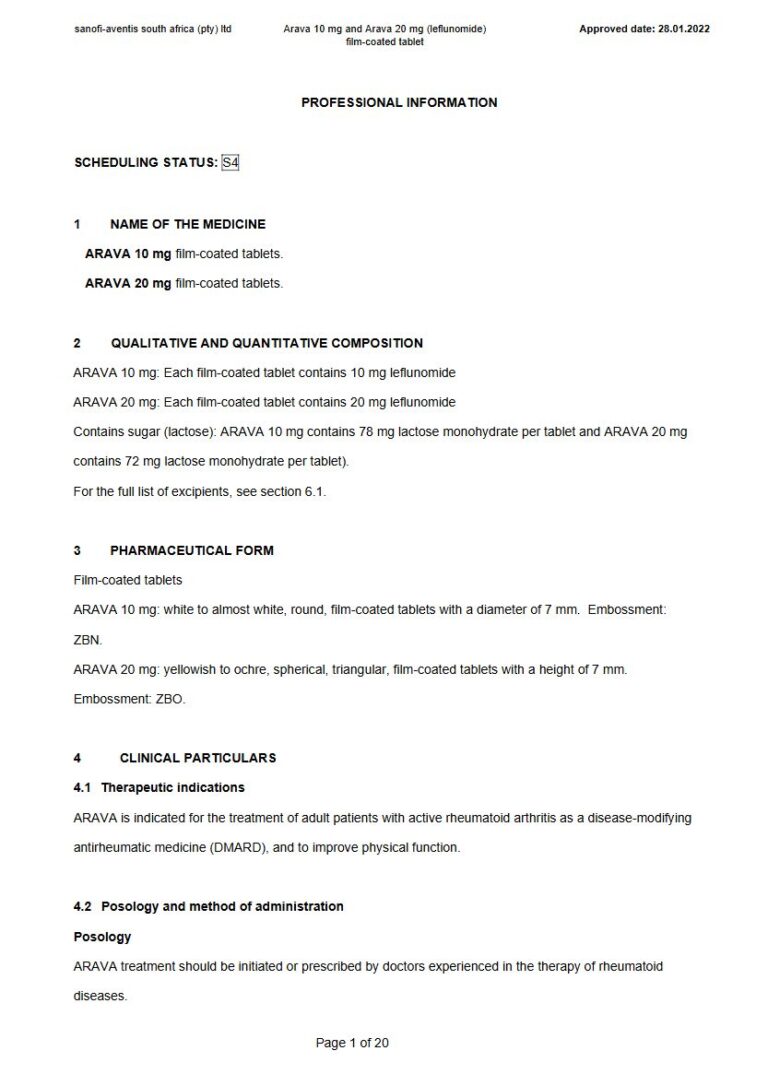
4.1 Therapeutic indications
ARAVA is indicated for the treatment of adult patients with active rheumatoid arthritis as a disease-modifying antirheumatic medicine (DMARD), and to improve physical function.
4.2 Posology and method of administration
Posology
ARAVA treatment should be initiated or prescribed by doctors experienced in the therapy of rheumatoid diseases. For monitoring recommendations see section 4.4. ARAVA therapy is started with a loading dose of 100 mg once daily for 3 days. The recommended maintenance dose is ARAVA tablets 10 mg to 20 mg once daily. A therapeutic effect usually starts after 4 to 6 weeks and may further improve up to 4 to 6 months. There is no dose adjustment recommended in patients with mild renal insufficiency. No dosage adjustment is required in patients above 65 years of age.
Administration:
ARAVA tablets should be swallowed whole, with sufficient amounts of liquid. The extent of leflunomide absorption is not affected if it is taken with food.
4.3 Contraindications
ARAVA must not be used in patients with hypersensitivity to leflunomide, the principal active metabolite teriflunomide (especially previous Stevens-Johnson syndrome, toxic epidermal necrolysis, erythema multiforme) or to any of the excipients in the tablets. ARAVA is contraindicated in:
- patients with impairment of liver function
- patients with severe immunodeficiency states, e.g. AIDS
- patients with significantly impaired bone marrow function or significant anaemia, leucopenia, neutropenia or thrombocytopenia due to causes other than rheumatoid arthritis
- patients with serious infections
- patients with moderate to severe renal insufficiency, because insufficient clinical experience is available in this patient group
- patients with severe hypoproteinaemia, e.g. in nephritic syndrome
- pregnant women, or women of childbearing potential who are not using reliable contraception during treatment with leflunomide and thereafter as long as the plasma levels of the active metabolite are above 0,02 mg/L. Pregnancy must be excluded before start of treatment with leflunomide. In animal studies leflunomide was teratogenic in rats and rabbits (see section 4.6).
- Women must not breastfeed while they are receiving ARAVA.
- Male patients should be aware of the possible male-mediated fetal toxicity. Reliable contraception during treatment with ARAVA should also be guaranteed.
- ARAVA is not recommended for use in patients under 18 years as its safety and efficacy have not been studied in this age group.
4.4 Special warnings and precautions for use
Recent treatment with hepatotoxic or haematotoxic DMARDs may result in increased side effects; therefore, the initiation of ARAVA treatment has to be carefully considered regarding these benefit/risk aspects. Moreover, switching from ARAVA to another DMARD without a washout period may increase the possibility of additive risks of side effects for a long time after the switching.
General:
Due to the prolonged half-life (usually 1 to 4 weeks) of the active metabolite of ARAVA, adverse reactions may occur or persist even after ARAVA administration has been discontinued. If a severe adverse reaction to ARAVA occurs (e.g. hepatotoxicity or haematotoxicity), or if for any other reason the primary metabolite needs to be cleared rapidly from the body (e.g. when switching to another DMARD (e.g. methotrexate) after treatment with ARAVA), a washout procedure as described below (and in section 4.9) has to be initiated and continued/repeated as clinically necessary. For suspected severe immunologic/allergic reactions, more prolonged colestyramine or charcoal administration may be necessary to achieve rapid and sufficient clearance. For washout procedures in case of desired pregnancy, see section 4.6.
Recommendations for monitoring and washout procedures:
Monitoring recommendations: ARAVA should be administered to patients only under careful medical supervision. Latent or active tuberculosis: Before starting treatment, all patients should be evaluated for active and inactive (latent) tuberculosis, as per locally approved guidelines on the diagnostic criteria for latent and active tuberculosis. Patients with a history of tuberculosis should be carefully monitored because of the possibility of reactivation of the infection (see Infections below).
Liver enzymes: ALT (SGPT) must be checked before initiation of treatment and at least at monthly intervals during the first six months of treatment and every 6 u2013 8 weeks thereafter. For confirmed ALT (SGPT) elevations between 2- and 3-fold the upper limit of normal, dose reduction from 20 mg to 10 mg may allow continued administration of leflunomide under close monitoring. If ALT (SGPT) elevations between 2- and 3-fold the upper limit of normal persist or if confirmed ALT elevations of more than 3-fold the upper limit of normal are present, leflunomide should be discontinued. Colestyramine or activated charcoal should be administered to more rapidly lower the levels of the active metabolite.
Blood pressure: Blood pressure must be checked before the start of ARAVA treatment and periodically thereafter, as increases in blood pressure may occur.
Blood cell count: A complete blood cell count, including differential white blood cell count and platelets, must be performed before start of ARAVA treatment as well as monthly for the first 6 months of treatment and every 6 u2013 8 weeks thereafter.
Combinations with other treatments: The use of ARAVA with antimalarials used in rheumatic diseases (e.g. chloroquine and hydroxychloroquine), intramuscular or oral gold, D-penicillamine, azathioprine and other immunosuppressive agents (with the exception of methotrexate) has not been studied up to now. The risk associated with combination therapy, in particular in long-term treatment, is unknown. Since such therapy can lead to additive or even synergistic toxicity (e.g. hepato- or haematotoxicity), combination with another DMARD (e.g. methotrexate) is not advisable.
Co-administration of teriflunomide with leflunomide is not recommended, as leflunomide is the parent compound of teriflunomide.
4.5 Interactions with other medicines
Increased side effects may occur in case of recent or concomitant use of hepatotoxic (including alcohol), haematotoxic or immunosuppressive substances. This is also to be considered when leflunomide treatment is followed by such substances without a washout period.
- Methotrexate: In a small (n=30) study with co-administration of ARAVA (10 mg to 20 mg per day) with methotrexate (10 mg to 25 mg per week) a 2- to 3-fold elevation in liver enzymes was seen in 5 of 30 patients. All elevations resolved, 2 with continuation of both medicines and 3 after discontinuation of ARAVA. A more than 3-fold increase was seen in another 5 patients. All of these also resolved, 2 with continuation of both medicines and 3 after discontinuation of ARAVA. Therefore, closer monitoring of liver enzymes is recommended in the initial phase after switching. Although a pharmacokinetic interaction with a BCRP substrate (rosuvastatin) was observed with the primary active metabolite of leflunomide (see below), no pharmacokinetic interaction between ARAVA (10 mg to 20 mg per day) (also a BCRP substrate) and methotrexate (10 mg to 25 mg per week) was demonstrated.
- Vaccinations: No clinical data is available on the efficacy and safety of vaccinations during ARAVA treatment. Vaccination with live vaccines is, however, not recommended. The long half-life of ARAVA should be considered when contemplating administration of a live vaccine after stopping ARAVA.
- Warfarin: There have been case reports of increased prothrombin time when ARAVA and warfarin were co-administered. A pharmacodynamic interaction with warfarin was observed with the primary metabolite in a clinical pharmacology study (see below). Therefore, when warfarin is co-administered, close INR follow-up and monitoring is recommended.
- NSAIDs: In clinical trials no safety problems were observed when NSAIDs metabolised by CYP2C9, and ARAVA were co-administered. If the patient is already receiving nonsteroidal anti-inflammatory medicines (NSAIDs) and/or corticosteroids, these may be continued after starting leflunomide.
- The extent of ARAVA absorption is not affected when taken with food.
- No difference in clinical efficacy was seen between smokers and non-smokers.
4.6 Fertility, pregnancy and lactation
Pregnancy
The active metabolite of leflunomide is teratogenic in rats and rabbits and it may cause fetal harm in humans. ARAVA must not be given to pregnant women, or women of childbearing potential who are not using reliable contraception during treatment with ARAVA and as long as the plasma levels of the active metabolite are above 0,02 mg/L (see Washout procedure below). Pregnancy must be excluded before start of treatment with ARAVA.
Suspected pregnancy or women deciding to fall pregnant:
Patients must be advised that if there is any delay in onset of menses or any other reason to suspect pregnancy, they must notify the doctor immediately for pregnancy testing, and if positive, the doctor and patient must discuss the risk to the pregnancy. It is possible that rapidly lowering the blood level of the active metabolite, by instituting the medicine elimination procedure described below, at the first delay of menses, may decrease the risk to the fetus from ARAVA.
Washout procedure:
For women receiving ARAVA treatment and who wish to become pregnant, one of the following procedures is recommended:
- After stopping treatment with leflunomide, colestyramine 8 g is administered three times daily for a period of 11 days.
- After stopping treatment with leflunomide, 50 g of activated charcoal is administered four times daily for a period of 11 days. The 11 days need not be consecutive unless there is a need to lower the primary metabolite plasma level rapidly. In either case, the primary metabolite plasma levels < 0,02 mg/L must be verified by two separate tests at least 14 days apart. Human plasma levels of the active metabolite less than 0,02 mg/L (0,02 u03bcg/mL) are expected to have minimal risk based on available data.
Waiting period:
Without the medicine elimination procedure, it may take up to 2 years to reach the primary metabolite levels of < 0,02 mg/L, due to individual variation in medicine clearance. However, also after such a waiting period, verification of the primary metabolite levels of < 0,02 mg/L by two separate tests at an interval of at least 14 days is required. If a waiting period of up to approximately 2 years under reliable contraception is considered impractical, prophylactic institution of a washout procedure may be advisable. Reliable contraception with oral contraceptives may not be guaranteed during the washout procedure with colestyramine or activated charcoal. Use of alternative contraceptive methods is recommended.
Lactation
Animal studies indicate that leflunomide or its metabolites pass into breast milk. Breastfeeding women must therefore not receive ARAVA.
4.7 Effects on ability to drive and use machines
ARAVA may cause side effects such as dizziness, which may affect the patientu2019s ability to concentrate and react properly (see section 4.8). Patients should therefore be advised not to drive or operate machinery until their individual susceptibility is known.
4.8 Undesirable effects
The following CIOMS frequency rating is used, when applicable: very common > 1/10; common > 1/100 to 1/1000 to 1/10 000 and < 1/1000; very rare: < 1/10 000 Not known (cannot be estimated from available data).
Infections and infestations:
Rare: severe infections and sepsis, which may be fatal. Immunosuppressive medications are known to increase susceptibility to infections, including opportunistic infections and infections with atypical organisms. In clinical studies, the incidence of, for example rhinitis and bronchitis (5 % vs 2 %), and pneumonia (3 % vs 0 %) was slightly increased in patients treated with ARAVA compared to placebo, whereas the overall incidence of infections was comparable to placebo.
Neoplasms benign and malignant (including cysts and polyps):
Not known: The risk of malignancy, particularly lymphoproliferative disorders, is also known to be increased with use of some immunosuppressive medicines.
Blood and lymphatic system disorders:
Common: leucopenia with leucocyte count > 2 x 10⁹/L (> 2 G/L). Uncommon: anaemia, thrombocytopenia with platelet count < 100 x 109/L (< 100 G/L). Rare: leucopenia with leucocyte count < 2 x 10⁹/L (< 2 G/L), eosinophilia, pancytopenia. Very rare: agranulocytosis.
Recent, concomitant or consecutive use of potentially myelotoxic agents may be associated with a higher risk of haematological effects.
Immune system disorders:
Common: mild allergic reactions. Very rare: severe anaphylactic/anaphylactoid reactions, vasculitis, including cutaneous necrotising vasculitis.
Metabolism and nutrition disorders:
Uncommon: hypokalaemia. Not known: hyperlipidaemia, uric acid levels usually decrease due to a uricosuric effect. Possible further laboratory findings for which a clinical relevance could not be established include: small increases in LDH and creatine kinase (CK), and a small decrease in phosphate.
Psychiatric disorders:
Uncommon: anxiety.
Nervous system disorders:
Common: headache, dizziness, paraesthesia. Uncommon: taste disturbances. Very rare: peripheral neuropathy.
Cardiac disorders:
Common: increase in blood pressure. Rare: severe increase in blood pressure. Not known: pulmonary hypertension.
Respiratory, thoracic and mediastinal disorders:
Rare: interstitial lung disease (including interstitial pneumonitis), which may be fatal.
Gastrointestinal disorders:
Common: colitis including microscopic colitis, diarrhoea, nausea, vomiting, anorexia, oral mucosal disorders (e.g. aphthous stomatitis, mouth ulcerations), abdominal pain. Very rare: pancreatitis.
Hepatobiliary disorders:
Common: elevation of liver parameters (e.g. transaminase, less often gamma-GT, alkaline phosphatase, bilirubin). Rare: hepatitis, jaundice/cholestasis. Very rare: severe liver injury such as hepatic failure and acute hepatic necrosis, that may be fatal. In clinical trials, ARAVA treatment was associated with elevations of liver enzymes (see section 4.4).
Skin and subcutaneous tissue disorders:
Common: rashes (including maculopapular rash), pruritus, eczema, dry skin, increased hair loss. Uncommon: urticaria. Very rare: Stevens-Johnson syndrome (erythema multiforme of major type), toxic epidermal necrolysis. In case reports received so far, a causal relationship with ARAVA treatment could not be established, but cannot be excluded. Not known: Cutaneous lupus erythematosus, pustular psoriasis or worsening psoriasis, drug reaction with eosinophilia and systemic symptoms (DRESS), skin ulcer (see section 4.4).
Musculoskeletal, connective tissue and bone disorders:
Common: tenosynovitis. Uncommon: tendon rupture, has been reported as adverse events under treatment with leflunomide, however, a causal relationship could not be established.
Renal and urinary disorders:
Not known: renal failure.
Reproductive system and breast disorders:
Not known: marginal (reversible) decreases in sperm concentration, total sperm count and rapid progressive motility.
General disorders and administration site conditions:
Common: weight loss, asthenia.
Reporting of suspected adverse reactions
Reporting suspected adverse reactions after authorisation of ARAVA is important. It allows continued monitoring of the benefit/risk balance of ARAVA. Health care professionals are asked to report any suspected adverse reactions to: The Pharmacovigilance Unit at Sanofi: [email protected] (email) or 011 256-3700 (tel), or SAHPRA via the u201c6.04 Adverse Drug Reactions Reporting Formu201d found online under SAHPRAu2019s publications: https://www.sahpra.org.za/Publications/Index/8.
4.9 Overdose
There have been reports of accidental overdose in patients taking ARAVA at daily doses up to five times the recommended daily dose for several days and reports of acute overdose in adults or children. There were no adverse events reported in the majority of case reports of overdose. Adverse events were consistent with the adverse effects profile for ARAVA. The most frequent adverse events observed were diarrhoea, abdominal pain, leucopenia, anaemia and elevated liver function tests.
In the event of relevant overdose or toxicity, colestyramine or charcoal must be given to accelerate elimination. Colestyramine given orally at a dose of 8 g three times a day for 24 hours to three healthy volunteers decreased plasma levels of the primary metabolite by approximately 40 % in 24 hours and by 49 % to 65 % in 48 hours. Administration of activated charcoal, orally or via a nasogastric tube at a dose of 50 g every six hours for 24 hours, has been shown to reduce plasma concentrations of the active metabolite by 37 % in 24 hours and by 48 % in 48 hours. The washout procedures may be repeated if clinically necessary.
