
Aspen Abacavir 300mg Tablets
PDF Leaflet Revision Date: 02 June 2017
Clinical Summary
Quick overview from the medicine insert
Indication
Treatment of HIV-1 in infected adults.
Dosage (summary)
1 tablet (300 mg) twice daily or 2 tablets (600 mg) once daily.
Onset of Action / Duration
Onset: 11 days, Duration: Not specified.
Special Populations
- Hepatic impairment
- Renal impairment
- Elderly
Pregnancy & Breastfeeding
Contraindicated in pregnancy and lactation.
Key Drug Interactions
- Ethanol increases AUC
- Ribavirin caution advised
Contraindications
- Hypersensitivity to abacavir
- Moderate or severe hepatic impairment
- Pregnancy
- Lactation
Common side effects
- Hypersensitivity reactions
- Nausea
- Diarrhoea
- Rash
- Fatigue
Counselling Points
- Monitor for hypersensitivity symptoms
- Do not restart after hypersensitivity
- Avoid alcohol
Serious warnings
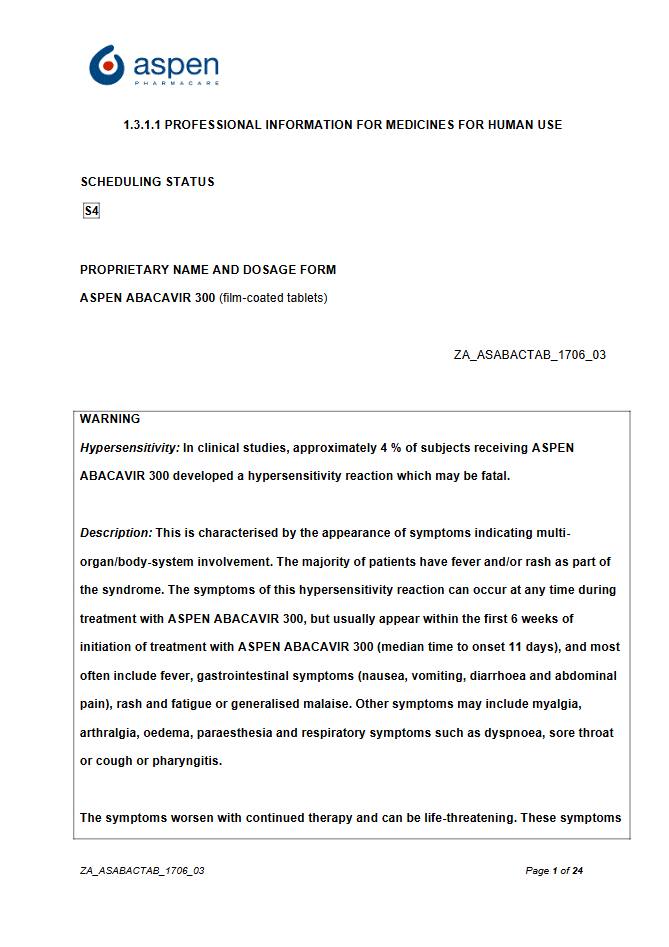
- Serious hypersensitivity reactions
- Lactic acidosis risk
- Hepatotoxicity
Important Disclaimer
The Aspen Abacavir 300mg Tablets professional information leaflet below is the property of Pharmacare Limited and is provided on Medinsert exactly as issued, with no.. alterations or editorial changes. We make every effort to keep content current by updating documents as soon as new versions become available. Medinsert serves as a trusted access point for healthcare professionals, but does not replace official sources or clinical judgement. For more details, please read our full disclaimer. read more>>
 Healthcare Professionals Only
This content is for registered healthcare professionals
Sign in or create a free account to read the full package insert.
Free for HPCSA-registered professionals. Powered by Medinsert.
Clinical Particulars
Section 4 of the official insert — extracted exactly as issued, no alterations
4.1 Therapeutic indications
ASPEN ABACAVIR 300 is indicated in antiretroviral combination therapy for the treatment of Human Immunodeficiency Virus (HIV - 1) in infected adults.
4.2 Posology and method of administration
Before starting ASPEN ABACAVIR 300, review medical history for prior exposure to any abacavir - containing product in order to avoid reintroduction in a patient with a history of hypersensitivity to abacavir. The recommended dose of ASPEN ABACAVIR 300 is 1 tablet twice daily. This may be taken as either 300 mg (one tablet) twice a day, or 600 mg (two tablets) once a day. ASPEN ABACAVIR 300 is not suitable for children < 12 years of age. ASPEN ABACAVIR 300 can be taken with or without food. ASPEN ABACAVIR 300 is a tablet formulation for adult dosage. ASPEN ABACAVIR 300 tablets should not be broken. Oral solutions are available on the market for administration to children, and for those patients for whom the tablets are inappropriate. Therapy should be initiated by a medical practitioner experienced in the management of HIV infection.
4.3 Contraindications
ASPEN ABACAVIR 300 is contraindicated:
- In patients with known hypersensitivity to abacavir or any ingredients of the formulation. Never restart ASPEN ABACAVIR 300 or any other abacavir - containing product following a hypersensitivity reaction to abacavir, regardless of HLA - B*5701 status.
- In patients with moderate or severe hepatic impairment.
- During pregnancy and lactation.
4.4 Special warnings and precautions for use
Hypersensitivity reaction (see Boxed warning) Serious and sometimes fatal hypersensitivity reactions have been associated with ASPEN ABACAVIR 300 and other abacavir - containing products. This is characterised by the appearance of symptoms indicating multi - organ/body system involvement. Patients who carry the HLA - B*5701 allele are at high risk for experiencing a hypersensitivity reaction to abacavir. Prior to initiating therapy with ASPEN ABACAVIR 300, screening for the HLA - B*5701 allele is recommended; this approach has been found to decrease the risk of a hypersensitivity reaction. Screening is also recommended prior to reinitiation of ASPEN ABACAVIR 300 in patients of unknown HLA - B*5701 status who have previously tolerated abacavir. For HLA - B*5701 - positive patients, treatment with an abacavir - containing regimen is not recommended and should be considered only with close medical supervision and under exceptional circumstances when the potential benefit outweighs the risk. HLA - B*5701 - negative patients may develop a hypersensitivity reaction to ASPEN ABACAVIR 300; however, this occurs significantly less frequently than in HLA - B*5701 - positive patients. Regardless of HLA - B*5701 status, patients who develop a hypersensitivity reaction must permanently discontinue ASPEN ABACAVIR 300 and MUST not be re - challenged with ASPEN ABACAVIR 300.
4.5 Interactions with other medicines
Based on the known major metabolic pathways of abacavir, the potential for interactions involving ASPEN ABACAVIR 300 is low. ASPEN ABACAVIR 300 shows no potential to inhibit metabolism mediated by the cytochrome P450 3A4 enzyme. It has also been shown not to interact with medicines that are metabolised by CYP3A4, CYP2C9 or CYP2D6 enzymes. Induction of hepatic metabolism has not been observed in clinical studies. Therefore, there is little potential for medicine interactions with antiretroviral protease inhibitors and other medicines metabolised by major P450 enzymes.
4.6 Fertility, pregnancy and lactation
ASPEN ABACAVIR 300 is contraindicated in pregnancy and lactation (see CONTRAINDICATIONS). ASPEN ABACAVIR 300 is excreted into human milk. Mothers should not breastfeed their babies while receiving treatment with ASPEN ABACAVIR 300. Additionally, it is recommended that HIV infected women do not breastfeed their infants in order to avoid transmission of HIV.
4.7 Effects on ability to drive and use machines
Since adverse reactions such as headache, migraine and lack of energy have been reported in patients receiving ASPEN ABACAVIR 300, patients should not drive, use machinery or perform any task that require concentration, until they are certain that ASPEN ABACAVIR 300 does not adversely affect your ability to do so.
4.8 Undesirable effects
The signs and symptoms of this hypersensitivity reaction are listed below:
- Skin: Rash (usually maculopapular or urticarial)
- Gastrointestinal tract: Nausea, vomiting, diarrhoea, abdominal pain, mouth ulceration
- Respiratory tract: Dyspnoea, sore throat, cough or pharyngitis, adult respiratory distress syndrome, respiratory failure
- Miscellaneous: Fever, fatigue, malaise, oedema, lymphadenopathy, hypotension, conjunctivitis, anaphylaxis
- Neurological/psychiatry: Headache, paraesthesia
- Haematological: Lymphopenia
- Liver/pancreas: Elevated liver function tests, hepatic failure, hepatitis
- Musculoskeletal: Myalgia, myolysis, arthralgia, elevated creatine phosphokinase
- Urology: Elevated creatinine, renal failure
- Infections and infestations: Less frequent: Ear/nose/throat infections, viral respiratory tract infections, pneumonia
- Blood and lymphatic system disorders: Less frequent: Anaemia, neutropenia
- Metabolism and nutrition disorders: Frequent: Anorexia; Less frequent: Redistribution/accumulation of body fat (see WARNINGS AND SPECIAL PRECAUTIONS), combination antiretroviral therapy has been associated with metabolic abnormalities such as hypertriglyceridaemia, hypercholesterolaemia, insulin resistance, hyperglycaemia and hyperlactataemia
- Psychiatric disorders: Frequent: Depressive disorders, dreams/sleep disorders; Less frequent: Anxiety
- Nervous system disorders: Frequent: Headache/migraine
- Gastrointestinal disorders: Frequent: Diarrhoea, vomiting, nausea; Less frequent: Pancreatitis, abdominal swelling and pain, gastritis
- Hepato-biliary disorders: Less frequent: Lactic acidosis/severe hepatomegaly with steatosis
- Skin and subcutaneous tissue disorders: Frequent: Skin rash (without systemic symptoms); Less frequent: Erythema multiforme, toxic epidermal necrolysis, Stevens - Johnson syndrome
- Musculoskeletal, connective tissue and bone disorder: Less frequent: Osteonecrosis, rhabdomyolysis
- General disorders and administrative site conditions: Frequent: Lethargy, fatigue, fever, malaise, chills
- Investigations: Less frequent: Elevated blood glucose and triglyceride concentrations, liver function test abnormalities, and CPK elevations
4.9 Overdose
Symptoms: If overdosage occurs the patient should be monitored for evidence of toxicity (see SIDE EFFECTS and WARNINGS AND SPECIAL PRECAUTIONS). Treatment: Standard supportive treatment applied as necessary. It is not known whether abacavir, as contained in ASPEN ABACAVIR 300, can be removed by peritoneal dialysis or haemodialysis.
