
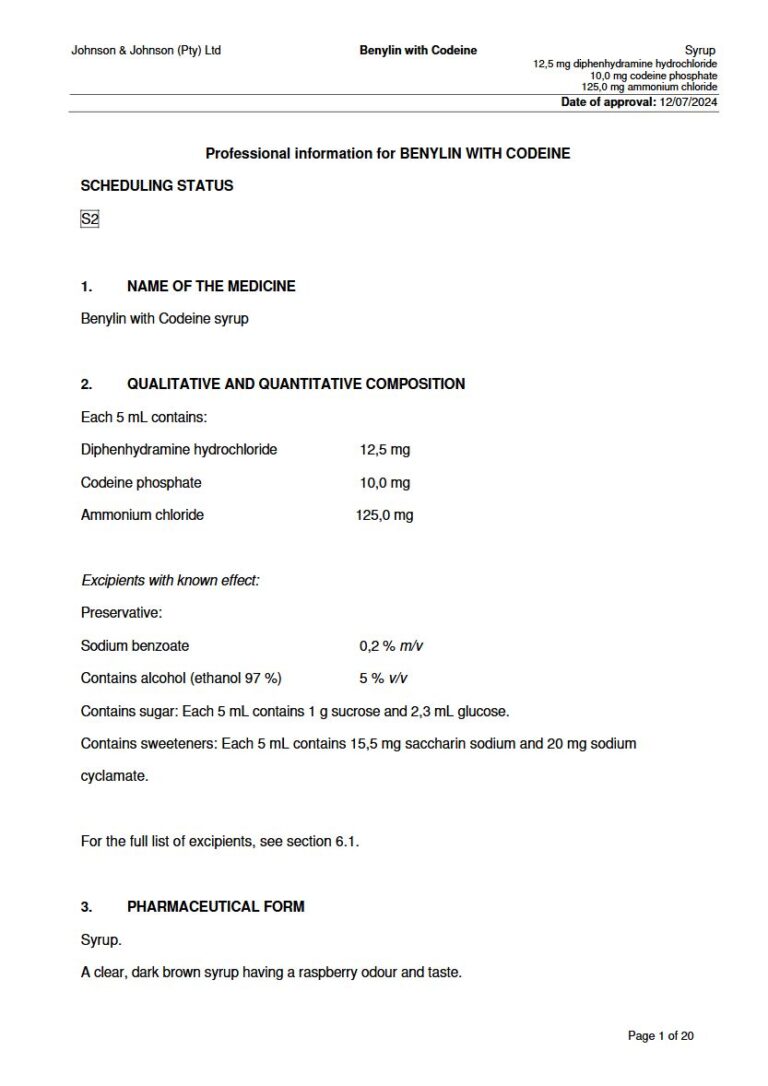
Benylin With Codeine Syrup
PDF Leaflet Revision Date: 12 July 2024
Clinical Summary
Quick overview from the medicine insert
Indication
Relief of cough.
Dosage (summary)
Adults: 5-10 mL every 4 hours, max 4 doses/day. Not for longer than 3 days.
Special Populations
- Elderly
- Renal impairment
- Hepatic impairment
Pregnancy & Breastfeeding
Contraindicated in pregnancy and breastfeeding due to risk of neonatal withdrawal syndrome and toxicity.
Key Drug Interactions
- CNS depressants
- Monoamine oxidase inhibitors
- Serotonergic medicines
Contraindications
- Hypersensitivity to ingredients
- Under 18 years
- CYP2D6 ultra-rapid metabolisers
- Acute asthma attacks
Common side effects
- Sedation
- Drowsiness
- Nausea
- Constipation
Counselling Points
- Do not exceed recommended dose
- Avoid alcohol
- Not for chronic cough
- May cause drowsiness
Serious warnings
- Risk of respiratory depression in ultra-rapid metabolisers
- Potential for addiction and misuse
Important Disclaimer
The Benylin With Codeine Syrup professional information leaflet below is the property of Johnson & Johnson and is provided on Medinsert exactly as issued, with no.. alterations or editorial changes. We make every effort to keep content current by updating documents as soon as new versions become available. Medinsert serves as a trusted access point for healthcare professionals, but does not replace official sources or clinical judgement. For more details, please read our full disclaimer. read more>>
 Healthcare Professionals Only
This content is for registered healthcare professionals
Sign in or create a free account to read the full package insert.
Free for HPCSA-registered professionals. Powered by Medinsert.
Clinical Particulars
Section 4 of the official insert — extracted exactly as issued, no alterations
4.1 Therapeutic indications
Benylin with Codeine is indicated for the relief of cough.
4.2 Posology and method of administration
A maximum of four doses per day should not be exceeded. Shake the bottle before use.
Adults 18 years and older: One to two 5 mL medicine measures (5 mL u2013 10 mL) every 4 hours. Use the lowest effective dose for the shortest duration. DO NOT USE FOR LONGER THAN 3 DAYS.
4.3 Contraindications
Known hypersensitivity to diphenhydramine hydrochloride, codeine phosphate, ammonium chloride or to any of the other ingredients in Benylin with Codeine (see section 6.1). Neither diphenhydramine hydrochloride nor codeine phosphate should be used with monoamine oxidase inhibitors or within 14 days of stopping treatment with monoamine oxidase inhibitors (see section 4.5). Contraindicated during acute asthma attacks, in the presence of acute alcoholism, head injuries and raised intracranial pressure, and in patients with impaired hepatic or renal function. Contraindicated under 18 years of age for cough. Contraindicated in CYP2D6 ultra-rapid metabolisers who convert codeine into its active metabolite more rapidly and completely than other people. These individuals may experience signs of overdose/toxicity including symptoms such as extreme sleepiness, confusion, or shallow breathing, which may be life threatening (see section 4.4 and section 5.2 u2013 Metabolism). Codeine containing products are contraindicated in breastfeeding mothers (see section 4.6).
4.4 Special warnings and precautions for use
Risk of death in ultra-rapid metabolisers of codeine: These individuals convert codeine into its active metabolite, morphine, more rapidly and completely than other people. This rapid conversion results in higher than expected serum morphine levels (see section 5.2). Even at labelled dosage regimens, ultra-rapid metabolisers of codeine may have life-threatening or fatal respiratory depression or experience signs of overdose (such as extreme sleepiness, confusion, or shallow breathing) (see section 4.9). Respiratory depression and death have occurred in children who received codeine in the postoperative period following tonsillectomy and/or adenoidectomy and had evidence of being ultra-rapid metabolisers of codeine (i.e., multiple copies of the gene for cytochrome P450 isoenzyme 2D6 or high morphine concentrations). Children who are ultra-rapid metabolisers of codeine with obstructive sleep apnoea when treated with codeine for post-tonsillectomy and/or adenoidectomy pain may be particularly sensitive to the respiratory depressant effects of codeine. Codeine is contraindicated in CYP2D6 ultra-rapid metabolisers (see section 4.3). Codeine is an opioid medicine and carries the risk of misuse and abuse. Exceeding the prescribed dose, together with prolonged and continuous use of Benylin with Codeine may lead to dependency and addiction. There is an increased risk of addiction in patients with a personal or family history of substance abuse or mental health disorders. Caution is advised and the benefit and risk of Benylin with Codeine should be carefully assessed by a health care professional based on the individual needs of each patient.
Codeine belongs to a class of medicines called opioids. Opioids have been associated with the following conditions:
- Adrenal insufficiency, a potentially life-threatening condition. Adrenal insufficiency may present with non-specific symptoms and signs such as nausea, vomiting, anorexia, fatigue, weakness, dizziness, and low blood pressure, which has been reported more often following greater than 1 month of use. Advise patient to seek medical attention if they experience a constellation of these symptoms.
- Androgen deficiency, which may present with non-specific symptoms and signs such as low libido, impotence, erectile dysfunction, amenorrhea, or infertility. Advise patient to seek medical attention if they experience any of these symptoms.
- Serotonin syndrome, a rare but potentially life-threatening condition resulting from concomitant administration of serotonergic medicines (see section 4.5). Warn patients of the symptoms of serotonin syndrome and to seek medical attention right away if symptoms develop. Instruct patients to inform their health care provider if they are taking, or plan to take serotonergic medications.
- Sleep-related breathing disorders such as sleep apnoea syndromes (including central sleep apnoea (CSA)) and hypoxia (including sleep-related hypoxia). Opioid use increases the risk of CSA in a dose dependent fashion. Advise patients to inform their health care provider if they have a history of sleep-related breathing disorders or if they experience symptoms of this disorder, for instance if anyone notices that they stop breathing whilst sleeping.
- Hyperalgesia may occur with the use of opioids, particularly at high doses. An unexplained increase in pain, or increased levels of pain can occur with increasing opioid dosages. If you are on any opioid for pain, consult a physician before using Benylin with Codeine.
Codeine should be used with caution in patients with convulsive disorders, head injuries, and in conditions in which intracranial pressure is raised (see section 4.3).
Codeine should be used with caution in patients with compromised respiratory function, such as bronchial asthma, pulmonary oedema, obstructive airways disease, acute respiratory depression, severe lung disease, obesity, obstructive sleep apnoea and in patients at risk of paralytic ileus. Codeine should be given with caution to patients with hypothyroidism, adrenocortical insufficiency, impaired liver function, prostatic hypertrophy or shock. It should be used with caution in patients with obstructive bowel disorders and in patients with myasthenia gravis. The dosage should be reduced in elderly and debilitated patients. The prolonged use of high doses of codeine has produced dependence of the morphine type. The use of Benylin with Codeine should be discontinued and quick medical attention should be sought at the earliest sign of codeine toxicity including symptoms such as extreme sleepiness, confusion, or shallow breathing, which may be life threatening. Diphenhydramine hydrochloride has anticholinergic properties and should be used with care in respiratory conditions such as emphysema, chronic bronchitis, or acute or chronic bronchial asthma and if the patient has glaucoma, urinary retention and prostatic hypertrophy. Diphenhydramine hydrochloride should be used with caution in patients with liver impairment or cardiovascular disease. Do not use with any other product containing diphenhydramine, even ones used on skin. Benylin with Codeine should not be used with alcohol.
4.5 Interactions with other medicines
The anticholinergic effects of atropine and tricyclic antidepressants may be enhanced by diphenhydramine hydrochloride. Monoamine oxidase inhibitors (MAOIs) may enhance the anticholinergic effects (see section 4.3). Diphenhydramine hydrochloride may mask the warning symptoms of damage caused by ototoxic medicines such as aminoglycoside antibiotics, and may affect the metabolism of other medicines in the liver.
CNS depressants (alcohol, sedatives, tranquilisers) Concomitant use with central nervous system depressants (e.g. barbiturates, chloral hydrate, benzodiazepines, phenothiazines, alcohol and centrally acting muscle relaxants) may cause additive CNS depression and respiratory depression. Diphenhydramine hydrochloride may enhance the sedative effect of central nervous system depressants including alcohol, barbiturates, hypnotics, narcotic analgesics, sedatives and tranquilisers. The depressant effects of codeine are enhanced by depressants of the central nervous system such as alcohol, anaesthetics, hypnotics and sedatives, phenothiazines and tricyclic antidepressants.
Opioid analgesics Concurrent use with other opioid receptor agonists may cause additive CNS depression, respiratory depression and hypotensive effects.
CYP2D6 inhibitors Codeine analgesia is believed to be dependent upon the cytochrome P450 isoenzyme CYP2D6 catalysed o-demethylation to form the active metabolite morphine although other mechanisms have been cited. An interaction with quinidine, methadone, and paroxetine (CYP2D6 inhibitors) leading to decreased plasma concentrations of morphine has been described, which may have the potential to decrease codeine analgesia.
Serotonergic medicines The concomitant use of opioids with other medicines that affect the serotonergic neurotransmitter system, such as selective serotonin reuptake inhibitors (SSRIs), serotonin and norepinephrine reuptake inhibitors (SNRIs), tricyclic antidepressants (TCAs), triptans, 5-HT3 receptor antagonists, medicines that effect the serotonin neurotransmitter system (e.g., mirtazapine, trazodone, tramadol), and monoamine oxidase inhibitors (MAOIs) (used to treat psychiatric disorders and also others, such as linezolid and intravenous methylene blue), may result in serotonin syndrome.
4.6 Fertility, pregnancy and lactation
Safety in pregnancy and lactation has not been established.
Pregnancy Codeine crosses the placenta. Neonates who have been exposed to codeine in utero can develop withdrawal syndrome (neonatal abstinence syndrome) after delivery. Cerebral infarction has been reported in this setting.
Lactation Ammonium chloride It is not known whether ammonium chloride or its metabolites are excreted in breast milk. Diphenhydramine Diphenhydramine crosses the placenta and is excreted into breast milk, but levels have not been reported. Codeine Codeine is contraindicated in breastfeeding women (see section 4.3). At labelled doses codeine and its active metabolites are present in breast milk at very low concentrations. In women with normal codeine metabolism (normal CYP2D6 activity), the amount of codeine secreted into human milk is low and dose dependent. Despite the common use of codeine products to manage postpartum pain, reports of adverse events in infants are rare. However, some women are ultra-rapid metabolisers of codeine. These women achieve higher-than-expected serum levels of codeineu2019s active metabolite, morphine, leading to higher-than-expected levels of morphine in breast milk and potentially dangerously high serum morphine levels in their breastfed infants. Deaths have occurred in nursing infants who were exposed to high levels of morphine in breast milk because their mothers were ultra-rapid metabolisers of codeine. Maternal use of codeine can lead to serious adverse reactions, including death, in nursing infants. This combination of ammonium chloride, codeine and diphenhydramine is contraindicated in breastfeeding, and should not be used during pregnancy.
4.7 Effects on ability to drive and use machines
Benylin with Codeine can cause side effects, such as drowsiness, dizziness, incoordination and blurred vision and may affect the ability to drive and use machinery. Patients should be warned not to drive a motor vehicle, operate dangerous machinery or climb dangerous heights as impaired decision making could lead to accidents.
4.8 Undesirable effects
Blood and the lymphatic system disorders Less frequent: thrombocytopenia Frequency unknown: agranulocytosis, leucopenia and haemolytic anaemia
Immune system disorders Less frequent: hypersensitivity Frequency unknown: allergic reactions, anaphylaxis
Endocrine disorders Less frequent: epigastric pain
Metabolism and nutrition disorders Less frequent: anorexia, increased appetite
Psychiatric disorders Less frequent: euphoria, confusion, changes of mood, agitation, hallucination, insomnia, irritability, nervousness
Nervous system disorders Frequent: sedation, drowsiness Less frequent: headache, restlessness, seizure, abnormal coordination, dizziness, paraesthesia, tremor
Eye disorders Less frequent: blurred vision, miosis
Ear and labyrinth disorders Less frequent: tinnitus, vertigo
Cardiac disorders Less frequent: bradycardia, palpitations, tachycardia
Vascular disorders Less frequent: hypotension, facial flushing, orthostatic hypotension
Respiratory, thoracic and mediastinal disorders Less frequent: tightness of the chest, dry throat, nasal dryness, respiratory depression
Gastrointestinal disorders Frequent: nausea, vomiting, constipation Less frequent: dry mouth, diarrhoea, dyspepsia
Skin and subcutaneous tissue disorders Less frequent: urticaria, pruritus and itching of the nose, sweating, rash, dermatitis
Musculoskeletal, connective tissue and bone disorders Less frequent: muscular weakness
Renal and urinary disorders Less frequent: difficulty in micturition, dysuria, antidiuretic effect, ureteric or biliary spasm, urinary retention
General disorders and administration site conditions Less frequent: hypothermia, asthenia, chest discomfort
Injury, poisoning and procedural complications Less frequent: increased intracranial pressure
Post-marketing experience Gastrointestinal disorders: Less frequent: Increased risk of abdominal pain, including pancreatitis. Codeine is an opioid medicine. Opioids have been associated with the following: u2022 sedation; u2022 vertigo; u2022 bronchospasm; u2022 gastrointestinal disorder, such as dyspepsia, nausea, vomiting, constipation; u2022 euphoric mood; u2022 medicine dependence can develop following long-term use of high doses.
Reporting of suspected adverse reactions: Reporting suspected adverse reactions after authorisation of Benylin with Codeine is important. It allows continued monitoring of the benefit/risk balance of Benylin with Codeine. Health care providers are asked to report any suspected adverse reactions to SAHPRA via the u201c6.04 Adverse Drug Reactions Reporting Formu201d, found online under SAHPRAu2019s publications: https://www.sahpra.org.za/Publications/Index/8. For further information, please contact the Consumer Care Contact Centre: www.kenvuecontact.eu.
4.9 Overdose
Ammonium chloride: Large doses of ammonium chloride may cause nausea, vomiting, drowsiness, thirst, headache, hyperventilation, profound acidosis and hypokalaemia. Excessive doses may give rise to hepatic encephalopathy.
Diphenhydramine hydrochloride: Overdosage may be fatal especially in infants and children. In infants & children CNS stimulations predominates over CNS depression causing ataxia, excitement, tremors, psychoses, hallucinations and convulsions; hyperpyrexia may also occur. Deepening coma and cardiorespiratory collapse may follow. In adults, CNS depression with drowsiness, coma and convulsions, progressing to respiratory failure or possibly cardiovascular collapse.
Codeine phosphate: Produces central stimulation with exhilaration and, in children, convulsions, followed by vomiting, drowsiness, respiratory depression and cyanosis, and coma.
Treatment: Naloxone hydrochloride is used to counteract the respiratory depression and coma produced by excessive doses of codeine. A dose of 0,4 to 2 mg is given intravenously, repeated at intervals of 2 to 3 minutes if necessary, up to 10 mg. In children, an initial dose of 10 u03bcg per kg body weight may be given intravenously followed, if necessary, by a larger dose of 100 u03bcg per kg. Further treatment is symptomatic and supportive.
