
Bilocor Tablets
PDF Leaflet Revision Date: 18 October 2024
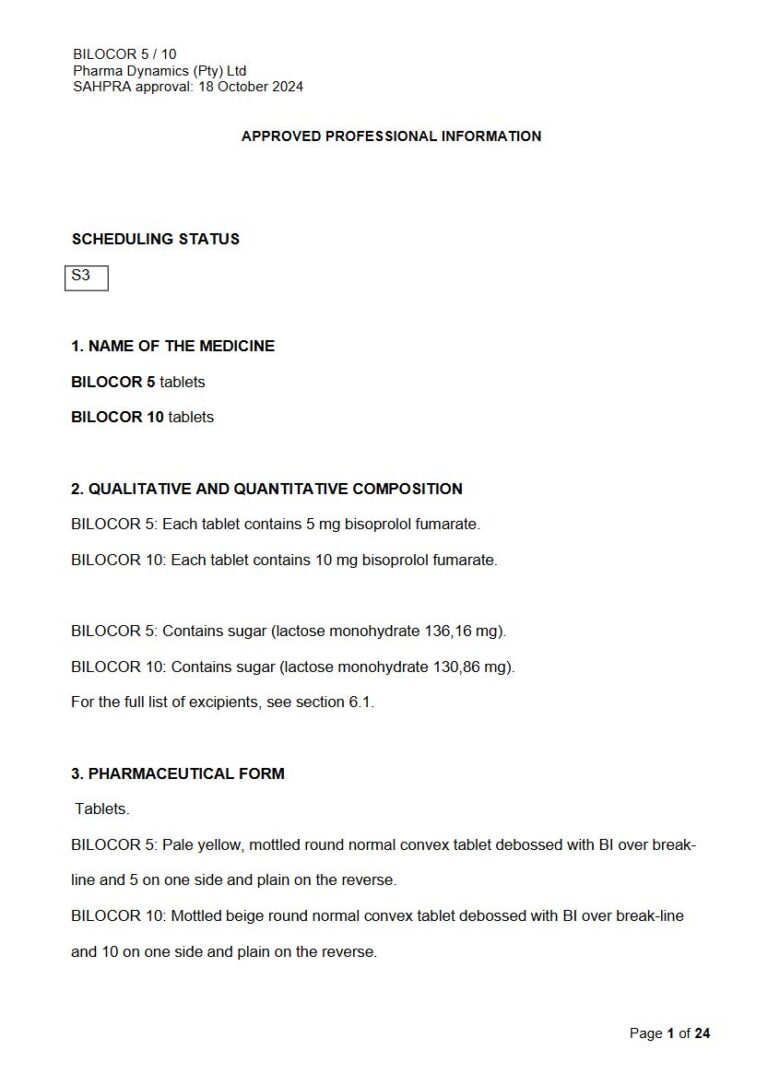
Clinical Summary
Quick overview from the medicine insert
Indication
Management of mild to moderate hypertension and angina pectoris.
Dosage (summary)
Adults: 5 to 10 mg once daily; max 20 mg.
Special Populations
- Elderly
- Hepatic impairment
- Renal impairment
Pregnancy & Breastfeeding
Contraindicated in pregnancy and breastfeeding.
Key Drug Interactions
- Calcium antagonists
- Clonidine
- Antiarrhythmic agents
- NSAIDs
Contraindications
- Hypersensitivity to bisoprolol
- Uncontrolled asthma
- Heart block
- Uncontrolled cardiac failure
Common side effects
- Bradycardia
- Hypotension
- Dizziness
- Fatigue
Counselling Points
- Take in the morning with or without food
- Do not stop abruptly
- Monitor for signs of bradycardia
Serious warnings
- Abrupt discontinuation may exacerbate angina
- Caution in heart failure
Important Disclaimer
The Bilocor Tablets professional information leaflet below is the property of Pharma Dynamics and is provided on Medinsert exactly as issued, with no.. alterations or editorial changes. We make every effort to keep content current by updating documents as soon as new versions become available. Medinsert serves as a trusted access point for healthcare professionals, but does not replace official sources or clinical judgement. For more details, please read our full disclaimer. read more>>
 Healthcare Professionals Only
This content is for registered healthcare professionals
Sign in or create a free account to read the full package insert.
Free for HPCSA-registered professionals. Powered by Medinsert.
Clinical Particulars
Section 4 of the official insert — extracted exactly as issued, no alterations
4.1 Therapeutic indications
BILOCOR is indicated for the management of mild to moderate hypertension and angina pectoris. BILOCOR may be used alone or in combination with other hypertensive medicines.
4.2 Posology and method of administration
Posology
Adults: 5 to 10 mg once a day in the morning with or without food. The dose must be individualised according to response and tolerance. The maximum recommended daily dose is 20 mg daily. In those patients treated for angina pectoris, no benefit was shown by increasing the dose to 20 mg once daily.
Special populations
Hepatic and/or renal insufficiency: In patients with liver or kidney function disorders of mild to moderate severity, no dosage adjustment is normally required. There is only limited experience with the use of BILOCOR in dialysis patients. There are no indications of the necessity to alter the dose regimen.
Severe renal impairment (creatinine clearance < 20 mL/min) or severe hepatic impairment: Do not exceed the daily dose of 10 mg.
Elderly: The normal dose should be reduced in these patients.
Paediatric population
The safety and efficacy of BILOCOR in children have not yet been established. No data are available.
Method of administration
The tablets are to be swallowed whole with some liquid in the morning before, during or after breakfast. The duration of treatment is not limited. It depends upon the nature and severity of the disease. BILOCOR therapy should not be stopped abruptly, particularly not in patients with ischaemic heart disease, as this may lead to acute deterioration of the patientu2019s state of health (see section 4.4). If discontinuation of therapy becomes necessary, the dose should be gradually reduced (e.g. halving of the dose at weekly intervals). BILOCOR can be divided into equal halves if required.
4.3 Contraindications
- hypersensitivity to bisoprolol or to any of the ingredients of BISOPROLOL (see section 6.1)
- uncontrolled asthma
- second and third-degree heart block (without a pacemaker) and bradycardia (less than 50 beats per minute u2013 sick sinus syndrome)
- pregnancy and lactation (see section 4.6)
- uncontrolled cardiac failure
- metabolic acidosis
- sinus bradycardia (less than 50 beats per minute)
- phaeochromocytoma before full alpha blockade is achieved (see section 4.4)
- hyperthyroidism, as clinical manifestations may be masked
- cardiogenic shock
- sinoatrial block
- symptomatic hypotension
- peripheral arterial occlusive disease and Raynaudu2019s phenomenon
- the safety and efficacy in children have not been established.
4.4 Special warnings and precautions for use
Discontinuation
Abrupt discontinuation of therapy with BILOCOR may cause exacerbation of angina pectoris in patients suffering from ischaemic heart disease. Discontinuation of BILOCOR should be gradual, and patients should be advised to limit the extent of their physical activity during the period that the medicine is being discontinued.
Caution is warranted when treating patients with hypertension or angina pectoris and concomitant heart failure with BILOCOR. Digitalisation of patients receiving long-term beta-blocker therapy including BILOCOR may be necessary if congestive cardiac failure is likely to develop. This combination can be considered despite the potentiation of the negative chronotropic effect of the two medicines. Careful control of dosages, and of the individual patient's response (and notably pulse rate), is essential in this situation.
It is dangerous to administer BILOCOR concomitantly with the following medicines: hypoglycaemic medicines, phenothiazines and various antiarrhythmic agents. Such drug-drug interactions can have life-threatening consequences (see section 4.5).
General anaesthesia
If the decision is made to withdraw BILOCOR before anaesthesia, at least 48 hours should be allowed to elapse between the last dose and surgery. If the medicine is to be continued, care should be taken when using anaesthetics such as ether, cyclopropane and trichloroethylene. Atropine (1-2 mg I.V.) may be used to correct vagal dominance. The patient must be maintained on their usual dosage peri-operatively to avoid aggravation of angina pectoris or hypertension. In the peri-operative period, it is generally unwise to reduce the dosage to which the patient is accustomed, as there may be danger of aggravation of angina pectoris or hypertension. A patientu2019s normal tachycardic response to hypovolaemia or blood loss may be obscured during or after surgery. The anaesthetist must be made aware of beta-blockade because of the potential for interactions with other medicines as indicated above. Tachycardia responses may be obscured.
BILOCOR may be used only with special caution in the following instances:
- diabetes mellitus, as symptoms and signs of hypoglycaemia may be masked, and as responses to hypoglycaemia (e.g. tachycardia, palpitations or sweating) is diminished
- strict fasting
- ongoing desensitisation therapy. As with other beta-blockers, bisoprolol may increase both the sensitivity towards allergens and the severity of anaphylactic reactions. Epinephrine (adrenaline) treatment does not always yield the expected therapeutic effect
- first degree AV block.
- in patients with Prinzmetalu2019s angina, as cases of coronary vasospasm have been observed. Despite its high beta1-selectivity, angina attacks cannot be completely excluded when BILOCOR is administered to patients with Prinzmetalu2019s angina
- peripheral arterial occlusive disease (intensification of complaints may occur especially when starting therapy). The following may occur: exacerbation of peripheral vascular disease, or the development of Raynaud's phenomenon (due to unopposed arteriolar alpha-sympathetic activation), sexual impotence, hypoglycaemia, skeletal muscle weakness and gastro-intestinal disturbances. Severe peripheral vascular disease and even peripheral gangrene may be precipitated. Adverse reactions are more common in patients with renal decompensation, and in patients who receive BILOCOR intravenously
- care should be taken in prescribing BILOCOR together with Class 1 anti-dysrhythmic medicines such as disopyramide, myocardial depressants and inhibitors of AV conduction such as calcium antagonists (see section 4.5).
- The normal dose should be reduced in elderly patients.
- The dosage of BILOCOR should be adjusted in severe renal impairment (see section 4.2).
- Chronic pulmonary diseases
- Bronchoconstriction may occur in patients suffering from asthma, bronchitis and other chronic pulmonary diseases. Congestive cardiac failure and marked bradycardia may also manifest. A variety of neuropsychiatric disorders, ranging from vague fatigue and nightmares to overt psychosis, have been observed.
- Asthma and Chronic Obstructive Pulmonary Disease: Although cardioselective (u03b21) beta-blockers may have less effect on lung function than non-selective beta-blockers, as with all beta-blockers, these should be avoided in patients with obstructive airways diseases, unless there are compelling clinical reasons for their use. Where such reasons exist, BILOCOR may be used with caution. In patients with obstructive airways diseases, the treatment with BILOCOR should be started at the lowest possible dose and patients should be carefully monitored for new symptoms (e.g. dyspnea, exercise intolerance, cough). In bronchial asthma or other chronic obstructive lung diseases, which may cause symptoms, bronchodilating therapy should be given concomitantly. Occasionally an increase of the airway resistance may occur in patients with asthma, therefore the dose of u03b22-stimulants may have to be increased.
- Psoriasis: Patients with psoriasis or with a history of psoriasis must only be given BILOCOR after careful consideration.
- Clonidine: Caution should be exercised when transferring a patient from clonidine, as the withdrawal of clonidine may result in the release of large amounts of catecholamines that may give rise to a hypertensive crisis (see section 4.5). If BILOCOR is administered in these circumstances, the unopposed alpha-receptor stimulation may potentiate this effect. If BILOCOR and clonidine are given concurrently, the clonidine should not be discontinued until several days after the withdrawal of BILOCOR, as severe rebound hypertension may occur.
- Impaired ventricular function: BILOCOR should be used with caution in combination with verapamil in patients with impaired ventricular function (see section 4.5). This combination should not be given to patients with conduction abnormalities. Neither medicine should be administered intravenously within 48 hours of discontinuing the other. The intravenous administration of calcium antagonists and antiarrhythmic medicines is not recommended during therapy with BILOCOR (see section 4.5).
- Hyperthyroidism: The symptoms of hyperthyroidism may be masked under treatment with BILOCOR.
- Pheochromocytoma: Patients with phaeochromocytoma usually require treatment with an alpha-adrenergic blocker. BILOCOR must therefore not be administered until after full alpha-receptor blockade has been established. Beta blockade is seldom required in the peri-operative preparation of these patients.
- Information on excipients of BILOCOR: BILOCOR contains lactose. Patients with rare hereditary problems of galactose intolerance, total lactase deficiency or glucose-galactose malabsorption should not take this medicine.
- Paediatric population: Safety and efficacy of BILOCOR have not been established in children.
4.5 Interaction with other medicines and other forms of interaction
Combinations not recommended
Calcium antagonists of the verapamil type and to a lesser extent of the diltiazem type: Negative influence on contractility and atrio-ventricular conduction. Intravenous administration of verapamil in patients on u03b2-blocker treatment may lead to profound hypotension and atrioventricular block.
Centrally acting antihypertensive drugs such as clonidine and others (e.g. methyldopa, moxonidine, rilmenidine): Concomitant use of centrally acting antihypertensive medicines may worsen heart failure by a decrease in the central sympathetic tonus (reduction of heart rate and cardiac output, vasodilation). Abrupt withdrawal, particularly if prior to u03b2-blocker discontinuation, may increase risk of u201crebound hypertensionu201d. If the two medicines are co-administered, the u03b2-blocker should be withdrawn several days before discontinuing clonidine. If replacing clonidine by u03b2-blocker therapy, the introduction of u03b2-blockers should be delayed for several days after clonidine administration has stopped.
Combinations to be used with caution
Calcium antagonists of the dihydropyridine type such as nifedipine, felodipine and amlodipine: Concomitant use may increase the risk of hypotension, and an increase in the risk of a further deterioration of the ventricular pump function in patients with heart failure cannot be excluded.
Class-III antiarrhythmic medicines (e.g. amiodarone): Effect on atrio-ventricular conduction time may be potentiated.
Class I antiarrhythmic medicines (e.g. quinidine, disopyramide; lidocaine, phenytoin; flecainide, propafenone): Effect on atrioventricular conduction time may be potentiated and negative inotropic effect increased.
Topical u03b2-blockers (e.g. eye drops for glaucoma treatment): May add to the systemic effects of BILOCOR.
Parasympathomimetic medicines: Concomitant use may increase atrio-ventricular conduction time and the risk of bradycardia.
Insulin and oral antidiabetic medicines: Increase of blood sugar lowering effect. Blockade of u03b2-adrenoreceptors may mask symptoms of hypoglycaemia (see section 4.4).
Anaesthetic medicines: Attenuation of the reflex tachycardia and increase of the risk of hypotension (see section 4.4).
Digitalis glycosides: Reduction of heart rate, increase of atrio-ventricular conduction time. BILOCOR and digoxin may be used concomitantly for patients with congestive heart failure provided that the pulse rate and patient response is monitored.
Non-steroidal anti-inflammatory drugs (NSAIDs): NSAIDs may reduce the hypotensive effect of BILOCOR.
Beta-sympathomimetics (e.g. dobutamine): Combination with BILOCOR may reduce the effect of both agents. Higher doses of epinephrine (adrenaline) may be necessary for treatment of allergic reactions.
Sympathomimetics that activate both u03b2- and u03b1-adrenoceptors (e.g. noradrenaline, adrenaline): Combination with BILOCOR may unmask the u03b1-adrenoceptor-mediated vasoconstrictor effects of these medicines leading to blood pressure increase and exacerbated intermittent claudication. Such interactions are considered to be more likely with nonselective u03b2-blockers.
Beta-adrenoceptor stimulating medicines: (e.g. isoprenaline) may antagonise the effects of BILOCOR.
Alpha-adrenoceptor stimulants as well as adrenergic neurone blocking medicines such as guanethidine and reserpine: May lead to life-threatening vasoconstriction in combination with BILOCOR.
Concomitant use with antihypertensive medicines as well as with other medicines with blood pressure lowering potential (e.g. tricyclic antidepressants, barbiturates, phenothiazines): May increase the risk of hypotension. The concomitant use of BILOCOR with phenothiazines and various anti-dysrhythmic medicines can have life-threatening consequences, e.g. myocardial depression with anti-dysrhythmic medicines.
Combinations to be considered
Mefloquine: Increased risk of bradycardia.
Monoamine oxidase inhibitors (except MAO-B inhibitors): Enhanced hypotensive effect of the u03b2-blockers but also risk for hypertensive crisis.
Rifampicin: Slight reduction of the half-life of bisoprolol possibly due to the induction of hepatic drug-metabolising enzymes. Normally no dosage adjustment is necessary.
Ergotamine derivatives: Exacerbation of peripheral circulatory disturbances. In high-dose salicylate administration the toxic effect of salicylates on the central nervous system may be enhanced.
4.6 Fertility, pregnancy and lactation
Pregnancy
BILOCOR is contraindicated in pregnancy (see section 4.3). Administration of BILOCOR to pregnant mothers shortly before birth or during labour may result in hypotonia, collapse or hypoglycaemia in the newborn. BILOCOR reduces placental perfusion, which has been associated with growth retardation, intrauterine death, abortion or early labour.
Breastfeeding
BILOCOR is contraindicated during breastfeeding (see section 4.3). It is not known whether BILOCOR is excreted in human breastmilk.
Fertility
No effect on fertility was observed in male or female rats treated with bisoprolol at oral doses up to 150 mg/kg/day.
4.7 Effects on ability to drive and use machines
BILOCOR has no or negligible influence on the ability to drive or use machinery. However, due to individual variations in reactions to BILOCOR (e.g. dizziness or fatigue), the ability to drive a vehicle or to operate machinery may be impaired. This should be considered particularly at start of treatment and upon change of medicine, as well as in conjunction with alcohol.
4.8 Undesirable effects
Tabulated list of adverse effects
System Organ Class Frequency Side effects
Blood and lymphatic system disorders Less frequent Leukopenia and thrombocytopenia
Immune system disorders Less frequent Hypersensitivity (allergic) reactions
Metabolism and nutrition disorders Frequency unknown Metabolic disturbances, hypoglycaemia, increase in uric acid levels, hypercholesterolaemia
Psychiatric disorders Less frequent Frequency unknown Sleep disorders or trouble sleeping, mental depression, nightmares and vivid dreams, hallucinations, confusion, Psychosis
Nervous system disorders Frequent Less frequent Frequency unknown Drowsiness, unusual tiredness or weakness, dizziness, mild headache, Anxiety, nervousness, syncope, Restlessness, lassitude, paraesthesia
Eye disorders Less frequent Frequency unknown Dry, sore eyes, reduced tear flow (to be considered if the patient uses lenses), conjunctivitis, Disturbances of vision
Ear and labyrinth disorders Frequency unknown Transient hearing loss
Cardiac disorders Frequent Less frequent Frequency unknown Bradycardia, Worsening of pre-existing cardiac failure, dysrhythmias, reduced peripheral circulation, Heart block, fluid retention
Vascular disorders Frequent Less frequent Frequency unknown Cold extremities, hypotension, Orthostatic hypotension, Exacerbation of peripheral vascular disease or the development of Raynaudu2019s phenomenon, peripheral gangrene may be precipitated
Respiratory, thoracic and mediastinal disorders Less frequent Bronchoconstriction or bronchospasm may occur in patients suffering from asthma, bronchitis and other chronic pulmonary diseases, nasal congestion, allergic rhinitis
Gastrointestinal disorders Frequent Frequency unknown Nausea, vomiting, diarrhoea, constipation, Mass gain, stomatitis
Hepatobiliary disorders Less frequent Frequency unknown Hepatotoxicity, hepatitis, Raised liver enzymes
Skin and subcutaneous tissue disorders Less frequent Frequency unknown Skin rash, psoriasiform eruption, pruritus, flush, angioedema, alopecia. Beta-blockers may provoke or worsen psoriasis or induce psoriasis-like rash, Perspiration
Musculoskeletal, connective tissue and bone disorders Less frequent Frequency unknown Back pain or joint pain, chest pain, muscle cramps, skeletal muscle weakness, Myopathy
Reproductive system and breast disorders Less frequent Decreased sexual ability or impotence, sexual dysfunction
General disorders and administrative site conditions Less frequent Asthenia, fatigue
Investigations Less frequent Increased triglycerides, increased liver enzymes (ALAT, ASAT).
Description of selected adverse reactions
Adverse reactions are more common in patients with renal decomposition.
Reporting of suspected adverse reactions
Reporting suspected adverse reactions after authorisation of the medicine is important. It allows continued monitoring of the benefit/risk balance of the medicine. Healthcare professionals are asked to report any suspected adverse reactions to SAHPRA via the online service for adverse drug reaction reporting by using either of the following links: https://www.sahpra.org.za/document/adverse-drug-reactions-and-quality-problem-reporting-form/ or https://www.sahpra.org.za/Publications/Index/8. An email can be sent directly to the company, [email protected], to ensure safety of the product.
4.9 Overdose
Signs and symptoms
In general, the most common signs expected with overdosage of a beta-blocker are bradycardia, hypotension, bronchospasm, acute cardiac insufficiency and hypoglycaemia. There is limited experience with overdose of bisoprolol, only a few cases of overdose with bisoprolol have been reported. Bradycardia and severe hypotension were noted. All patients recovered. There is a wide inter-individual variation in sensitivity to one single high dose of bisoprolol and patients with heart failure are probably very sensitive.
Management of overdose
Cases of overdose should be observed for at least 4 hours, as apnoea and cardiovascular collapse may appear suddenly. Repeated activated charcoal may be necessary in overdose. If overdose occurs, BILOCOR treatment should be stopped and supportive and symptomatic treatment should be provided. Limited data suggest that bisoprolol is hardly dialysable. Based on the expected pharmacologic actions and recommendations for other beta-blockers, the following general measures should be considered when clinically warranted.
Bradycardia: Atropine may be used to treat severe bradycardia. If the response is inadequate, glucagon may be given intravenously. Alternatively, dobutamine may be required to reverse beta-blockade. Intravenous cardiac pacing may be required for severe bradycardia.
Hypotension: Intravenous fluids and vasopressors should be administered. Intravenous glucagon may be useful.
AV block (second or third degree): Patients should be carefully monitored and treated with isoprenaline infusion or transvenous cardiac pacemaker insertion.
Bronchospasm: Bronchospasm should be treated with I.V. aminophylline or inhaled or I.V. beta-agonist e.g. salbutamol.
Hypoglycaemia: Administer I.V. glucose.
