
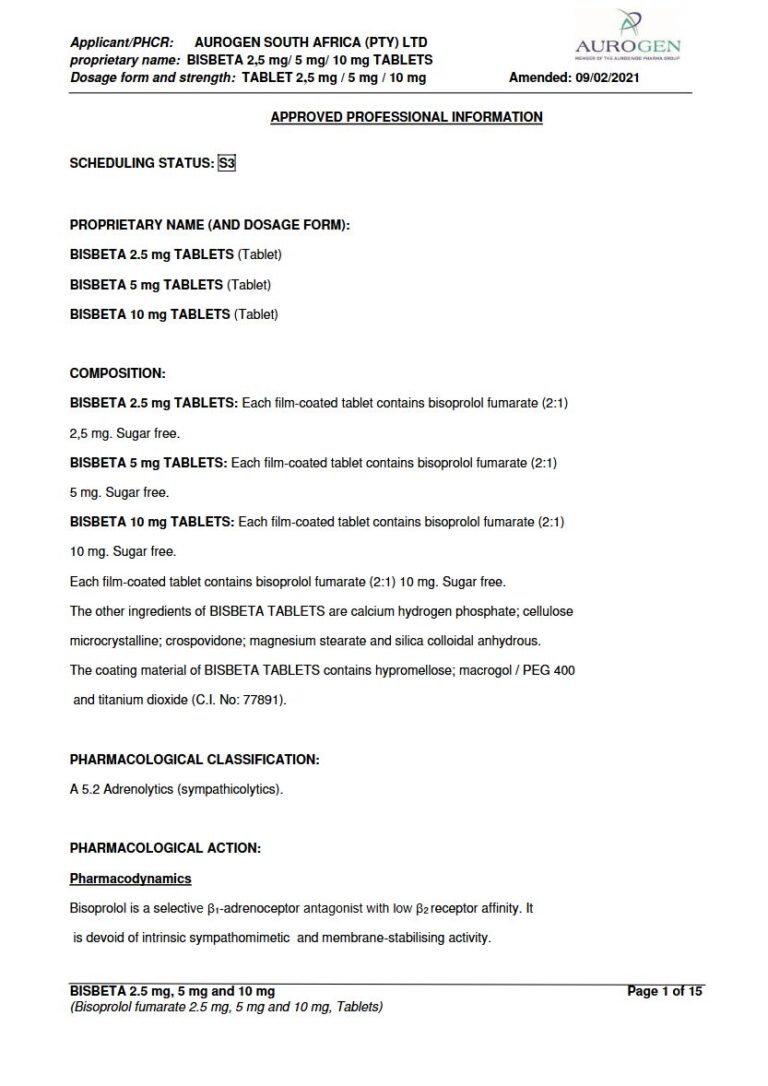
Bisbeta Tablets
PDF Leaflet Revision Date: 11 February 2022
Clinical Summary
Quick overview from the medicine insert
Indication
Treatment of stable chronic heart failure with reduced systolic function.
Dosage (summary)
Start with 1.25 mg daily, titrate to max 10 mg once daily.
Onset of Action / Duration
Onset: 3 hours, Duration: 24 hours
Special Populations
- Elderly
- Renal impairment
- Hepatic impairment
Pregnancy & Breastfeeding
Contraindicated in pregnancy and lactation due to risk of hypotonia in newborn.
Key Drug Interactions
- Hypoglycaemic agents
- Calcium antagonists
- Clonidine
- Antidysrhythmic agents
Contraindications
- Acute heart failure
- Cardiogenic shock
- AV block
- Severe asthma
- Bradycardia
Common side effects
- Dizziness
- Fatigue
- Nausea
- Cold extremities
- Bradycardia
Counselling Points
- Monitor blood pressure and heart rate
- Avoid sudden discontinuation
- Inform anaesthetist before surgery
Serious warnings
- Caution in diabetes
- Risk of bronchospasm
- Do not discontinue abruptly
Important Disclaimer
The Bisbeta Tablets professional information leaflet below is the property of Aurogen South Africa and is provided on Medinsert exactly as issued, with no.. alterations or editorial changes. We make every effort to keep content current by updating documents as soon as new versions become available. Medinsert serves as a trusted access point for healthcare professionals, but does not replace official sources or clinical judgement. For more details, please read our full disclaimer. read more>>
 Healthcare Professionals Only
This content is for registered healthcare professionals
Sign in or create a free account to read the full package insert.
Free for HPCSA-registered professionals. Powered by Medinsert.
Clinical Particulars
Section 4 of the official insert — extracted exactly as issued, no alterations
4.1 Therapeutic indications
BISBETA TABLETS are indicated for the treatment of stable chronic moderate to severe heart failure with reduced systolic ventricular function (ejection fraction < 35 %, based on echocardiography) in addition to ACE inhibitors, and diuretics, and optionally digoxin, prior to the administration of BISBETA TABLET. The patients should have stable chronic heart failure without acute failure during the previous six weeks and an unchanged basic therapy during the previous two weeks. They should be treated at optimal dose with an ACE inhibitor (or other vasodilator in case of intolerance to ACE inhibitors) and a diuretic, and optionally digoxin, prior to the administration of BISBETA TABLETS. It is recommended that the treating medical practitioner should be experienced in the management of chronic heart failure.
4.2 Posology and method of administration
The treatment of stable chronic heart failure with BISBETA TABLETS has to be initiated with a titration phase as given in the description below: The treatment with BISBETA TABLETS is to be started with a gradual uptitration according to the following steps:
- 1,25 mg once daily for 1 week, if well tolerated increase to
- 2.5 mg once daily for a further week, if well tolerated increase to
- 3.75 mg once daily for a further week, if well tolerated increase to
- 5 mg once daily for the 4 following weeks, if well tolerated increase to
- 10 mg once daily for maintenance therapy.
After initiation of treatment with 1,25 mg, the patients should be observed over a period of approximately 4 hours (especially as regards blood pressure, heart rate, conduction disturbances, signs of worsening of heart failure). The maximum recommended dose is 10 mg once daily. Occurrence of adverse events may prevent all patients being treated with the maximum recommended dose. If necessary, the dose reached can also be decreased step by step. The treatment may be interrupted if necessary and reintroduced as appropriate. During the titration phase, in case of worsening of the heart failure or intolerance, it is recommended first to reduce the dose of BISBETA TABLETS, or to stop immediately if necessary (in case of severe hypotension, worsening of heart failure with acute pulmonary oedema, cardiogenic shock, symptomatic bradycardia or AV block). Treatment of stable chronic heart failure with BISBETA TABLETS is generally a long-term treatment. The treatment with BISBETA TABLETS is not recommended to be stopped abruptly since this might lead to transitory worsening of heart failure. If discontinuation is necessary, the dose should be gradually decreased divided into halves weekly.
4.3 Contraindications
BISBETA TABLETS are contra-indicated in chronic heart failure patients with:
- hypersensitivity to bisoprolol or to any of the ingredients
- acute heart failure or during episodes of heart failure decompensation requiring i.v. inotropic therapy
- cardiogenic shock
- AV block of second or third degree (without a pacemaker)
- sick sinus syndrome
- sinoatrial block
- bradycardia with less than 50 beats/min before the start of therapy
- hypotension (systolic blood pressure less than 100 mm Hg)
- bronchial asthma, bronchitis and severe chronic obstructive pulmonary disease
- peripheral arterial occlusive disease
- Raynaudu2019s syndrome
- phaeochromocytoma
- metabolic acidosis
- pregnancy and lactation (see Pregnancy and Lactation)
- hyperthyroidism, as clinical manifestations may be masked
- peripheral vascular disease
- sinus bradycardia
4.4 Special warnings and precautions for use
BISBETA TABLETS must be used with caution in:
- concomitant treatment with inhalation anaesthetics
- diabetes mellitus with large fluctuations in blood glucose values; symptoms of hypoglycaemia can be masked, and as responses to hypoglycaemia are diminished
- strict fasting
- ongoing desensitisation therapy
- AV block of first degree
- Prinzmetalu2019s angina
- peripheral arterial occlusive disease (intensification of complaints might happen especially during the start of therapy)
There is no therapeutic experience of BISBETA TABLETS treatment in heart failure in patients with the following diseases and conditions:
- NYHA class II heart failure
- insulin dependent diabetes mellitus (type I)
- impaired renal function (serum creatinine <80 ml/min)
- impaired liver function
- patients older than 80 years
- restrictive cardiomyopathy
- congenital heart disease
- haemodynamically significant organic valvular disease
- myocardial infarction within 3 months
u03b2-blockers, such as BISBETA TABLETS, may cause bronchospasm in patients with asthma (see CONTRAINDICATIONS). Bisoprolol may increase both the sensitivity towards allergens and the severity of anaphylactic reactions. Epinephrine adrenaline treatment does not always give the expected therapeutic effect. Psoriasis may be aggravated by BISBETA TABLETS. The symptoms of a thyrotoxicosis may be masked under treatment with BISBETA TABLETS. Initiation of treatment with BISBETA TABLETS necessitates regular monitoring. The cessation of therapy with BISBETA TABLETS should not be done abruptly unless clearly indicated. Patients should be advised to limit the extent of their physical activity during the period in which BISBETA TABLETS is being discontinued. A patientu2019s normal tachycardiac response to hypovolaemia or blood loss may be obscured during or after surgery. Particular caution should be taken in this regard. In the event of surgery, the anaesthetist should be informed of therapy with BISBETA TABLETS prior to any operation. If the decision is made to withdraw BISBETA TABLETS before anaesthesia, at least 48 hours should be allowed to elapse between the last dose and surgery. If the medicine is to be continued, care should be taken when using halogenated anaesthetics. Atropine (1 u2013 2 mg I.V.) may be used to correct vagal dominance. The patient must be maintained on their usual dosage perioperatively. In the perioperative period it is generally unwise to reduce the dosage to which the patient is accustomed, as there may be danger of aggravation of angina pectoris or hypertension. In patients suffering from ischaemic heart disease, treatment should not be discontinued abruptly. The dosage of BISBETA TABLETS should be adjusted in severe renal impairment.
4.5 Interactions with other medicines
Care should be taken in prescribing BISBETA TABLETS together with Class 1 antidysrhythmic agents such as disopyramide, myocardial depressants and inhibitors of AV conduction such as calcium antagonists. Caution should be exercised when transferring a patient from clonidine, as the withdrawal of clonidine may result in the release of large amounts of catecholamines that may give rise to a hypertensive crisis. If BISBETA TABLETS are administered in these circumstances, the unopposed alpha receptor stimulation may potentiate this effect. If BISBETA TABLETS and clonidine are given concurrently, the clonidine should not be discontinued until several days after the withdrawal of BISBETA TABLETS, as severe rebound hypertension may occur. BISBETA TABLETS should be used with caution in combination with verapamil in patients with impaired ventricular function. This combination should not be given to patients with conduction abnormalities. Neither medicine should be administered intravenously within 48 hours of discontinuing the other. The intravenous administration of calcium antagonists and antidysrthythmic agents is not recommended during therapy with BISBETA TABLETS. The intravenous administration of verapamil in patients on treatment with BISBETA TABLETS may lead to profound hypotension and atrioventricular block. BISBETA TABLETS modifies the tachycardia associated with hypoglycaemia. Patients with phaeochromocytoma usually require treatment with an alpha-adrenergic blocker. BISBETA TABLETS may increase both the sensitivity towards allergens and the severity of anaphylactic reactions. Adrenaline treatment does not always give the expected therapeutic effect. BISBETA TABLETS may mask the symptoms of hyperthyroidism.
4.6 Fertility, pregnancy and lactation
Administration of BISBETA TABLETS to pregnant mothers shortly before birth or during labour may result in hypotonia, collapse or hypoglycaemia in the newborn. (See CONTRA-INDICATIONS).
4.7 Effects on ability to drive and use machines
BISBETA TABLETS may cause drowsiness and dizziness. Do not drive or use any tools or machines until you know how the tablets affect you.
4.8 Undesirable effects
Blood and the lymphatic system disorders
- Less frequent: leukopenia, thrombocytopenia, agranulocytosis, non thrombocytopenia purpura, transient eosinophilia
Immune system disorders
- Less frequent: hypersensitivity reactions (itching, flush, rash), systemic lupus erythematosus (SLE)
Metabolism and nutrition disorders
- Less frequent: metabolic disturbances
- Frequency unknown: Hypoglycaemia, hyperglycaemia, increase in uric acid levels, hypercholesterolaemia, changed in blood concentrations of triglycerides.
Psychiatric disorders
- Less frequent: sleep disturbances, depression, nightmares, hallucinations, overt psychosis has been observed with other beta-blockers.
Nervous system disorders
- Frequent: lassitude, fatigue, dizziness, mild headache, tiredness, exhaustion, dizziness, Headache (these symptoms generally occur at the beginning of treatment).
- Less frequent: sleep disorders, coma, convulsions
Eye disorders
- Frequency unknown: conjunctivitis, decreased tear production, blurred vision, soreness, disturbances of vision
Ear and labyrinth disorders
- Less frequent: transient hearing loss, hearing impairment
Cardiac disorders
- Less frequent: bradycardia, heart block, fluid retention, syncope, congestive cardiac failure, AV-stimulus disturbances, worsening of heart failure, orthostatic hypotension
Vascular disorders
- Frequent: cold extremities, hypotension, paraesthesia, feeling of coldness and numbness in the extremities
- Less frequent: paradoxical hypertension, exacerbation of peripheral vascular disease or the development of Raynaudu2019s phenomenon, restlessness, severe peripheral vascular disease and peripheral gangrene
Respiratory, thoracic and mediastinal disorders
- Less frequent: bronchospasm in patients with bronchial asthma or history of obstructive airways disease, shortness of breath, dyspnea, pneumonia, pulmonary fibrosis, pleurisy
Gastrointestinal disorders
- Frequent: nausea, vomiting, diarrhoea, constipation, abdominal cramping, other gastro-intestinal disturbances, nausea, vomiting, diarrhoea, constipation
- Frequency not known: stomatitis
Hepato-biliary disorders
- Less frequent: hepatotoxicity, hepatitis
Skin and subcutaneous tissue disorders
- Frequent: perspiration
- Less frequent: skin rash, allergic reactions
- Very rare: alopecia, rashes, pruritus, exacerbation of psoriasis
Musculoskeletal, connective tissue and bone disorders
- Less frequent: muscle weakness, cramps, myopathies, back and joint pain
Reproductive system and breast disorders
- Less frequent: potency disorders
General disorders and administrative conditions
- Less frequent: mass gain, asthenia
Adverse reactions are more common in patients with renal decompensation.
4.9 Overdose
Overdosage may produce bradycardia and severe hypotension. Bronchospasm and heart failure may be produced in certain individuals. Cases of mild overdose should be observed for at least 4 hours, as apnoea and cardiovascular collapse may appear suddenly. Gastric lavage should be performed within four hours of suspected overdose. Repeated activated charcoal may be necessary in overdose. Atropine may be used to treat severe bradycardia. If the response is inadequate, glucagon may be given intravenously. Alternatively, dobutamine may be required to reverse beta-blockade. Cardiac pacing may be required for severe bradycardia. Bronchospasm should be treated with IV aminophylline or inhaled or IV beta-agonist e.g. salbutamol.
