
Bio Metronidazole Injection
PDF Leaflet Revision Date: 20 October 2025
Clinical Summary
Quick overview from the medicine insert
Indication
Treatment and prevention of anaerobic infections.
Dosage (summary)
100 mL (500 mg) IV every 8 hours for treatment; same dose for prevention before and after surgery.
Special Populations
- Hepatic impairment
- Renal impairment
- Paediatric population
Pregnancy & Breastfeeding
Contraindicated in pregnancy and breastfeeding.
Key Drug Interactions
- Alcohol
- Warfarin
- Lithium
- Ciclosporin
- Busulfan
Contraindications
- Hypersensitivity to metronidazole
- End stage liver damage
- Blood dyscrasias
- Active CNS diseases
Common side effects
- Nausea
- Dizziness
- Headache
- Peripheral neuropathy
- Leukopenia
Counselling Points
- Avoid alcohol during and 1-3 days after treatment
- Monitor for signs of liver injury
- Report any CNS symptoms immediately
Serious warnings
- Hepatic impairment caution
- Potential for severe hepatotoxicity
- Risk of CNS toxicity with prolonged use
Important Disclaimer
The Bio Metronidazole Injection professional information leaflet below is the property of Biotech Laboratories and is provided on Medinsert exactly as issued, with no.. alterations or editorial changes. We make every effort to keep content current by updating documents as soon as new versions become available. Medinsert serves as a trusted access point for healthcare professionals, but does not replace official sources or clinical judgement. For more details, please read our full disclaimer. read more>>
 Healthcare Professionals Only
This content is for registered healthcare professionals
Sign in or create a free account to read the full package insert.
Free for HPCSA-registered professionals. Powered by Medinsert.
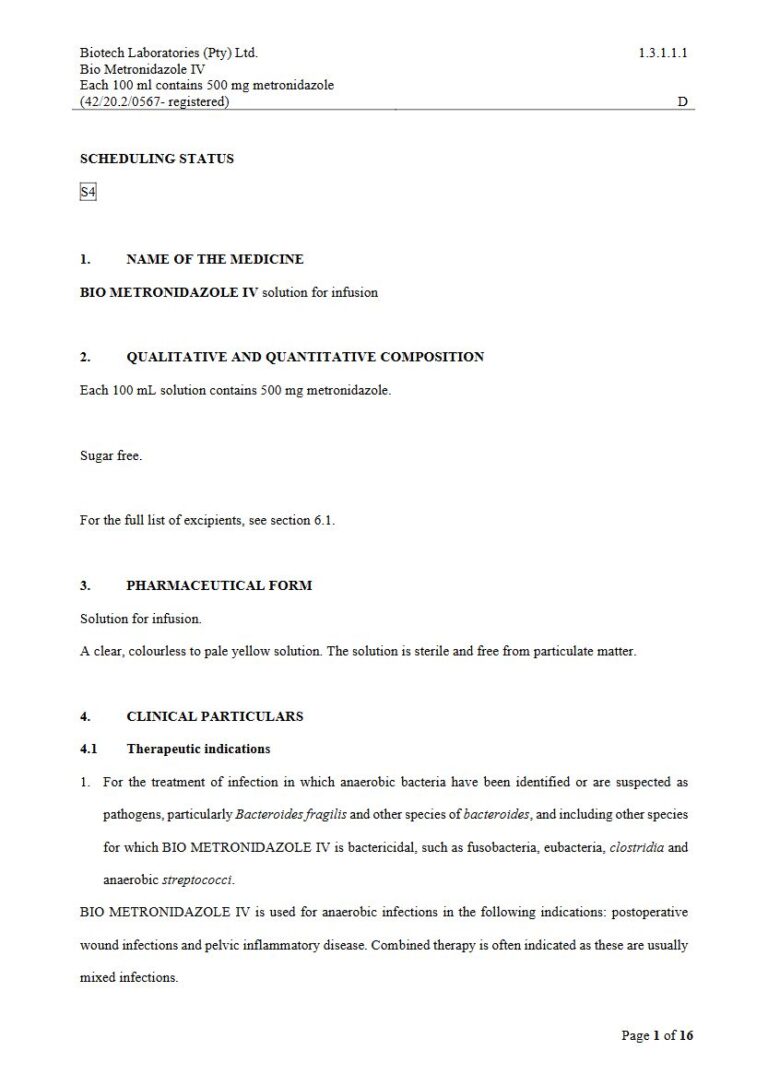
Clinical Particulars
Section 4 of the official insert — extracted exactly as issued, no alterations
4.1 Therapeutic indications
1. For the treatment of infection in which anaerobic bacteria have been identified or are suspected as pathogens, particularly Bacteroides fragilis and other species of bacteroides, and including other species for which BIO METRONIDAZOLE IV is bactericidal, such as fusobacteria, eubacteria, clostridia and anaerobic streptococci. BIO METRONIDAZOLE IV is used for anaerobic infections in the following indications: postoperative wound infections and pelvic inflammatory disease. Combined therapy is often indicated as these are usually mixed infections.
2. For the prevention of postoperative infections due to anaerobic bacteria:
- Given before and after gynaecological surgery;
- Given before and after appendectomy;
- Given before and after colonic surgery.
4.2 Posology and method of administration
Posology
Treatment of anaerobic infections: Adults and adolescents (over 12 years) dose: 100 mL (500 mg/100 mL) by intravenous infusion every 8 hours. The injection should be infused intravenously at the rate of 25 mg per minute (5 mL per minute), but may be administered alone or concurrently (but separately) with other bacteriologically appropriate antibacterial medicines in parental dosage forms. Oral medicine with 400 mg 8 hourly should be substituted as soon as this becomes feasible. Treatment for seven days should be satisfactory for most patients but, depending upon clinical and bacteriological assessments, the medical practitioner might decide to prolong treatment, e.g. for the eradication of infection from sites which cannot be drained or are liable to endogenous recontamination by anaerobic pathogens from the gut, oropharynx or genital tract.
Prevention: Adults and adolescents (over 12 years) dose: 100 mL (500 mg/100 mL) by intravenous infusion immediately before, during or after operation, followed by the same dose 8 hourly until oral medicine (200 u2013 400 mg 8 hourly) can be given.
Special populations
Hepatic impairment: Doses should be reduced in patients with severe hepatic impairment.
Paediatric population
Treatment of anaerobic infections: Children under 12 years: As for adults, but the single intravenous dose is based on 1,5 mL/kg body mass (7,5 mg metronidazole/kg body mass) and the oral dose of 7,5 mg/kg body mass.
Prevention: Children under 12 years: As for adults but the single intravenous dose is based on 1,5 mL (7,5 mg BIO METRONIDAZOLE IV)/kg body mass and the oral dose on 7,5 mg/kg body mass. In infants and other patients maintained on intravenous fluids, BIO METRONIDAZOLE IV may be diluted with appropriate volumes of normal saline, dextrose saline, dextrose 5 % m/v or potassium chloride injections (20 mmol and 40 mmol/litre).
Method of administration
Intravenous infusion.
4.3 Contraindications
- Hypersensitivity to metronidazole, other imidazoles derivatives, or any of the excipients listed in section 6.1.
- Use of BIO METRONIDAZOLE IV is contraindicated in patients with end stage liver damage, blood dyscrasias and active diseases of the central or peripheral nervous system.
- Pregnancy and lactation.
4.4 Special warnings and precautions for use
Hepatic impairment: Caution is needed in patients with severe hepatic impairment. The dose of BIO METRONIDAZOLE IV should be reduced as necessary. BIO METRONIDAZOLE IV is mainly metabolised by hepatic oxidation. Substantial impairment of BIO METRONIDAZOLE IV clearance may occur in the presence of advanced hepatic insufficiency. Doses should be reduced in patients with severe hepatic impairment. The risk/benefit of using BIO METRONIDAZOLE IV to treat trichomoniasis in such patients should be carefully considered. Plasma levels of BIO METRONIDAZOLE IV should be closely monitored.
Caution is needed in patients with hepatic encephalopathy. Patients with severe hepatic encephalopathy metabolise metronidazole slowly, with resultant accumulation of metronidazole. This may cause exacerbation of central nervous system (CNS) adverse effects. The dose of BIO METRONIDAZOLE IV should be reduced as necessary.
Cases of severe hepatotoxicity/acute hepatic failure, including cases with a fatal outcome with very rapid onset after treatment initiation in patients with Cockayne syndrome have been reported with products containing metronidazole for systemic use, such as BIO METRONIDAZOLE IV. In this population, BIO METRONIDAZOLE IV should therefore be used after careful benefit-risk assessment and only if no alternative treatment is available. Liver function tests must be performed just prior to the start of therapy, throughout and after end of treatment until liver function is within normal ranges, or until the baseline values are reached. If the liver function tests become markedly elevated during treatment, BIO METRONIDAZOLE IV should be discontinued.
Patients with Cockayne syndrome should be advised to immediately report any symptoms of potential liver injury to their physician and stop using BIO METRONIDAZOLE IV.
Renal disease: BIO METRONIDAZOLE IV is removed during haemodialysis and should be administered after the procedure is finished. Patients with renal impairment, including patients receiving peritoneal dialysis, should be monitored for signs of toxicity due to the potential accumulation of toxic metronidazole metabolites.
Patients on a low sodium diet: BIO METRONIDAZOLE IV contains 13,75 mmol (316 mg) sodium per 100 mL. This may be harmful to patients on a low sodium diet.
Alcohol: Patients should be advised not to drink alcohol before, during BIO METRONIDAZOLE IV therapy and for at least one day and up to 3 days afterwards because of the possibility of a disulfiram-like reaction (see section 4.5).
Intensive or prolonged therapy with BIO METRONIDAZOLE IV: Clinical and laboratory monitoring is advised in patients receiving BIO METRONIDAZOLE IV for more than 10 days. This period may only be exceeded in individual cases after a very strict benefit-risk assessment. Only in the rarest possible case should the treatment be repeated. Limiting the duration of treatment is necessary because damage to human germ cells cannot be excluded. Intensive or prolonged BIO METRONIDAZOLE IV therapy should be conducted only under conditions of close surveillance for clinical and biological effects and under specialist direction. Prolonged or intensive treatment with BIO METRONIDAZOLE IV has been associated with peripheral neuropathy, transient epileptiform seizures and leukopenia. In case of prolonged treatment, occurrence of undesirable effects such as paraesthesia, ataxia, dizziness and convulsive crises should be checked.
Monitoring: BIO METRONIDAZOLE IV may mask the immunological response seen in untreated early syphilis, due to its anti-treponemal activity. Patients suspected of having syphilis while receiving BIO METRONIDAZOLE IV should probably be screened for an additional 4 to 8 weeks. Regular clinical and laboratory monitoring (including leukocyte formula) are advised in cases of high-dose or prolonged treatment, in case of antecedents of blood dyscrasia, in case of severe infection and in severe hepatic insufficiency.
General: Patients should be warned that BIO METRONIDAZOLE IV may darken urine due to metronidazole metabolite. Pseudomembranous colitis has been reported with the use of BIO METRONIDAZOLE IV. Co-administration with busulfan: as plasma level of busulfan may be increased significantly, it may lead to severe busulfan toxicity and death. Studies have shown metronidazole, as in BIO METRONIDAZOLE IV, to be mutagenic in bacteria and carcinogenic in some animals. The half-life of metronidazole is reported to be longer in neonates and in patients with severe hepatic impairment; that of the hydroxyl metabolite is prolonged in patients with substantial renal impairment (see section 5.2).
4.5 Interaction with other medicines and other forms of interaction
Disulfiram: Acute psychoses or confusion have been associated with the concomitant use of BIO METRONIDAZOLE IV and disulfiram.
Alcohol: When given in conjunction with alcohol, BIO METRONIDAZOLE IV may provoke a disulfiram-like reaction in some individuals (effects including intense vasodilation and flushing on the face and neck, restlessness, anxiety, tachycardia, tachypnoea, headache, nausea, vomiting, hyperpnoea, chest pains, sweating, pallor and hypotension). Reactions have occurred after the administration of medicines formulated with alcohol, including injections as well as after drinking alcohol. Alcoholic beverages and medicines containing alcohol should not be consumed during therapy and for at least 1 u2013 3 days afterwards (see section 4.4).
Oral anticoagulant therapy (warfarin type): Potentiation of the anticoagulant effect and increased haemorrhagic risk. In case of coadministration with warfarin, prothrombin time/INR should be more frequently monitored and warfarin therapy/dose adjusted during treatment with BIO METRONIDAZOLE IV.
Lithium: Plasma levels of lithium may be increased by BIO METRONIDAZOLE IV. Plasma concentration of lithium, creatinine and electrolytes should be monitored in patients under treatment with lithium while they receive BIO METRONIDAZOLE IV.
Ciclosporin: Risk of elevation of ciclosporin serum levels. Serum ciclosporin and serum creatinine should be closely monitored when co-administration is necessary.
Phenytoin or phenobarbital: There is evidence that phenytoin might accelerate the metabolism of BIO METRONIDAZOLE IV. Plasma concentrations of BIO METRONIDAZOLE IV are decreased by the concomitant administration of phenobarbital, with a consequent reduction in the effectiveness of BIO METRONIDAZOLE IV.
5-Fluorouracil: Reduced clearance of 5-fluorouracil resulting in increased toxicity of 5-fluorouracil may occur.
Cimetidine: Hepatic metabolism may be decreased when BIO METRONIDAZOLE IV and cimetidine are used concurrently, possibly resulting in delayed elimination and increased serum metronidazole concentrations with an increased risk of neurological side effects.
CYP3A4 substrates: Concomitant use of BIO METRONIDAZOLE IV and CYP3A4 substrates (e.g., amiodarone, tacrolimus, cyclosporine, carbamazepine, and quinidine) may increase respective CYP3A4-substrate plasma levels. Monitoring of plasma concentrations of CYP3A4 substrates may be necessary.
Vecuronium (non-depolarising curare mimetic): BIO METRONIDAZOLE IV can potentialise the effects of vecuronium.
Cholestyramine: Cholestyramine may delay or reduce the absorption of metronidazole.
Busulfan: Plasma concentrations of busulfan may increase during concomitant treatment with BIO METRONIDAZOLE IV, which can result in severe busulfan toxicity and death.
Laboratory tests: BIO METRONIDAZOLE IV may immobilise treponema and thus may lead to falsely positive Nelsonu2019s test. BIO METRONIDAZOLE IV may interfere with serum aspartate transaminase (AST), alanine transaminase (ALT), lactate dehydrogenase (LDH), triglycerides, and glucose hexokinase determinations. Metronidazole causes an increase in ultraviolet absorbance at 340 nm resulting in falsely decreased values.
4.6 Fertility, pregnancy and lactation
Pregnancy: BIO METRONIDAZOLE IV is contraindicated during pregnancy (see section 4.3).
Breastfeeding: BIO METRONIDAZOLE IV is contraindicated during breastfeeding as metronidazole is excreted in breast milk (see section 4.3). Nursing mothers should either stop breastfeeding or BIO METRONIDAZOLE IV should be discontinued.
Fertility: There are no clinical data relating to the effect of metronidazole on fertility.
4.7 Effects on ability to drive and use machines
BIO METRONIDAZOLE IV has the potential to cause confusion, dizziness, hallucinations, convulsions or transient visual disorders. When these symptoms occur patients should be advised not to drive or operate machines.
4.8 Undesirable effects
Infections and infestations: Less frequent: Vaginal candidiasis.
Blood and lymphatic system disorders: Less frequent: Leucopenia, thrombocytopenia, agranulocytosis, neutropenia, pancytopenia. Frequency not known: Eosinophilia.
Immune system disorders: Less frequent: Hypersensitivity (manifesting as skin rash, fever, angioedema, hives, flushing, urticaria, pruritus), anaphylaxis, anaphylactic shock, Jarisch-Herxheimer reaction. Frequency not known: Mild erythematous eruptions with fleeting joint pains resembling serum sickness may occur.
Metabolism and nutrition disorders: Frequency not known: Anorexia, decreased appetite.
Psychiatric disorders: Frequency not known: Psychotic disorders including confusion, irritability and hallucinations. Changes in mood or mental state such as depression. Vertigo.
Nervous system disorders: Frequent: Dysgeusia. Less frequent: Central nervous system (CNS) effects such as weakness, drowsiness, dizziness or light-headedness; headaches. Peripheral neuropathy, usually presenting as numbness or tingling in the extremities, and seizures are serious adverse effects associated with high doses or prolonged treatment. CNS toxicity such as ataxia, clumsiness or unsteadiness. Encephalopathy and subacute cerebellar syndrome (e.g. ataxia, dysarthria, gait impairment, nystagmus and tremor) which may resolve with discontinuation of the medicine, seizures/convulsions, aseptic meningitis. Frequency not known: Paraesthesia, hypoaesthesia.
Eye disorders: Less frequent: Transient vision disorders such as diplopia and myopia have been reported. Optic neuropathy.
Vascular disorders: Frequency not known: Thrombophlebitis may follow intravenous administration.
Cardiac disorders: Frequency not known: Tachycardia, palpitations.
Respiratory, thoracic and mediastinal disorders: Frequency not known: Nasal congestion, dyspnoea.
Gastrointestinal disorders: Frequent: Gastrointestinal disturbances, nausea, vomiting, stomatitis, glossitis, oral mucositis. Nausea is sometimes accompanied by headache. Diarrhoea, constipation, dry mouth, and furred tongue. Less frequent: Antibiotic-associated colitis, pancreatitis, upper abdominal pain, tongue discolouration. Frequency not known: Pseudomembranous colitis, coated tongue and unpleasant taste.
Hepato-biliary disorders: Less frequent: Raised liver enzyme values have occasionally been reported. Cases of reversible abnormal liver function and cholestatic hepatitis, sometimes with jaundice have been reported.
Skin and subcutaneous tissue disorder: Less frequent: Pustular eruptions, mild erythematous eruptions with fleeting joint pains resembling serum sickness, Stevens-Johnson syndrome, toxic epidermal necrolysis, erythema multiforme. Frequency not known: Skin rash, flushing, pruritus, face swelling, urticaria, hyperhidrosis.
Musculoskeletal and connective tissue disorders: Frequent: Myalgia. Frequency not known: Arthralgia, muscle spasms.
Renal and urinary disorders: Less frequent: Urinary tract effects such as dysuria, increased urinary frequency, frequent or painful urination; inability to control urine flow; sense of pelvic pressure, dark urine.
General disorders and administration site conditions: Less frequent: Thrombophlebitis manifesting as pain, tenderness, redness or swelling at site of injection, asthenia, mucosal inflammation, pyrexia. Frequency not known: Injection site reaction, malaise, face oedema, peripheral oedema, chest pain, chills.
Reporting of suspected adverse reactions: Reporting suspected adverse reactions after authorisation of BIO METRONIDAZOLE IV is important. It allows continued monitoring of the benefit/risk balance of BIO METRONIDAZOLE IV. Health care providers are asked to report any suspected adverse reactions to SAHPRA via the Med Safety APP (Medsafety X SAHPRA) and eReporting platform (who-umc.org) found on SAHPRA website.
4.9 Overdose
Symptoms: In cases of overdose in adults, the clinical symptoms are usually limited to nausea, vomiting, and neurotoxic effects, including ataxia, slight disorientation, confusion, seizures and peripheral neuropathy. In a preterm newborn, no clinical or biological sign of toxicity developed.
Treatment: BIO METRONIDAZOLE IV infusion should be discontinued. There is no specific antidote, treatment is symptomatic and supportive.
