
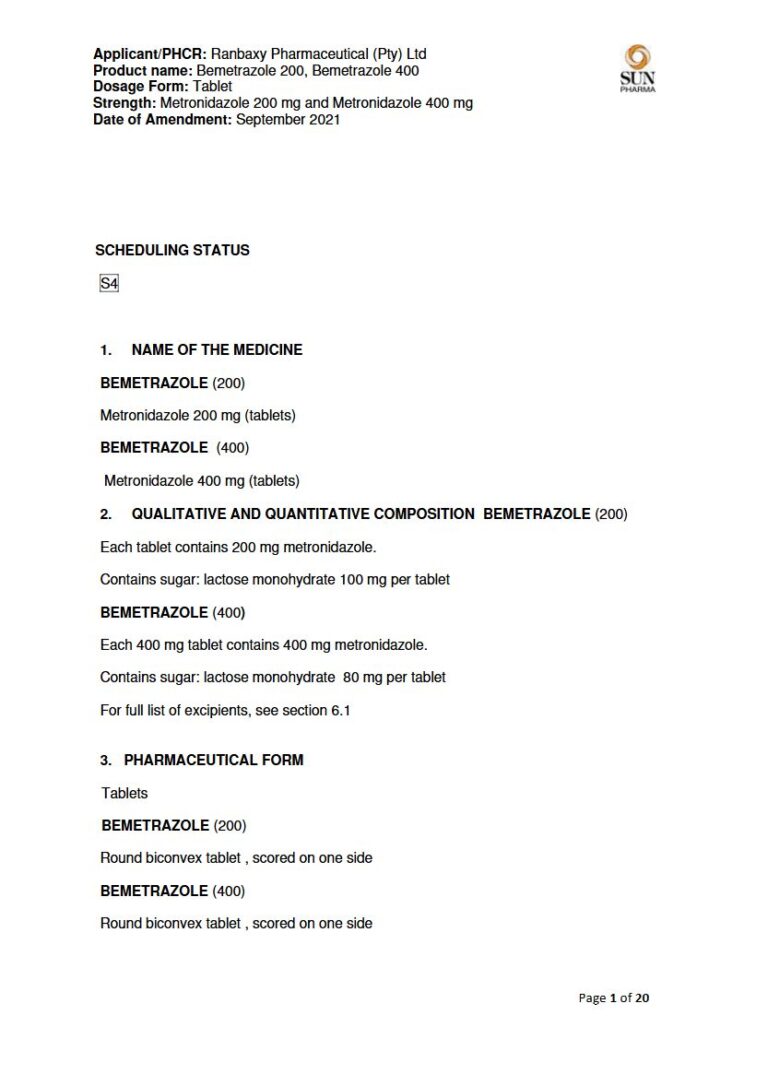
Bemetrazole Tablets
Clinical Summary
Quick overview from the medicine insert
Indication
Treatment of infections caused by anaerobic bacteria and certain protozoa, including bacterial vaginosis, trichomoniasis, and amebiasis.
Dosage (summary)
200 mg to 400 mg, taken orally, usually 2 to 3 times daily for 5 to 10 days depending on the infection being treated.
Onset of Action / Duration
Onset of action typically occurs within 1 to 2 hours after administration.
Special Populations
- Patients with liver impairment
- Elderly patients
- Patients with renal impairment
Pregnancy & Breastfeeding
Metronidazole is classified as Category B2 for pregnancy. It should be used during pregnancy only if clearly needed. It is excreted in breast milk; caution is advised when administering to nursing mothers.
Key Drug Interactions
- Alcohol: Concurrent use may cause a disulfiram-like reaction.
- Warfarin: May enhance the anticoagulant effect.
- Lithium: May increase lithium levels.
Contraindications
- Hypersensitivity to metronidazole or any component of the formulation.
- History of blood dyscrasias.
- First trimester of pregnancy (unless absolutely necessary).
Common side effects
- Nausea
- Headache
- Dizziness
- Diarrhea
- Metallic taste
- Abdominal cramps
Counselling Points
- Avoid alcohol during treatment and for at least 48 hours after completing therapy.
- Take the medication with food to minimize gastrointestinal upset.
- Complete the full course of therapy even if symptoms improve.
Serious warnings
- Use with caution in patients with a history of seizures.
- May cause darkening of urine.
- Monitor for signs of peripheral neuropathy with prolonged use.
Important Disclaimer
The Bemetrazole Tablets professional information leaflet below is the property of Ranbaxy Pharmaceutical and is provided on Medinsert exactly as issued, with no.. alterations or editorial changes. We make every effort to keep content current by updating documents as soon as new versions become available. Medinsert serves as a trusted access point for healthcare professionals, but does not replace official sources or clinical judgement. For more details, please read our full disclaimer. read more>>
 Healthcare Professionals Only
This content is for registered healthcare professionals
Sign in or create a free account to read the full package insert.
Free for HPCSA-registered professionals. Powered by Medinsert.
Clinical Particulars
Section 4 of the official insert — extracted exactly as issued, no alterations
4.1 Therapeutic indication
1. In the oral treatment of:
- Urogenital trichomoniasis.
- Non-specific vaginitis
- All forms of amoebiasis
- Acute ulcerative gingivitis (Vincent's).
- Giardiasis.
- Acute periconitis
2. Treatment of infections, in which anaerobic bacteria have been identified or are suspected as pathogens, particularly Bacteroides fragilis and other species of Bacteroides and including other species for which metronidazole is bactericidal such as Fusobacteria, Clostridia, Eubacteria and anaerobic Streptococci. BEMETRAZOLE has been used successfully for anaerobic infections in the following conditions: pelvic inflammatory disease and postoperative wound infections. Combined therapy is often indicated as there are usually mixed infections.
3. Prevention of post-operative infections due to anaerobic bacteria,
- i. Given before and after gynaecological surgery;
- ii. Given before and after appendectomy;
- iii. Given before and after colonic surgery.
4. Treatment of Helicobacter pylori-associated gastritis and duodenal ulcer. BEMETRAZOLE is used in combination with bismuth subsalicylate or colloidal bismuth subcitrate and appropriate antibiotic therapy.
4.2 Posology and Method of Administration
Method of Administration
Tablets should be swallowed (without chewing) with half a glass of water. It is recommended that tablets be taken during or after a meal.
Children over 10 years may be given a suitable proportion of the adult dosage according to body mass
DURATION OF DOSAGE IN DAYS
| ADULTS | CHILDREN | |
|---|---|---|
| 7 TO 10 YEARS | 3 TO 7 YEARS | 1 TO 3 YEARS |
UROGENITAL TRICHOMONIASIS. Where re-infection is likely, in adults the consort should receive a similar course of treatment
- 1 2 g as a single dose
- 7 200 mg three times daily or 400 mg twice daily
- 100 mg three times daily
- 100 mg twice daily
- 50 mg three times daily
2 800 mg in the concurrent morning and 1,2 g in the evening
NON-SPECIFIC VAGINITIS
- 7 400 mg twice daily OR 1 2 g as a single dose
AMOEBIASIS a) Invasive intestinal disease in susceptible subjects.
- 5 800 mg three times daily
- 400 mg three times daily
- 200 mg four times daily
- 200 mg three times daily
AMOEBIASIS b) Intestinal disease in less susceptible subjects and u201cchronic amoebic hepatitisu201d.
- 5 to 10 400 mg three times daily
- 200 mg three times daily
- 100 mg four times daily
- 100 mg three times daily
AMOEBIASIS c) Amoebic liver abscess, also other forms of extra-intestinal amoebiasis.
- 5 400 mg three times daily
- 200 mg three times daily
- 100 mg four times daily
- 100 mg three times daily
AMOEBIASIS (d) Symptomless cyst passers.
- 5 to 10 400 to 800 mg three times daily
- 200 to 400 mg three times daily
- 100 to 200 mg four times daily
- 100 to 200 mg three times daily
GIARDIASIS A second course of treatment may be necessary for some patients two weeks after the end of the first course.
- 3 2 g once daily
- 1 g once daily
- 600 to 800 mg once daily
- 500 mg once daily
ACUTE ULCERATIVE GINGIVITIS
- 3 200 mg three times daily
- 100 mg three times daily
- 100 mg twice daily
- 50 mg three times daily
ACUTE PERICORONITIS
- 3 to 7 200 mg three times daily
Anaerobic infections a) Treatment: Metronidazole may be given alone or concurrently with other bacteriologically-appropriate antibacterial agents. They should be given for 7 days or longer depending on clinical and bacteriological assessments of the patient's condition.
Adults: Initially, 800 mg followed by 400 mg by mouth every 8 hours.
Children and infants: 7,5 mg/kg body mass by mouth every 8 hours daily during or after meals
b) Prevention: Adults: Administered in doses similar to those used for the treatment of established infection. 400 mg may be given every 8 hours in the 24 hours before surgery followed postoperatively by intravenous or rectal administration until oral therapy is possible. Shorter pre-operative courses and oral doses of up to 1 g have been used
Children: as for treatment (a). Treatment of Helicobacter pylori-associated gastritis and duodenal ulcer The following regimens have been used: a) BEMETRAZOLE 200-250 mg u2013 4-5 times a day for 14 days in combination with other medicines.
4.3 Contraindications
- Hypersensitivity to metronidazole and other imidazoles or any of the excipients listed in section 6.1.
- Patients with blood dyscrasias or with active disease of the central nervous system.
- Co-administration with busulfan (see section 4.4)
4.4 Special warnings and precautions for use
Patients should be advised not to take alcohol during metronidazole therapy and for at least three days afterwards because of the possibility of a disulfiram-like reaction (see section 4.5).
Co-administration with busulfan: As plasma levels of busulfan may be increased significantly, it may lead to severe busulfan toxicity and death.
Pseudomembranous colitis has been reported following the use of metronidazole.
Studies have shown metronidazole to be mutagenic in bacteria and carcinogenic in some animals.
Metronidazole is mainly metabolised by hepatic oxidation. Substantial impairment of metronidazole clearance may occur in the presence of advanced hepatic insufficiency. Significant cumulation may occur in patients with hepatic encephalopathy and the resulting high plasma concentrations of metronidazole may contribute to the symptoms of the encephalopathy. The daily dosage should be reduced to one third and may be administered once daily.
BEMETRAZOLE should be administered with caution to patients with hepatic encephalopathy.
BEMETRAZOLE should be used with great care in patients with blood dyscrasias or with active disease of the central nervous system. All patients receiving BEMETRAZOLE for more than 10 days should be monitored and treatment discontinued if signs of peripheral neuropathy or CNS toxicity develop. Doses should be reduced in patients with severe liver disease.
BEMETRAZOLE has anti-treponemal activity and may mask the immunological response seen in untreated syphilis. Contacts of syphilis receiving BEMETRAZOLE should be probably be screened for an additional 4 to 8 weeks.
Patients should be warned that BEMETRAZOLE may darken urine (due to metronidazole metabolite).
Cases of severe hepatotoxicity/acute hepatic failure, including cases with a fatal outcome with very rapid onset after treatment initiation in patients with Cockayne syndrome have been reported with products containing metronidazole for systemic use. In this population, metronidazole should therefore be used after careful benefit-risk assessment and only if no alternative treatment is available. Liver function tests must be performed just prior to the start of therapy, throughout and after end of treatment until liver function is within normal ranges, or until the baseline values are reached. If the liver function tests become markedly elevated during treatment, the drug should be discontinued.
Patients with Cockayne syndrome should be advised to immediately report any symptoms of potential liver injury to their physician and stop taking metronidazole.
Cases of severe bullous skin reactions such Stevens Johnson syndrome (SJS), toxic epidermal necrolysis (TEN) or acute generalised exanthematous pustulosis (AGEP) have been reported with metronidazole. If symptoms or signs of SJS, TEN or AGEP are present, BEMETRAZOLE treatment must be immediately discontinued.
There is a possibility that after Trichomonas vaginalis has been eliminated a gonococcal infection might persist. The elimination half-life of metronidazole remains unchanged in the presence of renal failure. The dosage of metronidazole therefore needs no reduction. Such patients however retain the metabolites of metronidazole. The clinical significance of this is not known at present.
In patients undergoing haemodialysis metronidazole and metabolites are efficiently removed during an eight hour period of dialysis. Metronidazole should therefore be re-administered immediately after haemodialysis.
No routine adjustment in the dosage of metronidazole need be made in patients with renal failure undergoing intermittent peritoneal dialysis (IDP) or continuous ambulatory peritoneal dialysis (CAPD).
Lactose: Patients with the rare hereditary problems of galactose intolerance, total lactase deficiency or glucose-galactose malabsorption should not take this medication.
4.5 Interaction with other medicines and other forms of Interaction
Disulfiram: Acute psychoses or confusion have been associated with the concomitant use of BEMETRAZOLE and disulfiram.
Alcohol: When given in conjunction with alcohol, BEMETRAZOLE may provoke a disulfiram-like reaction in some individuals (effects include intense vasodilation and flushing of the face and neck, restlessness, anxiety, tachycardia, tachypnoea, chest pains, sweating, pallor and hypotension); reactions have occurred after the administration of pharmaceutical preparations formulated with alcohol, including injections, as well as after drinking alcohol. Alcoholic beverages and medicines containing alcohol should not be consumed during therapy and for at least 1 to 3 days afterwards (see section 4.4)
Oral anticoagulant therapy (warfarin type): Potentiation of the anticoagulant effect and increased haemorrhagic risk. In case of co-administration with warfarin, prothrombin time/INR should be more frequently monitored and warfarin therapy dose adjusted during treatment with BEMETRAZOLE
Lithium: Plasma levels of lithium may be increased by BEMETRAZOLE. Plasma concentrations of lithium, creatinine and electrolytes should be monitored in patients under treatment with lithium while they receive BEMETRAZOLE
Ciclosporin: Risk of elevation of ciclosporin serum levels. Serum ciclosporin and serum creatinine should be closely monitored when co-administration is necessary.
Phenytoin or Phenobarbitone: There is evidence that phenytoin might accelerate the metabolism of metronidazole, as in BEMETRAZOLE. Plasma concentrations of metronidazole are decreased by the concomitant administration of phenobarbitone, with a consequent reduction in the effectiveness of BEMETRAZOLE.
5-Fluorouracil: Reduced clearance of 5-fluorouracil resulting in increased toxicity of 5-fluorouracil may occur.
Busulfan: Plasma levels of busulfan may be increased by BEMETRAZOLE, which may lead to severe busulfan toxicity and death (see section 4.4)
Cimetidine: Hepatic metabolism may be decreased when BEMETRAZOLE and cimetidine are used possibly resulting in delayed elimination and increased serum metronidazole concentrations with an increased risk of neurological side effects.
4.6 Fertility, pregnancy and lactation
The safety of use during pregnancy has not been established. Metronidazole crosses the placental barrier and is excreted in breast milk. Women using BEMETRAZOLE should not breastfeed their infants.
4.7 Effects on ability to drive and use machines
Patients should be warned about the potential for confusion, dizziness, hallucinations, convulsions or transient visual disorders, and advised not to drive or operate machinery if these symptoms occur.
4.8 Undesirable effects
System Organ Class Frequent Less Frequent Frequency Unknown
- Blood and lymphatic system disorders
- Agranulositosis
- Neutropenia
- Thrombocytopenia
- Pancytopenia
- Leucopenia
- Immune system disorders
- Anaphylaxis
- Angioedema
- Urticaria
- fever
- Metabolism and nutrition disorders
- Anorexia
- Psychiatric disorders
- Psychotic disorders including
- Confusion
- Hallucination
- Depressed moods
- Irritability
- Change in mood or mental state such as depression or confusion
- Nervous system disorders
- Weakness
- Dizziness
- Drowsiness
- Insomnia
- cases of encephalopathy (eg confusion) and subacute cerebellar syndrome (eg ataxia, dysarthria, gait impairment, nystagmus and tremor which may resolve with discontinuation of BEMETRAZOLE)
- headache
- Peripheral Neuropathy usually presenting as numbness or tingling in extremities
- Epileptiform seizures
- Aseptic meningitis
- headache
- Eye disorders
- Transient vision disorders such as Diplopia and myopia
- Optic neuropathy/neuritis
- Transient vision disorders such as blurred vision, decreased visual acuity, changes in colour vision
- Ear and Labyrinth disorders
- Hearing impaired/hearing loss (including sensorineural), tinnitus
- Respiratory, thoracic and mediastinal disorders
- Nasal congestion
- Gastrointestinal disorders
- gastrointestinal disturbances, especially nausea and taste disorders; nausea is sometimes accompanied by headache, and vomiting.
- Diarrhoea
- dry mouth
- a furred tongue
- oral mucositis
- stomatitis
- pseudomembranous colitis
- Epigastric pain
- Hepatobiliary disorders
- Increase in liver enzymes
- cholestatic hepatitis sometimes with jaundice
- Pancreatitis
- Raised liver enzyme values
- Mixed hepatitis and hepatocellular liver injury
- jaundice and pancreatic which is reversible on drug withdrawal
- Skin and subcutaneous tissue disorders
- Pastular eruptions
- Mild erythematous eruptions with fleeting joint pains resembling serum sickness
- Skin rashes
- Fever
- Flushing
- Pruritis
- Erythema Multiforma
- Steven Johnson syndrome
- Toxic Epidermal Necrosis
- Musculoskeletal and connective tissue disorders
- Arthralgia
- Myalgia
- Renal and urinary disorders
- Urinary discomfort
- Darkening of urine
- General disorders and administration site conditions:
- Fever
Reporting of suspected adverse reactions
Reporting suspected adverse reactions after authorisation of the medicine is important. It allows continued monitoring of the benefit/risk balance of the medicine. Healthcare professionals are asked to report any suspected adverse reactions to SAHPRA u201c6.04 Adverse Drug Reactionu201d Reporting Form, found online under SAHPRAu2019s publications: https://www.sahpra.org.za/Publications/Index
4.9 Overdose
Treatment is symptomatic and supportive.
